
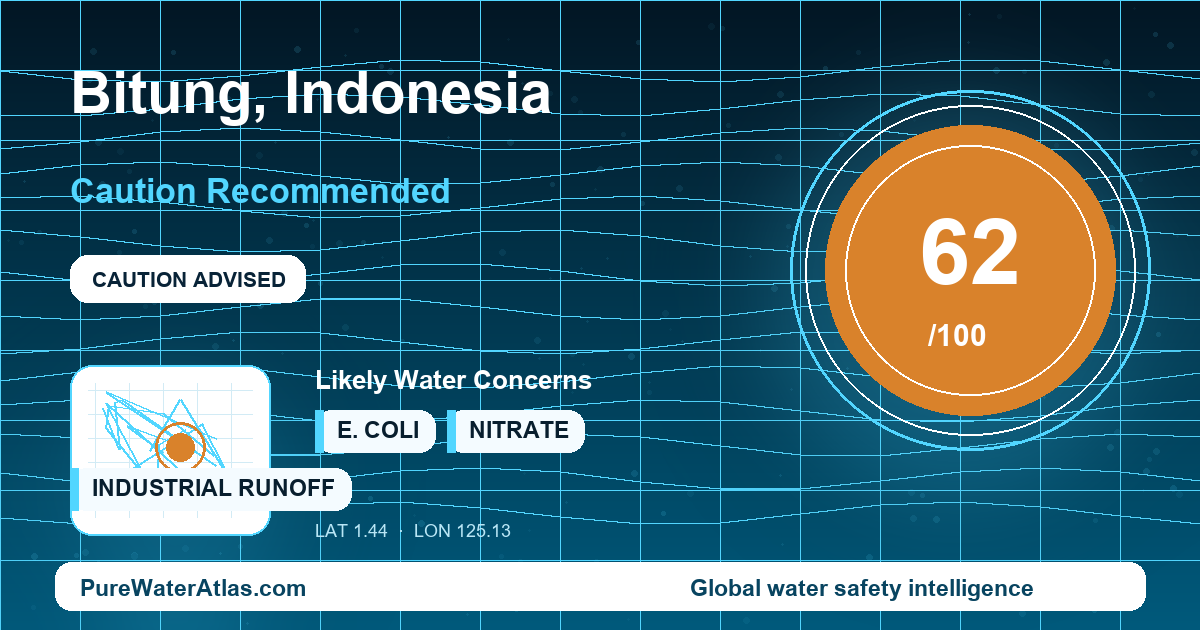
Bitung, North Sulawesi: a coastal port city with a formal municipal water utility, upland spring and surface-water catchments, and tap-water safety that depends heavily on treatment, pressure, storage, and point-of-use handling.
Quick Answer
| Overall safety status | Caution recommended. Bitung has a municipal drinking-water operator, but recent open-access, city-level tap-water compliance data are limited. The practical risk is variable distribution, storage, turbidity after rain, and microbiological safety rather than a single confirmed citywide contaminant. |
|---|---|
| Water safety score | 62 / 100 — Caution Recommended |
| Can visitors drink the tap water? | Not recommended without treatment. Short-term visitors should use sealed bottled water, reputable refill water, boiled water, or properly filtered water. |
| Resident advice | Municipal customers should treat Bitung tap water as utility-supplied water that still benefits from household protection: sediment prefiltration, activated carbon, and boiling, UV, or another microbiological barrier for drinking water. |
| Main water identity | Local spring and small surface-water catchments in Bitung’s upland and foothill setting, supplying municipal treatment and distribution through the local SPAM system. |
| Water authority | Perumda Air Minum Duasudara Kota Bitung, with local public-health oversight relevant through Dinas Kesehatan Kota Bitung and national standards set by Indonesia’s Ministry of Health. |
| Filter recommendation | Recommended for drinking and cooking, especially where supply is intermittent, water is stored in roof tanks, or the household uses wells, refill gallons, or coastal private sources. |
Why Bitung Is Different
Bitung is not a water-scarce desert city. It sits in North Sulawesi on the Lembeh Strait, with mainland neighborhoods facing Lembeh Island and upland terrain rising inland toward volcanic and protected forest catchments such as the Tangkoko-Duasudara area. That geography matters: Bitung’s drinking-water system is associated with nearby spring and surface-water catchments rather than a single large regional reservoir. In principle, upland spring and stream sources can be good raw-water sources, but they can also react quickly to heavy tropical rainfall, runoff, landslides, and catchment disturbance.
The city is also a port, fisheries, logistics, and industrial center. That does not mean Bitung municipal tap water is known to be industrially contaminated. The dataset does not support that claim. It does mean that protection of local waterways, drains, private wells, refill handling, and coastal aquifers is especially important outside the controlled municipal treatment system.
Bitung’s local risk profile is therefore practical and distribution-focused. Even where water is treated, safety at the tap can be affected by pressure drops, aging pipes, household roof tanks, intermittent service, refill containers, and property-level plumbing. This is why the PureWaterAtlas rating is Caution Recommended rather than a simple yes-or-no endorsement.
Where Does Bitung’s Tap Water Come From?
Bitung’s piped drinking-water supply is associated with Perumda Air Minum Duasudara Kota Bitung and local raw-water sources in the city’s upland and foothill setting. Publicly accessible materials point to a local SPAM system supplied from springs and small surface-water catchments around Bitung’s volcanic and forested terrain, with treatment and distribution through city production and service units.
A current, official, source-by-source production map is not readily available in open public sources. For that reason, the safest characterization is: Bitung relies on local springs and small surface-water systems feeding municipal treatment and distribution. This is a deliberately cautious description and avoids implying a single named reservoir or intake where the available dataset does not support it.
Key infrastructure relevant to drinking-water safety in Bitung includes the Perumda Air Minum Duasudara municipal distribution network, local spring and surface-water intakes, water treatment or production units serving mainland districts such as Maesa, Madidir, Girian, Matuari, Aertembaga, and Ranowulu, distribution reservoirs, transmission mains, household roof tanks, and local storage containers. Some households and businesses may also use non-piped alternatives, including wells, refill water depots, bottled water, and delivered water.
This mixed-source reality is important for both residents and travelers. Two buildings on the same street may not have identical risk if one receives steady municipal water directly and another relies heavily on stored water, refill gallons, a private shallow well, or poorly maintained plumbing.
Who Manages Drinking Water in Bitung?
The local municipal drinking-water provider is Perumda Air Minum Duasudara Kota Bitung. The city government’s official reference point is the Pemerintah Kota Bitung official website, while demographic and municipal statistical context is available through Badan Pusat Statistik Kota Bitung.
Indonesia’s national drinking-water and environmental health requirements are set through Ministry of Health regulations, including Permenkes No. 2 Tahun 2023. Municipal water operators are expected to manage treatment and distribution, while local health agencies conduct or oversee water-quality surveillance. National infrastructure context for Indonesian SPAM systems is also connected to the Kementerian Pekerjaan Umum dan Perumahan Rakyat, Directorate General of Human Settlements.
The key limitation for Bitung is transparency at the tap level. Basic city, utility, and regulatory information is available, but routine, current, Bitung-specific finished-water quality results are not consistently available in open public sources. This page therefore does not claim that every PDAM connection is unsafe, and it also does not claim full compliance at every household tap.
Main Local Water Concerns
- Limited public tap-level testing data: Recent Bitung-specific municipal water-quality results are not consistently available to the public, so confidence is moderate rather than high.
- Heavy-rain turbidity: Tropical rainfall can increase runoff, turbidity, and microbial loading in spring or small surface-water catchments.
- Microbial risk: If chlorination, pressure, or storage hygiene is poor, bacteria or other pathogens can become a practical concern, especially for visitors.
- Sediment and discoloration: Pipe repairs, pressure changes, low-flow periods, or tank disturbance can release sediment, discoloration, or taste changes.
- Coastal and island challenges: Private shallow wells near the coast or in small island/coastal settings can have brackish or salty taste, making conductivity, chloride, and total dissolved solids relevant.
- Household storage: Roof tanks and refill containers can become the weak point even when source water has been treated.
- Older plumbing: Internal building plumbing can contribute metals, sediment, or biofilm-related issues, although Bitung-specific citywide lead data are not publicly documented.
Seasonal conditions can intensify these issues. Storms and landslides in steep catchments can damage intakes, transmission pipes, or maintenance access. Dry periods can reduce spring flow, lower pressure, or increase reliance on alternative sources. Flooding and drainage overflow can contaminate wells, storage areas, and refill containers.
For Travelers
Short-term visitors should not rely on untreated tap water as their main drinking water in Bitung. Use sealed bottled water, reputable refill water, boiled water, or a reliable purifier. This is especially important for visitors staying near the harbor, dive operators, or Lembeh Strait access points, where properties may use a mix of municipal water, storage tanks, refill gallons, or bottled water.
For brushing teeth, use bottled, boiled, or filtered water if you have a sensitive stomach, are pregnant, are immunocompromised, or are traveling with young children. Many long-term residents may brush with local tap water, but visitor tolerance is different and gastrointestinal illness can quickly disrupt a diving, port, or island itinerary.
Avoid ice from unknown street vendors or small stalls unless you can confirm it was made from treated water. Ice in reputable hotels, dive resorts, and established restaurants is generally lower risk, but it still depends on how the property sources water, cleans containers, and handles ice. Ask whether drinking water and ice are from bottled, boiled, filtered, or refill-gallon sources.
For a short stay in Bitung, carry sealed water for drinking and toothbrushing, choose hot drinks made with fully boiled water, avoid swallowing shower water, and rehydrate with treated water during hot-weather travel, port visits, and diving activities. For emergency treatment guidance, see the PureWaterAtlas Boiling Water Purification Guide.
For Residents
Residents connected to the Perumda network should treat Bitung tap water as a managed utility supply that still deserves point-of-use caution. A practical household setup is a washable sediment prefilter, activated carbon for taste and chlorine-related concerns, and UV, ultrafiltration, or boiling for microbiological protection. Reverse osmosis may be useful for households using brackish wells, but it is not automatically necessary for every municipal connection.
Testing is especially important for households using private wells, shared wells, refill depots, or stored household water. Test for E. coli or total coliforms at least annually if your drinking water is not directly and reliably supplied through a treated municipal line. If water tastes salty, metallic, earthy, or changes after rain, test turbidity, color, odor, pH, conductivity, chloride, and total dissolved solids. Test iron and manganese if water stains laundry or fixtures or contains brown, black, or reddish particles.
Shallow wells near septic tanks, livestock, gardens, or drainage channels should be tested for nitrate. Older buildings or rented properties with unknown plumbing should consider lead and copper testing after long stagnation periods, even though Bitung-specific citywide lead contamination has not been publicly documented. After floods, pipe breaks, tank cleaning, or long service interruptions, boil drinking water until clarity and normal pressure return and consider microbiological testing.
Storage tanks are a major practical risk point in Bitung’s climate. Keep tanks covered, screened from insects and animals, cleaned periodically, and protected from runoff. If stored water is used for drinking, final treatment at the tap is strongly recommended.
Relevant Contaminants and Water-Quality Issues
The most relevant Bitung water-quality issues are microbial safety, turbidity, sediment, disinfectant management, and source-specific minerals rather than a documented single contaminant crisis. Start with E. coli in Drinking Water, because intermittent pressure, wells, and household storage can create microbial exposure pathways. Heavy-rain and runoff concerns make Turbidity in Drinking Water directly relevant, while pipe disturbance and tank deposits make Sediment in Drinking Water important for residents.
Disinfection is also a balance. A chlorine residual can help protect water in the network, but taste and odor can push households toward less-controlled sources. See Chlorine in Drinking Water for context. For staining, particles, or groundwater-related complaints, review Iron in Drinking Water and Manganese in Drinking Water.
How to Verify Your Water Quality
The best way to move from general caution to household-specific confidence is testing. PureWaterAtlas recommends using a local accredited laboratory or credible field-testing program where available, especially for wells, refill water, stored water, and buildings with unknown plumbing. Use the Water Testing Complete Guide to choose parameters and interpret results.
For treatment options, compare boiling, filtration, UV, and reverse osmosis in the Water Purification Methods Guide. UV can be useful for clear water with microbial risk; see the UV Water Purification Guide. For older buildings, the Lead Testing and Detection Guide explains how to check plumbing-related risk without assuming a citywide lead problem. For shallow wells near sanitation or drainage concerns, see Nitrate Contamination Testing.
Travelers comparing destinations can use the Global Water Quality Checker. To research specific substances or symptoms such as odor, particles, salinity, or discoloration, use the PureWaterAtlas Contaminants Search Engine. Broader background is available in the PureWaterAtlas guides to Drinking Water Safety and Water Microbiology.
Official and Technical Sources
- Pemerintah Kota Bitung official website — municipal identity and local administrative context.
- Badan Pusat Statistik Kota Bitung — official demographic and municipal statistics context.
- Perumda Air Minum Duasudara Kota Bitung — local municipal drinking-water provider identity.
- Ministry of Health Regulation, Permenkes No. 2 Tahun 2023 — Indonesian national health-based water-quality regulatory context.
- Kementerian PUPR, Directorate General of Human Settlements — national SPAM and drinking-water infrastructure context.
- WHO/UNICEF Joint Monitoring Programme: Indonesia — country-level WASH service context, not a substitute for Bitung tap testing.
- CDC Travelers’ Health: Indonesia — traveler food and water precaution context.
- WHO Guidelines for Drinking-water Quality — international framework for microbial risk, turbidity, disinfection, and safe water management.
Bottom Line
Bitung’s tap water should be approached with caution recommended, not panic. The city has a formal municipal utility, Perumda Air Minum Duasudara Kota Bitung, and its supply is linked to local upland spring and surface-water catchments rather than a desert-scarcity setting. The main uncertainty is the lack of consistently public, recent, tap-level water-quality data. In practice, heavy-rain turbidity, intermittent pressure, coastal and island distribution challenges, household storage, refill handling, and older plumbing can determine safety at the point of use. Visitors should use bottled, boiled, refill, or properly filtered water for drinking and toothbrushing. Residents should consider sediment filtration, activated carbon, a microbiological barrier, tank hygiene, and targeted testing for wells or stored water.
Read the full guide: Global Water Quality Guide
Explore more in this category: Global Water Quality Articles