
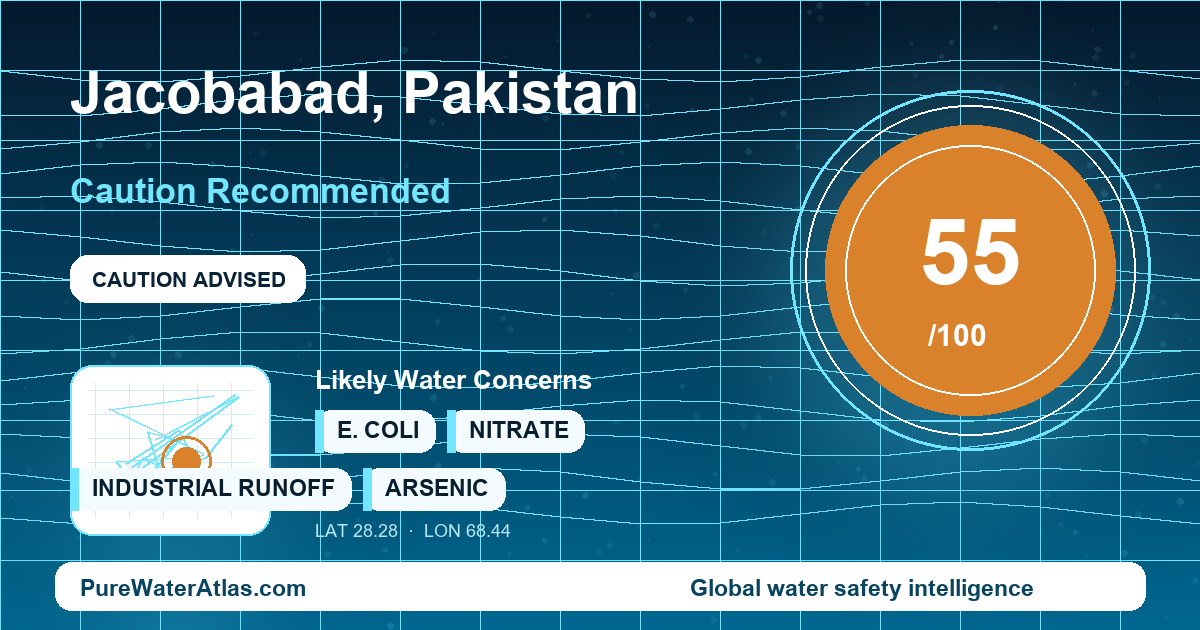
Jacobabad, Pakistan: canal-fed urban water in an extreme-heat city where intermittent supply, household storage, and mixed backup sources make point-of-use treatment important.
Quick Answer
| Overall safety status | Caution recommended. Jacobabad should not be treated as a routine tap-and-drink city. PureWaterAtlas assigns a water safety score of 55/100, reflecting practical risk rather than confirmed citywide failure. |
|---|---|
| Can visitors drink the tap water? | No for routine travel use. Visitors should use sealed bottled water from reputable shops or water that has been boiled, disinfected, and filtered. |
| Resident guidance | Residents should treat tap or stored household water before drinking unless recent local testing confirms safe microbiology and acceptable chemical quality at the tap and after storage. |
| Main water source | Jacobabad depends primarily on Indus-derived canal water delivered through the local irrigation canal system, with private boreholes, hand pumps, tankers, bottled water, and small filtration plants used as backups. |
| Responsible institutions | Urban water supply is associated with Municipal Committee Jacobabad under the Local Government Department, Government of Sindh, with Public Health Engineering Department involvement in water-supply schemes and district-level services. |
| Filter recommendation | Usually yes for drinking water: sediment prefiltration, safe storage, and disinfection by boiling, UV, or chlorination. Reverse osmosis is most appropriate where testing confirms high TDS, salinity, nitrate, arsenic, fluoride, or other dissolved contaminants. |
Why Jacobabad Is Different
Jacobabad is not a typical urban water-supply case because its drinking-water risk is shaped by climate, canal dependence, intermittent service, and household storage at the same time. The city is in upper Sindh near the Balochistan border and is known for extreme heat. That climate creates unusually high daily water demand and makes safe storage more important than it would be in a cooler, continuously pressurized system.
The practical question in Jacobabad is not only whether municipal water is treated somewhere in the system. The more important household question is what happens between the canal-fed source, municipal pumping and storage, neighborhood distribution lines, home tanks, drums, rooftop tanks, coolers, and the cup used for drinking. Intermittent supply and pressure loss can allow contamination to enter aging or leaky pipes. Long storage in hot weather can deplete chlorine residual and allow bacterial regrowth if tanks are dirty or uncovered.
For this reason, PureWaterAtlas classifies Jacobabad as Caution Recommended. The available public information supports the main risk pathways: microbial contamination, turbidity and sediment, inconsistent disinfection at the point of use, and possible salinity or high total dissolved solids in private groundwater or tanker sources. However, recent public distribution-zone monitoring tables for Jacobabad are limited, so this page avoids making exact claims about every neighborhood.
Where Does Jacobabad’s Tap Water Come From?
Jacobabad is in the arid upper Sindh canal-irrigation region. Its main raw water supply is primarily Indus-derived surface water delivered through the local irrigation canal system, commonly described in local context as the Begari and related right-bank canal command area. That water is then routed through municipal waterworks, storage ponds or reservoirs, pumping stations, and chlorination or basic treatment points before reaching parts of the city distribution network.
The city also relies heavily on non-municipal backup water. When piped water is intermittent or insufficient, households may turn to private boreholes, hand pumps, water tankers, bottled water vendors, or small filtration plants. These sources are not automatically equivalent. Canal-fed municipal water, shallow groundwater, tanker water, and bottled water each have different risk profiles. Groundwater in Sindh can be variable in quality, including salinity and bacteriological contamination risks, so private-source water should be tested rather than assumed safe.
Key infrastructure in Jacobabad includes canal intake or canal-fed raw-water delivery, municipal storage and pumping systems, intermittent distribution mains, neighborhood supply lines, and household storage tanks. In practical terms, the household tank is often part of the drinking-water system. A clean, sealed tank can reduce recontamination risk; an uncovered or uncleaned tank can make otherwise improved water unsafe.
Who Manages Drinking Water in Jacobabad?
Urban water supply in Jacobabad is associated with Municipal Committee Jacobabad under the Local Government Department, Government of Sindh. The Public Health Engineering Department, Government of Sindh, may also be involved in water-supply schemes and district-level services. Operating responsibility can vary by scheme, neighborhood, and project status, which is one reason citywide consumer-style reporting is difficult to interpret from outside the local system.
Pakistan’s drinking-water quality is guided by the National Standards for Drinking Water Quality and public-health guidance from national and provincial agencies. In Sindh, relevant institutions include the Sindh Environmental Protection Agency and provincial local-government and public-health engineering bodies. Unlike some high-compliance cities that publish detailed routine consumer confidence reports, publicly accessible Jacobabad distribution-zone data, residual-chlorine records, and current tap-by-tap contaminant tables are not widely available.
This data limitation matters. It means residents should not rely only on a general statement about the city’s source water. Household testing, especially after floods, canal disruptions, tank contamination, new borehole use, or major pipe repairs, is the most reliable way to know what is coming out of a specific tap.
Main Local Water Concerns
The most immediate public-health concern in Jacobabad is microbial contamination. Intermittent supply, pressure loss, sewage intrusion, unsafe household storage, and insufficient disinfection can allow bacteria, viruses, or fecal indicators to reach drinking water. Testing for E. coli in drinking water or thermotolerant coliforms should be prioritized because these indicators directly relate to fecal contamination risk.
Turbidity and sediment are also important. Canal water can become more turbid after disturbance, desilting, monsoon rains, flood impacts, damaged pipes, or storage-tank accumulation. Turbid water is not only unpleasant; suspended particles can reduce the effectiveness of disinfection. PureWaterAtlas has separate references on turbidity in drinking water and sediment in drinking water for households interpreting test results or visible particles.
Low or inconsistent chlorine residual is another Jacobabad-relevant issue. Chlorination can protect water as it moves through distribution, but residual chlorine may decline during long storage, high temperatures, or contact with organic matter and sediment. This is why residents should not judge water safety only by whether it was chlorinated somewhere upstream. Learn more about the role and limits of chlorine in drinking water.
For private boreholes, hand pumps, and some tanker sources, salinity, high TDS, nitrate, arsenic, fluoride, and other dissolved contaminants may be more relevant than for treated municipal canal water. The dataset does not support claiming a citywide exceedance for any one chemical, but it does support screening private and shallow sources. Regional Sindh groundwater concerns such as arsenic and fluoride should be checked by laboratory testing. Agricultural and shallow-source indicators such as nitrate should also be included where households use boreholes, hand pumps, or tanker water.
Lead is best treated as a premise-plumbing issue in Jacobabad rather than a confirmed citywide contaminant. Older buildings, metal pipes, brass fittings, solder, corroded tanks, or unknown repairs can add metals or sediment after water enters the property. Residents in older buildings can review lead in drinking water and test first-draw and flushed samples if infants, pregnant people, or young children drink the water.
For Travelers
Visitors should not drink untreated tap water in Jacobabad. Use sealed bottled water from reputable shops or water that has been boiled, disinfected, and filtered. Because Jacobabad’s heat can cause rapid dehydration, travelers should carry enough sealed drinking water during the day and check that bottle seals are intact. Avoid bottles that appear refilled or tampered with.
For brushing teeth, use bottled, boiled, or otherwise treated water. This is especially important for short-stay visitors, children, pregnant travelers, older adults, and anyone with a sensitive stomach or weakened immune system. For ice, avoid cubes in street drinks and informal restaurants unless the establishment can clearly confirm that the ice is made from treated or commercially purified water.
In hotels, ask whether drinking water comes from sealed bottled water or from a maintained filtration system, such as a sediment filter combined with UV or RO where appropriate. Also ask whether storage tanks are cleaned. In small restaurants and roadside shops, choose sealed bottled drinks or hot beverages prepared with water that has reached a rolling boil. If bottled water is unavailable, boil clear water for at least one minute, allow it to cool in a clean covered container, and avoid recontamination when pouring.
For Residents
Most Jacobabad households should use some form of drinking-water treatment unless recent testing confirms that the household tap and storage tank are safe. A practical setup starts with safe storage, sediment prefiltration, and disinfection. Boiling is the simplest emergency microbial control method; see the PureWaterAtlas boiling water purification guide. UV can also be useful when water is clear and the unit is powered, maintained, and correctly sized; see the UV water purification guide.
Reverse osmosis should not be selected only because water is from Jacobabad. RO is useful when testing confirms high total dissolved solids, salinity, nitrate, arsenic, fluoride, or other dissolved contaminants. It also produces reject water and requires maintenance, which matters in a water-scarce, high-demand household. If the main problem is microbial contamination in otherwise low-turbidity water, disinfection and clean storage may be more directly relevant than RO alone.
Testing should be done at least annually and after floods, pipe repairs, canal disruptions, new borehole installation, major changes in taste, odor, or color, or illness patterns suspected to be water-related. Prioritize E. coli or thermotolerant coliforms, turbidity, pH, electrical conductivity, total dissolved solids, hardness, and residual chlorine at both the tap and after household storage. For boreholes, hand pumps, or tanker sources, add arsenic, fluoride, nitrate, chloride, sulfate, iron, manganese, and salinity indicators.
Household tanks are a major control point in Jacobabad. Keep underground tanks, rooftop tanks, drums, and coolers sealed. Clean tanks routinely, protect vents and overflows from insects and dust, avoid dipping cups into stored water, and disinfect after floods, sewage backups, long outages, or visible contamination. In older buildings, let stagnant water run before drinking, avoid using hot tap water for cooking, and test if metal plumbing or corroded fittings are suspected.
Relevant Contaminants and Water-Quality Issues
The most Jacobabad-specific issues to understand are microbial contamination, turbidity, sediment, chlorine residual, private-source salinity and TDS, and source-specific chemical screening. Start with E. coli because fecal contamination is the most immediate health risk in intermittent and stored-water systems. Pair that with turbidity and sediment, since cloudy or particle-laden water can interfere with disinfection and signal disturbance in canal water, pipes, or tanks.
For disinfection decisions, review chlorine in drinking water. For private boreholes, hand pumps, and tanker sources, use the PureWaterAtlas profiles on nitrate and arsenic, and consult the testing guides for arsenic detection and nitrate testing. For old homes or unknown plumbing materials, the lead testing guide explains first-draw and flushed sampling.
How to Verify Your Water Quality
Because recent public Jacobabad tap-by-tap monitoring data are limited, the best verification is household-specific testing. Use a recognized laboratory where possible, such as PCRWR facilities, provincial public-health laboratories, university laboratories, or accredited private labs. Take samples from the actual drinking point, not only the source line, because the household tank and internal plumbing can change water quality.
PureWaterAtlas resources can help interpret results. Use the complete water testing guide to choose parameters and sampling methods. The drinking water safety guide explains how to judge safety when official local data are limited. The water microbiology guide is especially relevant to Jacobabad’s storage and intermittent-supply risks. For treatment choices, see water treatment systems.
You can also compare Jacobabad with other locations using the Global Water Quality Checker, and look up any contaminant appearing in your lab report through the PureWaterAtlas Contaminants Search Engine.
Official and Technical Sources
- Pakistan Council of Research in Water Resources — national water research and drinking-water quality monitoring authority.
- PCRWR water quality publications — Pakistan-wide and available local water-quality publications; useful where Jacobabad-specific reports are available or for national context.
- Government of Sindh, Local Government Department — provincial department relevant to municipal services and local councils.
- Sindh Environmental Protection Agency — provincial environmental regulator relevant to water pollution and environmental oversight.
- Public Health Engineering Department, Government of Sindh — public-health engineering institution associated with water-supply and sanitation schemes.
- USAID Pakistan Municipal Services Program — development-sector context for municipal infrastructure work in Sindh cities, including water and sanitation.
- UNICEF Pakistan Water, Sanitation and Hygiene — public-health context for drinking water, sanitation, hygiene, and child-health risks in Pakistan.
- World Bank Climate Change Knowledge Portal: Pakistan — climate, heat, rainfall variability, and flood-risk context affecting water safety.
- World Health Organization Guidelines for Drinking-water Quality — international reference for microbial risk, chemical contaminants, turbidity, residual disinfection, and safe drinking-water management.
Bottom Line
Jacobabad’s tap water requires caution because the city depends mainly on Indus-derived canal water moving through municipal storage, pumping, intermittent distribution, and extensive household storage in an extreme-heat environment. The main practical risks are microbial contamination, turbidity or sediment, declining chlorine residual in stored water, and variable quality from boreholes, tankers, or hand pumps. Visitors should not drink untreated tap water and should avoid ice unless made from treated water. Residents should treat drinking water, maintain sealed and clean tanks, and test household water regularly, especially after floods, canal disruptions, repairs, or source changes. Current public neighborhood-level monitoring data are limited, so household testing is essential for confident decisions.
Read the full guide: Global Water Quality Guide
Explore more in this category: Global Water Quality Articles