
Introduction
Safe drinking water is one of the most important foundations of public health. The World Health Organization (WHO) develops drinking-water guidelines to help countries, utilities, health professionals, and communities evaluate whether water is safe to consume and how to reduce risk when contamination occurs. Understanding who drinking water guidelines health effects is essential because water can carry a wide range of hazards, including microbes, chemicals, metals, toxins, and by-products from treatment or distribution systems.
These guidelines are not simply numerical targets on a chart. They are part of a broader risk-management framework designed to prevent disease, protect vulnerable populations, and guide decision-making across very different environmental and economic settings. They address both immediate dangers, such as outbreaks of diarrheal illness from microbial contamination, and slower, cumulative concerns, such as long-term exposure to arsenic, fluoride, lead, nitrate, or industrial chemicals.
For households, clinicians, educators, and policy makers, the WHO framework is useful because it connects water quality with real health outcomes. It explains how exposure happens, what types of symptoms may appear, which groups face the greatest danger, and what actions can reduce harm. Readers seeking broader background can explore drinking water safety resources or a more comprehensive overview at this complete guide to WHO drinking water guidelines.
This article explains the meaning of these guidelines, where drinking-water hazards come from, how they affect health, how testing is performed, and what prevention and treatment measures can lower risk. It also reviews common misunderstandings and places WHO recommendations within the broader context of public-health regulation.
What It Is
The WHO Guidelines for Drinking-water Quality are internationally recognized recommendations that describe the conditions under which water is considered safe for human consumption. They are intended to support national standards and local water-safety planning, not to serve as rigid universal laws. Countries use them to develop regulations that reflect local geology, infrastructure, disease patterns, treatment capacity, and patterns of water use.
At the core of the WHO approach is a preventive model. Rather than relying only on final water testing, the guidelines encourage control of hazards from source to consumer. This means identifying contamination risks in watersheds, groundwater, treatment plants, storage systems, and household distribution. The goal is to prevent hazards from entering drinking water or to reduce them to levels that do not threaten health.
The WHO framework generally considers three major classes of hazards:
- Microbiological hazards, including bacteria, viruses, protozoa, and parasites that can cause acute infectious disease.
- Chemical hazards, such as arsenic, lead, nitrate, fluoride, pesticides, cyanotoxins, and industrial contaminants that may cause either short-term or chronic health effects.
- Radiological hazards, involving naturally occurring or man-made radioactive substances in certain water sources.
When discussing who drinking water guidelines exposure levels, it is important to understand that guideline values are based on toxicology, epidemiology, feasibility of treatment, and lifetime exposure assumptions. They are generally designed to protect health over long periods of regular consumption, often accounting for daily intake across a lifetime. However, some contaminants can cause effects after relatively short exposure periods, especially at high concentrations.
The guidelines also distinguish between health-based targets and operational monitoring. For example, a substance may have a guideline value rooted in health science, but utilities may also monitor pH, turbidity, disinfectant residual, or conductivity because those indicators help determine whether the treatment system is functioning properly.
The WHO perspective therefore extends beyond a list of contaminants. It is a practical system linking hazard identification, exposure assessment, treatment control, surveillance, and public communication.
Main Causes or Sources
Contamination of drinking water can happen at the source, during treatment, within distribution systems, or even inside the home. Understanding the major pathways is essential to evaluating risk and interpreting the WHO recommendations accurately. Additional source-specific discussion is available at this guide on causes and sources.
Natural Geological Sources
Some hazardous substances occur naturally in groundwater and surface water. Arsenic, fluoride, manganese, iron, uranium, and other minerals can leach from rocks and soils into aquifers. In some regions, naturally elevated fluoride can help prevent dental caries at low concentrations but may cause dental or skeletal fluorosis when levels are too high. Arsenic is especially important because chronic exposure has been associated with skin lesions, cardiovascular disease, developmental effects, and several cancers.
Microbial Contamination from Human and Animal Waste
Fecal contamination is one of the most urgent global drinking-water risks. Pathogens can enter water through inadequate sanitation, open defecation, sewage leaks, agricultural runoff, flooding, or poorly protected wells. Common microbial threats include:
- Bacteria such as E. coli, Vibrio cholerae, Salmonella, and Campylobacter
- Viruses such as norovirus, rotavirus, hepatitis A, and enteroviruses
- Protozoa such as Giardia and Cryptosporidium
These organisms can cause acute illness rapidly, especially in settings with poor disinfection or damaged distribution systems.
Agricultural Activities
Fertilizers and animal waste can raise nitrate and nitrite levels in drinking water sources. Pesticides and herbicides may also infiltrate groundwater or wash into rivers and reservoirs. Nitrate is a notable who drinking water guidelines medical concerns issue because infants are especially vulnerable to methemoglobinemia, a condition that reduces the blood’s oxygen-carrying capacity.
Industrial and Mining Pollution
Factories, refineries, waste disposal sites, and mining operations may release solvents, heavy metals, petroleum compounds, acids, and persistent organic pollutants into nearby water sources. Industrial contamination can be difficult to detect without targeted testing because it may not alter color, smell, or taste in a noticeable way.
Water Treatment and Distribution Problems
Even when source water is acceptable, problems may arise during treatment or distribution. Inadequate filtration, insufficient disinfection, pipe corrosion, biofilm formation, intermittent service, or cross-connections can compromise water quality. Lead and copper may leach from plumbing materials, particularly when water is corrosive. Disinfection by-products can also form when chlorine reacts with natural organic matter.
Household Storage and Handling
In many communities, water is collected from public taps or delivered intermittently, then stored at home. Unsafe storage containers, contaminated scoops, hand contact, or uncovered vessels can reintroduce microbes into otherwise safe water. This highlights why WHO emphasizes a full-chain safety approach, not just source protection.
Health and Safety Implications
The health effects associated with unsafe drinking water range from mild temporary discomfort to severe chronic disease or death. The severity depends on the contaminant, concentration, duration of exposure, age and health status of the individual, and whether multiple hazards are present at the same time.
Acute Health Effects
Microbial contamination most often causes short-term illness. Common who drinking water guidelines symptoms linked to contaminated water include:
- Diarrhea
- Vomiting
- Abdominal cramps
- Nausea
- Fever
- Dehydration
- Headache and weakness
These symptoms may appear within hours to days after exposure. In healthy adults, some infections resolve without lasting injury, but in infants, older adults, pregnant women, and immunocompromised individuals, dehydration and systemic infection can become medical emergencies.
Chemical Exposure and Short-Term Concerns
Chemical contaminants may also cause acute effects when levels are high enough. For example, nitrate can interfere with oxygen transport in infants. Copper at elevated concentrations may produce gastrointestinal symptoms such as nausea, vomiting, and stomach pain. Cyanobacterial toxins in surface water can cause gastrointestinal, hepatic, or neurologic effects depending on the toxin type and dose.
Chronic Disease Risks
Many of the most serious concerns in the WHO framework involve long-term exposure. The issue of who drinking water guidelines long term risks is especially important because chronic exposure often occurs silently over years, without immediate symptoms. Health outcomes may include:
- Cancer, associated with some exposures such as arsenic and certain disinfection by-products
- Neurological harm, associated with lead, manganese at high exposure, and other neurotoxic substances
- Kidney damage, associated with heavy metals and some industrial chemicals
- Bone and skeletal effects, such as skeletal fluorosis from excessive fluoride
- Thyroid and endocrine disruption, associated with certain chemicals including perchlorate and other emerging contaminants in some settings
- Cardiovascular and metabolic effects, reported for some chronic contaminant exposures including arsenic in certain populations
- Developmental and reproductive effects, especially where exposure occurs during pregnancy or early childhood
Lead as a Special Concern
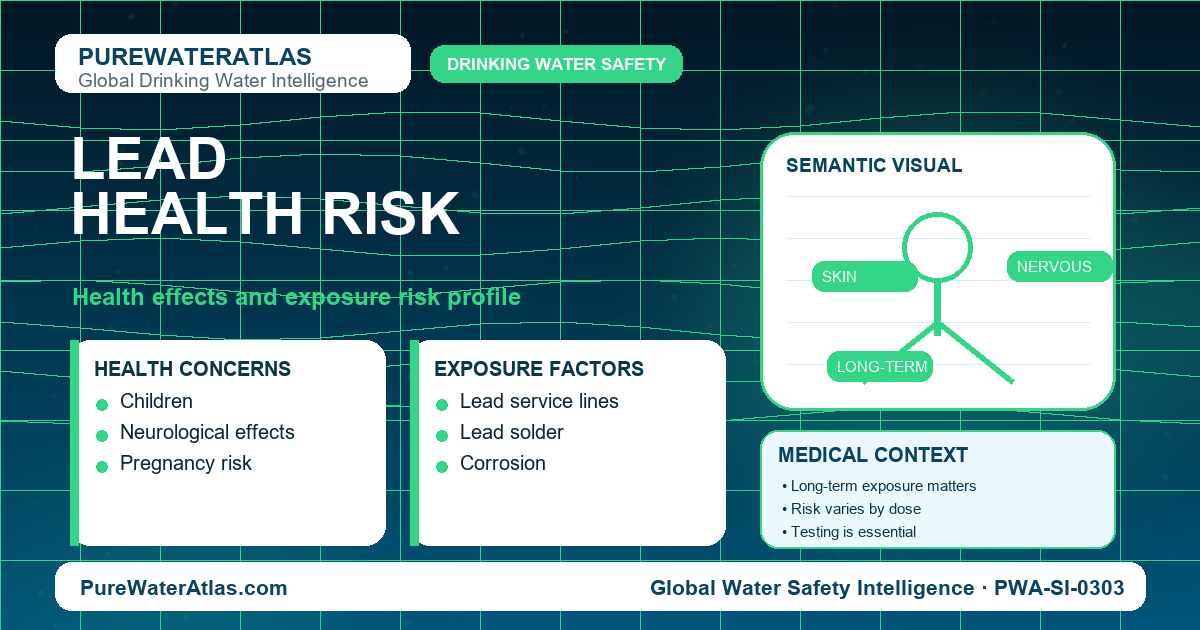
Lead deserves particular attention because no level of exposure is considered truly beneficial, and even relatively low exposure may impair neurodevelopment in children. Water may not be the only source of lead, but when lead-containing pipes, solder, or fixtures are present, drinking water can become an important contributor. Effects may include reduced IQ, attention problems, behavioral changes, anemia, kidney stress, and adverse pregnancy outcomes.
Arsenic and Fluoride
Arsenic contamination is a major worldwide public-health issue in certain groundwater-dependent regions. Prolonged exposure can cause skin thickening, pigmentation changes, peripheral vascular disease, neuropathy, and increased risk of cancers of the skin, bladder, and lung. Fluoride presents a more complex situation: low concentrations can support dental health, but chronic excess can cause mottling of teeth and, at still higher long-term exposure, painful skeletal changes.
Microbial Risks and Community Impact
Unsafe water does not only affect individuals. Waterborne disease can spread through households, schools, health-care facilities, and food preparation environments. Outbreaks disrupt work, education, and health services. In low-resource settings, repeated childhood diarrheal disease is linked with malnutrition, impaired growth, and long-term developmental consequences.
Vulnerable Groups
The topic of who drinking water guidelines vulnerable groups is central to understanding health protection. Risks are not evenly distributed. Groups with higher susceptibility include:
- Infants and young children, due to immature immune systems, lower body weight, and higher water intake per kilogram
- Pregnant women, because some contaminants may affect fetal development
- Older adults, who may have weaker immune systems or chronic illness
- Immunocompromised individuals, including people receiving chemotherapy, transplant recipients, or those with advanced immune disorders
- People with kidney or liver disease, who may have reduced ability to handle toxic exposures
- Communities relying on untreated private wells or informal supplies, where testing and treatment may be inconsistent
For these groups, contaminants that might cause mild illness in a healthy adult can lead to severe complications.
Exposure Levels and Risk Interpretation
Understanding who drinking water guidelines exposure levels requires more than comparing a test result with a single number. Health risk depends on several factors:
- The concentration of the contaminant
- The amount of water consumed
- How long exposure continues
- Whether the person is a child, pregnant, elderly, or medically vulnerable
- Whether exposure also occurs through food, air, or occupation
A guideline exceedance does not always mean immediate poisoning, but it does indicate increased concern and a need for risk management. Conversely, water that looks clear and tastes normal cannot be assumed safe without proper testing and system control.
Testing and Detection
Testing is essential because many dangerous contaminants are invisible, tasteless, and odorless. WHO guidance promotes monitoring systems that detect hazards early and verify that treatment barriers are working. For a detailed technical overview, see testing and detection methods for WHO drinking water guidelines.
Microbiological Testing
Microbial safety is often assessed using indicator organisms, especially E. coli, which signals fecal contamination. Utilities may also monitor total coliforms, turbidity, chlorine residual, and treatment performance. In outbreak settings or advanced surveillance systems, laboratories may test directly for specific pathogens, but routine indicator testing remains a practical and widely used approach.
Chemical Testing
Chemical analysis may include arsenic, lead, fluoride, nitrate, pesticides, disinfection by-products, hardness-related minerals, volatile organic compounds, and region-specific contaminants. Testing frequency depends on the risk profile of the source and the distribution system. For example:
- Groundwater in arsenic-prone areas requires periodic arsenic testing
- Agricultural regions may need nitrate and pesticide monitoring
- Older buildings may require lead and copper testing at taps
- Reservoir-based systems may monitor cyanotoxins seasonally
Operational Monitoring
Not all useful monitoring is direct contaminant measurement. Operators also track parameters such as:
- Turbidity
- pH
- Disinfectant residual
- Conductivity
- Temperature
- Filter performance
These indicators help determine whether the system is likely to control hazards effectively.
Source Assessment and Sanitary Inspection
WHO emphasizes preventive evaluation of the whole system. A sanitary inspection examines wells, springs, intakes, storage tanks, and distribution networks for structural or operational vulnerabilities such as nearby latrines, flooding risk, broken seals, or illegal connections. This kind of assessment often identifies risk before contamination appears in laboratory results.
Household and Private Well Testing
Private wells are not always monitored as consistently as public systems. Owners may need periodic testing for bacteria, nitrate, arsenic, lead, and locally relevant contaminants. Testing is especially important after flooding, construction, changes in water taste or appearance, or unexplained gastrointestinal illness in the household.
Prevention and Treatment
The most effective approach to drinking-water safety is prevention. WHO strongly supports water safety plans that identify hazards, set control points, monitor system performance, and prepare for corrective action. Treatment choices vary depending on the contaminant and setting. More practical resources are available in water treatment systems.
Source Protection
Protecting the source is often the first and most cost-effective barrier. This may involve:
- Safeguarding recharge areas and watersheds
- Controlling sewage discharge and agricultural runoff
- Proper well construction and sealing
- Restricting hazardous industrial releases
- Managing stormwater and flood-related contamination
Municipal Treatment
Public water systems may use combinations of coagulation, flocculation, sedimentation, filtration, activated carbon, membrane treatment, ion exchange, and disinfection. Chlorination remains common because it not only disinfects water but can also provide residual protection in distribution systems. However, treatment must be managed carefully to balance microbial control with the formation of unwanted by-products.
Point-of-Use and Point-of-Entry Treatment
At the household level, treatment options include boiling, certified filters, ultraviolet disinfection, reverse osmosis, distillation, and chemical disinfection in emergency situations. The correct method depends on the contaminant:
- Boiling is effective for many pathogens but does not remove heavy metals or nitrate.
- Activated carbon can reduce some organic chemicals and improve taste and odor, but performance varies by product.
- Reverse osmosis can reduce many dissolved contaminants including arsenic, fluoride, nitrate, and some metals.
- UV treatment can inactivate microbes when water is sufficiently clear.
- Distillation can remove many dissolved substances but may be slow and energy-intensive.
Consumers should use systems certified for the specific contaminant of concern and maintain them properly. A neglected filter can lose effectiveness or become a contamination source itself.
Corrosion Control
To prevent lead and copper leaching, utilities may adjust pH, alkalinity, and corrosion inhibitors. Replacing lead service lines, lead-containing fixtures, and old plumbing materials is often the most reliable long-term solution. Flushing taps can temporarily reduce stagnant-water lead levels, but it is not a substitute for infrastructure correction.
Response to Contamination Events
When a contaminant exceeds health-based guidance, response measures may include boil-water advisories, alternative water supply distribution, immediate treatment adjustments, infrastructure repair, targeted public communication, and medical follow-up for exposed populations. In cases of serious chemical contamination, boiling may worsen the problem by concentrating certain substances, so public instructions must match the specific hazard.
Medical Evaluation and Follow-Up
The issue of who drinking water guidelines medical concerns becomes especially important when exposure is suspected. Clinicians may need to consider water history when patients present with gastrointestinal outbreaks, neurologic symptoms, unexplained skin changes, developmental concerns in children, or signs consistent with heavy metal or nitrate exposure. In some situations, laboratory testing of blood or urine may be appropriate, particularly for lead or other metals.
Common Misconceptions
Public understanding of drinking-water risk is often shaped by myths. Correcting these misconceptions is important for effective prevention.
If Water Looks Clean, It Is Safe
This is false. Many of the most dangerous contaminants, including arsenic, nitrate, lead, and many pathogens, cannot be detected by sight alone. Clear water can still be unsafe.
Boiling Solves Every Problem
Boiling is valuable for microbial contamination but does not remove most dissolved chemicals or metals. In some circumstances, boiling can concentrate contaminants as water evaporates.
Guideline Exceedance Always Means Immediate Severe Illness
Not necessarily. Some exceedances raise concern primarily because of cumulative long-term risk rather than acute toxicity. However, any exceedance deserves attention because it signals loss of the intended health margin of safety.
Bottled Water Is Always Safer
Bottled water quality varies by source, regulation, storage conditions, and handling. It may be useful during emergencies, but it is not automatically safer than well-managed tap water.
Only Developing Regions Face Drinking-Water Risks
Unsafe drinking water is a global issue. Aging infrastructure, lead plumbing, industrial contamination, agricultural runoff, and climate-related disruptions affect high-income and low-income settings alike. For broader international context, readers can review global water quality resources.
Testing Once Is Enough
Water quality can change over time with seasons, storms, land use, infrastructure deterioration, or treatment failures. Ongoing monitoring is essential.
Regulations and Standards
WHO guidelines are influential worldwide, but they are not themselves legally binding regulations. Instead, they provide a scientific basis that governments and agencies adapt into enforceable national or regional standards. This distinction is important when comparing local laws with WHO values.
Role of WHO Guidance
The WHO framework helps countries establish health-based targets, monitoring priorities, and management approaches. It is especially valuable where regulatory systems are still developing, but it also informs mature regulatory environments by providing global scientific review and risk-based methodology.
National Adaptation
Countries may set standards that match, exceed, or in some cases differ from WHO guideline values depending on local feasibility, background exposure, and technical considerations. For example, a country with widespread arsenic contamination may need phased mitigation strategies and prioritized protections for highly exposed populations.
Water Safety Plans
One of the most significant contributions of the WHO approach is the promotion of water safety plans. These plans move beyond end-product testing and establish a preventive management system that covers:
- System assessment
- Hazard identification
- Control measures
- Operational monitoring
- Verification
- Incident response
- Documentation and communication
This model has become a cornerstone of modern drinking-water management because it reduces the chance of failure before contaminated water reaches consumers.
Balancing Practicality and Protection
Regulators must weigh scientific evidence, treatment capability, cost, infrastructure limits, and public-health urgency. WHO guidance recognizes that the greatest risk in many settings is microbial contamination, which can cause immediate large-scale disease. Therefore, while chemical risks are important, failure to maintain basic microbial safety may produce even greater harm.
Public Communication and Transparency
Standards alone do not protect health unless they are communicated clearly. Authorities should explain what contaminants were found, how measured values compare with guidance, whether the risk is short-term or long-term, who is most vulnerable, and what actions the public should take. Transparent reporting builds trust and encourages compliance with advisories.
Conclusion
Understanding who drinking water guidelines health effects means understanding that safe water is both a scientific and a public-health achievement. WHO guidance helps translate toxicology, microbiology, engineering, and epidemiology into practical actions that protect communities from both immediate illness and chronic disease.
These guidelines matter because drinking-water risks are diverse. Some contaminants cause fast-moving outbreaks with diarrhea, vomiting, and dehydration. Others create hidden burdens over years, including neurologic injury, organ damage, developmental problems, and cancer. The seriousness of these outcomes depends on contaminant type, concentration, duration, and the susceptibility of the exposed person, especially among infants, pregnant women, older adults, and immunocompromised individuals.
The most effective protection comes from prevention: protecting sources, maintaining treatment systems, monitoring water quality, controlling corrosion, and responding quickly when hazards are detected. Testing remains essential because appearance and taste alone cannot confirm safety. For households and institutions alike, the best approach is to combine reliable data, appropriate treatment, and clear risk communication.
Ultimately, the WHO drinking-water framework is not just about compliance with numbers. It is about reducing disease, protecting vulnerable groups, and ensuring that water truly supports health rather than threatening it. When applied well, these guidelines provide a strong foundation for safer communities and better long-term public health outcomes.
Read the full guide: Drinking Water Safety Guide
Explore more in this category: Drinking Water Safety Articles