
Istanbul’s tap water is treated and chlorinated by İSKİ, but safety at the tap can depend heavily on apartment plumbing, private storage tanks, pressure systems and local building maintenance.
Quick Answer
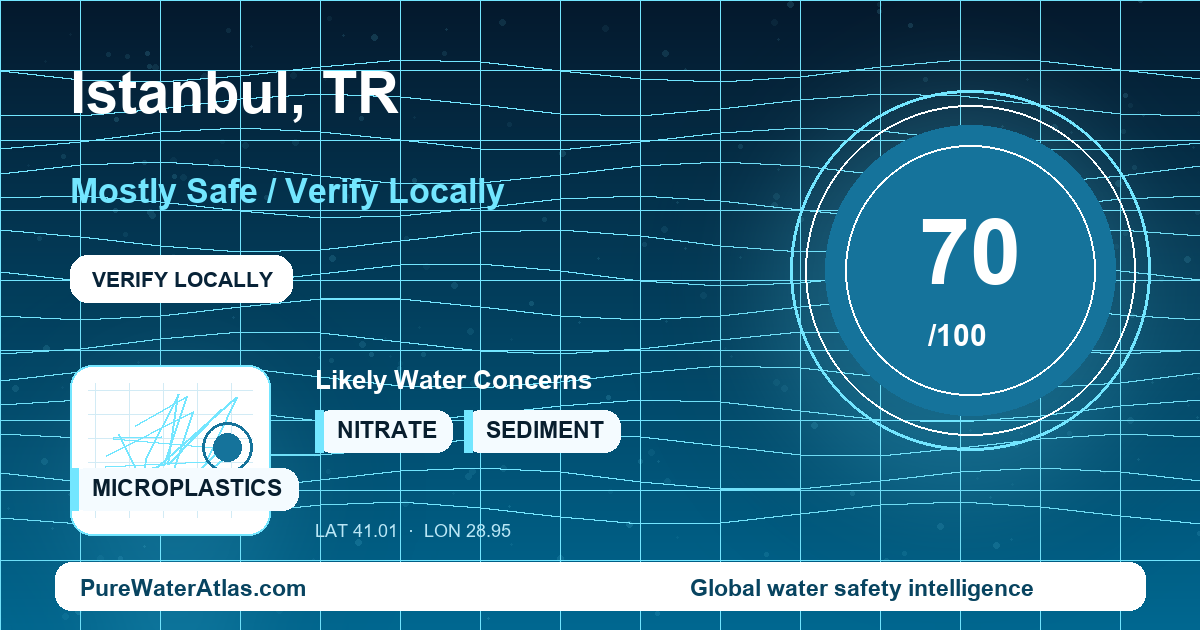
| Overall safety score | 70 / 100 |
|---|---|
| Risk level | Mostly Safe / Verify Locally |
| Can you drink the tap water? | Generally yes at the municipal-system level. Istanbul’s water is treated and chlorinated, but building-level conditions can affect what reaches your tap. |
| Traveler advice | Tap water is usually acceptable for brushing teeth and hot drinks in modern hotels and established restaurants. Cautious travelers, infants, immunocompromised people and sensitive stomachs should use sealed bottled water or properly filtered water for direct drinking. |
| Resident advice | Treat the city supply as intended to be potable unless an official notice says otherwise, but verify your own building, especially if it is old or uses rooftop, basement or intermediate storage tanks. |
| Main water source | Primarily treated surface water from Istanbul’s reservoir and interbasin-transfer network, including systems such as Ömerli, Darlık, Terkos/Durusu, Büyükçekmece, Sazlıdere, Alibeyköy, Elmalı, Melen, Yeşilçay and Istranca. |
| Water authority | İstanbul Su ve Kanalizasyon İdaresi, commonly known as İSKİ. |
| Filter recommendation | Not automatically required for every home. Use activated carbon for chlorine taste and odor, sediment filtration for particles, and certified lead-rated or reverse-osmosis systems only when testing or plumbing history supports the need. |
Why Istanbul Is Different
Istanbul is not a simple one-source city. It straddles Europe and Asia, draws water from both sides of the Bosphorus, and depends on reservoirs, transfer tunnels, long transmission mains, treatment plants, pressure zones and building-level systems. That complexity is the main reason a citywide answer such as “safe” or “unsafe” is not precise enough for Istanbul.
At the municipal level, Istanbul’s water is treated and chlorinated by İSKİ and is generally intended to meet Turkish drinking-water standards in the distribution system. The more practical uncertainty is endpoint variability. Many residents receive water through apartment storage tanks, hydrophores, long building risers, older internal pipes or fixtures. These private-side components can change taste, turbidity and microbial risk independently of the treatment plant.
This is also why many Istanbul residents buy bottled water or use home filtration even though the municipal water is treated. That behavior is often driven by chlorine taste, odor, distrust of old plumbing, tank hygiene concerns and habit, rather than by one documented citywide contaminant failure. The best interpretation is: Istanbul’s municipal supply is mostly safe, but your specific tap still matters.
Where Does Istanbul’s Tap Water Come From?
Istanbul is supplied mainly by treated surface water from a regional reservoir and interbasin-transfer network. Important sources include Ömerli and Darlık on the Asian side, Elmalı near the Bosphorus, and Terkos or Durusu, Büyükçekmece, Sazlıdere and Alibeyköy on the European side. The city also relies on additional transfer systems, including Melen, Yeşilçay and Istranca, to supplement local reservoirs and improve resilience during dry periods.
The system is not primarily a local groundwater supply. Historically, Istanbul relied on local reservoirs, aqueducts and forested catchments close to the city, including Terkos, Elmalı and Alibeyköy. Modern demand from a very large metropolitan population has pushed Istanbul toward a wider regional water-supply network, including long-distance transfers from outside the immediate urban area.
Key infrastructure includes İSKİ reservoirs and dams, major drinking-water treatment plants reported by İSKİ, such as Ömerli, Kağıthane, İkitelli, Büyükçekmece and Elmalı, plus large distribution reservoirs, pumping stations and pressure zones. In high-rise apartment districts, the final part of the system can include building-level booster pumps and storage tanks. For a resident or traveler, that final building-level stage may be more relevant than the name of the source reservoir.
Seasonal storage is a visible public issue in Istanbul. İSKİ publishes dam occupancy figures, and those figures are closely watched during drought years. Late summer and early autumn can bring lower reservoir storage after dry periods. Heavy rain after dry spells can increase raw-water turbidity and require more treatment attention, while warm weather can worsen taste, odor and biological activity in poorly maintained private tanks.
Who Manages Drinking Water in Istanbul?
Istanbul’s municipal water and wastewater utility is İstanbul Su ve Kanalizasyon İdaresi, commonly abbreviated İSKİ. İSKİ operates treatment and distribution systems and publishes official information, including dam occupancy data and water quality reports.
Drinking water in Türkiye is regulated under national rules for water intended for human consumption, with the Ministry of Health and local health authorities responsible for public-health oversight. The national regulatory framework is available through the Regulation on Water Intended for Human Consumption, and public-health water resources are provided by the Türkiye Ministry of Health General Directorate of Public Health.
The important limitation is that official city-level information does not prove conditions at every tap. İSKİ can treat and monitor water in the municipal system, but plumbing after the municipal connection can depend on building owners, managers, tank cleaning schedules and internal maintenance. Older fixtures, corroded pipes, storage tanks and pressure interruptions are not fully captured by citywide water-quality summaries.
Main Local Water Concerns
The main Istanbul-specific concerns are practical and building-dependent rather than a single confirmed citywide contaminant problem. The first concern is seasonal reservoir drawdown and drought pressure, especially after dry winters or hot summers. Istanbul’s dependence on a multi-dam and transfer system makes official storage levels important for supply security.
The second concern is taste and odor from chlorination. Chlorine is used to maintain disinfection in treated municipal water, and some residents notice a stronger chlorine smell or taste in certain buildings or districts. This is usually a palatability issue, not automatically a health violation, but it can lead households to use bottled water or carbon filters.
The third concern is turbidity, sediment or rust-colored water after pipe works, pressure changes, heavy rainfall events or disturbance of a private tank. If the problem occurs only at one tap, the fixture or internal plumbing may be the source. If it occurs throughout the building, storage tanks, risers or building plumbing should be investigated. If neighboring buildings also have the issue, recent municipal works or distribution disturbances may be relevant.
The fourth concern is old internal plumbing. Potential lead or metal exposure in Istanbul is most relevant to old pipes, solder, fittings and fixtures inside buildings, not to a proven citywide source-water issue. Families with pregnant people, infants or young children should be more cautious in older apartments with unknown plumbing materials.
The fifth concern is microbial risk in poorly maintained rooftop, basement or intermediate storage tanks. A clean municipal supply can become unsafe if stored in a dirty tank with poor covers, unscreened vents, pest entry, irregular cleaning or long stagnation. This risk is especially relevant in older buildings, short-term rentals, small hotels and properties where tank maintenance is unclear.
For Travelers
For short stays in Istanbul, tap water in modern hotels, airports, malls and established restaurants is typically treated municipal water. Many travelers use it without incident, especially for brushing teeth, tea, coffee and cooked foods. However, direct drinking is where caution is reasonable, because building plumbing and storage tanks vary from one hotel or rental apartment to another.
Brushing teeth with tap water is usually acceptable unless there is a local advisory, visible discoloration, unusual odor or the building reports tank or plumbing problems. Hot drinks are generally lower concern because the water is heated, although boiling does not remove metals such as lead or dissolved salts.
Ice in reputable hotels, cafes and restaurants is generally a lower concern when made from treated municipal water or commercial ice. Avoid ice from informal vendors or places where hygiene is uncertain. If staff tell you not to drink the tap water in a small hotel, hostel or short-term rental, follow that local advice.
Use sealed bottled water for infants, immunocompromised travelers, medical-device rinsing and if you have a sensitive stomach. If water is cloudy, brown, has an unusual strong smell or appears immediately after nearby pipe work, let it run briefly and switch to bottled or boiled water until it clears. For general traveler-health framing, see the CDC Travelers’ Health page for Türkiye.
For Residents
Residents should treat Istanbul’s municipal water as system-level potable unless İSKİ or health authorities issue a notice, but should verify the conditions of their own building. The highest household-specific concern is often not the treatment plant; it is the building. Older apartments may have aging galvanized pipes, old fittings, corroded internal lines or fixtures that contribute metals, rust-colored water, sediment or unpleasant taste.
A home filter is not automatically required for every Istanbul household. Choose filtration based on the actual concern. Activated carbon can help with chlorine taste and odor. Sediment prefilters can help with visible particles. Certified lead-rated systems or reverse-osmosis systems should be considered when testing or plumbing history indicates a metal concern. For broader filter selection, see Water Treatment Systems.
If the building is old or has unknown plumbing materials, test both first-draw and flushed samples for lead and other metals through an accredited laboratory. If the home uses rooftop, basement or intermediate tanks, test periodically for total coliform and E. coli, especially after tank cleaning, flooding, construction or long vacancy. If water is frequently cloudy or contains particles, document whether it occurs at one tap, all taps or neighboring buildings, then ask building management and İSKİ about recent works.
Storage tanks should be covered, screened, protected from pests, inspected, cleaned and disinfected on a regular schedule. After plumbing repairs, long stagnation or pressure outages, flush taps before drinking and consider microbiological testing if odor, slime or recurrent gastrointestinal complaints occur. Do not rely on taste or simple TDS meters to prove safety; they cannot rule out microbes, lead, pesticides or many organic contaminants.
Relevant Contaminants and Water-Quality Issues
Several PureWaterAtlas contaminant profiles are especially relevant to Istanbul’s practical water questions. Chlorine in Drinking Water explains why treated water can have a disinfectant taste or odor. Turbidity in Drinking Water is relevant after heavy rain, pressure changes, pipe works or tank disturbance. Sediment in Drinking Water can help residents interpret visible particles, rust-colored water or disturbed building plumbing.
For older buildings, Lead in Drinking Water is important because endpoint plumbing can create risk even when water leaving treatment plants is compliant. For storage-tank concerns, E. coli in Drinking Water explains why microbial testing matters if tanks are poorly maintained or if a boil-water concern arises.
How to Verify Your Water Quality
The most reliable way to verify an Istanbul tap is to combine official information with site-specific checks. Start with İSKİ’s published water-quality and dam-storage information, then evaluate your own building: age, pipe materials, tank presence, tank maintenance, pressure interruptions and any recurring discoloration or odor.
For older apartments, use laboratory testing rather than assumptions. PureWaterAtlas has a practical guide to Lead in Drinking Water: Testing and Detection Methods and a follow-up guide on Lead in Drinking Water: Best Filters, Systems and Solutions. For microbial concerns and emergency response, see Boiling Water Purification: Complete Guide and Boiling Water Purification: Testing and Detection Methods.
For a broader decision framework, use Drinking Water Safety, Water Testing, Water Microbiology, the Global Water Quality Checker and the Contaminants Search Engine.
Official and Technical Sources
- İSKİ official website — municipal water utility and water-service context for Istanbul.
- İSKİ dam occupancy data — official reservoir storage information for Istanbul’s multi-dam supply system.
- İSKİ water quality reports — published municipal water-quality information and monitoring context.
- İSKİ annual activity reports — infrastructure, treatment plant, source-system and utility operations context.
- Regulation on Water Intended for Human Consumption — Türkiye’s national drinking-water regulatory context.
- Türkiye Ministry of Health public health water resources — public-health context for drinking water and water intended for human consumption.
- CDC Travelers’ Health: Türkiye — general traveler food and water precaution framing.
Bottom Line
Istanbul’s tap water should be understood as mostly safe at the municipal-system level but variable at the tap. İSKİ treats and chlorinates water from a large reservoir and transfer network, and official city-level information is available. The main uncertainty is the final delivery path: old apartment plumbing, rooftop or basement tanks, booster systems, pipe works, pressure changes and tank hygiene can affect taste, sediment, metals or microbial risk. Travelers can usually brush teeth and use tap water for hot drinks in modern hotels, but cautious visitors should choose sealed bottled or filtered water for direct drinking. Residents should focus on their own building: maintain tanks, investigate discoloration, and test older plumbing rather than relying on citywide assumptions.
Read the full guide: Global Water Quality Guide
Explore more in this category: Global Water Quality Articles