
Lagos has formal treated-water infrastructure, but drinking-water safety depends heavily on the actual source serving your building, the condition of tanks and pipes, and whether recent testing confirms the water is safe.
Quick Answer
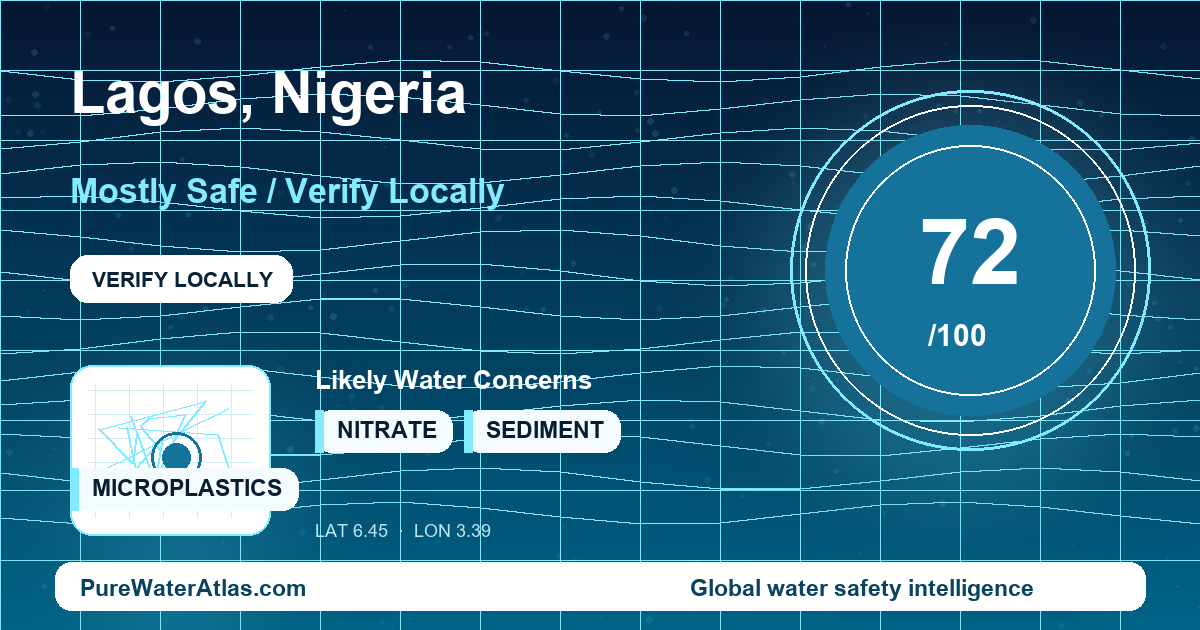
| Water safety score | 72 / 100 |
|---|---|
| Risk level | Mostly Safe / Verify Locally |
| Overall status | Lagos tap water should be treated as conditionally safe only when it comes directly from a maintained Lagos Water Corporation supply or from a verified private system with recent test results. Safety varies substantially by building and supply chain. |
| Traveler advice | Most short-term visitors should not rely on ordinary tap water in Lagos unless a hotel confirms treatment and safe storage. Use sealed bottled water, properly treated water, or boiled water for drinking. |
| Resident advice | Verify the actual water source. Boreholes, tanker water, estate systems, wells, private storage tanks, and older plumbing should be tested before being used as drinking water. |
| Main water source | The public system is centered on treated surface water, especially the Ogun River system feeding major works such as Iju and Adiyan through the Akute intake area. Many users also rely on boreholes, tanker water, storage tanks, sachet water, and bottled water. |
| Water authority | Lagos Water Corporation is the principal state-owned utility. Lagos State Water Regulatory Commission is the state water-sector regulator, with broader oversight from the Lagos State Ministry of the Environment and Water Resources. |
| Filter recommendation | A home treatment system is advisable for many Lagos homes. Selection should be based on test results, often combining sediment filtration, activated carbon, verified disinfection such as UV, and reverse osmosis where salinity, nitrate, or dissolved contaminants are confirmed. |
Why Lagos Is Different
Lagos is not a city where a single citywide answer reliably describes what comes out of every tap. It is a low-lying coastal megacity built around lagoons, creeks, barrier islands, wetlands, and the Atlantic shoreline. That geography matters for drinking water because flooding, poor drainage, sanitation pathways, stormwater, surface water, and shallow groundwater can interact in ways that increase contamination risk.
The city also has a mixed water reality. Some locations receive treated public water from the Lagos Water Corporation system. Others depend partly or fully on boreholes, private estate systems, tanker deliveries, underground tanks, overhead tanks, sachet water, or bottled water. A single address may use utility water for some purposes, borehole water in storage tanks, bottled water for drinking, and sachet water for daily consumption. For Lagos, the key question is not only whether the city has treated waterworks; it is what source fills the building’s taps and tanks today.
This is why PureWaterAtlas rates Lagos as Mostly Safe / Verify Locally rather than universally safe. The city has identifiable official water institutions and significant treatment infrastructure, but publicly accessible, current, tap-level compliance information for every distribution zone, estate, borehole, tank, vendor, and packaged-water source is limited. Building-specific verification is essential.
Where Does Lagos’s Tap Water Come From?
The formal public piped-water system in Lagos is centered on treated surface water. A major part of that system is abstraction from the Ogun River system, including infrastructure around the Akute raw-water intake feeding large waterworks such as Iju and Adiyan. Iju Waterworks is one of the historic backbone facilities of Lagos public supply, developed to serve the expanding city before later schemes such as Adiyan were added.
Key Lagos water infrastructure includes the Lagos Water Corporation public supply network, Iju Waterworks, Adiyan Waterworks, the Akute raw-water intake and related Ogun River abstraction infrastructure, smaller and mini waterworks within Lagos State, distribution mains, service reservoirs, and booster systems where available.
In practice, many Lagos households and businesses are not served by a continuous public piped supply. Because network coverage and continuity are not uniform across the metropolis, many buildings use private boreholes, overhead tanks, underground storage tanks, tanker deliveries, sachet water production, packaged bottled water systems, or privately operated estate water systems. These last-mile conditions can determine safety more directly than the original source.
Water that leaves a treatment plant in acceptable condition can become unsafe if it passes through compromised distribution pipes, low-pressure sections, damaged service lines, or dirty storage tanks. Likewise, clear-looking borehole water can still have microbial contamination, salinity, nitrate, or metals that require testing to identify.
Who Manages Drinking Water in Lagos?
Lagos Water Corporation is the principal state-owned water utility responsible for public water production and distribution in Lagos. The Lagos State Water Regulatory Commission is the state water-sector regulator, relevant to licensing, regulation, and consumer protection. The Lagos State Ministry of the Environment and Water Resources also has oversight responsibilities affecting water supply, drainage, sanitation, and environmental risk.
Drinking-water quality in Nigeria is guided nationally by the Nigerian Standard for Drinking Water Quality and by public-health expectations aligned with World Health Organization drinking-water guidance. In Lagos, the utility and regulator operate within Lagos State water-sector laws and policies. However, Lagos does not consistently provide public consumer-confidence-style tap reports for every local distribution zone or building type. This limits the ability to make one blanket statement about all tap water in the city.
For residents and long-stay users, the practical standard should be source-specific proof: What is the water source? Is it treated? Is it stored? Are tanks clean and sealed? Is there residual disinfectant where chlorination is expected? Has the water been tested recently for microbiological and chemical parameters?
Main Local Water Concerns
The most important Lagos water concerns are local, practical, and building-specific. Intermittent supply and low pressure can increase intrusion risk in distribution pipes, especially where lines are old, damaged, or close to drains. After outages, pipe repairs, flooding, or tank disturbance, sediment and turbidity can appear; high turbidity can reduce disinfection effectiveness and may signal contamination.
Storage tanks are a major control point. Underground and overhead tanks can introduce microbial contamination if covers, vents, float valves, and cleaning schedules are poor. Tanks also need protection from floodwater, rodents, sludge, algae, cracks, and cross-connections. In Lagos, the storage system between the source and the tap is often just as important as the treatment plant or borehole.
Boreholes and shallow wells can be vulnerable to contamination from septic systems, latrines, flooding, waste dumps, fuel handling, and industrial or commercial activity. In coastal and lagoon-side settings, groundwater can also be affected by salinity or brackish intrusion, especially where aquifers are over-pumped or poorly protected. Iron and manganese are commonly reported aesthetic and operational concerns in many groundwater systems in the region, causing color, staining, taste, and sediment complaints.
Lead risk should not be judged citywide. It depends on building plumbing, fixtures, solder, pumps, and old service materials. Older buildings and buildings with unknown plumbing should be tested rather than assumed safe. Packaged water also requires caution: sachet and bottled water quality depends on producer licensing, source control, treatment, packaging hygiene, storage, and heat exposure during distribution.
Seasonal conditions can intensify these risks. Heavy rainy-season flooding can mobilize sewage, refuse, runoff, and drain water into wells, borehole heads, tanks, and damaged pipes. Rainy-season turbidity can increase treatment burden at surface-water plants and private systems. Dry-season pumping may stress boreholes and worsen salinity concerns in susceptible coastal aquifers. Power outages can affect pumping, pressure continuity, treatment equipment, and building tank turnover.
For Travelers
For most travelers, the safest rule is simple: do not drink ordinary Lagos tap water unless your hotel or building can confirm that it comes from a treated system and that storage tanks are maintained. Prefer sealed bottled water from reputable brands, properly boiled water, or water treated by a reliable purifier.
Use bottled, boiled, or otherwise treated water for brushing teeth if you are a short-term visitor, immunocompromised, pregnant, traveling with young children, or staying somewhere with unknown tank or borehole maintenance. Tap water may be acceptable for showering and handwashing if it is clear and not strongly odorous, but it should not automatically be treated as drinking water.
Avoid ice unless the hotel or restaurant confirms that it is made from treated water. In casual bars, street vendors, and places using unknown storage water, skip ice. Higher-end hotels and restaurants often use filtration, disinfection, bottled water, or centralized treatment, but this should not be assumed. Ask whether drinking water and ice are produced from treated water and whether tanks are cleaned regularly.
Carry sealed bottled water, check caps and seals, avoid refilled bottles, and use treated water for oral medications. Be cautious with raw salads or foods washed in untreated water. If boiling water, bring it to a rolling boil and store it in a clean, covered container. PureWaterAtlas also has a practical guide to boiling water purification for situations where reliable bottled or filtered water is not available.
For Residents
Lagos residents should start by identifying their actual source: Lagos Water Corporation supply, borehole, well, tanker delivery, estate system, storage tank, sachet refill source, or a combination. If connected to Lagos Water Corporation, confirm supply consistency and consider a point-of-use barrier for drinking water where water is stored in tanks or plumbing is old. If using a borehole, well, tanker, or estate system, periodic laboratory testing is strongly recommended.
A home treatment system is advisable for drinking water in many Lagos homes, especially where water comes from a borehole, tanker, storage tank, older building plumbing, or intermittent supply. A practical setup often includes sediment prefiltration, activated carbon for taste and chlorine-related issues, UV or another verified disinfection method for microbes, and reverse osmosis where salinity, nitrate, or dissolved contaminants are confirmed by testing. Filters should be selected from water test results, not only taste, color, or appearance.
At minimum, borehole, well, tanker-supplied, or estate-supplied water should be tested for E. coli or thermotolerant coliforms, total coliforms, turbidity, pH, electrical conductivity or total dissolved solids, nitrate, chloride or salinity indicators, iron, manganese, hardness, and residual chlorine where chlorinated water is expected. Add lead and other metals testing if the building is old, plumbing materials are unknown, water has low pH, or water has been stagnant in pipes.
Retest after flooding, borehole repair, tank cleaning, plumbing work, major outages, unusual taste, odor, color, or illness clusters. Use an accredited or reputable laboratory where possible. Home kits can screen some parameters, but they should not replace microbiological and metals laboratory testing when the results will guide drinking-water decisions.
Older Lagos buildings and buildings with unknown plumbing can have localized metal risks from pipes, fittings, fixtures, solder, pumps, or storage components. Lead cannot be ruled out from citywide source-water information; first-draw and flushed samples should be tested if the tap is used for drinking. For additional guidance, see PureWaterAtlas resources on lead testing and detection and lead filter options.
Relevant Contaminants and Water-Quality Issues
For Lagos, the most relevant water-quality issues are microbial safety, turbidity, sediment, salinity indicators, nitrate, iron, manganese, residual disinfectant, and building-level metals where plumbing is uncertain. Microbial contamination is the top practical concern for water stored in tanks, affected by flooding, drawn from unverified boreholes, or supplied through low-pressure or damaged systems. Learn more about E. coli in drinking water and the broader role of water microbiology.
Turbidity and sediment are important after outages, flooding, pipe repairs, or tank disturbance because particles can interfere with disinfection and may indicate intrusion. Chlorine is relevant where chlorinated water is expected, especially for verifying whether a distribution or storage system has residual disinfectant.
Groundwater-dependent buildings should pay attention to nitrate, iron, and manganese. Nitrate is important where sanitation pathways may affect groundwater, while iron and manganese can cause color, staining, taste, and sediment complaints. Lead is not best assessed by citywide source information; it depends on local plumbing and should be tested in older or unverified buildings.
How to Verify Your Water Quality
The most reliable way to decide whether Lagos tap water is safe in your specific location is to verify the source, storage, treatment, and recent test results. Ask whether the building uses Lagos Water Corporation supply, a borehole, tanker water, an estate plant, packaged water, or a mixture. Inspect storage tanks for covers, cracks, sludge, algae, rodent access, poor vents, and flood exposure. Confirm whether any filtration or disinfection equipment is maintained and whether cartridges, UV lamps, or other components are replaced on schedule.
For a testing plan, use the PureWaterAtlas complete guide to water testing and analysis. For broader safety context, see Drinking Water Safety, Water Treatment Systems, and the Global Water Quality guide.
You can also compare issues through the Contaminants Search Engine and check broader destination guidance with the Global Water Quality Checker. If microbial risk is suspected, boiling can be a short-term control, while UV purification may be appropriate where water is already clear and the system is correctly designed and maintained.
Official and Technical Sources
- Lagos Water Corporation — primary state utility for Lagos public water production and distribution context.
- Lagos State Water Regulatory Commission — state water-sector regulator relevant to licensing, regulation, and consumer protection.
- Lagos State Ministry of the Environment and Water Resources — state oversight for environmental and water resources policy affecting water supply, drainage, and sanitation risk.
- World Bank: Nigeria Sustainable Urban and Rural Water Supply, Sanitation and Hygiene Program — high-authority context on Nigeria’s water supply, sanitation, and hygiene challenges.
- CDC Nigeria travel health information — traveler-facing public-health guidance supporting cautious use of bottled or treated water.
- WHO Guidelines for Drinking-water Quality — international reference for drinking-water risk management, microbial safety, disinfection, and chemical assessment.
- WHO drinking-water fact sheet — global public-health reference on microbial contamination risks and safe drinking-water management.
- WHO/UNICEF Joint Monitoring Programme: Nigeria WASH data — national household WASH access context for Nigeria.
- Lagos Resilience Strategy — city-level context on urban growth, flooding, infrastructure stress, and resilience issues relevant to water safety.
Bottom Line
Lagos tap water is best treated as conditionally safe, not automatically safe. The city has major treated-water infrastructure, including systems linked to the Ogun River, Akute intake, Iju Waterworks, Adiyan Waterworks, and the Lagos Water Corporation network. But many buildings rely on boreholes, tankers, estate systems, storage tanks, sachet water, or bottled water, and public tap-level data are not consistently available across the metropolis. Travelers should use sealed bottled, boiled, or properly treated water for drinking and brushing teeth unless a hotel can verify safe treatment and tank maintenance. Residents should test their actual source, protect storage tanks, and select filters based on results, especially for microbial indicators, turbidity, salinity, nitrate, iron, manganese, and plumbing-related metals.
Read the full guide: Global Water Quality Guide
Explore more in this category: Global Water Quality Articles