
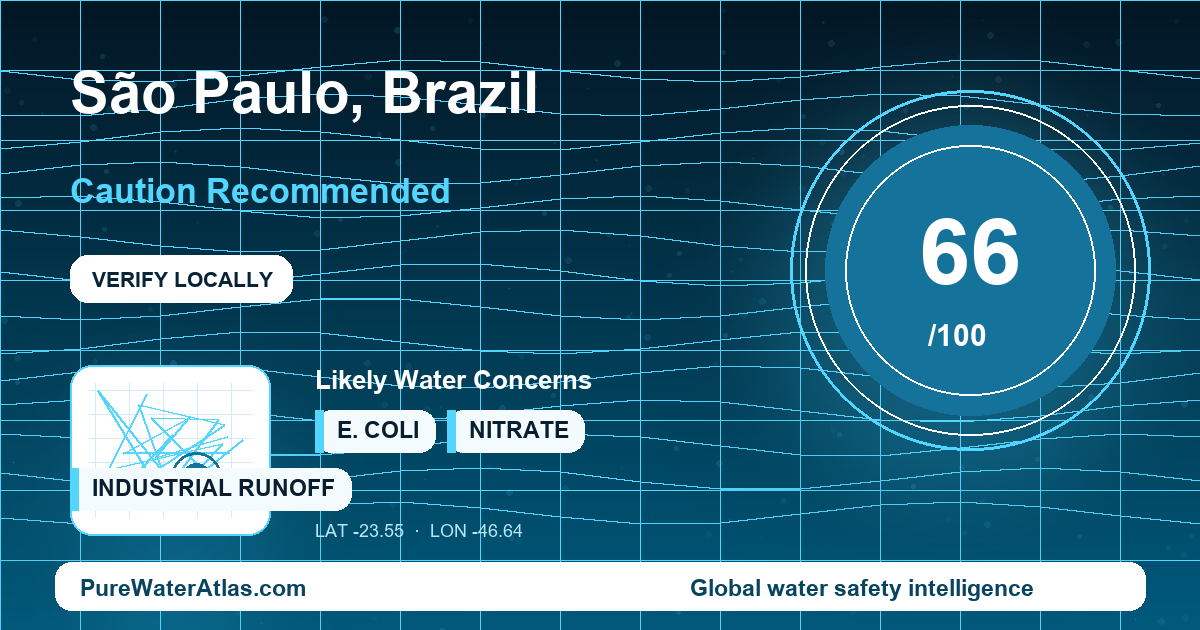
São Paulo’s tap water comes from one of Brazil’s largest integrated metropolitan systems, but traveler and household risk depends heavily on drought stress, reservoir quality, distribution interruptions, and building-level tanks or plumbing.
Quick Answer
| Overall safety status | Caution Recommended — PureWaterAtlas score: 66/100. São Paulo has regulated, professionally treated municipal water, but it is not a universally low-risk tap-water city because final tap quality can be affected by storage tanks, older internal plumbing, pressure changes, and localized events. |
|---|---|
| Can tourists drink it? | Short-stay visitors should use sealed bottled water or reliably filtered water for routine drinking, especially if they have a sensitive stomach. Tap water is usually acceptable for brushing teeth in formal hotels and reputable restaurants. |
| Resident guidance | Residents connected to Sabesp can generally treat the public supply as regulated, but should manage building-level risks: clean caixas d’água, maintain filters, flush stagnant taps, and test if persistent color, odor, turbidity, sediment, or metallic taste occurs. |
| Main water source | The Sabesp Integrated Metropolitan Water Supply System, using multiple systems including Cantareira, Alto Tietê, Guarapiranga, Rio Grande, Rio Claro, Alto Cotia, Baixo Cotia, and São Lourenço. |
| Water authority | Companhia de Saneamento Básico do Estado de São Paulo, Sabesp, with state regulation by ARSESP and national potable-water standards under Brazil’s Ministry of Health. |
| Filter recommendation | A certified point-of-use filter is a practical precaution in apartments, older buildings, rentals, and homes with taste, odor, sediment, or plumbing concerns. Choose activated carbon for chlorine taste and some organic compounds; choose a system certified for metals where older plumbing is suspected. |
Why São Paulo Is Different
São Paulo is not a coastal salinity-intrusion case. It is an inland megacity on the upper Tietê plateau, and its drinking-water challenges are tied to scale, urban watershed pressure, reservoir storage, treatment burden, drought vulnerability, and the “last meters” between the distribution network and the tap. The water leaving a large treatment plant may be more dependable than the water coming from an individual apartment, hotel bathroom, hostel, or older building if that building has a dirty storage tank, corroded internal pipes, stagnant branches, or intermittent pressure conditions.
The city’s rapid urban growth outgrew many local sources and increased dependence on large reservoir systems and inter-basin transfers. The Cantareira System became historically important because it transfers water from headwater reservoirs in the Piracicaba, Capivari, and Jundiaí river basins toward the metropolitan area. At the same time, urban source-water areas such as Guarapiranga and the Billings/Rio Grande complex remain important but vulnerable to dense development, sewage pressure, and land-use change.
The 2014 to 2015 drought and Cantareira water crisis showed why São Paulo’s tap-water safety cannot be judged only by treatment-plant capability. Reservoir levels, demand management, interconnections, and supply resilience matter. Sabesp has a large professional system, but the city’s risk profile is best described as caution recommended, not because of one single known toxic contaminant, but because multiple system and building-level factors can affect the water that finally reaches a glass.
Where Does São Paulo’s Tap Water Come From?
São Paulo is served by the Integrated Metropolitan Water Supply System managed mainly by Sabesp. Instead of one simple local river intake, the metropolitan region relies on a network of producer systems and reservoirs that can be rebalanced over time. A given address may not always receive water from the same raw-water system, especially as Sabesp manages demand, reservoir storage, and operational needs across the region.
Key systems serving the São Paulo Metropolitan Region include Cantareira, Alto Tietê, Guarapiranga, Rio Grande, Rio Claro, Alto Cotia, Baixo Cotia, and São Lourenço. Cantareira and the Guaraú water treatment plant have historically served a large share of metropolitan demand. The Guarapiranga reservoir and Alto da Boa Vista treatment infrastructure serve important parts of the city. Alto Tietê supports the eastern metropolitan area, Rio Grande draws from the Billings reservoir complex, and São Lourenço was added to increase supply resilience.
After treated water enters the distribution network, many São Paulo apartments, condominiums, hotels, and commercial buildings store water in building-level reservoirs or rooftop tanks, commonly called caixas d’água. These tanks are a major practical difference between regulated utility water and the water at an individual tap. A covered, routinely cleaned tank helps preserve water quality; an open, dirty, or poorly maintained tank can create avoidable microbial and sediment risks.
Who Manages Drinking Water in São Paulo?
The main water and sanitation utility for São Paulo is Sabesp, formally Companhia de Saneamento Básico do Estado de São Paulo. Sabesp operates the metropolitan supply infrastructure and publishes water-quality information, including annual reporting through its water quality information and reports. Its system descriptions also identify the metropolitan water supply systems that serve the wider region.
State-level regulation is performed by ARSESP, the São Paulo State Public Services Regulatory Agency. National drinking-water health standards are set by Brazil’s Ministry of Health under Portaria GM/MS 888/2021, with public-health surveillance linked to systems such as SISAGUA.
This regulatory framework matters, but it does not mean every individual tap in every apartment, hotel, rental, or older house has been directly verified. Public reporting is typically organized by municipality, system, or compliance program. It does not fully reveal private building plumbing, tank hygiene, filter maintenance, or short-lived events after repairs, flooding, or pressure changes. That limitation is central to São Paulo’s tap-water risk profile.
Main Local Water Concerns
São Paulo’s most important water concerns are practical and system-specific. Urban reservoir pressure is a major source-water issue, especially in catchments such as Guarapiranga and Billings/Rio Grande, where dense development, sewage pressure, informal settlement impacts, and land-use change can affect raw-water quality. State environmental and water-management authorities, including CETESB’s inland water quality publications and reports, provide important context for these pressures.
Drought and reservoir-level stress are also central. The Cantareira system is a nationally important water-resource system, and the 2014 to 2015 crisis, also discussed in World Bank documentation on the São Paulo water crisis, demonstrated how prolonged dry periods can strain supply security. Broader state water-security and watershed management context is provided by the São Paulo State Government water and environment authority.
Seasonal conditions matter. During the summer rainy season, runoff can increase turbidity, organic matter, and pollutant pulses in reservoirs, increasing the burden on treatment and sometimes affecting taste, odor, or chlorine demand. During dry periods or multi-year drought stress, lower storage can concentrate source-water quality problems. After heavy storms, localized distribution work, flooding, or pressure interruptions, residents should watch for official notices and visible changes in color, odor, or sediment.
At the household level, the key concerns are sediment or discolored water after repairs or tank disturbance, chlorine taste and odor, possible premise-plumbing metals risk in older buildings, and microbial risk from dirty caixas d’água, illegal cross-connections, or intermittent pressure conditions. Public city-level evidence is limited for emerging contaminants such as PFAS and microplastics at the final tap, so this guide does not claim neighborhood-level PFAS or microplastics results for São Paulo.
For Travelers
For most visitors, the conservative recommendation in São Paulo is to drink sealed bottled water, água mineral, or water from a reliable filter. The municipal supply is treated and regulated, but travelers usually cannot verify the condition of a hotel’s internal plumbing, hostel storage tank, rental apartment caixa d’água, or building maintenance schedule. This is especially relevant for people with sensitive stomachs or short trips where avoiding gastrointestinal disruption is the priority.
Brushing teeth with tap water is generally acceptable in formal hotels, serviced apartments, and reputable restaurants. If staying in low-cost, visibly poorly maintained, or uncertain accommodation, use bottled or filtered water for brushing as an extra precaution. Avoid making a habit of drinking directly from bathroom taps, especially in older buildings or rentals where the pipe route and tank condition are unknown.
Ice in established restaurants, hotels, cafes, and chains is usually lower risk because it is commonly made from treated or commercial water. Avoid ice from informal street vendors or places where water handling looks uncertain. In good hotels and restaurants, the issue is more likely to be chlorine taste, odor, or building maintenance than untreated raw water, but asking for água mineral remains the safest traveler default.
If you do use tap water, run it for 30 to 60 seconds when it has been stagnant, do not drink visibly cloudy or rusty water, and follow Sabesp or municipal health advisories after outages, flooding, or maintenance. If a boil-water notice applies, follow a reliable boiling protocol such as the PureWaterAtlas Boiling Water Purification: Complete Guide.
For Residents
For São Paulo residents connected to Sabesp, a home filter is not automatically required to make treated public water potable, but it is a sensible risk-reduction measure in many apartments, older buildings, and homes with taste, odor, or sediment complaints. A certified activated-carbon filter can improve chlorine taste and reduce some organic compounds. A system certified for lead or other metals is appropriate where old internal plumbing is suspected. Reverse osmosis is more comprehensive, but it requires careful maintenance and has water-waste considerations.
Test the kitchen tap if water has persistent color, metallic taste, sewage odor, unusual turbidity, or sediment after flushing. In older buildings, consider laboratory testing for lead and other metals, especially if infants, pregnant people, or young children drink the water. If any part of the property uses a private well or non-Sabesp source, test for microbiology, nitrate, turbidity, and basic chemistry; do not assume it matches regulated municipal water.
Older São Paulo buildings may have aging internal pipes, old fittings, solder, galvanized steel corrosion, or stagnant branch lines. Public utility reports describe the regulated distribution system; they do not prove the final quality after water passes through every private building’s plumbing. After tank cleaning, plumbing repairs, or long vacancy, flush lines and consider microbiological testing if odors, slime, or illness complaints occur.
Caixas d’água and condominium reservoirs deserve special attention. They should be covered, protected from insects and animals, and cleaned on a routine schedule by the owner, condominium, or building manager. A dirty or open storage tank can undermine otherwise treated water. Filter maintenance is also essential: an old or saturated filter can become a water-quality problem rather than a safeguard.
Relevant Contaminants and Water-Quality Issues
Several PureWaterAtlas contaminant profiles are especially relevant to São Paulo’s practical risk profile. Chlorine in Drinking Water is useful because chlorine residual and taste complaints can occur in treated municipal systems. Turbidity in Drinking Water helps explain rainy-season runoff, reservoir treatment burden, and visible cloudiness after pressure changes. Sediment in Drinking Water is relevant for building tanks, pipe disturbance, and discolored water events.
Microbial risk is not primarily a claim that Sabesp water is untreated; it is a concern when storage tanks, cross-connections, or pressure interruptions compromise the final tap. For that topic, see E. coli in Drinking Water and the broader Water Microbiology guide. For older buildings, Lead in Drinking Water and Lead in Drinking Water: Testing and Detection Methods are relevant, while avoiding unsupported neighborhood-level claims. For emerging-contaminant context, see PFAS in Drinking Water and PFAS in Drinking Water: Testing and Detection Methods.
How to Verify Your Water Quality
Start with official information from Sabesp and any building management records for tank cleaning or recent repairs. If your concern is at the household level, test the water at the tap you actually drink from, usually the kitchen tap. Use accredited laboratories where possible and compare results with current Brazilian Ministry of Health potable-water standards rather than informal internet thresholds.
PureWaterAtlas resources can help you decide what to test and how to interpret issues. The Water Testing guide explains testing strategy. The Drinking Water Safety guide provides general decision rules for whether tap water is safe to drink. The Water Purification guide can help choose filters or treatment methods, and the UV Water Purification: Complete Guide is useful for private wells or emergency microbial treatment, not as a replacement for maintaining storage tanks.
To research individual substances, use the Contaminants Search Engine. To compare São Paulo with other destinations, use the Global Water Quality Checker. Related PureWaterAtlas sections include Global Water Quality, Drinking Water Safety, Water Testing, and Water Treatment Systems.
Official and Technical Sources
- Sabesp official website — utility identity and service information for São Paulo.
- Sabesp water quality information and reports — utility water-quality reporting.
- Sabesp metropolitan water supply systems — description of the integrated metropolitan supply systems.
- ARSESP — state-level regulation of public water and sanitation services.
- Brazil Ministry of Health Portaria GM/MS 888/2021 — national potable-water regulatory framework.
- SISAGUA — Brazilian drinking-water quality surveillance information system.
- Brazil National Water and Sanitation Agency, Cantareira system information — Cantareira water-resource context.
- CETESB inland water quality publications and reports — source-water and reservoir-quality context.
- São Paulo State Government water and environment authority — broader water security and watershed-management context.
- World Bank documentation on the São Paulo water crisis — context for the 2014 to 2015 drought and supply crisis.
Bottom Line
São Paulo’s tap water is treated, regulated, and supplied by a large Sabesp metropolitan system, but the safest practical verdict is caution recommended. The city’s main issues are not seawater salinity or one confirmed citywide toxic contaminant; they are urban reservoir pressure, drought vulnerability, turbidity and taste/odor events, distribution interruptions, and building-level tanks or plumbing. Tourists should default to bottled or reliably filtered water for drinking, while using tap water for brushing teeth in formal hotels is generally acceptable. Residents should focus on the final tap: maintain filters, clean caixas d’água, flush stagnant lines, and test if persistent discoloration, odor, sediment, turbidity, or metallic taste appears.
Read the full guide: Global Water Quality Guide
Explore more in this category: Global Water Quality Articles