Hanoi has a large treated municipal water system, but drinking-water safety depends on the supplier, district network, building plumbing, storage tanks, and whether the water is filtered, boiled, or otherwise verified at the point of use.
Quick Answer
| City | Hanoi, Vietnam |
|---|---|
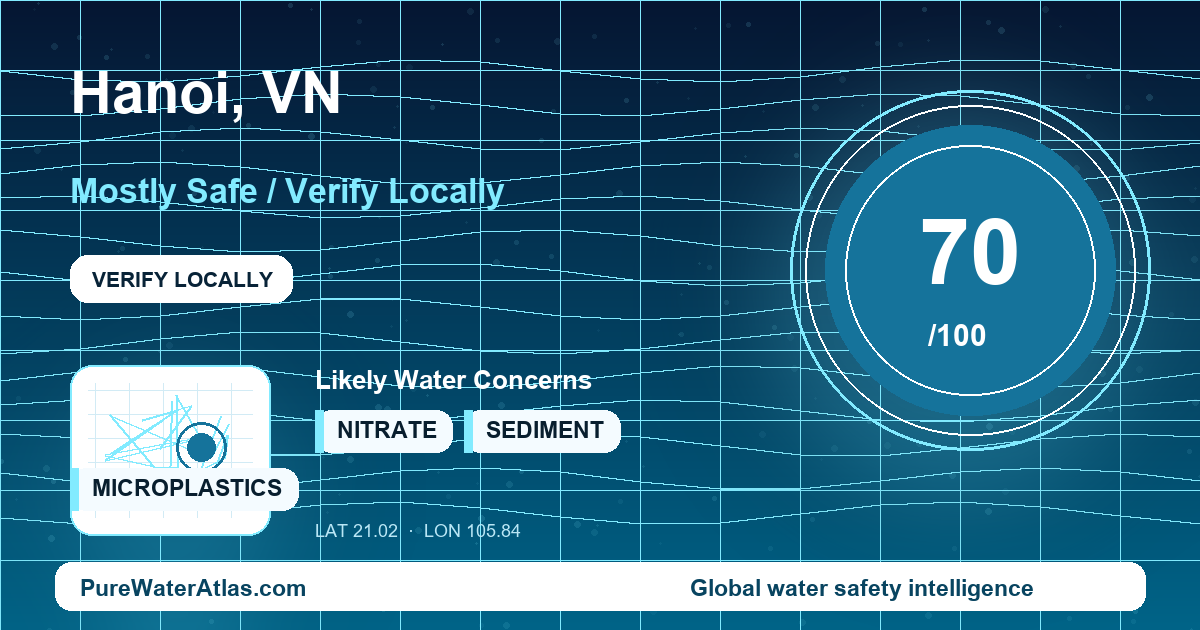
| PureWaterAtlas safety score | 70 / 100 |
| Risk level | Mostly Safe / Verify Locally |
| Can you drink the tap water? | Do not assume every Hanoi tap is safe to drink directly. Use sealed bottled water, properly boiled water, hotel-provided filtered water, or a maintained purifier unless you have recent confirmation for the specific building. |
| Traveler advice | Tap water is usually acceptable for showering and often for brushing teeth in higher-standard hotels, but sensitive travelers should use bottled or filtered water for brushing and drinking. |
| Resident advice | Municipal users should consider point-of-use treatment, maintain storage tanks, and test when water has odor, color, turbidity, low pressure, sediment, or comes from a private well. |
| Main water sources | Mixed supply: treated surface water from the Da River system, treated surface water from the Duong River, and groundwater wellfields from Red River delta aquifers. |
| Authorities and suppliers | Multiple utilities and suppliers operate in Hanoi, including HAWACOM, VIWACO, Song Da clean-water companies, and Duong River surface-water operators, with oversight involving the Hanoi People’s Committee, Hanoi Department of Construction, and Vietnam Ministry of Health regulations. |
| Filter recommendation | For drinking water, a practical Hanoi setup is sediment prefiltration plus activated carbon or reverse osmosis, selected according to municipal supply, building conditions, or private-well risk. Filter maintenance is essential. |
Why Hanoi Is Different
Hanoi is not a simple “safe” or “unsafe” tap-water city. It sits in the Red River delta, where drinking-water management has to account for river-water quality, flood-season turbidity, urban runoff, and groundwater chemistry. The city has a large treated municipal supply and is generally safer than untreated private wells, but the water that reaches a kitchen tap may have passed through several risk points after treatment.
The most important Hanoi-specific issue is the mixed nature of the supply. Parts of the city receive treated surface water from major systems such as the Da River and Duong River, while groundwater wellfields remain relevant in parts of the network and in some suburban or private supplies. Historically, Hanoi relied heavily on groundwater from alluvial aquifers beneath and around the city. Scientific work in the Red River delta and near Hanoi has documented arsenic risks in groundwater, along with iron, manganese, and ammonium concerns. These findings do not mean every treated municipal tap contains arsenic, but they do mean private wells and groundwater-based supplies should be tested rather than trusted by taste or clarity.
Another Hanoi-specific factor is building-level storage. Many homes, apartment blocks, hotels, and shops use rooftop or underground tanks. Water can leave a treatment plant in acceptable condition but change in quality because of internal pipes, stagnant plumbing, uncovered tanks, biofilm, insects, sediment, or cross-connections. This is why the cautious answer for Hanoi is building-specific: municipal treatment matters, but the last meters of plumbing and storage matter too.
Where Does Hanoi’s Tap Water Come From?
Hanoi uses a mixed drinking-water system. Important raw-water sources include treated surface water from the Da River system, treated surface water from the Duong River, and groundwater wellfields from Red River delta aquifers. The city has been shifting more of its supply toward large surface-water plants, while groundwater remains part of the broader supply picture in some areas and in certain suburban or private systems.
The consumer’s actual tap water may travel through a long chain: river or groundwater intake, treatment plant, transmission mains, district distribution network, service connection, building plumbing, and then rooftop or underground storage tanks. In Hanoi apartments, older houses, small hotels, and rented rooms, the final building plumbing and tank stage is often the most practical difference between “treated water supplied to the area” and “safe water at this tap.”
Key infrastructure includes Hanoi Water Limited Company, commonly known as HAWACOM, which is the main urban water utility for central Hanoi areas. The Song Da or Da River clean-water system supplies treated surface water to parts of the city through long transmission pipelines and distribution companies. The Duong River Surface Water Plant is another major surface-water treatment system serving Hanoi and surrounding areas. VIWACO and other companies distribute water in parts of the Hanoi service area, especially in southwestern urban districts. Because several suppliers and distributors are involved, water quality can vary by district, service zone, and building.
A major city-specific reminder is the 2019 Song Da water contamination incident, when waste oil dumped upstream affected the Da River water supply and caused odor and styrene concerns in parts of Hanoi. This incident does not prove routine contamination today, but it shows why source-water protection, public advisories, and local verification matter.
Who Manages Drinking Water in Hanoi?
Drinking-water supply in Hanoi is served by multiple utilities and suppliers rather than a single citywide tap-water identity. Relevant organizations include Hanoi Water Limited Company for central urban supply context, VIWACO for parts of the Hanoi distribution area, the Duong River Surface Water Plant, and Song Da clean-water companies supplying parts of the network.
Oversight and planning involve the Hanoi People’s Committee and the Hanoi Department of Construction. National public-health water quality standards are set by Vietnam’s Ministry of Health, including QCVN 01-1:2018/BYT, the national technical regulation for clean water used for domestic purposes.
The main data limitation is that recent, routine, address-level tap results for every Hanoi district, building, storage tank, and hotel are not consistently available in one public, English-accessible database. Public information is fragmented across suppliers and agencies. Conditions can also change after treatment because of service lines, tanks, pressure events, local repairs, and internal plumbing. For that reason, this profile gives a moderate-confidence city assessment, not a guarantee for any single tap.
Main Local Water Concerns
- Private wells and groundwater: Groundwater in the Red River delta can contain arsenic. Well users should test for arsenic rather than relying on clear appearance or normal taste.
- Iron, manganese, and ammonium: Groundwater in and around Hanoi can have elevated iron, manganese, and ammonium, which may cause staining, taste, odor, or treatment challenges.
- Building plumbing and repairs: Old internal plumbing, low pressure, intermittent supply, and pipe works can introduce sediment, brown water, or microbial risk after water leaves the treatment plant.
- Storage tanks: Rooftop and underground tanks can become contaminated if uncovered, cracked, poorly cleaned, or connected through backflow-prone plumbing.
- Surface-water vulnerability: Surface-water systems can be affected by upstream spills, algal or organic pollution, storm runoff, and rainy-season turbidity.
- Chlorine balance: Residual chlorine may be noticeable at the tap. Low chlorine at the far end of a building or after storage can increase microbial regrowth risk.
- Microbial indicators: If water has passed through questionable storage or plumbing, testing for E. coli and total coliform is important, especially before drinking directly.
Seasonal conditions can make these concerns more visible. Rainy-season storms can increase turbidity and runoff in rivers feeding treatment plants. Flooding or drainage problems can raise risks around wells, underground tanks, and damaged service lines. Hot weather can accelerate microbial growth in stagnant storage tanks and long building plumbing runs. After pipe works, pressure changes, or service interruptions, residents should flush, filter, and verify before drinking if water appears brown, cloudy, oily, or unusually odorous.
For Travelers
Tourists should not assume Hanoi tap water is drinkable directly from every hotel, apartment, homestay, restaurant, or bathroom tap. The safer approach is to use sealed bottled water, properly boiled water, hotel-provided filtered water, or a reputable purifier. Check that bottle caps are intact and carry water during hot weather.
For brushing teeth, tap water is usually a lower-risk exposure than drinking a full glass, and it is often acceptable in higher-standard hotels connected to treated municipal supply. However, travelers with sensitive stomachs, young children, pregnancy, or immune compromise should use bottled or filtered water for brushing. Use filtered water for infant formula.
Ice requires local judgment. Ice in reputable hotels, chain cafes, and busy restaurants is often commercially produced, but unknown crushed ice, street ice, or ice handled in unhygienic conditions should be avoided. When uncertain, choose sealed drinks or hot beverages.
Many Hanoi hotels provide bottled water, dispensers, or filtered water because direct tap drinking is not universally assumed safe. Ask whether the drinking water is filtered on-site, boiled, or bottled. Do not refill bottles from bathroom taps unless the hotel specifically confirms that the tap is intended for drinking. If tap water smells oily, chemical, musty, or strongly unusual, do not drink it even after boiling. Boiling can reduce microbial risk when done properly, but it does not remove metals, arsenic, solvents, or chemical contamination. For more detail, see the PureWaterAtlas Boiling Water Purification guide.
The U.S. CDC Vietnam Traveler View supports cautious food and water practices for visitors to Vietnam, which aligns with the practical recommendation for Hanoi: drink verified bottled, boiled, or filtered water rather than assuming every tap is safe.
For Residents
For most Hanoi residents, a home treatment step is prudent for drinking water, especially in apartments, older houses, and buildings with tanks. A sediment filter can reduce particles and visible debris. Activated carbon can improve chlorine taste and reduce some organic compounds. Reverse osmosis is often chosen where dissolved metals, nitrate, ammonium, or private-well uncertainty are concerns. A purifier that is not maintained can become a contamination source, so cartridges, membranes, storage reservoirs, and taps should be serviced on schedule.
If using a private well or any groundwater source, test for arsenic, iron, manganese, ammonium, nitrate, E. coli, total coliform, pH, turbidity, and conductivity or TDS. If connected to municipal supply but drinking directly or after a home filter, test at the kitchen tap for E. coli, total coliform, turbidity, pH, free chlorine residual, iron, manganese, and lead if older plumbing is possible.
Testing is especially important after moving into a new apartment, after major plumbing work, after flooding, after a long vacancy, or whenever water has unusual odor, taste, color, sediment, or an oil-like sheen. In buildings with rooftop or underground tanks, test both incoming water and water after the tank. This helps identify whether contamination is entering from the public supply or occurring inside the building.
Older buildings and renovated houses can have corroded internal pipes, dead-end plumbing, poorly sealed tanks, and unknown fittings. Do not assume the utility’s treated water quality is identical to the water at the kitchen tap. Flush stagnant water, maintain filters, and test when infants, pregnant people, or immunocompromised residents drink the water.
Storage tanks are a major practical risk point in Hanoi. Tanks should be covered, screened, cleaned regularly, protected from insects and runoff, and inspected for cracks, sediment, biofilm, and cross-connections. If a tank has not been cleaned or inspected, use filtered or boiled water for drinking and cooking until the system is verified.
Relevant Contaminants and Water-Quality Issues
The most relevant Hanoi water-quality issues are not limited to one contaminant. Building and network conditions make turbidity, sediment, and microbial indicators such as E. coli important for practical safety. Treated municipal water may contain a noticeable chlorine residual, while low residual after storage can increase regrowth concerns.
For groundwater and private wells, Hanoi’s Red River delta setting makes arsenic a priority testing issue. Iron, manganese, ammonium, and nitrate may also be relevant depending on the source. In older buildings, lead should be considered when plumbing materials are uncertain. For deeper background, see PureWaterAtlas guides on arsenic testing, lead testing, and nitrate testing.
How to Verify Your Water Quality
The best way to verify Hanoi tap water is to test the water you actually drink, not only the district supply. For households, the most useful sample is usually the kitchen tap after normal stagnation and after any building storage tank. If a purifier is used, test both before and after treatment to confirm whether the device is improving water quality.
Use an accredited local laboratory when results will guide health decisions. Home strips can help screen for some parameters but should not be used to confirm arsenic, lead, or microbiological safety. If water smells oily, chemical, musty, or unusually strong, stop using it for drinking and cooking until the source is identified.
PureWaterAtlas resources that can help include the complete water testing guide, the Global Water Quality Checker, and the Contaminants Search Engine. For broader background, see Drinking Water Safety, Water Microbiology, Water Treatment Systems, and Water Contamination. UV systems may be relevant for microbial control in some homes, but they require suitable pretreatment and maintenance; see the UV Water Purification guide.
Official and Technical Sources
- Hanoi Water Limited Company official website — HAWACOM, main municipal water utility context for central Hanoi.
- Hanoi Department of Construction official website — local government infrastructure and water-supply management context.
- Duong River Surface Water Plant official website — official source for one of Hanoi’s major surface-water treatment systems.
- VIWACO official website — distributor serving parts of Hanoi, including areas associated with Da River clean-water supply.
- QCVN 01-1:2018/BYT — Vietnam Ministry of Health national technical regulation for clean water used for domestic purposes.
- Vietnam Traveler View — U.S. Centers for Disease Control and Prevention traveler health guidance.
- Reuters report on the 2019 Hanoi Song Da oil contamination incident — city-specific source-water incident context.
- Arsenic contamination of groundwater and drinking water in Vietnam — peer-reviewed evidence relevant to groundwater caution.
- Arsenic pollution of groundwater in Vietnam exacerbated by deep aquifer exploitation — peer-reviewed study near Hanoi supporting groundwater testing concerns.
Bottom Line
Hanoi tap water should be treated as mostly safe only when the specific source, building plumbing, storage tanks, and point-of-use treatment are known. The city has major treated municipal systems, including Da River and Duong River surface-water supplies and groundwater-based sources, but conditions vary across suppliers, districts, apartment buildings, hotels, and tanks. Tourists should drink sealed bottled, properly boiled, or verified filtered water rather than relying on bathroom or kitchen taps. Residents can often use municipal tap water after sensible treatment, tank maintenance, and periodic testing. Private wells require special caution because Red River delta groundwater can contain arsenic and other chemistry concerns. For Hanoi, the practical rule is simple: treated supply is a good start, but verify the water at the tap you actually drink.
Read the full guide: Global Water Quality Guide
Explore more in this category: Global Water Quality Articles