
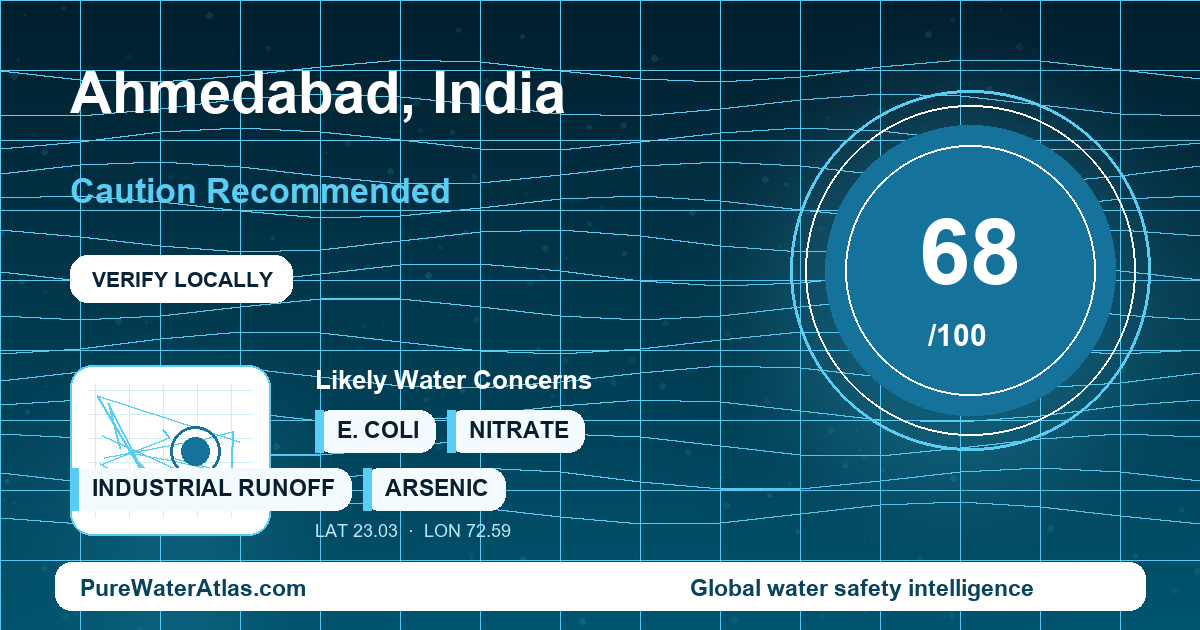
Ahmedabad has a major treated municipal supply linked strongly to Narmada canal water, but direct drinking from the tap deserves caution because consumer-end safety can change after treatment through intermittent pressure, old pipes, building tanks, and possible borewell mixing.
Quick Answer
| Overall safety status | Caution Recommended — PureWaterAtlas water safety score: 68/100. |
|---|---|
| Can tourists drink the tap water? | Not recommended without treatment. Visitors should use sealed bottled water, hotel-provided purified water, or tap water that has been boiled, disinfected, or treated by a reliable purifier. |
| Resident guidance | Ahmedabad Municipal Corporation water is intended to be potable after treatment, but many homes should still use a maintained point-of-use purifier or boil water during monsoon, low-pressure periods, repairs, cloudy water events, or when storage-tank hygiene is uncertain. |
| Main water source | Primarily treated surface water, with major dependence on Narmada canal-linked supply and municipal treatment and distribution infrastructure. |
| Water authority | Ahmedabad Municipal Corporation, with state-level water-resource and bulk-water functions connected to Gujarat water agencies. |
| Filter recommendation | Sediment prefiltration plus activated carbon and UV is useful for many homes; RO should be selected based on testing, especially where TDS, salinity, nitrate, fluoride, or groundwater mixing is a concern. |
Why Ahmedabad Is Different
Ahmedabad is an inland, semi-arid city on the Sabarmati River in Gujarat. Its drinking-water story is shaped by high urban demand, a hot dry season, monsoon conditions, surrounding industrial activity, and a large municipal system that now relies heavily on imported surface water. The key question is not whether Ahmedabad has treatment infrastructure; it does. The more practical question is what happens between the treatment works and the glass.
The city has shifted substantially toward Narmada-linked supply, reducing dependence on stressed local groundwater and unreliable local river flow. Historically, Ahmedabad depended more on the Sabarmati River, local surface sources, wells, and groundwater. Today, the Sabarmati is a highly regulated urban river reach, and regional concerns about sewage load, industrial discharge, seasonal flow variability, and urbanization help explain why source-water management remains important.
For residents and visitors, however, the most immediate issue is often last-mile reliability. Water may leave treatment facilities in better condition than it reaches a consumer tap. Intermittent supply, pressure changes, leakage, cross-connections, pipe repairs, and private underground or overhead storage tanks can all affect quality. In many Ahmedabad buildings, the actual drinking water is not simply “municipal water”; it is municipal water after it has passed through neighborhood pipes, local storage, booster pumping, and internal plumbing.
Where Does Ahmedabad’s Tap Water Come From?
Ahmedabad’s public supply is primarily a surface-water system operated through Ahmedabad Municipal Corporation infrastructure. The modern system has major dependence on Narmada canal water brought to city treatment works. Kotarpur water works and associated Narmada canal-linked supply infrastructure are widely referenced as a major component of the city’s current municipal water system.
The broader network includes treatment plants, pumping stations, trunk mains, distribution reservoirs, and ward-level distribution systems. Older water works and distribution assets still serve established parts of the city, including central and eastern zones. These assets matter because pipe age, leakage, and intermittent pressure can influence consumer-tap quality even when treatment is functioning.
Private building infrastructure is also a major part of Ahmedabad’s drinking-water pathway. Apartment underground sumps, rooftop tanks, overhead tanks, internal pipelines, and booster pumps are common. A clean, chlorinated municipal supply can become unsafe if a building tank is open, cracked, poorly covered, contaminated by insects or animals, or not cleaned and disinfected regularly.
Who Manages Drinking Water in Ahmedabad?
Ahmedabad Municipal Corporation is the primary urban local body responsible for municipal water supply and sewerage services within the city. State-level water-resource and bulk-water functions are connected to Gujarat’s Narmada, Water Resources, Water Supply and Kalpsar Department and related agencies, including Narmada-linked regional infrastructure.
In India, municipal drinking-water quality is generally benchmarked against Bureau of Indian Standards IS 10500 drinking-water specifications and public-health guidance. Monitoring roles may involve municipal, state, and national institutions, but India does not publish consumer confidence reports in the same standardized public format used in some countries. For Ahmedabad, the institutional picture and general source-water system are well documented, but recent public, ward-level consumer-tap data for microbiology, residual chlorine, metals, turbidity, and disinfection by-products are limited in easily accessible official sources.
This data limitation is important. It would be misleading to claim that every Ahmedabad neighborhood is safe or unsafe. Actual tap quality can vary by ward, season, building plumbing, storage-tank maintenance, local repairs, pressure conditions, and whether borewell water is mixed with municipal water.
Main Local Water Concerns
- Microbial contamination at the consumer end: The main practical risk is recontamination after treatment, especially during low-pressure supply, pipe breaks, flooding, cross-connections, or poorly maintained building tanks.
- Turbidity and sediment: Cloudiness or sediment can occur during monsoon runoff, source-water changes, distribution disturbances, or pipe repair work. Cloudy water should not be treated as normal drinking water until properly addressed.
- Residual chlorine issues: Chlorine is used to protect water through the distribution system and can create taste or odor complaints. At the same time, absence of residual chlorine at the tap can be a warning sign in high-risk buildings or long distribution paths.
- Groundwater-related risks: In and around Ahmedabad district, groundwater can be affected in some locations by salinity, high total dissolved solids, nitrate, fluoride, and urban or industrial contamination. This is most relevant where borewell water is used directly or mixed with municipal supply.
- Sabarmati basin pollution context: Industrial and sewage pollution in the Sabarmati River system is a documented regional concern, especially downstream of urban and industrial areas. This is an environmental and source-water concern, not proof that every treated municipal tap is contaminated.
- Old plumbing: Older buildings may have aging galvanized iron lines, corroded pipes, or legacy plumbing materials. Lead should not be assumed citywide without testing, but older plumbing can contribute rust, sediment, metallic taste, and metals at the tap.
Season matters. Monsoon can increase turbidity, runoff, sewer-overflow risk, and contamination risk where distribution pipes or tanks are compromised. Summer heat increases demand and can worsen storage-tank hygiene problems. After pipeline repairs, flooding, construction, or local complaints of cloudy water, residents should flush taps and use boiled or properly filtered water until clarity and disinfection are restored.
For Travelers
Most travelers should not drink ordinary Ahmedabad tap water unless it has been boiled, disinfected, or treated by a reliable purification system. Use sealed bottled water or hotel-provided purified water, especially during short visits when your stomach is not adapted to local microbial exposures and when you cannot inspect building tanks or plumbing.
For brushing teeth, conservative travelers should use bottled, boiled, or filtered water. This is especially important for people with sensitive stomachs, immunocompromised travelers, and anyone staying in budget accommodation where storage-tank hygiene is uncertain. Many long-term residents may use tap water for brushing, but traveler risk tolerance should be lower.
Avoid ice from street vendors and small venues unless you know it is made from purified water. In higher-end hotels and restaurants, ask whether ice is made from treated or packaged water. Do not assume a jug of water is safe unless the venue can explain its filtration and storage practices.
During hot weather, carry sealed water and check bottle caps for tampering. Use bottled or boiled water for oral rehydration solutions. Avoid drinking from bathroom taps, unknown public taps, or taps connected to uncertain storage systems. If tap water must be used, bring it to a rolling boil and store it in a clean, covered container. PureWaterAtlas also provides a practical guide to boiling water for purification.
For Residents
Residents connected to Ahmedabad Municipal Corporation supply can generally treat their water as a municipal source designed to be potable after treatment, but that does not remove the need for point-of-use caution. A home purifier is advisable for many Ahmedabad households, particularly apartment buildings, older homes, homes using storage tanks, and homes that mix borewell water with municipal water.
A sensible treatment approach often starts with sediment prefiltration to protect downstream equipment and reduce visible particles. Activated carbon can help with chlorine taste and some odor issues. UV can be useful for microbial risk when water is clear enough and the system is properly maintained; PureWaterAtlas has a detailed guide to UV water purification. RO should not be chosen blindly for every home because it wastes water and can remove minerals. It is most justified when testing shows elevated TDS, salinity, nitrate, fluoride, or specific dissolved contaminants.
Testing should be done at the point of use, not only at the building inlet, because storage tanks and internal plumbing can change water quality. At minimum, consider E. coli or thermotolerant coliforms, total coliforms, turbidity, pH, TDS, residual chlorine, hardness, nitrate, fluoride, chloride, iron, and manganese. Homes using borewell or mixed supply should include nitrate, fluoride, chloride, sulfate, total dissolved solids, and metals relevant to local geology and nearby industry.
Older buildings deserve extra attention. If plumbing materials are uncertain, test first-draw and flushed samples for lead and other metals rather than assuming the risk is absent. Flush stagnant taps, inspect old pipes, and be especially cautious where water is used for infants, pregnant people, or children.
Storage tanks are one of the most important Ahmedabad-specific last-mile risks. Underground and overhead tanks should be tightly covered, screened against insects and animals, cleaned and disinfected on a routine schedule, and inspected after monsoon flooding or construction work. If tank hygiene is uncertain, boil or properly filter water used for drinking.
Relevant Contaminants and Water-Quality Issues
The most relevant Ahmedabad concerns are microbial safety, turbidity, residual chlorine, groundwater chemistry where borewells are involved, and possible metals from older plumbing. For microbial risk from storage tanks, low-pressure distribution, and post-treatment contamination, see E. coli in Drinking Water. For cloudy water, sediment, and monsoon or pipe-disturbance events, see Turbidity in Drinking Water.
Chlorine deserves balanced interpretation in Ahmedabad. A chlorine smell can be unpleasant, but residual chlorine helps protect water in the network. Learn more at Chlorine in Drinking Water. In older buildings, lead risk should be evaluated by testing rather than assumed; see Lead in Drinking Water and Lead in Drinking Water: Testing and Detection Methods. Where borewell or mixed water is used, Nitrate in Drinking Water and nitrate testing guidance are especially relevant.
How to Verify Your Water Quality
The best way to evaluate Ahmedabad tap water is to test the water you actually drink: the kitchen tap after the building tank and internal plumbing. Quick home strips can screen TDS, chlorine, pH, and hardness, but they are not a substitute for microbiological testing. Use an accredited laboratory where possible, especially for E. coli, total coliforms, nitrate, fluoride, and metals.
Retest after major plumbing work, flooding, long vacancy, repeated stomach illness in the household, persistent taste or odor changes, visible sediment, or repeated cloudy-water events. Ahmedabad’s variable last-mile conditions make one-time building-inlet results less useful than point-of-use results.
For broader guidance, use the PureWaterAtlas Water Testing guide, the Drinking Water Safety framework, and the Water Microbiology guide. To choose between sediment, carbon, UV, and RO systems, see Water Treatment Systems. You can also compare city-level risk with the Global Water Quality Checker and research individual contaminants using the Contaminants Search Engine.
Official and Technical Sources
- Ahmedabad Municipal Corporation official website — primary local authority for municipal services, including water supply and sewerage.
- Narmada, Water Resources, Water Supply and Kalpsar Department — Gujarat state authority relevant to water resources and bulk water planning.
- Sardar Sarovar Narmada Nigam Limited — official source for the Sardar Sarovar and Narmada canal system.
- Central Ground Water Board — national source for groundwater status and quality issues such as salinity, fluoride, nitrate, and over-extraction.
- Gujarat Pollution Control Board — state authority relevant to Sabarmati basin water quality and industrial pollution control.
- Central Pollution Control Board water quality monitoring — national surface-water monitoring and polluted river stretch information.
- Bureau of Indian Standards — drinking-water specification benchmark IS 10500.
- Water Quality Management Information System — Government of India platform related to drinking-water quality monitoring and laboratory systems.
- CDC India traveler advice — traveler health guidance supporting conservative water and ice precautions.
- WHO Guidelines for Drinking-water Quality — international reference for microbial safety, chemical risk, and household treatment principles.
Bottom Line
Ahmedabad’s tap water comes from a large treated municipal system with major Narmada-linked surface-water supply, so the city is not comparable to a place without organized treatment. The reason for caution is last-mile reliability: intermittent pressure, older distribution assets, private underground and overhead tanks, internal plumbing, monsoon turbidity, and possible borewell mixing can change water quality before it reaches the tap. Tourists should use sealed bottled, boiled, or reliably purified water and avoid uncertain ice. Residents should maintain storage tanks, test point-of-use water, and choose filtration based on actual results. For many homes, sediment filtration, carbon, and UV are sensible; RO is best reserved for tested dissolved-contaminant problems such as high TDS, salinity, nitrate, or fluoride.
Read the full guide: Global Water Quality Guide
Explore more in this category: Global Water Quality Articles