Qingdao has a treated municipal water supply supported by major inter-basin transfer infrastructure, but direct-from-tap drinking should still be verified at the building level.
Quick Answer
| City | Qingdao, China |
|---|---|
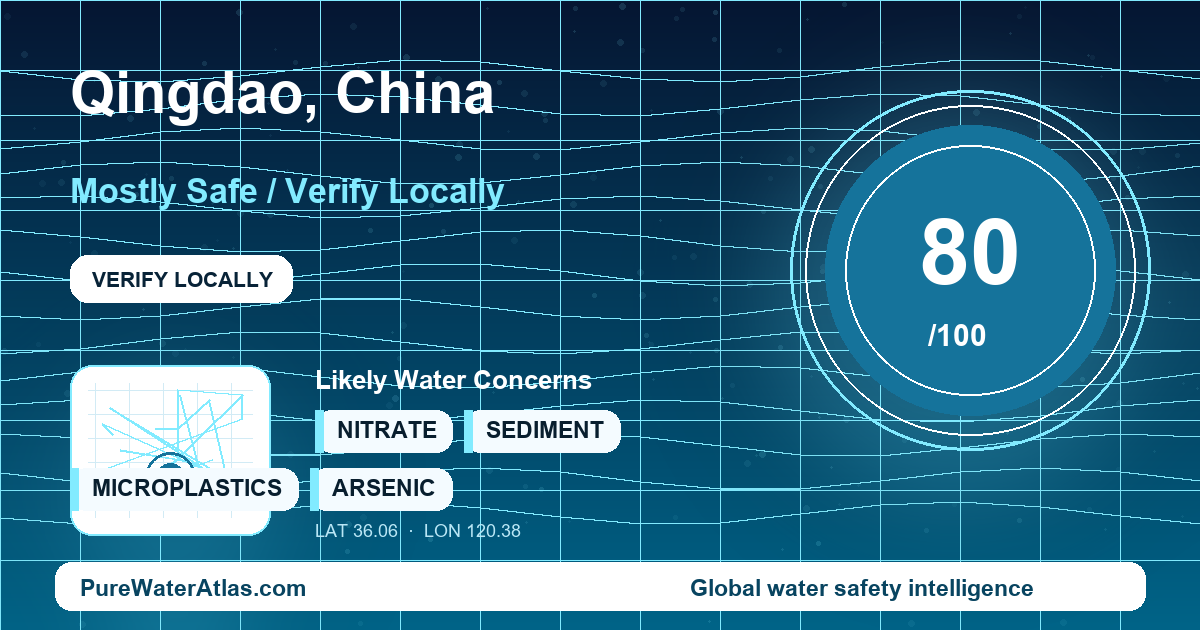
| Water safety score | 80 / 100 |
| Risk level | Mostly Safe / Verify Locally |
| Is tap water safe to drink? | Qingdao municipal tap water is treated and generally suitable for normal domestic use, brushing teeth, washing food, and boiling. For routine direct drinking from the tap, use a cautious approach because final water quality can depend on building plumbing, secondary storage tanks, and local distribution conditions. |
| Traveler advice | Use bottled water, boiled tap water, or verified hotel-filtered water for drinking. Tap water is generally acceptable for brushing teeth in urban hotels if it is clear and odor is normal. |
| Resident advice | Municipal supply can generally be relied on as treated public water, but residents should verify older buildings, rooftop tanks, secondary pressurization systems, and any repeated discoloration, sediment, or unusual taste. |
| Main water system | Mixed raw-water supply, including Yellow River water delivered through the Yellow River-to-Qingdao diversion system and regulated through Jihongtan Reservoir, plus regional transfer water and local reservoirs where available. |
| Water authority | Qingdao Water Group Co., Ltd., with oversight involving Qingdao Municipal Water Affairs Management Bureau and health authorities responsible for drinking-water hygiene monitoring. |
| Filter recommendation | A filter is not automatically required for every household, but activated carbon can improve chlorine taste and odor, while reverse osmosis may be chosen for broader reduction of dissolved contaminants when properly maintained. |
Why Qingdao Is Different
Qingdao is not a city whose drinking-water story can be explained by a single nearby river or a simple local groundwater system. It sits on the Shandong Peninsula on the Yellow Sea, with a large port, dense urban districts, tourism demand, and limited local freshwater availability compared with demand. That coastal geography makes water supply more infrastructure-dependent than in cities with abundant local river flow.
The defining feature of Qingdao’s drinking-water security is its reliance on transferred raw water. The city uses a mixed supply that includes external water transferred from the Yellow River through the Yellow River-to-Qingdao diversion system, commonly known in Chinese as Yinhuang Ji Qing. Jihongtan Reservoir functions as a major regulating reservoir for transferred raw water. Local reservoirs, including Laoshan Reservoir and other municipal source-water reservoirs, also form part of the broader supply mix where available.
This matters for everyday water safety because Qingdao’s tap water begins as part of a regional engineered system, is treated by municipal facilities, then moves through distribution pipes and, in many high-rise or multi-unit buildings, secondary supply equipment such as pumps, tanks, and building-level reservoirs. A sample leaving a treatment plant is not always identical to water coming from an old apartment tap after passing through many kilometers of pipework and internal plumbing.
Where Does Qingdao’s Tap Water Come From?
Qingdao is a water-scarce coastal city with a mixed raw-water system. A major component is transferred Yellow River water delivered through the Yellow River-to-Qingdao diversion system and regulated through Jihongtan Reservoir. The city also uses other regional transfer connections associated with Shandong and Jiaodong water allocation systems, along with local reservoirs in the Qingdao area where available.
Historically, Qingdao relied more heavily on local surface-water reservoirs and local groundwater for the urban area. Rapid urban growth, limited local runoff, drought pressure, and the city’s coastal setting made those local sources insufficient as a long-term foundation for urban and industrial demand. The Yellow River-to-Qingdao diversion project therefore became a defining water-security project for the city.
Because this system depends on long-distance transfer, reservoir regulation, treatment plants, distribution pressure management, and building-level infrastructure, Qingdao’s practical drinking-water risk is not just a source-water question. It is also a distribution and building-maintenance question. Source blending may change during dry periods, summer demand, or regional water-allocation conditions. Heavy rain and typhoon-season storms can increase raw-water turbidity and runoff into reservoirs or waterways, requiring treatment and monitoring rather than assumptions that all source water is pristine.
Who Manages Drinking Water in Qingdao?
The municipal water-supply enterprise identified for Qingdao is Qingdao Water Group Co., Ltd.. Public oversight involves the Qingdao Municipal Water Affairs Management Bureau and health authorities responsible for drinking-water hygiene monitoring. Qingdao municipal information is also available through the Qingdao Municipal Government official portal.
Urban drinking water in Qingdao is expected to be managed under China’s national drinking-water quality standard GB 5749. The National Standard Information Public Service Platform is the official standards access point, while the National Health Commission of the People’s Republic of China is relevant to national public-health and drinking-water hygiene policy. Broader water-resources context is provided by the Shandong Provincial Department of Water Resources and the Ministry of Water Resources of the People’s Republic of China.
Data availability is a limitation. Official Chinese-language sources identify Qingdao’s water-management institutions and source-water context, including the importance of transferred water and Jihongtan Reservoir. However, current tap-by-tap results, district-level residual disinfectant patterns, building-tank maintenance records, and English-language consumer-confidence-style reports are limited. This profile therefore does not claim that every Qingdao tap, building, or neighborhood is verified as compliant at all times.
Main Local Water Concerns
Qingdao’s most important local concern is not evidence of a citywide acute water emergency. The practical issue is the gap between treated municipal water and the water that may emerge from a specific tap after distribution and building-level storage. This is especially relevant in older apartments, high-rise buildings, and properties using secondary pressurization systems, rooftop tanks, underground tanks, or building reservoirs.
- Transferred-water dependence: Qingdao’s supply security is sensitive to regional drought, water-allocation decisions, and transfer-infrastructure performance because the city relies heavily on external raw-water systems.
- Taste and odor: Chlorination, source-water changes, or distribution stagnation can produce taste and odor complaints even when water is treated.
- Turbidity and sediment: Pipe work, pressure changes, heavy rainfall, or local distribution disturbance can temporarily mobilize particles or cause visible discoloration.
- Building-level plumbing risk: Old internal pipes, poorly maintained tanks, stagnant plumbing, open vents, cross-connections, and secondary supply equipment can affect tap-level quality.
- Coastal water-resource pressure: Groundwater salinity and seawater-intrusion concerns are relevant to regional water resources, although core urban municipal drinking water is treated and is not simply untreated coastal groundwater.
- Runoff pressure: Agricultural and urban runoff in catchments and reservoirs makes treatment and monitoring important for mixed source-water systems.
Season also matters. Summer tourism increases demand in coastal districts and hotels. Heavy rain and typhoon-season storms can increase raw-water turbidity and runoff. Dry periods can increase dependence on transferred water and may affect source blending. Warmer months can increase biological activity in reservoirs and distribution systems, making disinfectant management more important. Cold-season pipe repairs or pressure changes can temporarily disturb sediment in local pipes.
For Travelers
Visitors should treat Qingdao tap water as mostly safe for brushing teeth and hot drinks after boiling, but should use bottled water, boiled water, or verified hotel-filtered water for routine drinking. This is conservative traveler advice, not evidence that the entire city supply is unsafe. It reflects the common practical reality in China: many residents and hotels still boil tap water or provide bottled water because final safety depends partly on building plumbing and storage.
For brushing teeth, tap water is generally acceptable in urban hotels and serviced apartments connected to the municipal supply. If the water is visibly discolored, has particles, smells unusual, or the building posts a storage-tank warning, use bottled water until the issue is resolved.
Ice is a higher-uncertainty item. Ice from reputable hotels, major restaurants, and chains is usually lower risk if made from treated or filtered water. Avoid ice from street vendors or small venues where the water source and ice handling are unclear.
Most Qingdao hotels provide electric kettles and bottled water. Hot tea, coffee, and boiled-water service are safer choices than drinking cold tap water directly. If a hotel offers a drinking-water dispenser, ask whether it is filtered and maintained. For a short stay, the simplest low-risk routine is bottled water for drinking, tap water for washing and brushing, and boiled tap water for tea or coffee.
Travelers with sensitive stomachs, infants, pregnancy-related caution, or immune compromise should be stricter: use sealed bottled water or properly boiled water for drinking and preparing infant formula unless a reliable potable filtered source is clearly provided.
For Residents
Residents connected to Qingdao’s municipal system can generally regard the supply as treated public water, but household-level decisions should account for the building. A home filter is not automatically required for every Qingdao household. It is reasonable, however, for taste, chlorine odor, sediment reduction, and building-plumbing risk management.
For drinking water, a certified activated-carbon filter can improve taste and reduce chlorine odor. Reverse osmosis is a stronger option for residents who want broader reduction of dissolved contaminants, but it must be maintained correctly. Some households may prefer remineralization after reverse osmosis for taste. Poorly maintained filters can create their own problems, so replacement schedules matter.
Older buildings deserve special attention. Internal pipes, fixtures, solder, valves, or storage systems may not be reflected in treatment-plant data. If the first water in the morning is yellow, brown, metallic, or particle-laden, do not use it for drinking until flushed and investigated. Flush cold taps until clear after pipe repairs, pressure interruptions, or visible discoloration. Avoid drinking hot tap water from building systems.
High-rise and multi-unit buildings may use secondary pressurization, rooftop tanks, underground tanks, or building reservoirs. Poor cleaning, open vents, cross-connections, or long stagnation can create microbial and sediment risk even when the municipal supply entering the building is properly treated. Residents should ask building management for cleaning and disinfection records for secondary water-supply tanks.
Relevant Contaminants and Water-Quality Issues
The most relevant Qingdao water-quality issues are tied to treated municipal supply, distribution conditions, source-water variability, and building systems. Chlorine is relevant because it is commonly associated with disinfectant taste and odor in treated municipal water. Turbidity matters after storms, pipe work, reservoir changes, or sediment disturbance. Sediment is particularly relevant in old building pipes and after pressure changes.
Lead should be understood as a building-level plumbing concern rather than a confirmed citywide Qingdao contaminant in this dataset. Testing is most relevant in older properties or where first-draw water has metallic taste or discoloration. Nitrate is relevant as a screening concern in agricultural and watershed runoff contexts. E. coli is important for verifying microbiological safety where storage tanks, stagnant plumbing, or secondary supply systems are suspected.
For broader context, see PureWaterAtlas guides to boiling water purification, lead testing and detection, nitrate testing, and UV water purification.
How to Verify Your Water Quality
The best way to verify Qingdao tap water is to separate city-level treatment questions from building-level tap questions. If you live in an older building or suspect old internal pipes, test both first-draw and flushed samples. Metals risk is often plumbing-specific. If the concern is repeated taste, odor, sediment, or stomach illness, consider testing for turbidity, residual chlorine, coliform or E. coli indicators, lead, iron, manganese, nitrate, total dissolved solids, and general chemistry.
Use an accredited local laboratory or official health-related testing channel when results matter. Inexpensive color-strip kits can be useful for rough screening, but they should not be relied on alone for microbiology or metals decisions. If your building uses secondary tanks, request maintenance records from property management, including cleaning and disinfection history.
PureWaterAtlas resources that may help include the complete guide to water testing, the drinking water safety guide, and the water treatment systems guide. You can also compare Qingdao with other locations using the Global Water Quality Checker, browse the Global Water Quality hub, or look up individual substances in the Contaminants Search Engine.
Official and Technical Sources
- Qingdao Water Group Co., Ltd. — local water-supply enterprise for service notices, water-supply operations, and utility context.
- Qingdao Municipal Water Affairs Management Bureau — municipal authority for water resources, supply management, reservoir information, and water-affairs policy.
- Qingdao Municipal Government official portal — official city notices and departmental information disclosure.
- Shandong Provincial Department of Water Resources — provincial context for water resources, diversion projects, drought management, and allocation affecting Qingdao.
- Ministry of Water Resources of the People’s Republic of China — national context for water resources, inter-basin transfer, drought, and conservation policy.
- National Health Commission of the People’s Republic of China — national public-health authority associated with drinking-water hygiene policy.
- National Standard Information Public Service Platform — official access point for Chinese national standards, including GB 5749.
- WHO Guidelines for Drinking-water Quality — international reference for interpreting microbial and chemical drinking-water risks.
Bottom Line
Qingdao’s tap water comes from a modern, treated municipal system supported by important regional transfer infrastructure, especially the Yellow River-to-Qingdao diversion system and Jihongtan Reservoir. For everyday use, brushing teeth, washing food, and boiling, it is generally suitable in urban areas connected to municipal supply. For direct drinking, the safer recommendation is to verify locally: use bottled, boiled, or reliably filtered water unless you know your building’s plumbing and storage systems are well maintained. Residents should pay special attention to old pipes, rooftop or secondary tanks, discoloration, sediment, chlorine taste, and pressure interruptions. The city-level risk is moderate-low, but tap-level quality can vary by building.
Read the full guide: Global Water Quality Guide
Explore more in this category: Global Water Quality Articles