
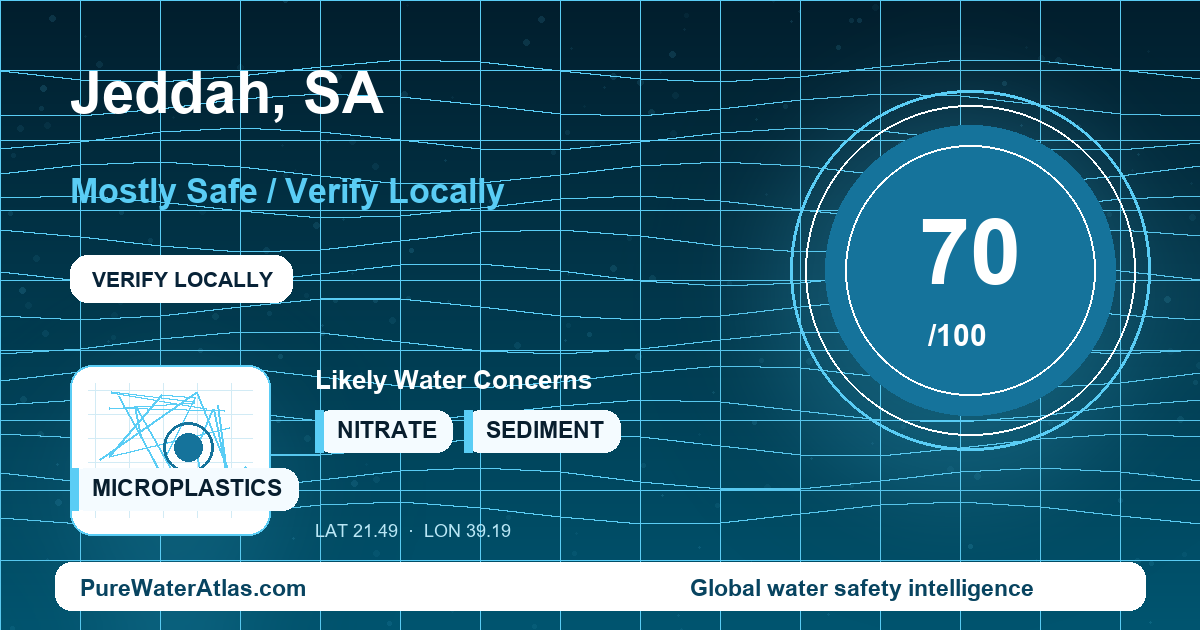
Jeddah’s drinking water is largely desalinated Red Sea water delivered through Saudi Arabia’s modern water system, but the real tap-water decision depends heavily on building tanks, pumps, plumbing, and recent local service conditions.
Quick Answer
| Overall tap-water status | Mostly Safe / Verify Locally — water safety score: 70/100. Jeddah’s municipal supply is generally treated, but quality at the tap can change after water enters building storage tanks and internal plumbing. |
|---|---|
| Can travelers drink it? | In reputable hotels or modern serviced apartments, tap water is usually treated municipal water, but bottled water is the lower-friction choice for short stays because it avoids uncertainty from building tanks. |
| Resident advice | Focus on the last mile: clean storage tanks, maintained pumps, internal pipes, and testing at the kitchen tap if there are particles, discoloration, illness concerns, old plumbing, or vulnerable residents. |
| Main water source | Desalinated Red Sea water, supported by large desalination and transmission infrastructure serving Jeddah and the wider Makkah region. |
| Main authority | The National Water Company is the main customer-facing utility for Jeddah; national oversight involves Saudi water-sector bodies including the Saudi Water Authority, Water Regulator, and Ministry of Environment, Water and Agriculture. |
| Filter recommendation | A filter is not automatically required for every home, but a sediment prefilter plus activated carbon is often useful for particles and chlorine taste. Reverse osmosis may help with dissolved-mineral taste but must be maintained carefully. |
Why Jeddah Is Different
Jeddah is not a city where the drinking-water story begins with a river or a large natural freshwater lake. It sits on Saudi Arabia’s Red Sea coast in an arid climate with very limited renewable local freshwater. That makes Jeddah’s tap-water identity strongly tied to engineered water supply, especially desalination, transmission pipelines, pumping systems, strategic storage, and building-level tanks.
The practical safety question in Jeddah is therefore different from the question in many inland cities. The desalinated water produced for the public system is treated, stabilized, and disinfected before distribution. However, many residents and visitors do not drink water directly from the public network. They receive it after it has moved through a building’s underground or rooftop storage tank, pump room, internal pipework, and fixtures. In Jeddah, that last-mile chain can be the difference between clean, acceptable tap water and water with sediment, stale taste, turbidity, or possible microbial risk.
This is why a simple claim such as “Jeddah uses desalinated water, so all taps are safe” is too broad. The better conclusion is that the municipal supply is generally credible, while the final decision should be made locally: look at the specific hotel, apartment, villa, storage tank, and recent service history.
Where Does Jeddah’s Tap Water Come From?
Jeddah’s municipal drinking water supply is dominated by desalinated seawater from the Red Sea. Large-scale desalination and transmission systems serving the western region are central to the city’s water security. The Shuaibah desalination and power/water production complex south of Jeddah is a major supply source for Jeddah, Makkah, and nearby areas, and the wider western Saudi supply system depends on large engineered assets rather than abundant natural freshwater.
After desalination and treatment, water is moved through transmission pipelines to Jeddah and the Makkah region, then distributed through the urban network operated for customers by the National Water Company. Strategic reservoirs and local pumping systems help manage demand and reliability. At the property level, however, water is commonly stored again in private building tanks before it reaches bathrooms and kitchens.
Historically, Jeddah and the wider western region relied on local wells, groundwater, delivered water, and stored supplies in a water-scarce environment. Modern urban growth, regional demand, and the limits of local natural freshwater shifted the city toward desalination and long-distance water transmission. That history still matters: storage and reliability practices remain part of how water is actually experienced inside buildings.
Who Manages Drinking Water in Jeddah?
The main customer-facing water and wastewater utility for Jeddah is the National Water Company. Its Makkah Region services are relevant because Jeddah is in the Makkah region and the utility manages regional operations. For production, strategy, regulation, and oversight, Saudi Arabia’s water sector also involves national bodies such as the Saudi Water Authority, the Water Regulator, and the Ministry of Environment, Water and Agriculture.
Saudi drinking water is governed through national water-sector institutions and standards rather than a city-by-city public consumer confidence report model. That matters for interpretation. Publicly accessible, recent, neighborhood-level compliance data for individual Jeddah buildings is limited. The available high-authority context supports the city’s reliance on desalinated Red Sea water and modern water institutions, but it does not prove that every hotel tap, apartment tap, or building tank has identical quality.
For consumers, this means official utility and regulatory information should be combined with property-level verification. Ask about tank cleaning, inspect visible water clarity, pay attention to odor and taste changes, and test water at the point where you actually drink it if there are concerns.
Main Local Water Concerns
The main Jeddah tap-water concerns are mostly practical last-mile issues rather than a claim that the desalination plant itself is unsafe. Desalinated water may have a different taste profile, including a low-mineral or chlorinated taste after post-treatment and disinfection. Residual chlorine can be noticeable, especially when water warms in storage or when users are sensitive to taste and odor.
Sediment, visible particles, cloudiness, or discoloration may appear after plumbing work, tank disturbance, local network changes, pressure changes, or repairs. Intermittent supply and pressure fluctuations can disturb deposits in pipes or affect how water moves through building tanks. In older buildings, internal plumbing, old fixtures, stagnant branches, or corroded components can influence what reaches the tap.
Storage tanks are one of the most important Jeddah-specific concerns. Tanks that are open, cracked, poorly sealed, exposed to roof debris, insects, dust, birds, or not cleaned routinely can create point-of-use risks even if the water entering the property was properly treated. High summer heat can also make stored water warmer, which increases the importance of hygiene, turnover, and proper tank maintenance.
Occasional intense rain and flooding events in Jeddah can affect urban infrastructure and may coincide with localized service disruptions. This does not prove contamination at a specific tap, but after outages, repairs, or pressure changes, residents should flush taps and avoid drinking visibly turbid, brown, cloudy, or unusual-smelling water until it clears.
For Travelers
For visitors, the safest simple answer is: bottled water is the easiest default in Jeddah, especially for short stays. Bottled water is widely available and removes uncertainty about a hotel’s or apartment’s storage tank, pump room, roof tank cover, and internal plumbing. This is especially practical in hot weather, when travelers need to carry water while sightseeing outdoors.
In major hotels and established restaurants, tap water may be managed through treated municipal supply, filtration, bottled water service, or internal quality controls. Many visitors still choose bottled water for drinking because the building-level history is not obvious. If you are staying in a reputable hotel and the water is clear, has no unusual odor, and the property confirms potable supply, brushing teeth with tap water is usually reasonable. Use bottled water instead if you are in budget accommodation, an older apartment, or a property where tank maintenance is unclear.
For ice, choose ice from reputable hotels, cafes, and restaurants where it is made from treated water. Avoid loose or unknown-source ice from informal vendors if you are trying to minimize gastrointestinal risk. If you are immunocompromised, have a sensitive stomach, are traveling with small children, or are recovering from illness, be more conservative: drink bottled water, ask whether ice is filtered or bottled-source, and avoid any tap water that is cloudy, brown, particle-filled, sewage-like in odor, or drawn immediately after a building outage without flushing.
Boiling can reduce microbial risk, but it does not remove salts, metals, or dissolved chemical contaminants. For a detailed explanation of what boiling can and cannot do, see PureWaterAtlas’ Boiling Water Purification: Complete Guide.
For Residents
Residents in Jeddah should think beyond the city network and focus on the home or building system. The first priority is not always buying a filter; it is making sure the building storage tank is clean, sealed, protected from contamination, and maintained on a routine schedule. Tanks should be covered against insects, dust, birds, and roof debris, and they should be inspected after repairs, floods, long periods of low use, or unexplained water-quality changes.
A home filter is not automatically required for every Jeddah property, but it is often practical. For many apartments and villas, a sediment filter plus activated carbon can improve particles and chlorine taste. Reverse osmosis can reduce dissolved minerals and some contaminants and may be considered where dissolved-mineral taste is a concern. However, reverse osmosis units need scheduled cartridge changes, disinfection, and attention to post-treatment mineral balance. A poorly maintained treatment unit can become a problem rather than a solution.
Testing should be done at the kitchen tap, not only at the building inlet, because tanks and internal plumbing can change water quality. If the water has visible particles, color, or cloudy appearance, check turbidity and tank cleanliness before assuming a point-of-use filter is enough. If there are infants, pregnant residents, immunocompromised residents, older plumbing, unexplained gastrointestinal illness, or recurring discoloration, use a qualified laboratory and include microbial indicators such as E. coli or total coliforms where appropriate. Older buildings may also warrant lead and metals testing because fixtures and internal plumbing can matter even when the main source water is desalinated seawater.
Relevant Contaminants and Water-Quality Issues
Several PureWaterAtlas contaminant profiles are especially relevant to Jeddah’s practical tap-water concerns. Chlorine in Drinking Water is relevant because disinfected municipal and stored water can have a noticeable chlorine taste or odor. Turbidity in Drinking Water is important after local repairs, distribution disturbances, tank issues, or any period when water appears cloudy rather than clear.
Sediment in Drinking Water applies to particles from building tanks, pipe deposits, plumbing work, or disturbed internal systems. E. coli in Drinking Water is relevant when tank hygiene is uncertain, especially if tanks are unsealed, contaminated, or rarely cleaned. Lead in Drinking Water is not presented here as a claimed citywide source-water issue for Jeddah, but it can be relevant in older buildings or homes with unknown plumbing materials and fixtures.
For broader background, PureWaterAtlas also provides guides on Water Microbiology, Water Treatment Systems, and Drinking Water Safety.
How to Verify Your Water Quality
The best verification point in Jeddah is the water you actually drink: the kitchen tap after the building tank and internal plumbing. A building inlet sample can be useful, but it may miss contamination or sediment introduced by the tank, pump room, roof tank, or apartment pipes. If taste, odor, color, or clarity changes after plumbing work, tank cleaning, pressure changes, outages, or long absences, flush taps first and consider testing if the issue continues.
For residents, start with the practical observations: Is the water clear? Are there particles? Does it smell normal? When was the storage tank last cleaned and sealed? Then choose tests based on the concern. Turbidity and sediment checks are useful for visible cloudiness or particles. Microbial indicators are important if tank hygiene is uncertain or there are vulnerable residents. Lead and metals testing may be sensible in older buildings with unknown plumbing materials. Reverse osmosis users should periodically check total dissolved solids and make sure the unit is not biologically fouled.
Useful PureWaterAtlas resources include the Complete Guide to Water Testing and Analysis, the Global Water Quality Checker, and the Contaminants Search Engine. For more category-level research, see Global Water Quality, Drinking Water Safety, and Water Testing.
Official and Technical Sources
- National Water Company — official customer-facing water and wastewater utility for Saudi cities including Jeddah.
- National Water Company: Makkah Region services — relevant regional utility information for Jeddah.
- Saudi Water Authority — national water authority relevant to Saudi water production and desalination.
- Water Regulator, Kingdom of Saudi Arabia — official regulator for water and wastewater services.
- Ministry of Environment, Water and Agriculture — national ministry for water policy and broader environmental governance.
- Saudi Water Partnership Company — relevant to Shuaibah-area desalination and water projects in the western Saudi supply system.
- World Bank Climate Knowledge Portal: Saudi Arabia — supports the arid-climate and water-scarcity context.
- WHO/UNICEF Joint Monitoring Programme: Saudi Arabia drinking water data — national drinking-water service context.
- CDC Travelers’ Health: Saudi Arabia — traveler health and food/water precaution context.
- WHO Guidelines for Drinking-water Quality — international framework for interpreting microbial, chemical, and operational risks.
Bottom Line
Jeddah tap water is generally based on treated desalinated Red Sea water supplied through Saudi Arabia’s modern water system, but the safest decision depends on the building. For travelers, bottled water is the easiest default, while brushing teeth with clear tap water is usually reasonable in reputable hotels that confirm potable supply. For residents, the key risks are storage tanks, pumps, older plumbing, sediment, turbidity, chlorine taste, and maintenance gaps after water leaves the public network. Clean and sealed tanks, flushing after outages or repairs, and targeted testing at the kitchen tap are more useful than relying only on the city’s desalination status. The available data supports a “mostly safe, verify locally” verdict, not a guarantee for every tap.
Read the full guide: Global Water Quality Guide
Explore more in this category: Global Water Quality Articles