
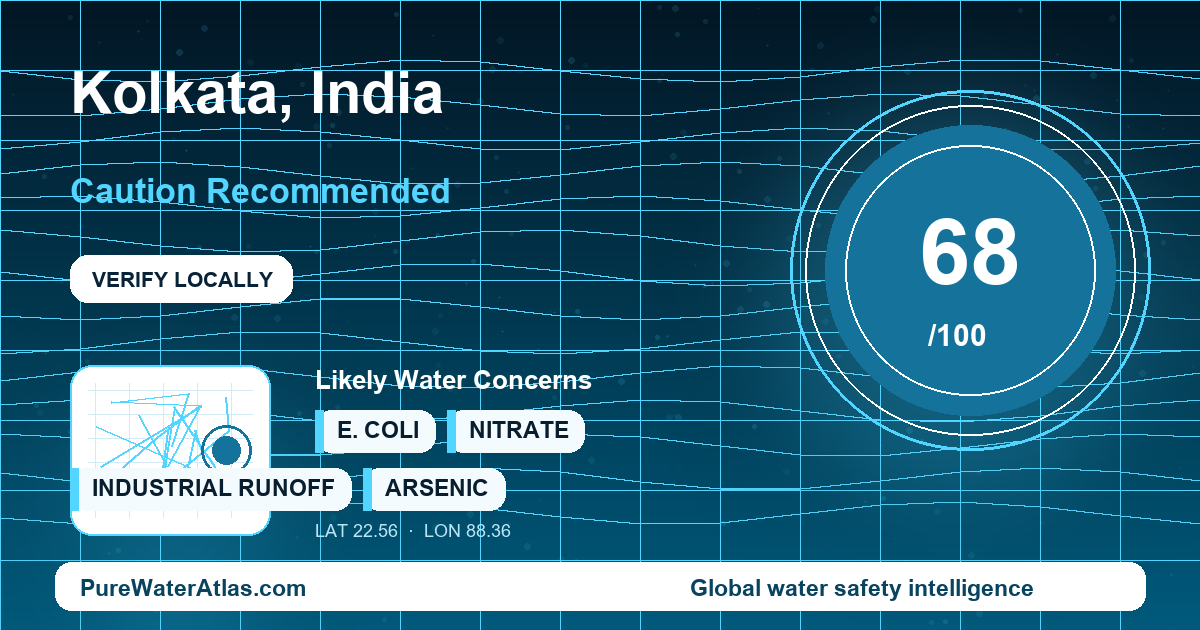
Kolkata has a major treated municipal water system drawing mainly from the Hooghly River, but tap-level safety depends heavily on distribution pipes, building tanks, plumbing condition, monsoon impacts, and whether the specific supply is municipal surface water, private groundwater, or mixed.
Quick Answer
| Overall safety status | Caution Recommended — PureWaterAtlas water safety score: 68/100. |
|---|---|
| Can tourists drink the tap water? | Not recommended untreated. Short-term visitors should use sealed bottled water, boiled water, or water treated by a reliable hotel or restaurant system. |
| Can residents drink it? | Many residents on regular Kolkata Municipal Corporation treated supply can use tap water after appropriate point-of-use treatment and good tank hygiene. Private borewells, mixed supplies, and stored building water should be tested. |
| Main water source | Primarily treated surface water drawn from the Hooghly River, a distributary of the Ganga. |
| Main authority | Kolkata Municipal Corporation is the main water supplier inside the municipal area. KMDA and West Bengal Public Health Engineering Department are relevant in the wider metropolitan and state context. |
| Filter recommendation | For regular KMC treated supply, a sediment prefilter plus UV or UF is commonly appropriate for tank and microbial concerns. RO should be selected based on testing, especially for groundwater, salinity-related parameters, arsenic, nitrate, fluoride, or high TDS. |
The short answer is that Kolkata’s municipal water is not best judged only at the treatment plant. The city has important treated-water infrastructure, but water can change after treatment as it moves through old mains, pressure changes, repairs, underground sumps, rooftop tanks, and building plumbing. Publicly accessible, current, ward-by-ward tap-level data are limited, so the safest advice depends on whether you are a visitor or a resident with control over testing and treatment.
Why Kolkata Is Different
Kolkata is a low-lying, densely urbanized city on the lower Gangetic delta, on the eastern bank of the Hooghly River. That geography shapes its drinking-water question. The city is connected to a large river system, affected by monsoon rainfall, drainage stress, and source-water pressures from urban, industrial, stormwater, and upstream pollution loads. Municipal treatment is designed to handle raw-water quality, but the final safety question is not only what enters the treatment plant.
Kolkata’s water identity is also tied to very old and very specific infrastructure. Palta Water Works, the Hooghly intake and treatment system, Tallah Tank, Garden Reach Water Works, pumping stations, service reservoirs, and the Kolkata Municipal Corporation distribution network are all part of the city’s water story. This is not a generic “Indian city tap water” situation: Kolkata has a major surface-water supply system, but it also has old neighborhoods, aging internal plumbing, rooftop tanks, underground sumps, and building-by-building maintenance differences.
For this reason, the practical question in Kolkata is often: what happened between the treatment plant and this tap? A clean municipal supply can become less safe if it passes through a leaking distribution zone, experiences low pressure, enters a dirty underground tank, or sits in an uncovered rooftop tank. That last-mile uncertainty is why visitors should avoid untreated tap water and why residents should focus on testing, tank hygiene, and source-specific treatment.
Where Does Kolkata’s Tap Water Come From?
Kolkata’s core municipal drinking water supply is mainly treated surface water drawn from the Hooghly River, a distributary of the Ganga. Major intake and treatment infrastructure has historically been located along the Hooghly. The Palta waterworks system north of the city has long been one of Kolkata’s principal treated-water sources, while the Garden Reach system serves southern and southwestern supply needs.
The city’s distribution system includes Kolkata Municipal Corporation water mains, booster pumping stations, local water supply networks, service reservoirs, and landmark storage and distribution assets such as Tallah Tank in north Kolkata. These large assets are central to Kolkata’s municipal water identity, but they are only part of the tap-water pathway. In many apartments, hotels, offices, institutions, and older houses, municipal water is first stored in an underground sump or rooftop tank before it reaches a drinking-water tap.
That building-level storage step matters. Tanks that are not routinely cleaned, disinfected, covered, and protected from pests or backflow can introduce microbial contamination after municipal treatment. Old internal pipes, corroded fittings, dead-end plumbing runs, and stagnant water can also affect taste, sediment, metals, and microbial indicators. Before Kolkata’s modern piped system expanded, residents relied more heavily on ponds, tanks, wells, and shallow groundwater; today those older sources are not equivalent to the treated municipal supply, but the legacy of dense old neighborhoods and storage practices still affects tap-level risk.
Who Manages Drinking Water in Kolkata?
Inside the municipal area, the primary urban water supplier is the Kolkata Municipal Corporation through its water supply function. The Kolkata Municipal Corporation Water Supply Department and the broader KMC official portal are the key local references for municipal water functions and public notices.
For the wider metropolitan area, the Kolkata Metropolitan Development Authority is relevant to broader infrastructure and water-sector projects, while the West Bengal Public Health Engineering Department is relevant outside or around the core municipal jurisdiction. Drinking water quality in India is generally benchmarked against Bureau of Indian Standards IS 10500 specifications and public-health guidance from national and state authorities.
Environmental water quality is monitored by agencies such as the Central Pollution Control Board and the West Bengal Pollution Control Board. These sources are important for river and surface-water context, including the Ganga-Hooghly basin. However, there is an important limitation: current, comprehensive, publicly accessible ward-by-ward tap-water compliance data, building-tank results, and distribution-zone performance evidence are not available in one simple public dataset. That is why this profile gives a moderate-confidence verdict and emphasizes verification at the tap.
Main Local Water Concerns
- Hooghly River source-water pressure: Kolkata’s raw municipal source is affected by a large river system that receives urban, industrial, stormwater, and upstream pollution loads. Treatment is intended to address this, but source variability makes filtration and disinfection performance important.
- Monsoon turbidity and drainage-related contamination: Heavy rainfall can increase river turbidity, stir sediments, overwhelm drainage, and create cross-contamination risk where leaking water mains, sewer lines, and flooded streets are close together.
- Aging distribution and intermittent pressure: Older pipes, leakage, repairs, and pressure changes can allow contaminated water to enter the distribution system, particularly during low-pressure periods or after outages.
- Building storage tanks: Underground and rooftop tanks are common in Kolkata apartments, hotels, offices, and older houses. If tanks are dirty, uncovered, poorly screened, or exposed to pests, they can contaminate treated water before it reaches the tap.
- Private groundwater and arsenic context: West Bengal’s alluvial aquifers are internationally known for arsenic risk in several districts. Central Kolkata’s KMC supply is mainly treated surface water, so arsenic should not be assumed at every municipal tap. Private borewells, mixed supplies, and fringe supplies should be tested.
- Iron, manganese, sediment, and metallic taste: Private wells and old building plumbing can produce staining, discoloration, sediment, or metallic taste. These signs do not automatically prove acute health risk, but they do mean the water should be tested before choosing treatment.
- Lead uncertainty in old premises: Comprehensive public lead service-line data for Kolkata are not available. Any lead risk is more likely to be building-specific, from older fittings, solder, brass fixtures, or stagnant water, rather than a confirmed citywide claim.
For Travelers
Short-term visitors should not drink untreated tap water in Kolkata. Use sealed bottled water, boiled water, or water from a verified hotel or restaurant treatment system. This caution is based on last-mile uncertainty: visitors usually cannot inspect the building tank, plumbing, filter maintenance, or recent supply conditions.
For brushing teeth, conservative travelers, children, pregnant travelers, and people with sensitive stomachs should use bottled or treated water. Many long-term residents may brush with tap water, but visitors have less familiarity with local microbial exposure and less ability to verify a building’s water system.
Avoid ice from street vendors and small unverified outlets. In reputable hotels and restaurants, ask whether ice is made from filtered, RO, UV-treated, or packaged water. Do not assume that a large building automatically has a maintained drinking-water system. In budget stays and older guesthouses, ask how storage tanks and filters are cleaned and serviced.
During summer and monsoon travel, carry sealed bottled water. Check bottle caps and seals. For longer stays, a kettle, UV purifier, or reliable certified filter is sensible. Avoid drinking from taps in railway stations, older guesthouses, and public washrooms unless the water point is clearly marked and maintained for drinking. For emergency microbial protection, see the PureWaterAtlas guide to boiling water purification.
For Residents
Residents should treat Kolkata tap-water safety as a source-and-building question. If your home receives regular KMC treated supply and the building storage system is well maintained, a sediment prefilter plus UV or UF can be a practical point-of-use approach for common particulate and microbial concerns. UV treatment is especially relevant where water is municipally treated but may be affected by storage-tank hygiene; see the PureWaterAtlas UV water purification guide for how this treatment works.
RO should not be selected automatically. It can be appropriate when testing shows dissolved contaminants such as high TDS, salinity-related issues, arsenic, nitrate, fluoride, or other contaminants that require membrane treatment. Unnecessary RO wastes water and removes minerals, so it should be chosen based on results, not taste alone. If testing confirms arsenic in a private groundwater source, see arsenic filter and treatment options.
Test water at the kitchen tap, not only at the building inlet. For municipal treated supply, useful tests include total coliform, E. coli, turbidity, pH, TDS, residual chlorine, iron, and basic metals if there is discoloration or taste. For private borewells or mixed groundwater supply, add arsenic, iron, manganese, nitrate, fluoride, chloride, hardness, electrical conductivity, and salinity-related parameters.
Old Kolkata buildings deserve extra care. Flush taps after long stagnation, avoid using the first water of the morning for infant formula, and test if the building is old, recently renovated, or has metallic taste or discoloration. In older premises, consider first-draw and flushed samples for lead if plumbing age or brass fixtures are a concern. Underground sumps and rooftop tanks should be covered, screened, cleaned, and disinfected on a routine schedule, especially after flooding, long supply interruptions, or tank-cleaning failures.
Relevant Contaminants and Water-Quality Issues
The most important Kolkata tap-water issues are not a single contaminant; they are the combination of source-water variability, monsoon conditions, distribution integrity, storage tanks, and plumbing. Microbial indicators are central. Learn more about E. coli in drinking water, especially for traveler illness risk, flooding, storage tanks, and distribution intrusion.
Because the Hooghly system can experience sediment and turbidity changes, particularly during monsoon conditions, turbidity and sediment are relevant to both treatment performance and household complaints after repairs or interruptions. Chlorine is also important because residual disinfectant helps protect water as it moves through a large urban network.
For groundwater users, Kolkata’s wider West Bengal context makes arsenic testing important, especially for private borewells and mixed supplies. Iron and manganese can contribute to staining, metallic taste, and source-specific treatment needs. For older buildings, lead should be considered as a premise-plumbing concern when fittings, solder, brass fixtures, or long stagnation may be involved.
How to Verify Your Water Quality
The best way to verify drinking-water safety in Kolkata is to test the water you actually drink. A building inlet sample may show municipal supply quality, but the kitchen tap sample reflects the combined effect of the distribution network, underground sump, rooftop tank, internal plumbing, and point-of-use filter.
Start with a certified laboratory if infants, pregnant residents, elderly residents, or immunocompromised people rely on the water. Test after flooding, major pipe repairs, long outages, sudden changes in color, smell, or taste, or if multiple household members report illness patterns. For old-building lead concerns, first-draw and flushed samples can help distinguish stagnant plumbing effects from the broader supply.
PureWaterAtlas resources that can help include the complete guide to water testing, the drinking water safety guide, the water microbiology guide, and the water treatment systems guide. You can also compare locations with the Global Water Quality Checker and interpret specific test results through the Contaminants Search Engine. For borewell arsenic sampling, see arsenic testing and detection methods. For older plumbing, see lead testing and detection methods.
Official and Technical Sources
- Kolkata Municipal Corporation Water Supply Department — primary local authority reference for Kolkata’s municipal water supply function and infrastructure.
- Kolkata Municipal Corporation official portal — official municipal source for city services and public information.
- Kolkata Metropolitan Development Authority — relevant for wider metropolitan infrastructure and water-sector projects.
- Central Pollution Control Board National Water Quality Monitoring Programme data — high-authority environmental monitoring for river and surface-water context.
- West Bengal Pollution Control Board water quality information — state-level environmental water quality source.
- National Mission for Clean Ganga — official Ganga basin program relevant to the Hooghly-Ganga source-water context.
- Central Ground Water Board — authoritative groundwater source for India, relevant to West Bengal aquifer and arsenic concerns.
- CDC India Traveler View — travel health guidance supporting conservative advice for visitors on drinking water and food safety.
Bottom Line
Kolkata’s tap water should be approached with informed caution. The city has a major treated municipal surface-water system based largely on the Hooghly River, with important infrastructure such as Palta, Tallah, and Garden Reach. However, tap-level safety depends on old distribution areas, pressure changes, repairs, monsoon flooding, building tanks, and premise plumbing. Visitors should avoid untreated tap water and use sealed bottled, boiled, or reliably treated water. Residents on regular KMC supply should prioritize tank hygiene, tap-level testing, and appropriate point-of-use treatment. Private borewells or mixed supplies need broader testing, especially for microbial indicators, arsenic, iron, manganese, nitrate, fluoride, hardness, chloride, conductivity, and salinity-related parameters.
Read the full guide: Global Water Quality Guide
Explore more in this category: Global Water Quality Articles