
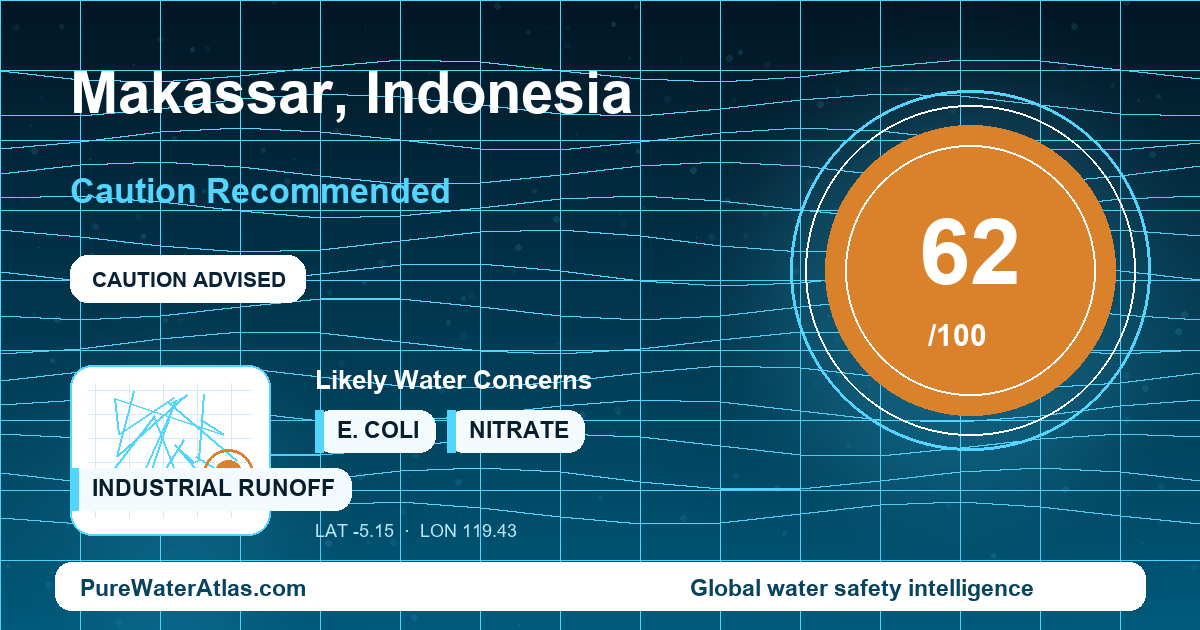
Makassar has a formal treated municipal supply, but seasonal raw-water stress, coastal salinity concerns, intermittent pressure, sediment, and building storage tanks mean untreated tap water should not be considered reliably safe to drink without verification.
Quick Answer
| City | Makassar, Indonesia |
|---|---|
| Water safety score | 62 / 100 |
| Risk level | Caution Recommended |
| Can visitors drink the tap water? | No, not as a default travel recommendation. Use sealed bottled water, properly treated water, or boiled water. |
| Resident guidance | Use municipal water for general domestic purposes, but boil, filter, disinfect, or use a trusted treated source for drinking unless recent building-specific tests confirm potability. |
| Main raw-water systems | Regional treated surface-water sources, especially the Jeneberang River and Bili-Bili Dam system, plus the Lekopancing or Maros raw-water system serving parts of the city. |
| Local water authority | Perumda Air Minum Kota Makassar, formerly PDAM Kota Makassar. |
| Filter recommendation | For regular drinking use, consider a multi-barrier setup: sediment filtration, activated carbon, and boiling, UV, ultrafiltration, or reverse osmosis depending on testing results and salinity or dissolved-solids concerns. |
Overall verdict: Caution is recommended. Makassar has a municipal water utility and treated surface-water supply, but recent public distribution-zone tap-water results are not consistently available in an easy-to-verify format. Practical risk varies by season, supply zone, pressure stability, pipe condition, and especially by building storage tanks.
Why Makassar Is Different
Makassar is a low-lying coastal city on the west coast of South Sulawesi, facing the Makassar Strait. That coastal setting matters for drinking-water safety because local water concerns are not limited to treatment-plant performance. Dry-season raw-water stress, salty-tasting water complaints in some supply periods, drainage and flooding pressure, sediment, and building-level storage practices all affect the final water that reaches a tap.
The city’s formal supply is operated by Perumda Air Minum Kota Makassar, but the water reaching a hotel, apartment, boarding house, cafe, or family home can differ substantially even within the same neighborhood. Makassar’s distribution network includes older pipes, variable pressure zones, private pumps, roof tanks, and underground storage tanks. These final building systems can degrade water quality after it leaves the municipal main. A clean treated supply can become unsafe if it sits in a poorly covered, unclean, or flood-exposed tank.
Makassar’s water-security context is also regional. The city depends on surface-water systems outside the dense urban core, including Jeneberang-Bili-Bili and Lekopancing or Maros-related infrastructure. Public reports and local discussions have repeatedly connected dry-season disruptions with reduced raw-water availability in these systems, while heavy rain can increase turbidity and treatment burden. Because transparent, recent, zone-by-zone public tap-quality data are limited, this guide does not claim that every tap in Makassar is unsafe or safe. Instead, it recommends a cautious, building-specific approach.
Where Does Makassar’s Tap Water Come From?
Makassar’s municipal supply relies mainly on treated surface water from regional catchments. The most important systems identified for the city are the Jeneberang River and Bili-Bili Dam system to the south, and the Lekopancing or Maros raw-water system to the northeast. Different treatment plants and service zones may receive different raw-water mixes, so the practical water quality at the tap can vary across the city.
Important local infrastructure includes the Perumda Air Minum Kota Makassar distribution network, the Jeneberang River catchment and Bili-Bili Dam raw-water system, and the Lekopancing or Maros intake system serving parts of Makassar’s supply. Major water treatment facilities reported in the Makassar system include Panaikang, Somba Opu, Ratulangi, Antang, and Maccini Sombala facilities. These plants and networks are central to the formal supply, but they are only part of the safety chain.
For many users, the last stage is the most uncertain stage: the building. Roof tanks, ground tanks, booster pumps, old internal plumbing, stagnant pipe sections, and fittings can all change water quality before it reaches the kitchen tap. This is why two buildings receiving similar municipal water may have different drinking-water risk. In Makassar, point-of-use decisions should account for both the utility source and the building’s storage and plumbing condition.
Who Manages Drinking Water in Makassar?
Makassar’s piped water service is managed by Perumda Air Minum Kota Makassar, the municipal water company formerly known as PDAM Kota Makassar. The utility is responsible for the city’s piped drinking-water service and customer-facing water-supply information.
Raw-water and river-basin infrastructure are connected to national public-works agencies, including the BBWS Pompengan Jeneberang, part of Indonesia’s Directorate General of Water Resources under the Ministry of Public Works and Housing. This is relevant because Makassar’s drinking-water security depends on regional surface-water systems, not only on infrastructure inside the city.
Indonesia’s health-based drinking-water requirements are set nationally by the Ministry of Health. The current regulatory context includes Peraturan Menteri Kesehatan No. 2 Tahun 2023, which establishes environmental health standards and water-quality requirements. However, this profile does not assert that every Makassar tap or service zone meets all standards, because recent public distribution-zone compliance data were not found in a consistently transparent, easy-to-verify format.
Main Local Water Concerns
Dry-season raw-water stress: Makassar’s dependence on regional surface-water sources makes the city sensitive to dry-season reductions in raw-water availability. Reduced flow can contribute to low pressure, intermittent service, and operational strain.
Salinity and salty taste: Salty-tasting water has been a recurring local concern during some dry periods, especially when raw-water levels fall or coastal influence increases. Boiling water will not remove salinity, chloride, or high dissolved solids; if tap water tastes salty, it should not be treated as a simple microbial problem.
Rainy-season turbidity: Heavy rainfall and runoff can increase sediment and suspended particles in surface-water sources. Higher turbidity can raise treatment demands and may contribute to cloudy-water events, especially after storms, flooding, or disturbed flows.
Intermittent pressure and pipe disturbance: Low pressure, pipe repairs, outages, and pressure restoration can mobilize sediment or increase the risk of intrusion if local network integrity is poor. Discolored or particle-filled water after an outage should be flushed and not consumed without appropriate treatment and verification.
Storage tanks: Private roof tanks and underground tanks are major practical risk points in Makassar. Poor covers, insect access, animal intrusion, stagnant water, floodwater entry, and lack of cleaning can create microbial risk even when utility water has been treated.
Older internal plumbing: There is no strong public evidence for a citywide lead problem in Makassar, but metals cannot be ruled out in older buildings with legacy plumbing, fittings, solder, corrosion, or poorly maintained internal systems. Iron may also be relevant where discoloration, pipe corrosion, or tank sediment are present.
For Travelers
Do not drink untreated tap water as a default. Visitors to Makassar should use sealed bottled water, properly treated water, or water that has been boiled. This is especially important for children, pregnant travelers, elderly travelers, and immunocompromised visitors.
Brushing teeth: Use bottled, boiled, or reliably filtered water. Healthy adults may tolerate brief exposure better than vulnerable travelers, but for short stays the safer and simpler choice is treated water.
Ice: Avoid ice from informal vendors or unclear sources. In higher-end hotels and restaurants, ask whether ice is made from treated or commercial purified water. If staff cannot answer clearly, skip ice.
Hotels and restaurants: Many hotels, cafes, and restaurants may use bottled water, gallon water, or in-house treatment for drinking and ice, but do not assume this automatically. Ask whether drinking water is commercially purified or treated on site, and check whether dispensers appear maintained. If uncertain, choose sealed bottled water.
Visible warning signs: Do not drink tap water that is salty, cloudy, discolored, particle-filled, or recently restored after a service outage unless it has been appropriately treated and tested. Boiling can reduce microbial risk when done correctly, but it does not remove salinity, heavy metals, or chemical contamination. For travel preparation, see the PureWaterAtlas Boiling Water Purification: Complete Guide.
For Residents
Residents commonly use Makassar municipal water for washing and general domestic purposes, but households that intend to drink it regularly should use a multi-barrier approach. A practical setup may include a sediment prefilter, activated carbon for taste and chlorine-related issues, and a final microbial barrier such as boiling, UV, ultrafiltration, or another validated disinfection method. Where salinity, high dissolved solids, nitrate, or metals are a concern, reverse osmosis may be more relevant, but only if it is correctly installed and maintained.
Testing should be done at the tap actually used for drinking, not only at the incoming utility pipe. Tanks, pumps, internal plumbing, and fittings can change water quality after water enters the property. At minimum, residents who drink the water routinely should consider testing for E. coli or total coliform, turbidity, residual chlorine, pH, conductivity or TDS, chloride or salinity indicators, iron, manganese, nitrate, and basic metals where older plumbing is possible.
Testing is especially important after major plumbing work, tank cleaning, flooding, long service interruptions, unusual taste or odor, salty taste, or visible discoloration. If infants, pregnant people, elderly residents, or immunocompromised people live in the home, use a certified treated source and prioritize microbiological testing. The PureWaterAtlas guides on UV Water Purification, Lead in Drinking Water: Testing and Detection Methods, and Nitrate Contamination in Drinking Water may help residents choose the right verification steps.
Storage tanks deserve special attention in Makassar. Roof tanks and underground tanks should be covered, screened against insects and animals, cleaned periodically, protected from floodwater entry, and disinfected after cleaning or contamination events. Older rented houses, boarding houses, and small commercial buildings may have unknown pipe materials, corroded fittings, dead-end pipe sections, or poorly maintained pumps. Do not assume that utility-treated water remains safe at the kitchen tap without checking the building system.
Relevant Contaminants and Water-Quality Issues
The most relevant water-quality issues for Makassar are not limited to one contaminant. Turbidity is important because rainy-season runoff can increase cloudy water and particle loading in surface-water systems. Sediment matters after outages, pipe repairs, pressure changes, and in tanks that accumulate deposits. E. coli is a key indicator for microbial safety where intermittent pressure, flooding, or storage-tank contamination is possible.
Chlorine residual is central to distribution-system protection, but it can vary by distance, pressure, storage time, and building plumbing. Lead is not identified here as a confirmed citywide problem, but it remains relevant for older internal plumbing and unknown fittings. Iron is relevant to discoloration, corrosion, aesthetic complaints, and sediment in pipes or tanks.
How to Verify Your Water Quality
The safest way to decide whether Makassar tap water is drinkable in a specific building is to test the actual point of use. Taste, odor, color, and a simple TDS meter are not enough. A TDS meter cannot detect pathogens such as E. coli, and clear water can still be microbiologically unsafe.
Start with a local accredited laboratory where possible. Ask for microbiological testing, turbidity, residual chlorine, pH, conductivity or TDS, chloride or salinity indicators, iron, manganese, nitrate, and metals if the building is older or plumbing materials are uncertain. Test again after long outages, flooding, repairs, tank cleaning, salty taste, or dirty-water events.
For broader context, use the Global Water Safety Checker, the Contaminants Search Engine, and the PureWaterAtlas guide to Water Testing. Background guides on Drinking Water Safety, Global Water Quality, Water Microbiology, and Water Treatment Systems can help interpret results and choose treatment options.
Official and Technical Sources
- Perumda Air Minum Kota Makassar official website — local municipal water utility responsible for Makassar’s piped water service.
- BBWS Pompengan Jeneberang — official river-basin authority relevant to the Jeneberang system and regional raw-water infrastructure.
- Peraturan Menteri Kesehatan No. 2 Tahun 2023 — Indonesia’s national framework for environmental health standards and drinking-water quality requirements.
- Indonesia Country Water Assessment, Asian Development Bank — background on Indonesia’s water resources and urban water-management challenges.
- Indonesia Traveler View, U.S. CDC Travelers’ Health — travel-health guidance supporting conservative food and water precautions.
- WHO Drinking-water fact sheet — international reference on drinking-water health risks and safe management.
- BPS Kota Makassar — official city statistical source for Makassar context and municipal indicators relevant to water demand.
Bottom Line
Makassar tap water should be approached with caution. The city has a formal treated municipal supply operated by Perumda Air Minum Kota Makassar and draws from important regional surface-water systems including Jeneberang-Bili-Bili and Lekopancing or Maros sources. However, public zone-level tap-quality data are limited, and local risks include dry-season supply stress, salinity complaints, rainy-season turbidity, intermittent pressure, pipe sediment, and building storage tanks. Travelers should avoid untreated tap water and use bottled, boiled, or reliably treated water, including for brushing teeth. Residents who want to drink tap water regularly should maintain tanks, use appropriate filtration and disinfection, and test the actual drinking tap.
Read the full guide: Global Water Quality Guide
Explore more in this category: Global Water Quality Articles