
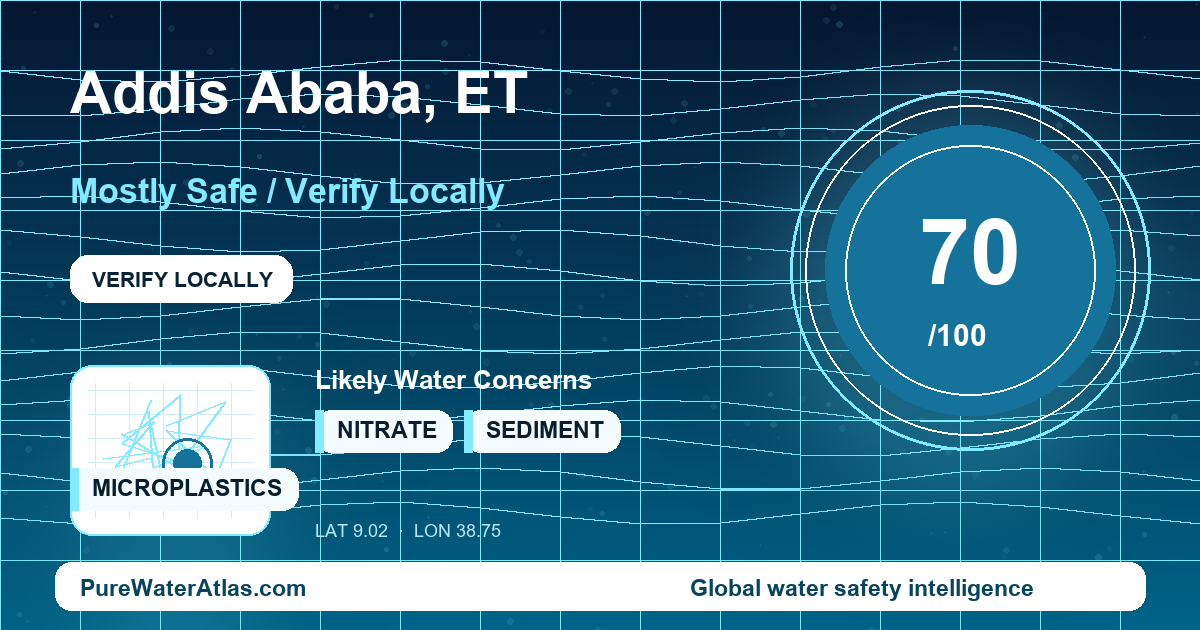
Addis Ababa has a treated municipal water system, but tap-water safety can vary by pressure zone, outages, building storage tanks, and local plumbing conditions.
Quick Answer
| Overall safety status | Mostly Safe / Verify Locally — PureWaterAtlas score: 70/100. Addis Ababa has a formal treated municipal supply, but tap safety is not uniform across all buildings and neighborhoods. |
|---|---|
| Can tourists drink the tap water? | Use caution. Short-term visitors should generally drink sealed bottled water, boiled water, or properly filtered and disinfected water rather than assuming every tap is safe. |
| Resident guidance | Residents connected to the Addis Ababa network should verify conditions at the building level, especially after outages, repairs, low-pressure periods, or when rooftop or basement tanks are used. |
| Main water sources | Treated surface water from reservoir systems including Legedadi, Gefersa, and Dire, supplemented by groundwater wellfields and boreholes. |
| Water authority | Addis Ababa Water and Sewerage Authority, commonly abbreviated AAWSA. |
| Filter recommendation | A home filter is not automatically required for every municipal connection, but it is a sensible risk-reduction measure where supply is intermittent, storage tanks are used, sediment is frequent, or household members are vulnerable. For microbial risk, filtration should be paired with disinfection unless the device is designed for microbiological protection. |
Why Addis Ababa Is Different
Addis Ababa is not a city where the drinking-water question can be answered by looking only at whether a municipal treatment plant exists. The city does have a formal municipal water system operated by AAWSA, and municipal water is generally a safer option than unimproved sources. The more important question is what happens between the treatment works and the tap.
The city sits at high altitude on the central Ethiopian highlands, roughly around 2,300 to 2,500 meters above sea level. Its drinking water comes from reservoirs and groundwater sources around the urban fringe rather than from one large river running through the center of the city. As Addis Ababa has grown rapidly, water-production and distribution capacity have had to expand through reservoir, groundwater, transmission, and network investments. In some areas, demand and infrastructure constraints can contribute to intermittent delivery or rationing.
This matters for drinking-water safety because intermittent supply and pressure drops can increase the chance of intrusion into distribution pipes. Many homes, apartments, hotels, and businesses also use storage tanks to manage unreliable supply. Tanks can improve availability, but they become a control point for safety: an open lid, poor vent screening, roof runoff, sediment, insects, algae, or irregular cleaning can turn treated water into uncertain water before it reaches the glass.
Where Does Addis Ababa’s Tap Water Come From?
Addis Ababa’s municipal drinking water is supplied by a mixed system of treated surface water and groundwater. Commonly cited surface-water sources include the Legedadi, Gefersa, and Dire dam-reservoir systems. Gefersa is one of the older municipal surface-water sources, while Legedadi and Dire became important parts of the modern bulk-water system as the capital expanded. Groundwater production from wellfields and boreholes, including sources around the Akaki area and other city production wells, supplements surface-water supply.
Key infrastructure includes the Legedadi reservoir and treatment works east or northeast of the city, the Gefersa reservoir and treatment works west of Addis Ababa, the Dire reservoir and related treatment infrastructure, groundwater wellfields, bulk transmission mains, service reservoirs, distribution pipelines, pressure zones, and building-level storage systems. This layered system means water quality can be affected at several points: raw reservoir quality, treatment performance, transmission and pressure management, pipe repairs, and storage within buildings.
Surface-water sources can face higher turbidity during the main rainy season, generally June to September, when runoff and erosion increase. Higher turbidity can place more pressure on treatment and disinfection processes. In the dry season, reduced inflows and high demand can worsen intermittent supply and increase dependence on stored water. These seasonal patterns do not prove that all taps are unsafe during any particular month, but they do explain why local verification is important in Addis Ababa.
Who Manages Drinking Water in Addis Ababa?
The municipal utility responsible for water supply and sewerage services in Addis Ababa is the Addis Ababa Water and Sewerage Authority. AAWSA operates the city system, including production, treatment, transmission, distribution, and sewerage services.
Nationally, Ethiopia’s drinking-water governance sits within a broader public-health and water-sector framework involving institutions such as the Ministry of Water and Energy and national health authorities. The Ethiopian Public Health Institute is relevant to public-health, disease surveillance, laboratory capacity, and health-related water-quality context. Ethiopian drinking-water standards are broadly aligned with the concepts used in the WHO Guidelines for Drinking-water Quality, including microbial safety, turbidity control, and disinfection principles.
A key limitation for consumers is that publicly accessible, frequently updated, neighborhood-level water-quality reporting for Addis Ababa is limited compared with some utilities in high-income countries. Available sources identify the system, the utility, and infrastructure pressures, but they do not provide a complete public tap-by-tap compliance map showing residual chlorine, microbial results, lead-at-the-tap data, and storage-tank conditions for every building. That is why this profile rates the city as mostly safe but locally variable, rather than universally safe at every tap.
Main Local Water Concerns
The primary water-safety issue in Addis Ababa is not simply whether water is treated at the treatment works. The more practical concern is distribution and storage after treatment. Intermittent supply, low pressure, pipe breaks, repairs, illegal or aging connections, and old internal plumbing can all create local risk points.
- Intermittent water supply and low pressure: When pressure drops, contaminated water from surrounding soil, drains, or damaged pipe zones may be more likely to enter the network.
- Rainy-season turbidity: During June to September rains, runoff and erosion can increase raw-water turbidity in surface-water catchments, placing more stress on treatment and disinfection.
- Reduced chlorine residual: Long residence time, dirty tanks, or extended building storage can reduce free residual chlorine before water reaches a tap.
- Storage-tank contamination: Rooftop and basement tanks are common practical features in Addis Ababa. Poor lids, open vents, sediment, algae, insects, or irregular cleaning can create microbial risk.
- Sediment, color, and taste changes: Water may show sediment or discoloration after outages, pipe repairs, rationing, or disturbed distribution lines.
- Older building plumbing: Old internal pipes, corroded fixtures, brass fittings, solder, or long stagnant plumbing runs can create building-level metal concerns. Public evidence is not sufficient to claim a citywide lead problem, but older buildings should not ignore plumbing risk.
- Private groundwater uncertainty: Groundwater chemistry can vary locally. Addis Ababa should not be generalized with high-fluoride Rift Valley groundwater unless site-specific test results support that concern. Private wells and boreholes need their own testing.
For Travelers
For short-term travelers, the safest practical answer is: do not assume tap water is reliably safe to drink everywhere in Addis Ababa. Treated municipal water exists, and many buildings are connected to the formal system, but visitors usually do not know the recent outage history, tank-cleaning schedule, plumbing condition, or whether residual chlorine is present at the tap.
Use sealed bottled water, boiled water, or water that has been properly filtered and disinfected for drinking. Check that bottle caps are intact. Boiled water is a reliable short-term option for microbial safety, although it does not remove dissolved chemicals or metals. For infant formula, use boiled water or another verified safe source.
For brushing teeth, conservative advice is to use bottled or treated water, especially during a short visit or if you have a sensitive stomach. In a reputable hotel with verified in-house filtration and disinfection, tap water may be acceptable for brushing teeth, but confirm locally rather than assuming.
Avoid ice unless the hotel or restaurant can confirm it was made from treated safe water. Ice from unknown street vendors or smaller establishments should be treated as a possible risk. Higher-end hotels and international restaurants may use bottled water, treated water, or in-house filtration, but this is not automatic. Ask whether water served in a jug is bottled, boiled, filtered, or otherwise disinfected.
The CDC Travelers’ Health page for Ethiopia supports conservative food and water precautions for visitors. Travelers comparing destinations can also use the PureWaterAtlas Global Water Quality Checker.
For Residents
Residents connected to the municipal system should focus on building-level verification. A home filter is not required for every Addis Ababa household, but it is a practical risk-reduction tool where service is intermittent, water is stored in a tank, sediment is common, taste changes occur, or household members include infants, pregnant people, older adults, or immune-compromised residents.
For microbial risk, a basic taste-and-odor or sediment filter is not enough unless it is specifically designed for microbiological removal. If water safety is uncertain after an outage, repair, tank problem, or flooding, boiling or another disinfection step is appropriate. PureWaterAtlas has separate guides to boiling water purification, UV water purification, and broader water purification methods.
Testing is especially useful for households with rooftop or basement tanks, shared building systems, private boreholes, repeated outages, or medically vulnerable residents. Practical tests include E. coli or thermotolerant coliforms, free residual chlorine at the tap, turbidity when water looks cloudy or brown, and metals such as lead in older buildings where plumbing materials are unknown. Private wells and boreholes should be tested for nitrate, fluoride, electrical conductivity, major ions, and microbial indicators before drinking use.
Storage tanks should be covered, screened, protected from roof runoff and animals, cleaned periodically, and disinfected after maintenance. If a tank has visible sediment, algae, insects, open vents, or an unsecured lid, do not treat its water as reliably potable without treatment and testing.
Relevant Contaminants and Water-Quality Issues
The most relevant water-quality issues for Addis Ababa are microbial indicators, turbidity, sediment, disinfectant residual, and building-level plumbing contaminants.
- E. coli is the key indicator for fecal contamination risk after pressure loss, pipe intrusion, or storage-tank contamination.
- Turbidity matters because rainy-season runoff can increase suspended particles in surface-water catchments and affect disinfection performance.
- Sediment is relevant after outages, rationing, pipe repairs, and disturbed distribution lines.
- Chlorine residual is a practical field indicator that water still has disinfectant protection after distribution and storage.
- Lead is not established here as a citywide problem, but it is relevant in older buildings with unknown internal plumbing, stagnant water, solder, or fittings.
- Nitrate is especially relevant for private wells, boreholes, and groundwater affected by sanitation or urban runoff.
For deeper background, see PureWaterAtlas resources on water microbiology and how to know if tap water is safe to drink.
How to Verify Your Water Quality
Because Addis Ababa does not have easily accessible public reporting for every neighborhood, pressure zone, and building tank, the best verification is local and practical. Start by asking your building manager, hotel, landlord, or utility contact whether the property uses rooftop or basement storage, when tanks were last cleaned, whether water is filtered or disinfected after storage, and whether recent testing has been done.
At the tap, check for unusual color, odor, sediment, and changes after outages or repairs. If possible, test free residual chlorine during normal service and after water returns from an interruption. For higher-risk households or buildings, laboratory testing for microbial indicators is more meaningful than relying on appearance or taste.
PureWaterAtlas has a full water testing guide for choosing parameters and interpreting results. The Contaminants Search Engine can help residents look up contaminants such as E. coli, turbidity, chlorine, nitrate, and lead. For old buildings, see lead in drinking water testing and detection methods. For private groundwater users, see nitrate contamination testing and detection methods.
Official and Technical Sources
- Addis Ababa Water and Sewerage Authority — municipal authority responsible for water supply and sewerage services in Addis Ababa.
- World Bank Projects and Operations: Ethiopia Urban Water Supply and Sanitation — context on urban water-supply and sanitation investment needs, service expansion, and infrastructure pressures.
- World Bank Ethiopia resources — broader context on Ethiopia’s water infrastructure and urban service challenges.
- Ministry of Water and Energy, Ethiopia — national water-sector authority and institutional context.
- Ethiopian Public Health Institute — national public-health institution relevant to laboratory and health-related water-quality context.
- WHO Guidelines for Drinking-water Quality — international reference for microbial risk, turbidity, disinfection, and household water-safety principles.
- CDC Travelers’ Health: Ethiopia — traveler food and water precaution guidance.
- WHO/UNICEF Joint Monitoring Programme for Water Supply, Sanitation and Hygiene — national and service-level WASH context, not a substitute for city-specific tap testing.
Bottom Line
Addis Ababa has a real municipal water system using treated reservoir water and supplemental groundwater, managed by AAWSA, so it should not be treated like an unimproved source. However, tap-water safety can vary after treatment because of intermittent supply, pressure loss, pipe repairs, household storage tanks, and old internal plumbing. Travelers should generally use sealed bottled water, boiled water, or properly filtered and disinfected water for drinking, and avoid unknown ice. Residents should verify their own building conditions, especially tank maintenance, residual chlorine, microbial quality, sediment, and older plumbing risks. Because recent neighborhood-level public testing data are limited, the safest conclusion is: mostly safe in system design, but verify locally before drinking untreated tap water.
Read the full guide: Global Water Quality Guide
Explore more in this category: Global Water Quality Articles