
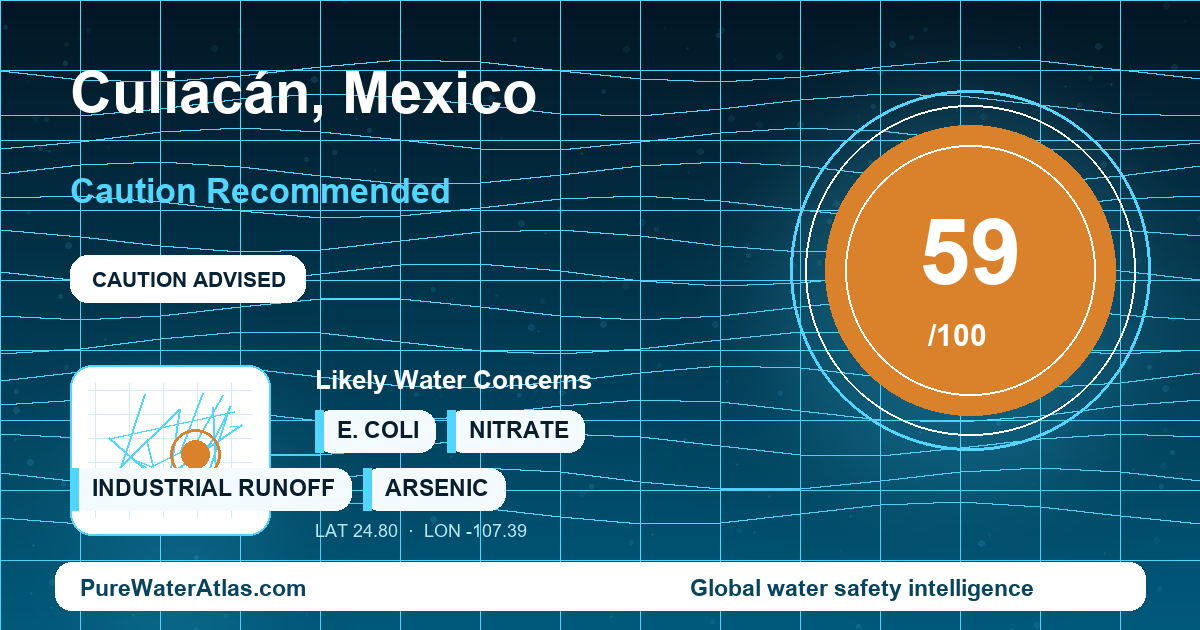
Culiacán, Sinaloa has a treated municipal water system operated by JAPAC, but river-source variability, household storage tanks, distribution conditions, and limited neighborhood-level public reporting mean caution is recommended before drinking directly from the tap.
Quick Answer
| Overall safety score | 59 / 100 |
|---|---|
| Risk level | Caution Recommended |
| Can visitors drink the tap water? | Not recommended as the default. Short-term visitors should use sealed bottled water, boiled water, or water treated by a reliable purifier. |
| Resident guidance | Residents on JAPAC supply may use tap water for many household purposes, but drinking-water confidence should depend on local advisories, residual chlorine at the point of use, plumbing condition, and cistern or rooftop tank hygiene. |
| Main water identity | Surface-water and reservoir system connected to the Humaya, Tamazula, and Culiacán rivers. |
| Local water authority | Junta Municipal de Agua Potable y Alcantarillado de Culiacán, commonly known as JAPAC. |
| Filter recommendation | A certified point-of-use system is prudent for drinking and cooking, especially where water is stored in a cistern or rooftop tank, where turbidity is noticed, or where vulnerable people live. |
Verdict: Caution recommended. Culiacán has a formal municipal utility and treated public supply, but travelers should not treat the tap as reliably drinkable without local confirmation. For residents, the key issue is often whether treated water remains protected after it leaves the utility system and passes through distribution pipes, building plumbing, cisterns, or rooftop tanks.
Why Culiacán Is Different
Culiacán is not a generic groundwater city. It sits in central Sinaloa at the confluence of the Humaya and Tamazula rivers, which form the Culiacán River. That three-river setting is central to the city’s water identity. The urban supply is tied to a surface-water system influenced by upstream reservoir regulation, including the Adolfo López Mateos dam on the Humaya system and the Sanalona dam on the Tamazula system.
This matters because surface-water systems can change quickly. Heavy rain, tropical storm remnants, river disturbance, reservoir conditions, runoff, and sediment pulses can alter raw-water quality before treatment. Culiacán’s location in one of Mexico’s most important agricultural regions also makes watershed pressure relevant. That does not prove contamination at the city tap, but it does mean nutrients, pesticides, turbidity, and reservoir water-quality changes are reasonable issues to watch, especially for private wells or vulnerable households.
The most practical Culiacán-specific question is therefore not only whether the water was treated by the municipal utility. It is also whether the water remained protected through distribution pressure, neighborhood infrastructure, private storage, and internal plumbing before reaching the glass.
Where Does Culiacán’s Tap Water Come From?
Culiacán’s urban drinking water is connected to the surface-water system of the Humaya, Tamazula, and Culiacán rivers. The city is located where the Humaya and Tamazula rivers meet, forming the Culiacán River. Upstream reservoirs and dams regulate the river systems, including Adolfo López Mateos on the Humaya system and Sanalona on the Tamazula system.
Municipal drinking water is treated through potable-water infrastructure operated by JAPAC before distribution. Key infrastructure includes surface-water intakes, potable-water treatment plants serving the urban area, municipal distribution mains, neighborhood storage and pressure infrastructure, and private household cisterns or rooftop tanks where they are used.
After treatment, water safety can still be affected by conditions between the treatment plant and the user. Distribution pressure interruptions, damaged pipes, repairs, old building plumbing, and poorly maintained tanks can all change the risk profile at the point of use. Wastewater and drainage infrastructure also matter indirectly because sewer overflows, stormwater, and river contamination can affect local water-quality conditions.
Who Manages Drinking Water in Culiacán?
The local drinking water and sewerage authority is JAPAC, the Junta Municipal de Agua Potable y Alcantarillado de Culiacán. JAPAC is the primary local authority for municipal drinking water and sewer services in the city. Its official transparency portal can be useful for checking utility documents, public information, and programs, although it is not the same as an easy neighborhood-by-neighborhood consumer water quality report.
Mexico’s federal drinking water quality framework includes NOM-127-SSA1-2021, the standard for water for human use and consumption. Broader water resources, basin information, and hydrologic context are associated with CONAGUA, including the Sistema Nacional de Información del Agua and the Organismo de Cuenca Pacífico Norte. State-level context is also connected to the Comisión Estatal de Agua Potable y Alcantarillado de Sinaloa.
Data limitation: Culiacán’s water authority, river-source context, and federal regulatory framework are identifiable. However, a recent, easy-to-access, neighborhood-level public dataset with routine results for microbiology, turbidity, disinfectant residual, metals, nitrate, and organic contaminants was not found during this synthesis. This profile therefore emphasizes system context, known risk pathways, and practical precautions rather than claiming exact current compliance at every tap.
Main Local Water Concerns
- Microbial risk after treatment: Treated water can become vulnerable if distribution pressure drops, pipes are damaged, storage tanks are dirty, or water is stored without maintenance. This is especially important for buildings with cisterns or rooftop tanks.
- Turbidity and sediment: Heavy rain, river disturbance, repairs, flushing events, and storm impacts can lead to cloudy or sandy water. Turbidity can also interfere with some treatment technologies, especially UV systems that require clear water.
- Disinfection residual: Chlorine taste or odor can be normal in disinfected municipal water. However, absent chlorine at the tap can be a warning sign where microbiological protection is uncertain.
- Agricultural watershed pressure: Central Sinaloa’s farming context makes nitrate and pesticide-related screening reasonable for private wells and for households that want added assurance, especially where infants, pregnant people, or immunocompromised residents use the water.
- Premise plumbing metals: Possible metal exposure can come from internal building plumbing, brass fixtures, solder, or old service materials. This should be treated as a building-specific issue unless testing shows otherwise.
- Seasonal variability: Summer rains and tropical storm remnants can increase river turbidity and microbial loading before treatment. Hot weather can increase demand and worsen problems in buildings relying on tanks if cleaning and residual disinfectant are not maintained. Drought or low reservoir conditions can concentrate dissolved minerals, organic matter, algae-related taste and odor compounds, or other source-water stressors.
For Travelers
Short-term visitors to Culiacán should not drink tap water as the default. Use sealed bottled water, boiled water, or water treated by a reliable purifier. This is a cautious traveler-health recommendation, not a claim that all municipal water in the city is untreated or unsafe.
For brushing teeth, bottled or treated water is the safer choice if you are visiting, have a sensitive stomach, are pregnant, immunocompromised, or traveling with young children. Many residents may brush with tap water, but visitors should be more conservative because they usually do not know the condition of the building’s pipes, cistern, or rooftop tank.
Avoid ice unless you can confirm it was made from purified water. In established hotels and restaurants, ice is often commercially produced or made from purified water, but smaller venues and informal settings vary. Useful phrases include agua purificada and hielo de agua purificada.
Carry sealed bottled water, check that bottle caps are intact, use bottled water for medications and infant formula, and avoid refilling from unknown taps. If bottled water is unavailable, boiling is an effective response for microbial risk; see the PureWaterAtlas Boiling Water Purification guide. Boiling does not remove metals, nitrate, salinity, or many chemicals.
For Residents
Residents connected to JAPAC’s treated supply can use tap water for many household purposes, but drinking-water decisions should be based on the actual point of use. A home filter is prudent for drinking and cooking water, especially where water is stored in a cistern or rooftop tank, where taste or turbidity is noticeable, or where vulnerable people live.
For broad protection, many households combine sediment prefiltration, activated carbon, and either reverse osmosis or another certified system selected according to test results. UV can help with microbial control only when the water is clear and prefiltered; the PureWaterAtlas UV Water Purification guide explains why turbidity and sediment matter before UV treatment.
Testing should be done at the tap after water has passed through the building’s actual plumbing and storage system, not only at the street connection. If using a cistern, tinaco, or rooftop tank, test for total coliform and E. coli after cleaning and again if illness, odor, slime, or pressure interruptions occur. If water is cloudy or sandy, check turbidity and sediment before relying on UV or fine filtration.
For infants, pregnant people, or immunocompromised residents, consider laboratory testing for nitrate, arsenic, lead, total coliform, E. coli, and basic chemistry such as TDS, hardness, chloride, and pH. Older homes or buildings with unknown plumbing should use first-draw and flushed lead testing to distinguish plumbing-related metals from incoming water. Private wells in rural sindicaturas or peri-urban areas should be tested more broadly, including microbiology, nitrate, arsenic, salinity indicators, and pesticides where agricultural influence is plausible.
Cisterns and rooftop tanks are a major practical risk point. Tanks should be covered, cleaned and disinfected regularly, protected from insects and dust, and checked after outages or low-pressure events. A dirty tank can defeat otherwise adequate municipal treatment.
Relevant Contaminants and Water-Quality Issues
Chlorine is relevant because Culiacán’s municipal water is disinfected, and chlorine residual helps protect water as it moves through distribution. Taste or odor can be noticeable, but the absence of residual disinfectant at the tap can also raise concern where microbial protection is uncertain.
Turbidity and sediment are especially relevant in a river and reservoir system that can experience storm-driven sediment pulses, repairs, flushing, or storage-tank disturbance. Cloudy water should not be ignored, particularly before using UV treatment.
E. coli is the key indicator for fecal contamination and is important after pressure interruptions, tank problems, or suspected microbial intrusion. Nitrate is relevant for private wells and vulnerable households because of the surrounding agricultural context. Lead is mainly a premise-plumbing concern in older buildings or buildings with unknown internal materials.
For deeper background, see PureWaterAtlas guides on agricultural runoff in drinking water, nitrate testing and detection, and lead testing and detection.
How to Verify Your Water Quality
The best way to verify drinking-water safety in Culiacán is to combine official information with point-of-use testing. Check JAPAC communications and local advisories, especially after pipe breaks, outages, repairs, flooding, or severe storms. For household decisions, test the water after it has passed through the building’s pipes and any cistern or rooftop tank.
PureWaterAtlas resources that can help include the complete guide to water testing, the Contaminants Search Engine, and the Global Water Quality Checker. For broader decision-making, see Drinking Water Safety, Water Microbiology, Water Treatment Systems, and Global Water Quality.
Related PureWaterAtlas categories include Drinking Water Safety, Global Water Quality, Water Testing, Water Contamination, and Water Purification.
Official and Technical Sources
- JAPAC, Junta Municipal de Agua Potable y Alcantarillado de Culiacán — local drinking water and sewer utility.
- JAPAC official transparency portal — utility documents and public information.
- CONAGUA Sistema Nacional de Información del Agua — national water resources and hydrologic context.
- CONAGUA Organismo de Cuenca Pacífico Norte — regional federal water-management context for Sinaloa.
- DOF NOM-127-SSA1-2021 — Mexican federal drinking water standard.
- CDC Travelers’ Health: Mexico — traveler food and water precautions.
- WHO Guidelines for Drinking-water Quality — international drinking-water risk framework.
- INEGI Culiacán municipality information — official geography and municipal context.
- Comisión Estatal de Agua Potable y Alcantarillado de Sinaloa — state water sector authority.
Bottom Line
Culiacán’s tap water comes from a treated municipal system tied to the Humaya, Tamazula, and Culiacán river-reservoir network, but PureWaterAtlas rates it as Caution Recommended because the final water quality at the tap can depend on distribution pressure, household storage tanks, old plumbing, seasonal turbidity, and limited neighborhood-level public reporting. Travelers should use sealed bottled, boiled, or properly filtered water for drinking, brushing teeth, medications, and infant formula. Residents should focus on point-of-use verification: maintain cisterns and rooftop tanks, watch for cloudy water after storms or repairs, test for microbiology where storage is used, and choose certified filtration based on actual results.
Read the full guide: Global Water Quality Guide
Explore more in this category: Global Water Quality Articles