
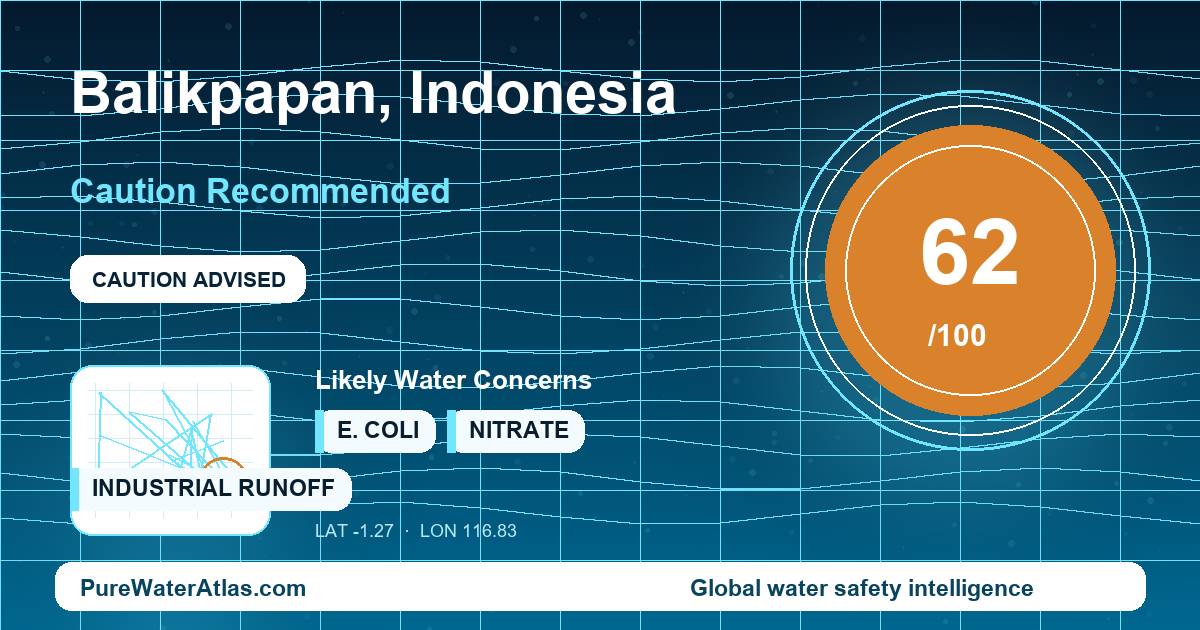
Balikpapan, Indonesia: a reservoir-dependent coastal city where treated municipal water exists, but drinking it untreated is not recommended for visitors and requires caution for households.
Quick Answer
| Water safety score | 62 / 100 |
|---|---|
| Risk level | Caution Recommended |
| Can visitors drink tap water? | No, not as a default. Visitors should use sealed bottled water, reputable refill water, or tap water that has been boiled or properly filtered and disinfected. |
| Resident guidance | Municipal water from Perumda Tirta Manuntung Balikpapan can generally be used for washing and cooking, but drinking water should be boiled and, where practical, filtered. |
| Main water source | Stored surface water, especially Waduk Manggar, with supplemental raw-water infrastructure such as Bendungan or Waduk Teritip and smaller local catchments. |
| Water authority | Perumda Tirta Manuntung Balikpapan, formerly known publicly as PDAM Balikpapan. |
| Filter recommendation | Sediment prefiltration plus activated carbon, followed by boiling or UV for microbiological safety. Private wells may require additional testing-based treatment. |
PureWaterAtlas classifies Balikpapan tap water as caution recommended. The city has an organized municipal utility and treated surface-water supplies, but it is also a water-stressed coastal city with reservoir dependence, periodic supply interruptions, complaints related to turbidity or sediment after operational events, and limited open access to recent plant-by-plant drinking-water quality results.
Why Balikpapan Is Different
Balikpapan is not a city where the main drinking-water challenge can be reduced to “is there a treatment plant?” The more important local issue is that Balikpapan is a coastal city on Balikpapan Bay in East Kalimantan with relatively small nearby catchments and high urban demand. Its municipal system depends heavily on stored surface water rather than a large perennial river system. That makes reservoir storage, dry-season conditions, treatment capacity, pumping reliability, and distribution pressure especially important for household water reliability.
The city’s role as an oil, port, logistics, and service center also matters. Balikpapan has become more strategically important because of development associated with Indonesia’s new capital region in East Kalimantan. Population growth and industrial-service activity increase pressure on water supply. A modern hotel in central Balikpapan may have clear-looking tap water and its own managed storage, while another household may experience intermittent flow, stored water, sediment after repairs, or reliance on tankers or wells. In Balikpapan, the condition of the building’s tank, pipes, and final-mile system can matter as much as the treated municipal source.
Where Does Balikpapan’s Tap Water Come From?
Balikpapan’s municipal supply is primarily associated with stored surface water. The long-running main raw-water source for the municipal system is Waduk Manggar, the principal reservoir linked to Balikpapan’s water supply. The city also has supplemental raw-water infrastructure, including Bendungan or Waduk Teritip, a Ministry of Public Works dam and reservoir intended to support Balikpapan’s supply and improve resilience.
This reservoir-based identity is important for safety and reliability. During dry periods or El Nino conditions, reservoir levels can decline, which may increase pressure on rationing, pumping, or distribution continuity. During heavy rainfall, raw water can become more turbid, placing greater burden on treatment. After outages or pipe work, first-flush water may carry sediment or discoloration and should be run clear before use.
Balikpapan also has water sources outside the municipal system. Some households or businesses use private shallow wells or boreholes where reliable utility service is unavailable or insufficient. These sources are separate from treated municipal water and should not be assumed safe. In low-lying or coastal settings, private groundwater may face salinity or brackish-water risk, and some groundwater or plumbing situations may produce iron, manganese, staining, or metallic taste. Testing is the only reliable way to distinguish a nuisance issue from a health-relevant one.
Who Manages Drinking Water in Balikpapan?
The municipal water utility is Perumda Tirta Manuntung Balikpapan, formerly known publicly as PDAM Balikpapan. It is responsible for municipal water service, including treated water, pumping, reservoirs, and the distribution network. Local household and building-level storage tanks are also an important part of the real drinking-water pathway, especially where intermittent supply or low pressure shifts risk from the treatment plant to the building.
Indonesia’s national drinking-water quality requirements are set by the Ministry of Health, including sanitary and drinking-water quality provisions under Permenkes No. 2 Tahun 2023. Local health authorities and the utility are relevant for monitoring and operational response, while Ministry of Public Works agencies are relevant for raw-water infrastructure such as dams and reservoirs.
A key limitation for consumers is transparency at the tap level. City-specific information is available for Balikpapan’s utility identity and raw-water infrastructure, but recent public laboratory results by treatment plant, neighborhood, and consumer tap are not consistently available in open sources. This profile therefore does not certify that any individual tap is compliant on the day of use. It distinguishes treated municipal water from private wells, refill water, tank water, and building plumbing because those final-mile conditions can substantially change risk.
Main Local Water Concerns
- Reservoir dependence and raw-water scarcity: Balikpapan relies heavily on stored surface water, especially Waduk Manggar, so dry-season storage levels can directly affect water reliability.
- Intermittent supply or low pressure: Outages or pressure drops can increase contamination risk in distribution pipes or building tanks, especially where household storage is poorly maintained.
- Turbidity and sediment: Heavy rain, reservoir changes, pipe repairs, or operational events can produce cloudy, discolored, or sediment-laden water at the tap.
- Disinfection taste and odor: Chlorine taste or odor may be noticeable where a residual is present. However, the absence of chlorine smell is not proof that water is safe.
- Private well risks: Coastal salinity, brackish groundwater, iron, manganese, and microbial contamination are possible concerns for private shallow wells or boreholes, depending on location and construction.
- Storage tank contamination: A clean municipal supply can become unsafe if stored in an uncovered, dirty, or poorly disinfected roof or ground tank.
For Travelers
Visitors to Balikpapan should not drink tap water untreated as a default. The lower-risk choice is sealed bottled water, reputable refill water, or tap water that has been boiled or treated with a suitable purifier. This is especially important in hot weather, during day trips, coastal trips, trekking, or work near industrial areas where safe taps may not be available.
For brushing teeth, short-term visitors, children, immunocompromised travelers, and people staying in budget accommodation with uncertain tank maintenance should use bottled, boiled, or filtered water. Some experienced travelers may brush with tap water in good hotels, but treated water remains the more cautious option.
Ice should be treated with the same caution. Avoid loose or informal ice unless you know it was made from treated water. Reputable hotels, cafes, and restaurants commonly use factory-made ice or filtered-water ice, but travelers with sensitive stomachs should ask. Hotel tap water should not be assumed drinkable unless the hotel explicitly states that it has a maintained filtration and disinfection system. Use the bottled or dispenser water provided for drinking, infant formula, and brushing teeth.
For Residents
Residents connected to Perumda Tirta Manuntung Balikpapan can generally use utility water for washing and cooking, but drinking water should be boiled and, where practical, filtered. A practical household setup is sediment prefiltration to reduce particles, activated carbon for taste and chlorine-related issues, and then boiling or UV disinfection for microbiological safety. See the PureWaterAtlas guides to boiling water purification and UV water purification for method-specific details.
Private wells and boreholes require a different approach. Reverse osmosis may be appropriate where testing shows salinity, nitrate, or dissolved-mineral problems, but it should not be chosen blindly. Test first, then select treatment. At minimum, private wells should be tested at least annually for E. coli, nitrate, salinity or chloride, iron, manganese, hardness, pH, and conductivity. Add metals testing if the well is near industrial, workshop, fuel-storage, landfill, or port-related activity.
For municipal tap water used for drinking, periodic tests should include E. coli or total coliforms, turbidity, residual chlorine, pH, iron, manganese, and total dissolved solids if taste or staining is present. Retest after flooding, long outages, tank cleaning failures, pipe repairs, or any sudden change in color, odor, or taste. If infants, pregnant people, elderly residents, or immunocompromised people drink the water, use a laboratory test rather than relying only on appearance, smell, or low-cost strips.
Older buildings need caution, but not exaggerated claims. Indonesia does not have the same documented lead-service-line history as some older North American or European cities, and no citywide Balikpapan lead claim should be made without testing. However, older internal plumbing can still include corrosion, brass fittings, solder, galvanized iron, or dirty internal pipes. Flush stagnant water and test first-draw and flushed samples if the building plumbing is old or unknown.
Storage tanks are one of Balikpapan’s most important final-mile risks. Keep roof tanks and ground tanks covered, screened, cleaned, and disinfected on a routine schedule. Do not mix municipal water with tanker or well water of unknown quality unless the combined supply is treated and tested.
Relevant Contaminants and Water-Quality Issues
The most relevant water-quality issues for Balikpapan are not exotic contaminants; they are practical, local problems linked to reservoirs, intermittent service, tanks, and wells. Turbidity is important because heavy rain, reservoir conditions, or pipe work can make water cloudy and can interfere with disinfection. Sediment is relevant when first-flush water after outages or repairs contains visible particles or discoloration.
E. coli is the key microbial indicator for untreated tap water, tanks, wells, and refill handling. Chlorine matters because it is part of the municipal disinfection barrier and can also affect taste or odor. Iron and manganese are relevant where residents see staining, black deposits, or metallic taste, especially in groundwater or plumbing contexts. Lead is not documented here as a citywide Balikpapan problem, but it can be relevant in older buildings with unknown internal plumbing; residents can also read PureWaterAtlas guidance on lead testing and detection and lead filters and solutions.
How to Verify Your Water Quality
The safest way to make a tap-specific decision in Balikpapan is to test the water you actually drink, not just the source water or utility system in general. For background on interpreting results, use the PureWaterAtlas guide to water testing. For broader safety principles, see Drinking Water Safety, Water Microbiology, Water Treatment Systems, and Water Purification.
Travelers comparing destinations can use the Global Water Quality Checker. Residents reviewing a lab report can look up individual parameters in the Contaminants Search Engine. For country and city comparison context, see the PureWaterAtlas page on Global Water Quality.
Official and Technical Sources
- Perumda Tirta Manuntung Balikpapan official website — identifies the municipal water utility serving Balikpapan and provides local operational and customer-service context.
- Balikpapan City Government official portal — official city context for local government and public-service information.
- BPS Kota Balikpapan — statistical source for city geography, population, and development context.
- Kementerian PUPR — public-works authority relevant to raw-water infrastructure such as Bendungan Teritip.
- Permenkes No. 2 Tahun 2023 — Indonesian national regulation setting health-based environmental and drinking-water quality requirements.
- WHO drinking-water fact sheet — guidance on microbial contamination, safe management, and public-health importance of drinking water.
- CDC Travelers’ Health: Indonesia — traveler-oriented food and water safety guidance relevant to visitors.
- Asian Development Bank Indonesia Country Water Assessment — national context on Indonesia water-resource and urban water-supply challenges.
Bottom Line
Balikpapan has a functioning municipal water utility and treated reservoir-based supplies, but untreated tap water is not the safest default for drinking. The city’s dependence on Waduk Manggar and supplemental reservoirs, combined with dry-season pressure, possible outages, turbidity after rain or repairs, and building-level storage tanks, creates real final-mile uncertainty. Visitors should use bottled, reputable refill, boiled, or properly purified water. Residents can generally use municipal water for washing and cooking, but should boil and preferably filter water intended for drinking, especially where tanks, old plumbing, intermittent supply, or visible sediment are involved. Private wells require their own laboratory testing and should never be treated as equivalent to municipal water without evidence.
Read the full guide: Global Water Quality Guide
Explore more in this category: Global Water Quality Articles