
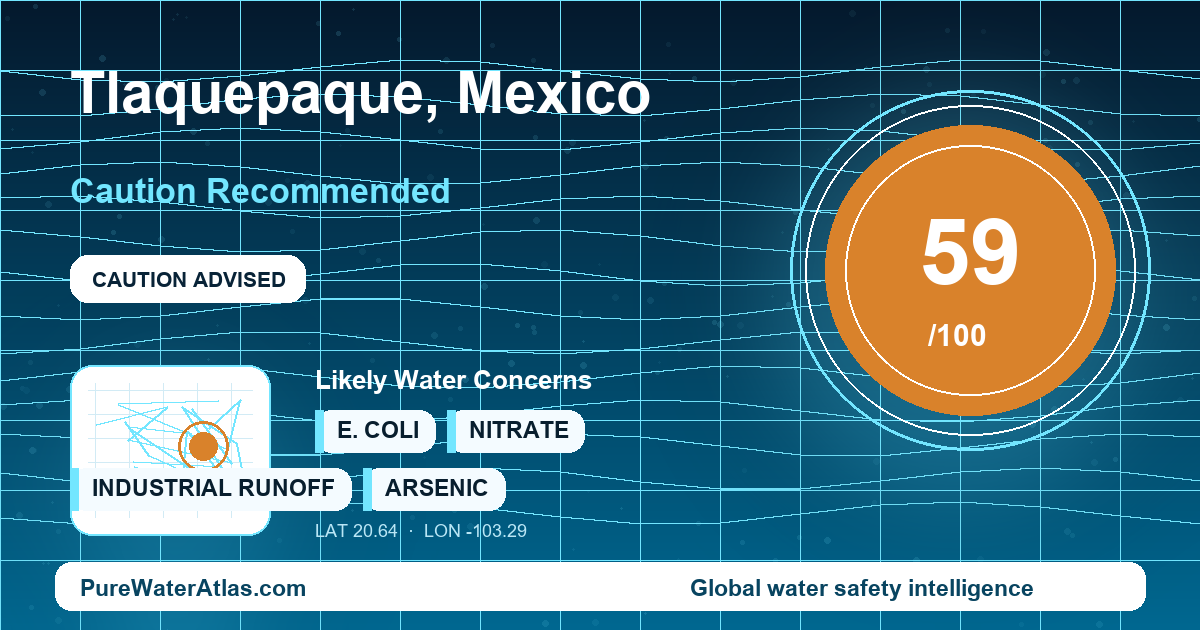
Tlaquepaque, Jalisco: metropolitan Guadalajara water supplied by SIAPA, with caution recommended because final tap safety can vary by neighborhood pressure conditions, cisterns, roof tanks, and building plumbing.
Quick Answer
| Overall safety status | Caution recommended. Tlaquepaque is served within the Guadalajara metropolitan water system, so treated municipal water may be chlorinated, but untreated tap water should not be assumed safe at every final tap. |
|---|---|
| Water safety score | 59 / 100 — risk level: Caution Recommended. |
| Traveler advice | Short-term visitors should use sealed bottled water, verified purified water, or properly boiled water for drinking. Ask whether ice and drinking water are made from purified sources. |
| Resident advice | Confirm service conditions with SIAPA, maintain cisterns and roof tanks, and use point-of-use treatment for direct drinking unless recent property-specific testing supports untreated use. |
| Main water source | A blended metropolitan supply including Lake Chapala surface water, the Calderón system, and groundwater from Guadalajara-area aquifers and well fields. |
| Water authority | SIAPA, the Sistema Intermunicipal de los Servicios de Agua Potable y Alcantarillado. |
| Filter recommendation | At minimum, a sediment prefilter plus certified activated carbon for taste, chlorine, and particles. Consider reverse osmosis or another certified technology if testing shows high dissolved solids, arsenic, nitrate, or other dissolved contaminants. |
Why Tlaquepaque Is Different
Tlaquepaque is not a separate, isolated drinking-water system. It is an urban municipality integrated into the southeast and central-southern Guadalajara metropolitan area, and its water conditions are tied to the wider regional network operated by SIAPA. That makes the city different from places where a single local well field or small municipal plant defines most household tap quality.
The most important drinking-water issue in Tlaquepaque is not simply whether the utility treats water. The practical concern is the combination of mixed regional sources, aging or intermittent distribution conditions, pressure changes, repairs, household storage tanks, and limited publicly accessible tap-by-tap water-quality data. A hotel in the historic center, a small restaurant, and an apartment building can all receive water from the metropolitan system, yet have different final-tap risk because of cisterns, roof tanks, old internal plumbing, low-use lines, or recent service interruptions.
This is why PureWaterAtlas classifies Tlaquepaque as Caution Recommended rather than broadly “safe” or “unsafe.” Treated municipal water may contain disinfectant residual, but visitors and sensitive residents should not assume every faucet in every building is safe to drink untreated.
Where Does Tlaquepaque’s Tap Water Come From?
Tlaquepaque’s tap water comes through the Guadalajara metropolitan service area. SIAPA uses a blended supply that includes surface water from Lake Chapala, the Calderón system, and groundwater from metropolitan aquifers and well fields. The exact blend at a specific property can vary by sector, maintenance, season, pressure zone, and operational conditions.
Lake Chapala is a strategic source for Guadalajara, but it is also a variable surface-water body affected by drought cycles, runoff, turbidity events, algal conditions, and basin-wide demand. Groundwater remains important as a backup and blending source, but some metropolitan aquifers are under pressure from urban demand and can produce harder or more mineralized water depending on the well field.
Key infrastructure affecting Tlaquepaque includes the SIAPA intermunicipal distribution network serving Guadalajara, Zapopan, Tlaquepaque, and Tonalá; conveyance and pumping infrastructure from Lake Chapala to Guadalajara; the Calderón surface-water supply system; metropolitan groundwater wells, including systems associated with aquifers such as Toluquilla and Atemajac; and the local mains, pressure zones, storage reservoirs, household cisterns, and roof tanks that strongly influence water quality at the final tap.
Historically, the Guadalajara metropolitan area has relied on both Lake Chapala surface water and local groundwater. As the metropolitan area expanded, municipalities such as San Pedro Tlaquepaque became dependent on shared intermunicipal infrastructure rather than isolated local wells alone.
Who Manages Drinking Water in Tlaquepaque?
The main drinking-water and sewer utility for Tlaquepaque is SIAPA, the Sistema Intermunicipal de los Servicios de Agua Potable y Alcantarillado. SIAPA serves the broader Guadalajara metropolitan area, including Guadalajara, Zapopan, Tlaquepaque, and Tonalá.
Mexico’s drinking-water quality framework is governed nationally by Secretaría de Salud standards, especially NOM-127-SSA1-2021, which defines quality limits and treatment requirements for water for human use and consumption. Sanitary surveillance responsibilities involve health authorities such as COFEPRIS and state health agencies. CONAGUA manages national water resources information, including surface-water and groundwater context, while CEA Jalisco provides state-level water planning and coordination context.
The key limitation for consumers is that system-level institutional information is available, but public data is limited for exact results by Tlaquepaque colonia, block, hotel, restaurant, or building. Final tap quality can differ from utility-treated water because of local pipes, pressure events, storage tanks, and internal plumbing.
Main Local Water Concerns
- Intermittent service and pressure drops: Low or fluctuating pressure can increase intrusion risk in compromised pipes and disturb sediment after repairs or outages. This is a relevant operational issue in large Mexican urban distribution systems, though the exact risk varies by zone and event.
- Household cisterns and roof tanks: Aljibes and tinacos are highly important in Tlaquepaque. Even disinfected municipal water can be recontaminated or lose disinfectant residual in dirty tanks, hoses, or building plumbing.
- Turbidity, sediment, and discoloration: Cloudy or discolored water after repairs, pressure changes, or seasonal runoff should not be consumed untreated. Particles can shield microbes from disinfection and may indicate disturbance in pipes or treatment challenges.
- Hardness and dissolved minerals: Groundwater-influenced sectors may have mineral taste, scaling, or elevated total dissolved solids. This is often a palatability and appliance issue unless testing identifies health-related contaminants.
- Lead and metals from building plumbing: The main lead risk is usually from premise plumbing, old solder, brass fixtures, or stagnant water, not necessarily from the utility source. Testing is needed for a specific building.
- Microbial risk at the final tap: E. coli or other microbial contamination can occur if storage tanks are unclean, disinfectant residual is lost, or plumbing is cross-connected. Boiling helps microbial risk but does not remove metals, salts, nitrate, or arsenic.
Season also matters. During the rainy season, roughly June through October, runoff can increase turbidity and organic matter in surface-water sources, while storms can affect distribution or poorly protected storage. During dry periods or drought, lower reservoir levels and higher demand can increase operational changes, well blending, pressure management, or water cuts. After pipe breaks, maintenance, or neighborhood outages, avoid untreated tap water until clarity, flow, and normal chlorine taste or odor return, and follow any official advisory.
For Travelers
Visitors to Tlaquepaque should not drink untreated tap water unless they can verify both treatment and storage conditions. Use sealed bottled water, verified purified water, or water brought to a rolling boil when no safer option is available. This is especially important for children, older adults, pregnant travelers, people with sensitive stomachs, and anyone with a weakened immune system.
For brushing teeth, many healthy adults face low exposure, but cautious travelers should use bottled or purified water, especially in small rentals, older buildings, or after outages. Use ice only when it is clearly commercial or made from purified water. Established hotels and restaurants often use purified water, but do not assume this in informal venues or private rentals. Ask directly whether drinking water and ice are from garrafón, a purification system, or another verified source.
Coffee and tea are generally lower risk when prepared with water that has been boiled. Cold drinks depend on the safety of the ice and dilution water. Carry bottled water for walking tours, markets, and long outdoor periods. If staying in an apartment, ask whether the property uses a tinaco or cistern and when it was last cleaned. During outages or when water returns cloudy, use bottled or boiled water until conditions normalize. For boiling details, see Boiling Water Purification: Complete Guide.
For Residents
Residents should treat Tlaquepaque tap-water safety as property-specific. A home treatment system is advisable for direct drinking unless you have recent evidence from your own tap and storage system showing the water is safe. At minimum, use a sediment prefilter plus activated carbon certified for chlorine, taste, odor, and particles. If laboratory testing shows high dissolved solids, arsenic, nitrate, or other dissolved contaminants, activated carbon alone is not enough; consider reverse osmosis or another certified technology matched to the contaminant. UV can help with microbes only when the water is already low in turbidity and the lamp is properly maintained. For system selection, see Water Treatment Systems and UV Water Purification: Complete Guide.
Testing should include the water you actually drink. If you use a cistern or roof tank, test stored water as well as the kitchen tap, including total coliform and E. coli. In older buildings or where plumbing materials are uncertain, test first-draw water after overnight stagnation and again after flushing; include lead and other metals. If the water tastes salty, bitter, or strongly mineral, test total dissolved solids, hardness, chloride, sulfate, and conductivity. Households with infants, pregnant residents, or immune-compromised people should include nitrate, arsenic, fluoride, E. coli, and total coliform in a certified laboratory panel.
Older buildings in Tlaquepaque’s historic and central areas may have aging internal pipes, stagnant branch lines, old fixtures, or repairs made with unknown materials. Flush stagnant water before use, avoid using hot tap water for cooking or infant formula, and test for metals when building age or pipe materials are unknown. Aljibes and tinacos should be physically cleaned, disinfected, sealed against insects, dust, animals, and stormwater entry, and rechecked after repeated outages or visible changes in water quality.
Relevant Contaminants and Water-Quality Issues
Several PureWaterAtlas contaminant profiles are especially relevant for Tlaquepaque because of its blended metropolitan supply and building-level storage risks. Chlorine in Drinking Water explains why disinfectant residual matters when water travels through a large network and then sits in cisterns or roof tanks. Turbidity in Drinking Water and Sediment in Drinking Water are important after rainy-season runoff, pressure changes, pipe repairs, or cloudy-water events.
For microbial safety, E. coli in Drinking Water is the key indicator to understand when evaluating cisterns, roof tanks, and post-outage water. For older properties, Lead in Drinking Water is relevant because premise plumbing and fixtures can create risk even where the utility source is treated. Where groundwater influence or mineralized water is suspected, testing may need to include Arsenic in Drinking Water and Nitrate in Drinking Water, especially for households with infants or pregnant residents.
How to Verify Your Water Quality
The most reliable way to know whether a Tlaquepaque tap is safe is to test the specific water being consumed. Start with the PureWaterAtlas guide to Water Testing, then match the laboratory panel to your property: microbes for cisterns and tinacos, metals for older plumbing, and dissolved contaminants where taste, conductivity, or source conditions suggest mineralized groundwater influence.
For deeper background, see Drinking Water Safety, Water Microbiology, and Water Contamination. Residents investigating older plumbing can also use Lead in Drinking Water: Testing and Detection Methods. For dissolved groundwater-related concerns, see Arsenic in Drinking Water: Testing and Detection Methods and Nitrate Contamination in Drinking Water: Testing and Detection Methods.
You can compare Tlaquepaque with other cities using the Global Water Quality Checker, and look up individual substances in the Contaminants Search Engine. Relevant PureWaterAtlas categories include Drinking Water Safety, Water Testing, Water Purification, and Water Contamination.
Official and Technical Sources
- SIAPA official website — official utility source for the Guadalajara metropolitan drinking-water and sewer service area, including Tlaquepaque.
- CEA Jalisco official website — state-level water planning and institutional context for Jalisco.
- CONAGUA national water information system — national water resources, surface-water, and groundwater context.
- CONAGUA aquifer availability program — groundwater availability and aquifer-pressure context.
- NOM-127-SSA1-2021 — Mexico’s national drinking-water quality framework for water for human use and consumption.
- COFEPRIS drinking-water sanitary surveillance information — federal public-health role in water for human use and consumption.
- CDC Travelers’ Health: Mexico — conservative food and water safety guidance for visitors.
- WHO Guidelines for drinking-water quality — international guidance on microbial safety, turbidity, disinfection, and risk-based water safety management.
Bottom Line
Tlaquepaque’s tap water should be approached with caution for direct drinking. The city is part of SIAPA’s Guadalajara metropolitan system, supplied by a blend of Lake Chapala water, the Calderón system, and groundwater, so the issue is not lack of regional treatment. The practical risk is what happens between the treated supply and the glass: pressure changes, old mains, repairs, cisterns, roof tanks, and building plumbing. Visitors should use sealed bottled, verified purified, or properly boiled water and confirm ice sources. Residents should maintain aljibes and tinacos, test the actual kitchen-tap and stored water, and use treatment matched to the results. Public data is not detailed enough to certify every Tlaquepaque tap, so property-specific verification is the safest approach.
Read the full guide: Global Water Quality Guide
Explore more in this category: Global Water Quality Articles