
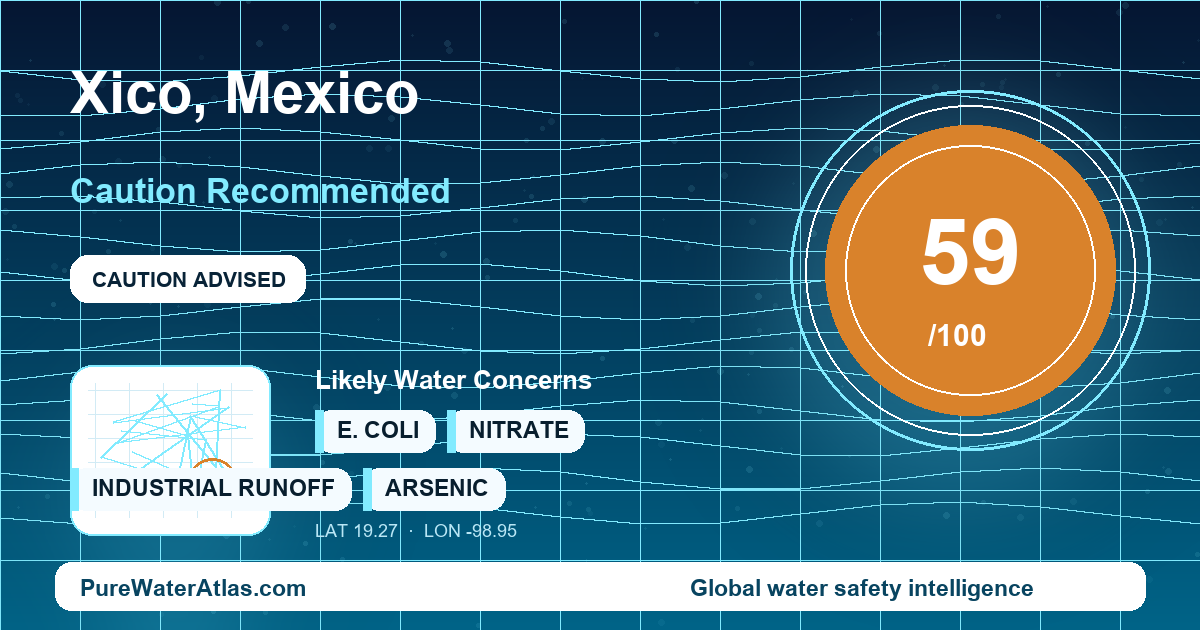
Xico, Veracruz is a humid mountain municipality with local spring and stream-fed water context, municipal distribution, and point-of-use risks that can vary by season, neighborhood pressure, and household storage tanks.
Quick Answer
| Overall safety status | Caution recommended. Xico’s tap water should not be assumed consistently safe to drink untreated at the point of use, especially after heavy rain, outages, repairs, or where water is stored in cisterns or roof tanks. |
|---|---|
| Water safety score | 59 / 100 — risk level: Caution Recommended |
| Traveler advice | Use sealed bottled water, boiled water, UV-treated water, or water from a verified hotel or restaurant filtration/disinfection system for drinking. |
| Resident advice | Confirm current municipal notices, maintain tinacos and cisterns, check free chlorine at the tap, and use a certified point-of-use barrier when microbial risk is suspected. |
| Main water source context | Local mountain water from the Cofre de Perote cloud-forest and foothill watershed area, likely including spring or stream-fed captations conveyed into the municipal network. |
| Responsible authority | Ayuntamiento de Xico through its municipal potable-water and sanitation function, with federal and state regulatory context from CONAGUA, Secretaría de Salud, COFEPRIS, and Veracruz water-sector institutions. |
| Filter recommendation | A sediment prefilter plus activated carbon is useful for clarity, taste, and chlorine-related issues; add UV, certified ultrafiltration, or boiling when microbial safety is uncertain. Reverse osmosis should be chosen based on testing, not guesswork. |
Why Xico Is Different
Xico is not a coastal city dealing with desalination, saltwater intrusion, or a large imported bulk-water system. It is an inland mountain municipality near Coatepec and Xalapa on the humid eastern slope of the Cofre de Perote region in Veracruz. Its water identity is tied to steep volcanic terrain, cloud-forest influence, high rainfall, springs, streams, and waterfalls, including the well-known Texolo area.
That setting can be favorable because local mountain catchments may provide abundant source water. It also creates a different safety profile from a large metropolitan utility. In a small municipal system, the final quality at a household tap may depend less on the idea of “pure mountain water” and more on whether source areas are protected, whether turbidity rises after storms, whether chlorination is consistent, whether pressure is maintained in distribution pipes, and whether property-level storage tanks are clean and sealed.
Xico is also a Pueblo Mágico with older central-area buildings and a tourism economy. Hotels, rentals, cafés, older homes, private cisterns, and roof tanks can create major building-by-building differences. Even if water leaves a municipal tank chlorinated, the final water at a sink may be affected by a dirty tinaco, an open cistern, stagnant premise plumbing, or a lack of measurable chlorine residual at the tap.
Where Does Xico’s Tap Water Come From?
Available municipal and regional context indicates that Xico depends on local mountain water from the Cofre de Perote cloud-forest and foothill watershed area. The likely supply pattern is spring or stream-fed captations conveyed by gravity or pumping toward municipal storage tanks and distribution mains. PureWaterAtlas did not find a current official Xico document that publicly lists every active drinking-water intake, treatment unit, storage tank, and distribution-zone laboratory result, so individual source names and operating status should be verified directly with the municipality.
The known infrastructure picture includes local spring or surface-water catchments in the upper Xico watershed area, conduction lines from source areas toward the town network, municipal storage tanks and distribution pipes operated locally, and disinfection by chlorination as the expected core public-health barrier under Mexican potable-water practice. No clearly identified large regional advanced-treatment plant or imported bulk-water aqueduct was found in public sources for Xico.
This matters because spring and stream-fed mountain systems can change quickly. Heavy Veracruz rainfall, tropical storms, landslides, disturbed catchments, or work on captation and distribution lines can increase turbidity and sediment. During dry periods, lower flows may increase operating stress and contribute to pressure changes or rationing. After outages, repairs, or visibly dirty water, residents should flush taps and use boiled, disinfected, or appropriately filtered water until clarity and chlorine residual are confirmed.
Who Manages Drinking Water in Xico?
Primary local responsibility rests with the Ayuntamiento de Xico, Veracruz, through its municipal potable-water and sanitation function, commonly handled by a municipal water office or Comisión Municipal de Agua Potable y Saneamiento. For a current service interruption, local repair, chlorination issue, billing question, or neighborhood-specific notice, the municipality is the most relevant first contact.
Mexico’s broader drinking-water framework is federal. CONAGUA’s national water-quality monitoring network and the Sistema Nacional de Información del Agua provide national and regional context, but they should not be read as a consumer-confidence-style tap-water report for every home in Xico. Health regulation is tied to Secretaría de Salud and COFEPRIS sanitary control for water for human use and consumption.
The key national standard is NOM-127-SSA1-2021, which establishes health criteria for water intended for human use and consumption in Mexico. That regulatory framework is important, but it does not prove that every household tap in Xico meets microbiological and chemical requirements at all times. PureWaterAtlas did not find a current Xico-specific public report with routine finished-water results by parameter, date, tank, treatment unit, or distribution zone.
Main Local Water Concerns
The primary Xico concern is microbial reliability, not coastal salinity or desalination chemistry. If source protection, chlorination, pipe pressure, or storage-tank hygiene fails, fecal-indicator organisms such as E. coli may become a concern. This is especially relevant after heavy rain, flooding, storm damage, landslides, repairs, or distribution pressure loss.
Turbidity and sediment are also important in Xico’s mountain setting. Cloudy or dirty water after storms or pipe work is not just an aesthetic issue: high turbidity can reduce disinfection effectiveness and can clog household filters. In a small spring or stream-fed system, sudden runoff pulses can change raw-water quality quickly.
Intermittent pressure and localized service interruptions are another risk driver because low or negative pressure can allow intrusion into distribution pipes. Household cisterns and tinacos are a major final barrier or failure point. A municipal supply that is acceptable when it enters a property can become unsafe if stored in an uncovered, dirty, insect-accessible, or animal-accessible tank.
Rural-edge homes, private connections, wells, or homes near agriculture, livestock, or septic influence should consider screening for nitrate and basic chemistry. Xico-specific finished-water results for nitrate, pesticides, metals, and routine disinfection parameters were not found in a current public report. Older buildings may also have premise-plumbing metal risks, including potential lead exposure from legacy plumbing, solder, brass fixtures, galvanized pipe, or stagnant plumbing runs. There is no verified citywide lead dataset for Xico, so the prudent approach is building-level testing.
For Travelers
Most visitors should not drink Xico tap water untreated. Use sealed bottled water, properly boiled water, UV-treated water, or water from a verified filtration and disinfection system. This is a risk-management recommendation, not a claim that all tap water in Xico is unsafe. The issue is uncertainty at the point of use, especially in a small municipal system with household or lodging storage tanks.
For brushing teeth, bottled or treated water is the lower-risk choice, especially for sensitive travelers, children, pregnant people, or anyone with a history of gastrointestinal illness while traveling. If you use tap water to brush, avoid swallowing it and be more cautious after storms, visible dirty water, outages, or stays in older lodging with unknown tank maintenance.
Use ice only when the hotel, café, or restaurant can confirm that it is made from purified water or commercial bagged ice. Avoid ice of unknown origin from small informal vendors. In Xico, as in many Mexican towns, water served to tourists may come from garrafón, bottled water, or a maintained purification system rather than straight tap water, but it is still reasonable to ask.
For waterfalls, hiking routes, and rural day trips, carry enough bottled or treated water. Do not treat clear spring or stream water as safe just because it looks clean or comes from a scenic mountain setting. Giardia, bacteria, and runoff contamination can occur in clear natural water. If you need an emergency method, see PureWaterAtlas guidance on boiling water purification and UV water purification.
For Residents
Residents should treat Xico tap water as a municipal supply that may be usable after verification and household risk control. A home treatment barrier is advisable unless you have current evidence of consistent residual chlorine and satisfactory microbiological results at your own tap. For many households, a sediment prefilter followed by activated carbon can improve clarity, taste, odor, and chlorine-related issues. When microbial risk is suspected, add UV, certified ultrafiltration, or boiling. Reverse osmosis can be useful if testing identifies nitrate, arsenic, excessive dissolved solids, or another dissolved contaminant, but it should not be selected blindly because it requires maintenance and does not solve every plumbing or storage problem by itself.
Testing priorities in Xico should reflect local risk drivers. Test for total coliform and E. coli after installing or cleaning a cistern, after pipe repairs, after flooding or storm damage, and whenever water has unusual odor, color, cloudiness, or illness concerns. Check free chlorine residual at the tap periodically, especially at the far end of household plumbing or after water has sat in a tinaco. Persistent cloudiness after heavy rain should be treated as a warning sign because turbidity can interfere with disinfection and shorten filter life.
If the home is older or has unknown plumbing, test first-draw and flushed samples for lead and other metals rather than assuming municipal source water is the only relevant risk. For infants, pregnant people, and long-term residents in older central-area buildings, building-level metals testing is especially prudent. PureWaterAtlas has a detailed guide to lead in drinking water testing and detection methods.
Cistern and tinaco hygiene is one of the most important resident actions in Xico. Keep tanks covered, screened from insects and animals, cleaned and disinfected on a routine schedule, and inspected after storms. A safe municipal source can become unsafe if stored in a dirty or open tank.
Relevant Contaminants and Water-Quality Issues
The most relevant Xico water-quality topics are practical and local: microbial indicators, disinfection residual, sediment movement, storm turbidity, household storage, and building plumbing. Start with E. coli because it is the key fecal-contamination indicator for small systems, storage tanks, and post-storm risk. Review turbidity and sediment if water becomes cloudy, brown, or gritty after rainfall, low pressure, or pipe repairs.
Chlorine is important because a measurable residual at the tap is one of the simplest field clues that municipal disinfection is reaching the point of use. It does not prove that every parameter is compliant, but absence of residual after storage or at distant taps should trigger caution. For older homes and rentals, lead is a premise-plumbing question rather than a verified citywide claim. For rural-edge homes, private-source users, or households near agriculture, livestock, or septic systems, nitrate screening is a reasonable addition; PureWaterAtlas also provides a guide to nitrate contamination testing and background on agricultural runoff in drinking water.
How to Verify Your Water Quality
Because PureWaterAtlas did not find a current Xico-specific public water-quality report with routine finished-water results by distribution zone, the best verification is local and point-specific. Ask the Ayuntamiento or local water office whether there are current advisories, recent repairs, chlorination problems, turbidity events, or neighborhood service interruptions. If you live in Xico, test the water that actually reaches your kitchen tap, not only the municipal source.
Use an accredited or reputable laboratory where possible for microbiology, nitrate, metals, and confirmatory chemistry. Home strips can help screen free chlorine and some basic parameters, but they are not a substitute for laboratory E. coli testing. For a structured approach, see the PureWaterAtlas pillar on how to test drinking water, the broader guide to drinking water safety, and the overview of water microbiology.
For choosing treatment after testing, compare options in water treatment systems and water purification methods. You can also use the PureWaterAtlas Contaminants Search Engine and the Global Water Quality Checker to compare Xico with other destinations and look up specific contaminants.
Official and Technical Sources
- Ayuntamiento de Xico, Veracruz — local government and primary municipal contact for services and notices.
- CONAGUA – Sistema Nacional de Información del Agua, calidad del agua — national water-quality context for Mexico.
- CONAGUA – Red Nacional de Medición de Calidad del Agua — official description of Mexico’s national water-quality monitoring network.
- Diario Oficial de la Federación – NOM-127-SSA1-2021 — federal potable-water health standard.
- COFEPRIS – Agua de uso y consumo humano — sanitary-control role for water for human use and consumption.
- INEGI – Censo de Población y Vivienda 2020 — demographic and household-services context for municipalities.
- SECTUR – Xico, Veracruz — official tourism context for Xico as a mountain destination.
- Gobierno del Estado de Veracruz – Comisión del Agua del Estado de Veracruz — state-level water-sector institution.
- Secretaría de Salud — federal health authority for sanitary standards and public-health framework.
Bottom Line
Xico’s tap-water profile calls for caution, not panic. The municipality sits in a wet mountain watershed with local spring and stream-fed water context, but PureWaterAtlas did not find a current public Xico report proving routine finished-water compliance at every distribution zone and household tap. The main risks are microbial contamination, storm turbidity, pressure interruptions, chlorination gaps, and dirty cisterns or roof tanks. Travelers should drink bottled, boiled, UV-treated, or verified purified water and confirm ice quality. Residents should maintain storage tanks, check free chlorine, test for E. coli after storms or repairs, and consider point-of-use treatment matched to actual test results. Final safety in Xico can vary significantly by property.
Read the full guide: Global Water Quality Guide
Explore more in this category: Global Water Quality Articles