
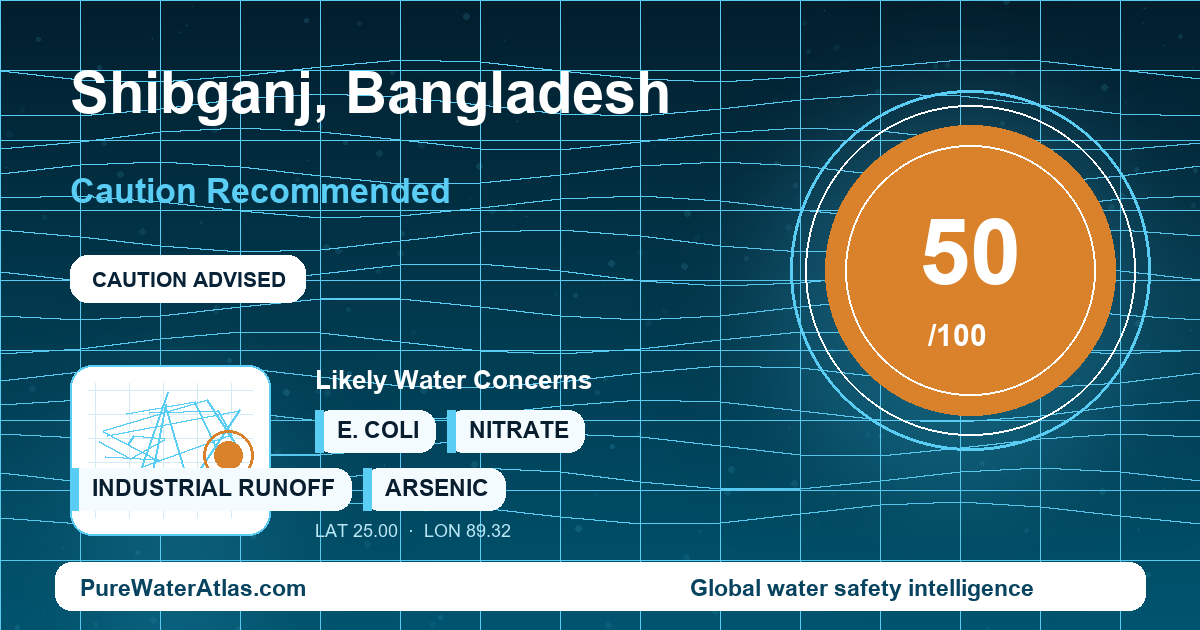
Shibganj, Chapainawabganj District, Bangladesh: a groundwater-dependent small-town and peri-urban water profile where safety depends on the exact well, tap, supply zone, and household storage conditions.
Quick Answer
| Overall safety status | Caution recommended. PureWaterAtlas assigns Shibganj a water safety score of 50/100. Publicly accessible, recent, city-level routine drinking-water compliance data for Shibganj could not be verified from open official sources. |
|---|---|
| Can visitors drink tap water? | No, not as a default travel practice. Visitors should use sealed bottled water, properly boiled water, or water treated with a proven purifier. |
| Resident advice | Treat safety as source-specific. A municipal tap, deep tube well, shallow tube well, and household storage tank can have different risks even within Shibganj or nearby unions. |
| Main water source context | Shibganj is best understood as a groundwater-dependent drinking-water area, with municipal and household supplies commonly relying on tube wells and local aquifers. |
| Responsible authority context | Where municipal piped supply exists, Shibganj Paurashava is the local body expected to manage municipal water services. The Department of Public Health Engineering supports rural and small-town water supply and water-quality functions nationally. |
| Filter recommendation | A filter may be advisable, but it should match test results. Microbial treatment does not solve arsenic; ordinary carbon filtration should not be assumed to remove arsenic or nitrate. |
Why Shibganj Is Different
This profile refers to Shibganj in Chapainawabganj District, northwestern Bangladesh, near the Padma/Ganges border-region landscape and the Barind-Ganges floodplain transition. Because Bangladesh has more than one place named Shibganj, the practical first step is confirming whether the water source is inside Shibganj Paurashava or in a surrounding union.
Shibganj is not a large metropolitan WASA city with routine consumer-facing water-quality dashboards. The local risk picture is therefore different from a city where one centralized utility publishes frequent compliance summaries. In Shibganj, drinking water may come from a municipal connection, a production tube well, a deep community or institutional tube well, a shallow household hand tube well, or water stored in a household tank. These sources can perform very differently.
The most important local theme is that clear-looking groundwater is not automatically safe. Bangladesh’s historic shift from visibly contaminated surface water to tube-well groundwater reduced many pathogen exposures, but it also revealed a major long-term groundwater-quality problem in many districts: arsenic in drinking water and other naturally occurring constituents vary strongly by aquifer and well depth. For Shibganj residents, that means safety should be evaluated well-by-well or supply-zone-by-supply-zone rather than by a single townwide assumption.
Shibganj is also in an agriculturally active part of Chapainawabganj, widely associated with mango and crop production. That does not prove nitrate or pesticide contamination in any particular well, but it does make wellhead protection, latrine setbacks, fertilizer storage, and testing more important for private and shared wells.
Where Does Shibganj’s Tap Water Come From?
Open sources do not verify a single treated surface-water source as the main drinking-water supply for Shibganj. The safest interpretation is that Shibganj is a groundwater-reliant drinking-water area. Municipal and household supplies in towns like Shibganj commonly depend on local aquifers accessed through production tube wells, deep tube wells, shallow hand tube wells, and private or shared wells.
The Padma/Ganges river system and local channels are geographically important in the wider Chapainawabganj-Shibganj area, especially for the regional landscape and agriculture. However, the dataset used for this profile does not verify those surface waters as the main treated drinking-water source for the town. Because of that, this page does not claim Shibganj tap water comes from a specific river treatment plant.
Key drinking-water infrastructure relevant to Shibganj includes household hand tube wells, private or shared groundwater wells, deep tube wells used for safer community or institutional supply where available, Shibganj Paurashava municipal piped-water infrastructure where service exists, and household overhead or ground-level storage tanks. Those storage tanks matter because they can become a contamination point after water leaves a well or pipe network. A source can test acceptably, yet water can become unsafe in a dirty, uncovered, poorly maintained tank or container.
Who Manages Drinking Water in Shibganj?
For municipal areas, Shibganj Paurashava is the local body expected to manage municipal water services where piped supply is provided. At the national level, the Department of Public Health Engineering, Government of Bangladesh, under the Ministry of Local Government, Rural Development and Co-operatives, is the main technical agency for rural and small-town water supply and sanitation support outside the large WASA cities.
Bangladesh drinking-water safety is governed through national drinking-water standards, public-health engineering programs, local government water-service responsibilities, and testing functions. In Shibganj, however, open sources did not provide a recent public consumer-facing water-quality report with routine results for arsenic, E. coli, residual chlorine, turbidity, nitrate, iron, manganese, and distribution-system performance. This is a major data limitation. Any claim that every Shibganj tap meets a specific standard would require current test data from the exact municipal zone, well, tap, or storage system.
Administrative and geographic context for the Shibganj assessed here is supported by Banglapedia’s Shibganj Upazila reference and national statistical context from the Bangladesh Bureau of Statistics.
Main Local Water Concerns
- Arsenic in groundwater: Bangladesh has one of the world’s best-documented groundwater arsenic problems. Arsenic cannot be detected by taste, smell, or color. Evidence is strong for Bangladesh as a national and regional groundwater issue, but recent neighborhood-level Shibganj values were not verified from open public sources.
- Microbial contamination including E. coli: Tube wells, taps, and stored household water can become contaminated by nearby latrines, damaged platforms, flooding, dirty containers, or low-pressure events. This is especially relevant during monsoon and flood periods.
- Iron and manganese: Groundwater in Bangladesh often contains iron or manganese that can cause reddish staining, black particles, metallic taste, or filter clogging. Elevated manganese may require targeted treatment.
- Turbidity and sediment: Sediment can enter from wells, old pipes, intermittent flow, tank contamination, or maintenance work. Cloudy water can interfere with disinfection and should be treated as a warning sign.
- Nitrate: Shallow wells near latrines, animal waste, fertilizer storage, or intensively cultivated land can be vulnerable. Infants and pregnant people are the most sensitive groups for nitrate exposure.
- Salinity: Shibganj is inland, so coastal salinity intrusion is not the main risk driver. Local mineral content and conductivity can still affect taste and suitability of individual groundwater sources.
Seasonal conditions matter. During monsoon and flood periods, heavy rain, ponding, and floodwater can contaminate shallow wells, hand-pump platforms, distribution leaks, and household tanks. During the dry season, lower groundwater levels and higher pumping demand may increase reliance on alternative or stored water. After maintenance or power interruptions, restarted flows can mobilize sediment and biofilm, so residents should flush taps and avoid drinking visibly turbid water without treatment.
For Travelers
Visitors should not drink untreated tap water in Shibganj as a default practice. This applies whether the water is described locally as municipal tap water, tube-well water, or stored household water, unless the source is verified safe and the water has been appropriately treated. Short-stay travelers are more likely to react to microbial contamination, and extra caution is important for children, pregnant travelers, older adults, and anyone with a weakened immune system or sensitive stomach.
Use sealed bottled water for drinking and for brushing teeth. If bottled water is unavailable, bring water to a rolling boil and let it cool in a clean, covered container. Boiling is useful for microbial risk, but it does not remove arsenic, nitrate, iron, manganese, salinity, or dissolved minerals. For more detail, see the PureWaterAtlas boiling water purification guide.
Avoid ice unless you know it was made from treated water. In small-town settings, ice may be produced off-site, and its source water is often not transparent to customers. In hotels and restaurants, ask for sealed bottled water. Hot tea and fully boiled beverages are generally lower risk when served steaming hot. Be cautious with uncooked foods washed in tap water, diluted juices, and open containers of drinking water.
For road travel around Shibganj and Chapainawabganj, carry bottled water. Travelers can also review broader destination precautions from CDC Travelers’ Health: Bangladesh.
For Residents
Residents should treat water safety in Shibganj as source-specific. Do not rely on appearance, taste, a neighbor’s result, or the assumption that a deeper or older well is automatically safe. Test the actual source used for drinking, especially if it is a private tube well, a shallow well, a storage tank, or a connection with intermittent service.
The highest-priority test for any private or unverified groundwater source is arsenic. Retest after installing a new well, changing well depth, changing treatment equipment, or relying on an old unmarked well. E. coli or thermotolerant coliform testing is also high priority for household tanks, shallow wells, wells near latrines, and water used by children, pregnant people, or older adults. Iron and manganese testing is recommended where water stains fixtures, tastes metallic, leaves reddish or black particles, or clogs filters. Nitrate testing is recommended for shallow wells near latrines, animal enclosures, fertilizer storage, or cultivated land, especially where infants use the water.
A home filter or treatment system can be useful, but it should be chosen after testing. For microbial risk, boiling, chlorination, UV, or certified microbiological filtration may help. UV systems require low-turbidity water and appropriate prefiltration; see the PureWaterAtlas UV water purification guide. For arsenic, use a technology specifically rated for arsenic removal, such as appropriate adsorption media or reverse osmosis, and verify performance with follow-up testing. A basic carbon filter alone should not be assumed to remove arsenic or nitrate. PureWaterAtlas also has a guide to arsenic filters and treatment options.
Older plumbing, improvised repairs, galvanized pipes, brass fittings, and rooftop tank connections can affect tap quality even if the source water is acceptable. Flush taps after stagnation, especially after interruptions or maintenance. Household storage tanks should be covered, screened from insects and animals, cleaned on a schedule, and disinfected after contamination events. Treated water can be recontaminated if stored in a dirty vessel.
Relevant Contaminants and Water-Quality Issues
The most important contaminant to verify in Shibganj groundwater is arsenic. It is invisible, tasteless, and well-specific. Residents using tube wells should also understand E. coli in drinking water, because microbial contamination can occur through sanitation proximity, flooding, damaged platforms, and household storage.
Cloudy or dirty water should be interpreted through the lens of turbidity and sediment. Turbidity can reduce disinfection effectiveness and can signal disturbance in a well, pipe, or tank. Groundwater taste and staining complaints may involve iron or manganese. Shallow wells near latrines, animal waste, or cultivated land should also consider nitrate, particularly when infants or pregnant people use the water.
How to Verify Your Water Quality
The most reliable way to answer “Is my Shibganj water safe?” is to test the water actually used for drinking. A municipal tap, private tube well, school well, mosque well, restaurant water source, and household storage tank can all produce different results. Start with arsenic and E. coli, then add turbidity, iron, manganese, nitrate, and electrical conductivity or total dissolved solids depending on the source and symptoms.
For a testing framework, use the PureWaterAtlas complete water testing guide. For broader decision-making, see Drinking Water Safety, Water Microbiology, and Water Treatment Systems. To compare issues, use the Contaminants Search Engine. Travelers and residents comparing destinations can also use the Global Water Quality Checker and the Global Water Quality guide.
For arsenic-specific testing methods, see Arsenic in Drinking Water: Testing and Detection Methods. For shallow-well and agriculture-related concerns, see Nitrate Contamination in Drinking Water: Testing and Detection Methods.
Official and Technical Sources
- Department of Public Health Engineering, Government of Bangladesh — national technical agency for public water supply and sanitation outside major WASA cities.
- Banglapedia: Shibganj Upazila, Chapainawabganj District — geographic and administrative reference for this Shibganj.
- Bangladesh Bureau of Statistics — national statistical context for administrative and demographic interpretation.
- WHO/UNICEF Joint Monitoring Programme: Bangladesh WASH data — national drinking-water and sanitation service context.
- UNICEF Bangladesh: Water, Sanitation and Hygiene — public-health context for Bangladesh WASH challenges.
- British Geological Survey: Arsenic contamination of groundwater in Bangladesh — major technical reference on Bangladesh groundwater arsenic.
- WHO Guidelines for Drinking-water Quality — international reference for microbial, chemical, and operational risks.
- World Bank: Bangladesh Arsenic Mitigation Water Supply Project — project reference documenting the scale of arsenic mitigation.
- Local Government Engineering Department, Government of Bangladesh — local infrastructure context.
Bottom Line
Shibganj tap water should be treated with caution, not assumed safe townwide. The main reason is not one verified local contamination event, but the absence of recent public Shibganj-level compliance reporting combined with a groundwater-dependent supply pattern. Municipal taps, deep tube wells, shallow tube wells, and household storage tanks can each carry different risks. Visitors should use sealed bottled water, boiled water, or a proven purifier and should avoid untreated tap water, ice of unknown origin, and open drinking-water containers. Residents should test their actual drinking-water source for arsenic and E. coli first, then consider iron, manganese, turbidity, nitrate, and conductivity based on the source and symptoms. Choose treatment only after testing.
Read the full guide: Global Water Quality Guide
Explore more in this category: Global Water Quality Articles