
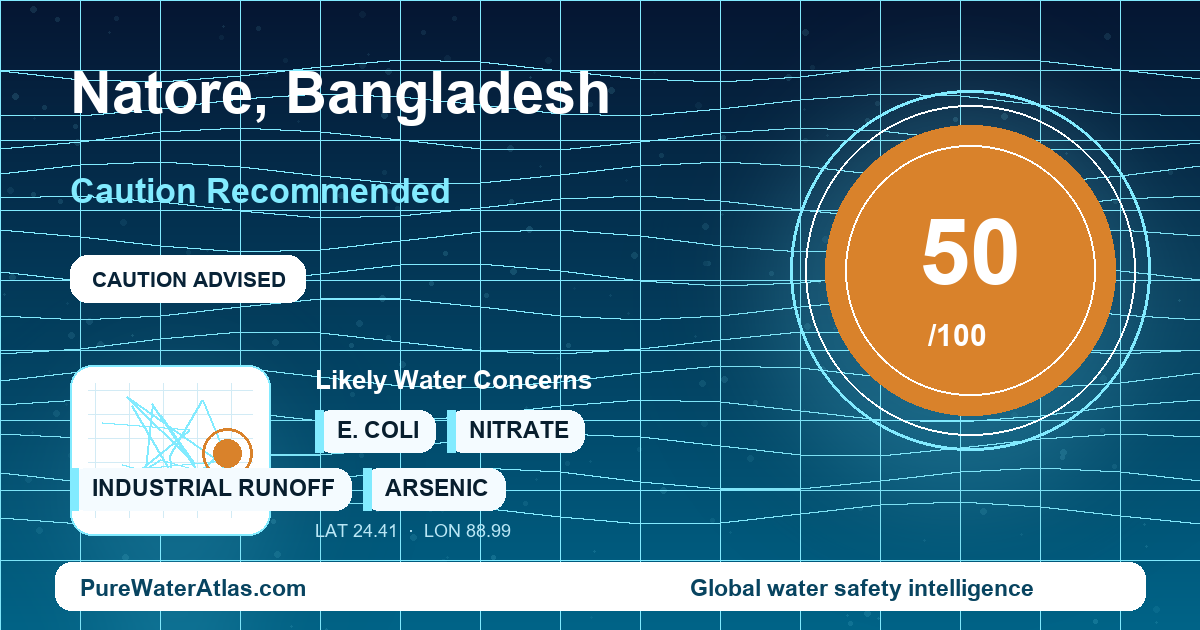
Natore, Bangladesh: groundwater-based drinking water with source-specific arsenic, microbial, storage, and household treatment considerations.
Quick Answer
| Water safety score | 50 / 100 |
|---|---|
| Overall status | Caution Recommended. Natore tap or tubewell water should not be assumed safe without source-specific testing and treatment. |
| For travelers | Do not drink untreated tap water in Natore. Use sealed bottled water, boiled water, or water treated by a proven filter or UV system. |
| For residents | Identify whether your home uses Natore Pourashava water, a private tubewell, a shared pump, or mixed sources. Test and treat accordingly. |
| Main water source | Predominantly groundwater from municipal production tubewells, deep tubewells, private hand tubewells, and local distribution systems. |
| Relevant authority | Natore Pourashava for municipal supply within the municipality, with sector support from Bangladesh’s Department of Public Health Engineering. |
| Filter recommendation | Often advisable, but the correct system depends on the source. Municipal piped water may need sediment control and disinfection; private wells should be tested for arsenic, iron, manganese, nitrate, and microbial indicators before choosing treatment. |
Natore’s drinking-water risk is not defined by one public contaminant number. The practical issue is uncertainty: groundwater chemistry can vary by well, piped water can be affected by intermittent pressure or storage, and recent public city-level consumer tap-water reports are limited. This guide therefore treats Natore water as source-specific rather than automatically safe or unsafe at every tap.
Why Natore Is Different
Natore is the district headquarters of Natore District in Rajshahi Division, in northwestern Bangladesh. It is an inland municipality, so coastal salinity intrusion is not the main local drinking-water issue. For Natore, the more relevant concerns are groundwater quality, sanitation protection around wells and pipes, monsoon-related contamination, intermittent supply, and household storage hygiene.
The city’s drinking-water identity is closely tied to groundwater. Natore Pourashava and nearby households are understood to depend mainly on production tubewells, deep tubewells, and private hand tubewells tapping local aquifers. There is no strong public evidence that Natore city relies on a large conventional river-water treatment plant for routine municipal drinking water. That matters because groundwater can look clear and still contain naturally occurring chemical contaminants, while piped or stored water can become microbiologically unsafe after abstraction.
Bangladesh expanded tubewell use because groundwater was historically considered microbiologically safer than ponds, rivers, and other surface sources. The later national arsenic crisis showed why that assumption is incomplete: groundwater safety can vary greatly by aquifer and even by individual well. In Natore, this means a tubewell should be tested rather than judged by taste, clarity, depth claims, or a neighbor’s experience.
Where Does Natore’s Tap Water Come From?
The realistic drinking-water pathway in Natore is groundwater pumped through a municipal or local distribution system, then often stored in building tanks or household containers before drinking. Key infrastructure may include Natore Pourashava municipal water-supply network sections, production tubewells or deep tubewells used for abstraction, pump houses, local distribution mains, overhead or elevated storage reservoirs where used, rooftop tanks, ground-level tanks, drums, jars, and private or institutional hand-pumped tubewells in peri-urban or non-networked areas.
Each step creates a separate risk point. Water can be affected at the wellhead if the source is chemically unsuitable or poorly protected. It can be affected in the pump and pipe network if pressure is intermittent or pipes are damaged. It can be affected in household tanks if covers are loose, insects or dust enter, cleaning is neglected, or floodwater reaches storage areas. This is why two homes in Natore may have different water quality even if both describe their water simply as “tap water.”
Season also matters. Monsoon rain can increase floodwater intrusion, drain overflow, turbidity, and microbial contamination risk, particularly where wells, pipes, or tanks are not well sealed. Heavy rain can contaminate shallow wells through surface runoff. In the dry season, groundwater pumping can change water levels and may worsen taste, color, or mineral concentration in some wells. Power outages and pump interruptions can also create intermittent supply, increasing the chance that contaminated water is drawn into leaky pipes.
Who Manages Drinking Water in Natore?
Within the municipality, local service responsibility sits with Natore Pourashava. Bangladesh’s Department of Public Health Engineering provides national technical and sector support for public water supply and sanitation, including groundwater-based systems outside the largest WASA cities. The Local Government Division is the national government division overseeing local government institutions and urban water-supply governance.
National drinking-water policy and standards are set through government agencies including the Local Government Division, DPHE, and Bangladesh Standards and Testing Institution. For Natore consumers, the practical gap is that national standards do not necessarily translate into publicly available, connection-level results for every municipal pipe, household tank, school, restaurant, or private tubewell.
Private wells are commonly household-managed and may not receive routine utility monitoring. If a family uses a private or shared tubewell, the household should not assume the water has been recently checked by a public authority. Testing is the only reliable way to know whether that specific source is suitable for drinking.
Main Local Water Concerns
Arsenic risk must be checked by testing. Natore should not be assumed arsenic-free based on taste, clarity, well depth claims, or neighbor results. Bangladesh’s groundwater arsenic history shows why well-by-well verification is essential. See PureWaterAtlas guidance on arsenic, arsenic testing and detection, and arsenic treatment options.
Microbial contamination is a practical day-to-day concern. Even if groundwater is chemically acceptable, contamination can occur through unsafe storage, cracked pipes, intermittent pressure, contaminated containers, flooding, or poor sanitation separation from wells. E. coli or thermotolerant coliform testing is especially relevant for stored water, shallow wells, flood-affected wells, and household tanks.
Iron and manganese can affect groundwater usability. In many parts of Bangladesh, iron and manganese can cause staining, metallic taste, deposits, blackish or reddish water, and treatment challenges. These should be included in resident testing where Natore water is colored, metallic, or leaves sediment in tanks and fixtures.
Turbidity and sediment reduce treatment reliability. Cloudy water can appear after pipe repairs, pump disturbances, monsoon flooding, or tank cleaning. High turbidity can interfere with chlorine and UV disinfection, so sediment filtration before disinfection is important when water is not clear.
Nitrate, agricultural, and plumbing-related issues are source-specific. Nitrate concerns are plausible where wells are near latrines, drains, animal areas, fertilizer storage, crop fields, or dense settlement, but Natore-specific concentrations should not be claimed without laboratory testing. Lead is not documented as a Natore-wide municipal source-water issue, but older building plumbing, brass fixtures, solder, pumps, and storage components can add metals at the tap.
For Travelers
Most visitors should not drink untreated Natore tap water. Use sealed bottled water from a reliable shop, boiled water, or water treated by a proven purifier. Check bottle caps for intact seals and avoid refilled bottles. In hot weather, carrying oral rehydration salts is practical, especially if traveling between towns or eating outside hotels.
Use bottled, boiled, or otherwise treated water for brushing teeth, particularly for short-stay visitors, children, and anyone with a sensitive stomach. Tap water may be acceptable for bathing, but avoid swallowing it. Use treated water for medicines, infant formula, and any medical or dental hygiene use.
Avoid ice unless the hotel or restaurant can confirm it was made from bottled or properly treated water. In smaller restaurants, street settings, or places where water is stored in open containers, assume ice may be made from local tap or stored water. Be cautious with salads, chutneys, cut fruit, uncooked foods washed in tap water, and drinks served in refilled bottles.
Better hotels may provide bottled or filtered water, but do not assume all kitchen water, ice, or food-washing water is treated. Ask specifically whether water is boiled, filtered, UV-treated, or from sealed bottles. If using a portable purifier, combine sediment prefiltration with disinfection; UV alone is less reliable in cloudy water. For broader travel context, the CDC Travelers’ Health page for Bangladesh supports safe food and water practices.
For Residents
Natore residents should start by identifying the actual household source: Natore Pourashava piped supply, a private tubewell, a shared pump, a building storage tank, jar water, or a mix of these. A municipal connection may be safer than an untested shallow household tubewell, but it still depends on pipe condition, pressure stability, tank hygiene, and household handling.
For municipal piped water, a sediment prefilter plus disinfection or a maintained purifier can reduce turbidity and microbial risk. For private tubewells, test first; do not buy a filter based only on taste, color, or a salesman’s claim. Test for arsenic through DPHE, an approved laboratory, or a reliable field-testing program, and retest if the well is new, repaired, deepened, or the source changes. Add E. coli or thermotolerant coliform testing when water is stored, shallow, flood-affected, or drawn from a tank. Test iron and manganese if water stains, tastes metallic, or forms deposits. Test nitrate where wells are near latrines, drains, animal areas, fertilizer storage, crop fields, or densely settled plots.
Households with babies, pregnant residents, elderly residents, or immunocompromised people should use tested and treated water consistently, not only during visible illness outbreaks. Reverse osmosis can help with several dissolved contaminants, but it requires maintenance and safe wastewater handling. Boiling is useful for microbial risk but does not remove arsenic, nitrate, iron, manganese, or lead.
Older or poorly maintained buildings can introduce metals or sediment from internal plumbing, pumps, fittings, solder, brass fixtures, or corroded tanks. If water is worse at one building than at nearby taps, compare first-draw and flushed samples. Storage tanks are a major control point: keep tanks covered, screened, raised from floodwater, and regularly cleaned and disinfected. Prevent animals, insects, dust, and roof runoff from entering, and use a clean tap or ladle rather than dipping cups into stored water.
Relevant Contaminants and Water-Quality Issues
The most relevant Natore water-quality topics are groundwater chemistry and microbial control from source to storage. The contaminant pages most directly connected to Natore’s risk profile are arsenic, E. coli, turbidity, iron, manganese, nitrate, and lead. These should not be read as claims that every Natore source exceeds a limit; they are the issues most appropriate to verify for a groundwater-based and storage-dependent drinking-water system.
For treatment background, see PureWaterAtlas guides to boiling water purification, UV water purification, water purification methods, and choosing water treatment systems. For agricultural-area concerns, see agricultural runoff in drinking water.
How to Verify Your Water Quality
Because recent Natore-specific public data were not found for routine tap-water compliance, residual chlorine at consumer taps, current municipal well results, distribution-zone pressure, tank hygiene, or ward-by-ward arsenic and microbial mapping, verification should happen at the actual source and tap. This limitation is important: the available evidence supports caution, but it does not prove that every Natore tap is unsafe or that every Natore well exceeds a chemical limit.
Residents can use a step-by-step approach. First, identify the source. Second, test for arsenic and basic chemistry if the source is a private or shared tubewell. Third, test for E. coli or thermotolerant coliforms if water is stored, shallow, flood-affected, or used by vulnerable people. Fourth, match treatment to the test results rather than relying on a generic filter. After flooding, pipe repairs, pump changes, or tank cleaning, flush taps and consider microbial testing before using the water untreated.
PureWaterAtlas resources that may help include the complete guide to water testing, the drinking water safety guide, the water microbiology guide, the Global Water Quality Checker, and the Contaminants Search Engine. Related categories include Global Water Quality, Drinking Water Safety, Water Testing, and Water Contamination.
Official and Technical Sources
- Natore Pourashava — local municipal authority context for services within Natore town.
- Department of Public Health Engineering, Government of Bangladesh — national technical agency supporting public water supply and sanitation.
- Local Government Division — national governance context for local government and urban water supply.
- WHO and UNICEF Joint Monitoring Programme data for Bangladesh — national WASH context for safely managed drinking water.
- UNICEF Multiple Indicator Cluster Surveys — household water, sanitation, hygiene, and water-quality survey context.
- British Geological Survey and DPHE arsenic studies in Bangladesh — technical background on groundwater arsenic risk and well-by-well testing.
- CDC Travelers’ Health: Bangladesh — traveler food and water safety guidance.
- WHO Guidelines for Drinking-water Quality — international reference for microbial safety, chemical contaminants, and source-to-tap risk management.
Bottom Line
Natore’s tap water should be approached with caution because the city is understood to rely mainly on groundwater and local distribution rather than a large publicly documented treated surface-water system. Visitors should avoid untreated tap water and use sealed bottled, boiled, or reliably treated water, including for brushing teeth. Residents should treat water quality as source-specific: municipal supply, private tubewells, shared pumps, and household tanks can have different risks. The most important checks are arsenic for wells, microbial indicators for stored or flood-affected water, and iron, manganese, nitrate, turbidity, and plumbing-related metals where conditions suggest them. Because recent Natore-level public compliance data are limited, testing at the actual source and tap is the most reliable safety step.
Read the full guide: Global Water Quality Guide
Explore more in this category: Global Water Quality Articles