
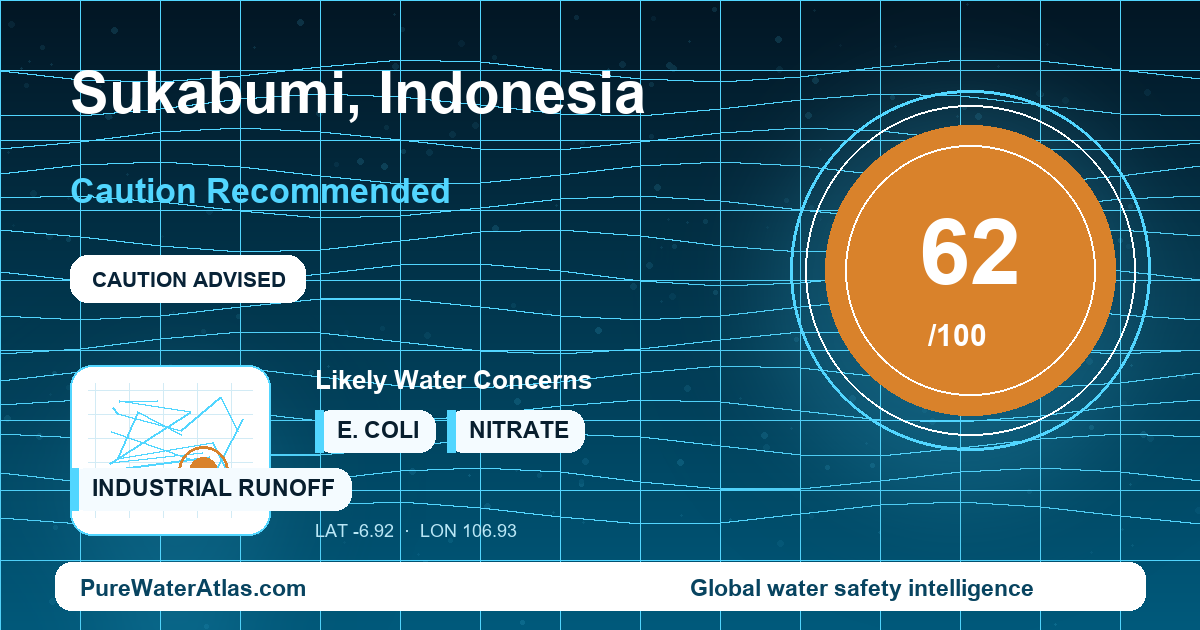
Sukabumi, West Java: inland upland water supply, municipal utility service, and practical tap-water precautions for visitors and residents.
Quick Answer
| Water safety score | 62 / 100 |
|---|---|
| Risk level | Caution Recommended |
| Can you drink Sukabumi tap water? | Not recommended untreated. Treat tap water before drinking unless you have recent local test results and confidence in your building plumbing and storage tanks. |
| Traveler advice | Use sealed bottled water, reputable refill gallons, or water that has been boiled, UV-treated, or filtered with an appropriate system. Be cautious with ice and dispenser water unless purification is confirmed. |
| Resident advice | Municipal water can generally be used for bathing and cleaning, but drinking water should have an added household barrier such as boiling, UV disinfection, or a maintained filter system, especially after outages, repairs, floods, or visible turbidity. |
| Main water setting | Upland West Java spring, surface-water, and groundwater context associated with mountainous catchments around Sukabumi, including the broader upper Cimandiri and Gede-Pangrango area. |
| Water authority | Perumda Air Minum Tirta Bumi Wibawa Kota Sukabumi, with oversight linked to Pemerintah Kota Sukabumi, the local health office, and Indonesian Ministry of Health standards. |
| Filter recommendation | For piped water, use sediment prefiltration and activated carbon for clarity, taste, and chlorine odor, plus boiling or UV for microbial protection. For wells, test first and match treatment to results. |
Confidence level: moderate. Sukabumi has identifiable water institutions and national regulatory standards, but a current, comprehensive, publicly accessible city-level consumer confidence report with routine finished-water results by treatment plant or distribution zone was not found.
Why Sukabumi Is Different
Sukabumi is not a coastal Indonesian water-supply case. It is an inland upland city in West Java, located south of the Gede-Pangrango volcanic highlands and far from the coast. That geography matters: seawater intrusion is not the main concern for drinking water in Sukabumi. The more relevant local risks are wet-season runoff, hillside erosion, storm turbidity, catchment protection, nearby sanitation, and what happens to water after it enters the distribution network or a household storage tank.
The city’s drinking-water context is therefore different from large coastal cities such as Jakarta or Semarang. Sukabumi’s water history is tied more to springs, hillside streams, and local groundwater than to large lowland reservoirs or desalination. This upland setting can be favorable, but it is not automatically safe at the tap. Mountain catchments can become turbid after intense rain, landslides can increase sediment loads, and dense settlement patterns or septic systems can affect shallow groundwater and local drainage.
The practical PureWaterAtlas verdict for Sukabumi is caution recommended. The city has an organized municipal utility, Perumda Air Minum Tirta Bumi Wibawa, and its raw-water setting is not dominated by salinity. However, the safety of water at a household tap can be shaped by pipe pressure, leaks, building plumbing, storage tanks, private wells, and short-term events such as outages or repairs. Because public city-level tap-water results are limited, untreated tap water should not be assumed potable for drinking.
Where Does Sukabumi’s Tap Water Come From?
Sukabumi’s public piped-water system is operated by Perumda Air Minum Tirta Bumi Wibawa Kota Sukabumi. The available source context points to an upland West Java supply setting: spring and surface-water sources from small rivers and mountainous catchments around Sukabumi, within the broader upper Cimandiri and Gede-Pangrango area. This is a local catchment-based water identity rather than a coastal desalination or seawater-intrusion story.
Important infrastructure includes the local SPAM drinking-water system, with intakes, treatment or chlorination facilities, reservoirs, and distribution pipes. The municipal network is only part of the full water pathway. Household roof tanks and ground storage tanks are common practical control points for contamination. In many homes, the water people actually drink has passed through a building tank, internal plumbing, hoses, dispensers, or refill-gallon storage before reaching a glass.
Many households also supplement or replace piped water with private wells, boreholes, depot air minum isi ulang, or bottled gallon water. That means Sukabumi residents may not share one uniform water profile. A home connected to Perumda supply, a boarding house using a roof tank, a household relying on a shallow well, and a family drinking refill-gallon water can face different water-quality risks. For private wells, local contamination from septic systems, drains, flooding, or nearby agriculture can be more important than the municipal source-water picture.
Who Manages Drinking Water in Sukabumi?
The local drinking-water utility is Perumda Air Minum Tirta Bumi Wibawa Kota Sukabumi. It is the most direct official entry point for customer service, utility information, and operational notices affecting piped-water users in the city. Broader local governance is linked to the Pemerintah Kota Sukabumi official portal, while city statistics and public-service context can be checked through BPS Kota Sukabumi.
Indonesia’s current national drinking-water health requirements are governed through Ministry of Health Regulation No. 2 of 2023, available through the BPK regulation database. Drinking-water infrastructure and SPAM policy context are also connected to the national Ministry of Public Works and Housing SPAM information portal.
A key limitation for Sukabumi is public disclosure. This review did not find a current, comprehensive Sukabumi consumer confidence report showing routine finished-water results by treatment plant, reservoir, or distribution zone. That does not prove the water is unsafe, but it prevents a strong public-data-based claim that every tap consistently meets a particular standard. In practice, building plumbing, intermittent pressure, storage tanks, and private wells can dominate household risk.
Main Local Water Concerns
The leading concern for untreated drinking water in Sukabumi is microbial contamination. This can affect untreated tap water after distribution-network intrusion, private wells near septic systems or drains, and water stored in tanks that are not cleaned and protected. Total coliform and E. coli are especially important indicators for wells and stored water. Learn more in the PureWaterAtlas guide to E. coli in drinking water.
Turbidity and sediment are also important in Sukabumi’s upland setting. Heavy rain, catchment erosion, landslides, pipe flushing, and repairs can make water cloudy or sediment-laden. Turbid water is not only unpleasant; it can interfere with disinfection and signal a higher chance of microbial risk. Relevant PureWaterAtlas references include turbidity in drinking water and sediment in drinking water.
Low-pressure or intermittent supply can increase risk by allowing intrusion through leaks or cross-connections. After outages, pipe repairs, or visibly cloudy water, residents should flush taps and use boiled or otherwise disinfected water for drinking until water is clear and normal service is restored. Dry-season flow reduction can also stress small streams and springs, potentially concentrating contaminants or contributing to service interruptions.
Private wells require separate attention. Possible issues include E. coli, nitrate from sanitation or agriculture, iron, manganese, unpleasant taste, staining, and sediment. In older houses, schools, clinics, boarding houses, or buildings with unknown plumbing, lead risk should not be assumed away. No public evidence was found for widespread lead service lines in Sukabumi, but older fixtures, brass components, solder, and premise plumbing can still affect water at the tap. Testing is the responsible way to assess that risk.
For Travelers
Short-stay visitors should not drink Sukabumi tap water untreated. Use sealed bottled water, reputable refill gallons, or water that has been boiled, UV-treated, or filtered with an appropriate purifier. This is especially important for visitors with sensitive stomachs, people who are immunocompromised, small children, and anyone taking medication with water.
For brushing teeth, bottled, boiled, or purified water is the safest choice for short stays. Many local residents may brush with tap water, but visitors should avoid swallowing untreated tap water because they do not have the same local exposure history and may not know the building’s storage and plumbing conditions.
Use extra caution with ice. Avoid ice from informal vendors unless you know it is made from purified or factory-produced water. In hotels, cafes, and restaurants, ask whether ice is made from air matang or purified water. Better hotels and restaurants may provide sealed bottles, gallon dispensers, or filtered water, but do not assume bathroom tap water is potable. If using a room dispenser, check that the gallon seal is intact and that the dispenser appears maintained.
Hot tea and coffee are generally lower risk when the water has been brought to a rolling boil. For longer stays, a practical setup is a kettle plus a maintained filter or UV unit. Boiling is the most reliable household microbial barrier when water clarity is acceptable; see the PureWaterAtlas boiling water purification guide and UV water purification guide for method details. Travelers can also review CDC Travelers’ Health guidance for Indonesia.
For Residents
Residents connected to Perumda supply may use tap water for bathing, cleaning, and general household use, but drinking water should have an added barrier unless recent local testing and building conditions support direct consumption. A sediment prefilter plus activated carbon can improve clarity, taste, and chlorine odor. For microbial protection, use boiling or UV disinfection. If using reverse osmosis, remember that it must be maintained properly and paired with safe storage.
Private well users should test at least annually for total coliform and E. coli, and again after flooding, well repairs, or nearby septic problems. Shallow wells or homes near agriculture, septic tanks, drains, or dense settlement should also consider nitrate and nitrite testing. Iron and manganese testing is useful if water stains laundry, fixtures, or tanks, or if it has metallic taste, black sediment, or brown sediment.
Older buildings need special caution. A municipal source result does not necessarily represent what comes out of an old building tap. Older fixtures, corroded premise plumbing, brass fittings, solder, and stagnant water can change metal levels. Flush taps after overnight stagnation, use only cold water for cooking and drinking, and test first-draw and flushed samples for lead and other metals if pregnant people, infants, or children use the water.
Storage tanks are one of the most important household risk points in Sukabumi. Roof tanks and ground tanks should be covered, insect-proof, protected from roof runoff and animals, drained and cleaned on a regular schedule, and disinfected after repairs or contamination. If tank water smells, looks cloudy, contains sediment, or has been stagnant, boil or disinfect it before drinking.
Relevant Contaminants and Water-Quality Issues
For Sukabumi, the most relevant PureWaterAtlas contaminant and water-quality profiles are those tied to upland catchment events, distribution conditions, wells, and household plumbing. Start with turbidity and sediment if your water becomes cloudy after heavy rain, pipe work, or outages. Review E. coli if you use a well, storage tank, refill water, or any source with uncertain disinfection.
Chlorine is relevant because disinfection helps control microbial risk, but taste and odor may vary, and low residual chlorine at the far end of a network can reduce protection. See chlorine in drinking water. For wells or homes near sanitation or agriculture, nitrate is a priority concern; the guide to nitrate testing and detection explains how to verify it. For older plumbing, see lead in drinking water and lead testing methods.
How to Verify Your Water Quality
The best way to verify water quality in Sukabumi is to test the water you actually drink: the kitchen tap after building plumbing, the roof-tank outlet, the private well, the dispenser, or the stored refill gallon. For a general framework, use the PureWaterAtlas guide to water testing. For broader safety principles, see Drinking Water Safety, Water Microbiology, and Water Purification.
If you are comparing risks or researching a specific contaminant, use the Contaminants Search Engine. For a broader location-based comparison, use the Global Water Quality Checker. Because Sukabumi lacks a comprehensive public finished-water report by distribution zone, household-level testing is especially useful for wells, old buildings, storage tanks, schools, clinics, boarding houses, and homes with infants or pregnant residents.
Official and Technical Sources
- Perumda Air Minum Tirta Bumi Wibawa Kota Sukabumi — local municipal drinking-water utility.
- Pemerintah Kota Sukabumi official portal — municipal public-service and governance context.
- BPS Kota Sukabumi — official statistics and city publications.
- Ministry of Health Regulation No. 2 of 2023 — Indonesian environmental health quality standards including drinking-water requirements.
- Ministry of Public Works and Housing SPAM information portal — national drinking-water infrastructure and SPAM context.
- BMKG Indonesia — rainfall, weather warnings, and seasonal conditions affecting turbidity, flooding, landslides, and source-water risk.
- CDC Travelers’ Health: Indonesia — traveler food and water precautions.
- WHO Guidelines for Drinking-water Quality — international public-health framework for microbial safety, disinfection, and drinking-water risk.
Bottom Line
Sukabumi’s tap-water risk is best described as caution recommended, not automatic rejection and not automatic potability. The city has a named municipal utility, Perumda Air Minum Tirta Bumi Wibawa, and an inland upland source setting where salinity intrusion is not the main concern. The practical risks are wet-season turbidity, catchment erosion, intermittent pressure, pipe repairs, private wells, roof tanks, refill-water handling, and building plumbing. Visitors should drink sealed bottled water, reputable refill water, or boiled, UV-treated, or properly filtered water. Residents should add a household treatment barrier for drinking and test wells or older building taps. Because detailed public Sukabumi tap-by-tap results are limited, verify your own water before relying on it untreated.
Read the full guide: Global Water Quality Guide
Explore more in this category: Global Water Quality Articles