
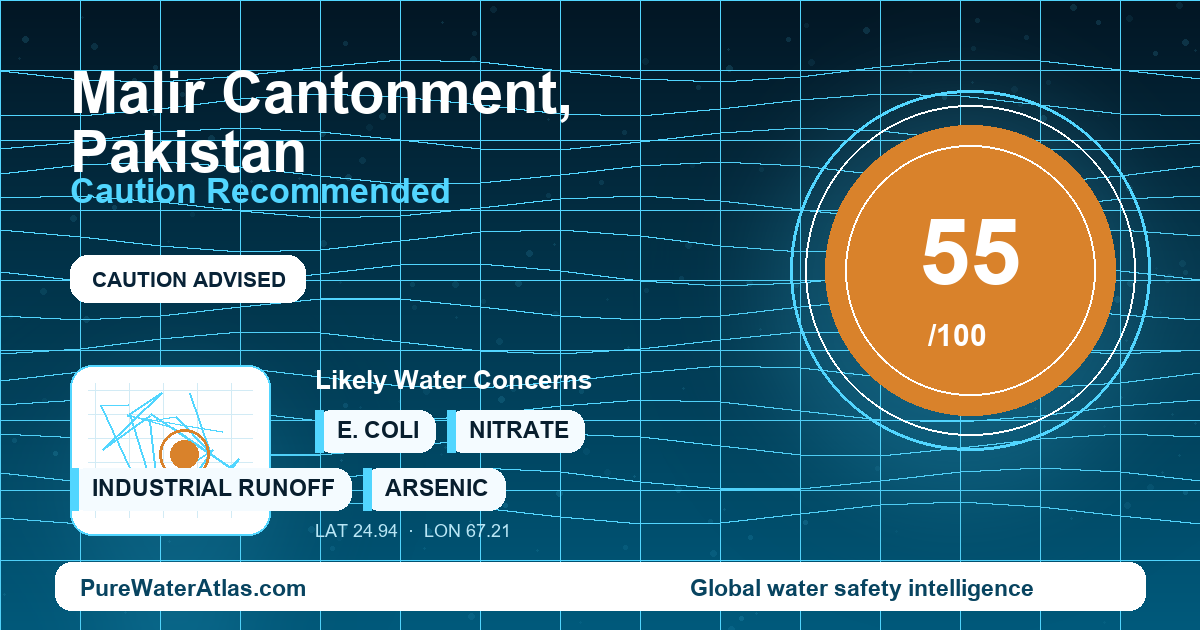
Malir Cantonment, Pakistan: tap water is best treated as conditionally usable, with caution recommended because safety can vary by source, storage tank, tanker use, plumbing, and building-level treatment.
Quick Answer
| Water safety score | 55 / 100 |
|---|---|
| Risk level | Caution Recommended |
| Can visitors drink the tap water? | No, not as a default. Visitors should use sealed bottled water or water that has been boiled, UV-disinfected, or treated through a well-maintained RO or certified filtration system. |
| Resident guidance | Treat tap water as conditionally usable, not automatically potable. Test at the point of use and maintain storage tanks and household treatment systems. |
| Main water context | Malir Cantonment is part of Karachi’s broader water-supply environment, primarily linked to imported surface water from the Indus system through Keenjhar Lake and Karachi-area transmission, pumping, and treatment infrastructure. |
| Local authority context | Cantonment Board Malir is the local cantonment civic authority, while Karachi Water and Sewerage Corporation is the main metropolitan bulk water and sewerage utility. |
| Filter recommendation | For many homes: sediment prefiltration, activated carbon, and UV disinfection. Consider RO where testing confirms high TDS, salinity, nitrate, arsenic, or other dissolved contaminants. |
Overall verdict: caution recommended. The main issue in Malir Cantonment is not that every tap is proven unsafe; it is that tap-water safety can change from one premises to another depending on intermittent supply, building tanks, local plumbing, tanker use, and whether water is actually treated before drinking. There is no widely published, continuously updated public tap-water dashboard for Malir Cantonment with recent sector-level results for E. coli, chlorine residual, turbidity, TDS, metals, and other key parameters.
Why Malir Cantonment Is Different
Malir Cantonment is not a separate hydrological city with a clearly isolated local water source. It is a cantonment area in eastern Karachi, within the Malir District urban corridor near Karachi’s airport and major road links. Its drinking-water risks are therefore tied to two layers: the larger Karachi supply system and the final-mile conditions inside the cantonment, including local distribution, institutional premises, private homes, underground tanks, rooftop tanks, water coolers, and household filtration.
This matters because the same general neighborhood can contain very different water realities. One building may receive regular piped water, store it in a clean covered tank, and send it through maintained filtration. Another may rely periodically on tanker-supplied water, a private bore, an unclean tank, or internal plumbing that has not been inspected for years. In Malir Cantonment, asking “is the tap water safe?” is less useful than asking: What is the source today, how is it stored, and what treatment is used before drinking?
Karachi’s broader water system has long faced demand growth, leakage, rationing, high non-revenue water, service interruptions, and dependence on large transmission infrastructure from distant sources. These citywide pressures are relevant in Malir Cantonment because variable pressure, scheduled supply, or tanker dependence can increase the chance of sediment, microbial contamination, and inconsistent disinfection at the tap.
Where Does Malir Cantonment’s Tap Water Come From?
Malir Cantonment sits within Karachi’s metropolitan water-supply environment. Public bulk water for Karachi is primarily imported from the Indus system through Keenjhar Lake and associated canals, conduits, pumping stations, and treatment works. Hub Dam has historically served parts of Karachi as well. Karachi-area infrastructure associated with the wider supply network includes Dhabeji, Gharo, Pipri, and other pumping and treatment facilities.
For a household, school, clinic, club, restaurant, or office inside Malir Cantonment, however, the bulk source is only part of the story. Water may pass through the Karachi distribution network, cantonment-level civic service infrastructure, local storage, private tanks, and premises plumbing before it reaches a drinking glass. During shortages or service interruptions, some premises may supplement with groundwater, private bowsers, or tanker-supplied water. The exact source at the point of use can vary by building and by time.
Groundwater should not be assumed potable in the Malir area without testing. The dataset identifies groundwater in eastern Karachi and the Malir area as variable and potentially brackish or affected by urban wastewater and land-use pressures. If a property uses a bore, shallow groundwater, or mixed tanker water, the testing plan should go beyond taste and include microbiological and chemical indicators.
Who Manages Drinking Water in Malir Cantonment?
Institutional responsibility in Malir Cantonment can overlap. Cantonment Board Malir is the local cantonment civic authority for municipal services within the cantonment area. Karachi Water and Sewerage Corporation is the main metropolitan bulk water and sewerage utility for Karachi. In practical terms, this means water safety may involve metropolitan bulk supply, local distribution, premises storage, and private treatment systems.
Drinking-water quality in Pakistan is guided by national standards and water-quality guidance, including the role of the Pakistan Standards and Quality Control Authority. National water-quality research and monitoring context is also provided by the Pakistan Council of Research in Water Resources. In Sindh, environmental and wastewater-related conditions are relevant to source and groundwater risk, and the Sindh Environmental Protection Agency provides the provincial environmental regulatory context.
The important limitation is transparency at the neighborhood level. No consistent official public dashboard was identified for Malir Cantonment showing recent sample-by-sample tap-water results across sectors for E. coli, residual chlorine, turbidity, TDS, chloride, nitrate, lead, arsenic, and related parameters. Because of that, this guide uses verified institutional context, Karachi-wide system evidence, national Pakistani water-quality concerns, and practical local risk factors rather than claiming that all taps in Malir Cantonment are either safe or unsafe.
Main Local Water Concerns
- Microbial contamination after treatment: The most immediate concern is fecal contamination where sewer leakage, intermittent pressure, poor storage, tanker water, or inadequate disinfection are present. In Malir Cantonment, the highest-risk taps are those fed by dirty tanks, leaky internal plumbing, or untreated tanker water. E. coli is a key indicator to test because it signals fecal contamination risk.
- Turbidity and sediment: Sediment can enter tanks and pipes after pressure changes, repairs, or service interruptions. Cloudy water is not just an aesthetic problem; turbidity can reduce the effectiveness of chlorination and UV disinfection.
- Variable chlorine residual: Even when water is chlorinated earlier in the system, residual disinfectant can decline in long distribution lines and warm storage tanks. Low or absent chlorine residual does not by itself prove contamination, but it means there is less safety margin at the tap.
- TDS, salinity, chloride, and taste: Bore water and tanker water in parts of Karachi can have elevated dissolved solids or brackish taste. Testing TDS, conductivity, chloride, hardness, and related parameters helps determine whether RO is needed.
- Lead and metals from premises plumbing: There is no verified evidence in the dataset of a Malir Cantonment-wide lead crisis. However, older internal plumbing, brass fittings, tanks, solder, or fixtures can affect individual buildings. Older homes, schools, clinics, nurseries, and childcare settings should consider first-draw and flushed testing for lead and other metals.
- Nitrate and sewage-related groundwater impact: If a property uses bore water, shallow groundwater, or uncertain tanker water, test for nitrate, microbiological indicators, and related chemical parameters. Urban and peri-urban groundwater can be affected by sewage, septic leakage, or land-use pressures.
Season also matters. During monsoon and heavy rain, flooding, sewer overflows, stormwater intrusion, and turbid water can increase microbial risk. In peak summer, high demand, heat, tank warming, and tanker reliance may raise risk. After supply interruptions or pipe repairs, first-flow water may carry sediment, discoloration, or stagnant water; flush taps and avoid drinking visibly dirty water until it clears, then disinfect or filter before consumption.
For Travelers
Short-term visitors to Malir Cantonment should not rely on untreated tap water for drinking. Use sealed bottled water from reputable brands, or water that has been boiled, UV-disinfected, or treated by a well-maintained RO system. Check bottle seals and avoid bottles that appear refilled. Carry sealed water when traveling locally, especially in hot weather.
For brushing teeth, visitors, immunocompromised travelers, children, and anyone unsure about the building’s tank hygiene should use bottled or treated water. Long-term residents who know their purifier is maintained may use filtered tap water, but that assumption should not be transferred to guests without verification.
Avoid ice from street vendors or unknown sources. In hotels, clubs, hospitals, and reputable restaurants, ask whether the ice and drinking water are made from purified water and whether water coolers are maintained. Do not assume that a formal venue automatically has safe drinking water. Hot tea or coffee is a safer choice only when the water has reached a full boil. Travelers should follow conservative Pakistan food and water precautions consistent with CDC Travelers’ Health guidance for Pakistan.
For Residents
Most Malir Cantonment households should use point-of-use treatment for drinking water unless recent laboratory testing confirms safe water at the tap and the household has clean storage. A practical setup for piped water is a washable sediment prefilter, activated carbon, and UV disinfection. Sediment filtration helps protect carbon and UV units; carbon improves taste and reduces some chemical and chlorine-related issues; UV provides a microbiological barrier when water is clear enough for UV to work properly. For a deeper comparison of options, see Water Treatment Systems and UV Water Purification: Complete Guide.
Reverse osmosis can be useful where testing confirms high TDS, salinity, chloride, nitrate, arsenic, or other dissolved contaminants. However, RO should be maintained carefully and should not be used as a substitute for tank hygiene. If the feed water is microbiologically unsafe or tanks are contaminated, treatment and storage practices must be managed together.
Storage tanks are a major control point in Malir Cantonment. Underground and rooftop tanks should be covered, screened against insects and animals, protected from sewage or stormwater entry, cleaned and disinfected on a schedule, and inspected after flooding, backflow, or unusual odors. Older premises should also be treated carefully: unknown pipe materials, corroded fittings, dead-end plumbing, and old storage tanks can affect water quality. Flush stagnant taps before use, but do not rely on flushing alone for safety.
Relevant Contaminants and Water-Quality Issues
The most relevant issue for Malir Cantonment is microbiological safety at the point of use. Testing for E. coli and total coliform is important where water is stored in tanks, delivered by tanker, or affected by pressure interruptions. Turbidity should be checked because cloudy water can shield microbes and interfere with disinfection. Chlorine residual is also useful because it indicates whether a disinfectant barrier remains at the tap or storage outlet.
For bore, groundwater, or uncertain tanker supplies, dissolved contaminants become more important. Nitrate can be relevant where groundwater is influenced by sewage or land-use impacts. Arsenic testing is prudent for groundwater or mixed-source supplies because Pakistan has regional arsenic concerns. For older buildings and sensitive premises, lead testing should be considered even though the dataset does not identify a confirmed cantonment-wide lead problem.
For treatment during emergencies, outages, monsoon contamination, or visible water-quality problems, see Boiling Water Purification: Complete Guide. For older buildings, see Lead in Drinking Water: Testing and Detection Methods. For groundwater users, see Arsenic in Drinking Water: Testing and Detection Methods and Nitrate Contamination in Drinking Water: Testing and Detection Methods.
How to Verify Your Water Quality
The best way to judge water safety in Malir Cantonment is to test the water actually used for drinking, not just the incoming line. Building tanks, rooftop storage, water coolers, filters, and internal pipes can change quality before water reaches the glass. For a general testing framework, use the PureWaterAtlas guide to Water Testing and the broader guide to Drinking Water Safety.
For routine household assessment, test total coliform, E. coli, turbidity, residual chlorine, pH, TDS, hardness, chloride, and electrical conductivity. If the home uses bore water or tanker water, add nitrate, sulfate, arsenic, fluoride, iron, manganese, and basic chemical parameters. Older buildings, nurseries, schools, clinics, and homes with infants or pregnant people should consider first-draw and flushed samples for lead and other metals.
Retest after major plumbing work, flooding, tank cleaning, a change in tanker supplier, unusual taste or odor, or a prolonged water-service interruption. Use an accredited laboratory where possible, keep results by date and sampling point, and compare results with recognized Pakistani drinking-water standards rather than relying only on taste or appearance. You can also compare broader location risk using the Global Water Quality Checker and research specific findings through the Contaminants Search Engine. For background on microbial risk, see Water Microbiology.
Official and Technical Sources
- Cantonment Board Malir — local cantonment civic authority for Malir Cantonment service context.
- Karachi Water and Sewerage Corporation — metropolitan water and sewerage utility context for Karachi’s bulk supply and sewerage system.
- World Bank: Karachi Water and Sewerage Services Improvement Project — infrastructure, service reliability, utility performance, rehabilitation, and governance context for Karachi’s water sector.
- Pakistan Council of Research in Water Resources — national water research and water-quality monitoring context.
- Pakistan Standards and Quality Control Authority — national standards context for drinking-water quality and bottled water.
- Sindh Environmental Protection Agency — provincial environmental context relevant to wastewater, discharge, and groundwater conditions.
- CDC Travelers’ Health: Pakistan — conservative food and water precautions for travelers.
- World Health Organization: Drinking-water — global public-health framework for safe drinking water and water safety management.
Bottom Line
Tap water in Malir Cantonment should be treated with caution. The cantonment is embedded in Karachi’s wider supply system, but the practical safety of drinking water often depends on the final mile: intermittent supply, tank cleanliness, tanker or bore use, internal plumbing, and whether a maintained purifier is in place. Visitors should use sealed bottled water or properly treated water and avoid uncertain ice. Residents should test water at the point of use, maintain underground and rooftop tanks, and use sediment filtration, carbon, and UV for typical piped-water microbial risk, with RO considered when testing confirms high dissolved contaminants. Because no recent public sector-level dashboard is available for Malir Cantonment, local testing is essential.
Read the full guide: Global Water Quality Guide
Explore more in this category: Global Water Quality Articles