
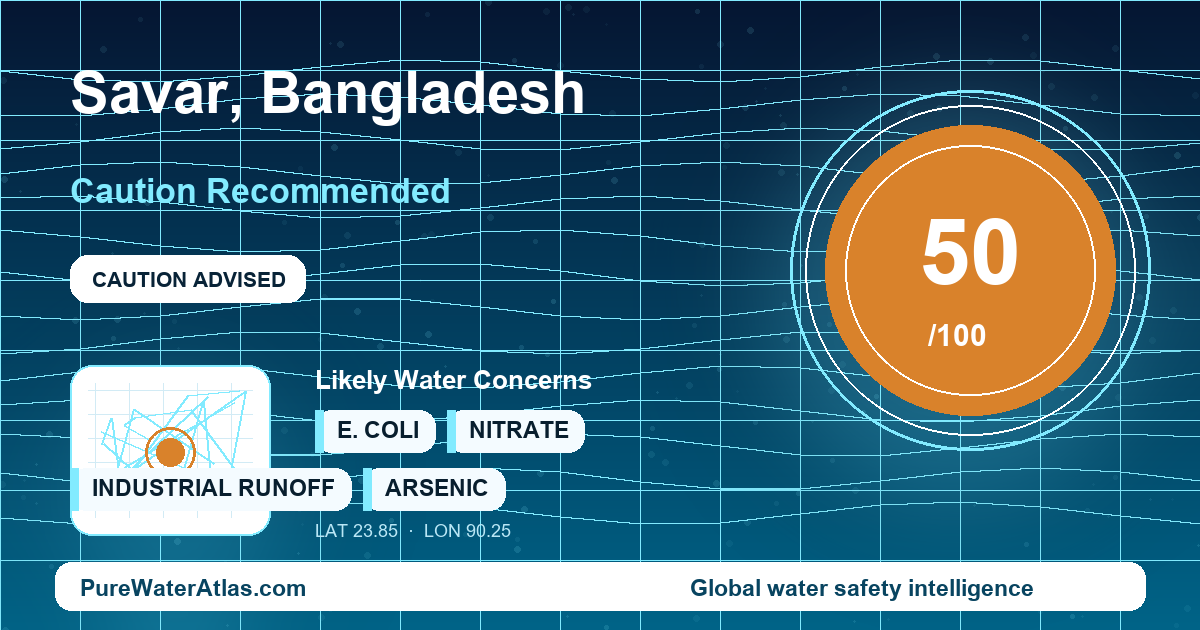
Savar, Bangladesh has a mixed groundwater-based drinking-water picture where municipal lines, private boreholes, apartment tanks, monsoon flooding, sanitation density, and nearby industrial activity can all affect what reaches the tap.
Quick Answer
| Water safety score | 50 / 100 |
|---|---|
| Risk level | Caution Recommended |
| Is Savar tap water safe to drink? | Caution is recommended. Savar does not have routinely published, address-level drinking-water quality reporting that supports a blanket safe-to-drink claim. Safety can vary by municipal line, private tubewell, apartment borehole, storage tank, plumbing condition, and flood exposure. |
| Traveler advice | Do not drink untreated tap water as a default. Use sealed bottled water, boiled water, or water treated by a verified and well-maintained RO, UV, or equivalent system. |
| Resident advice | Treat tap and well water as source- and building-specific. Test private wells, apartment boreholes, and kitchen taps, especially for E. coli, arsenic, iron, manganese, nitrate, turbidity, pH, conductivity, and TDS. |
| Main water source | Primarily groundwater: municipal production wells where piped service exists, plus private, institutional, community, and household tubewells in areas without reliable municipal coverage. |
| Local authority | Savar Pourashava or its water supply section in municipal service areas; the Department of Public Health Engineering provides national technical support for public water supply and arsenic mitigation. |
| Filter recommendation | A home treatment system is advisable for many households, but the right system depends on testing. Microbial risk requires disinfection; arsenic, nitrate, high TDS, or industrial chemicals require specialized treatment beyond basic carbon filtration. |
Why Savar Is Different
Savar is not a simple “one utility, one source, one quality report” city. It is a rapidly urbanizing area in Dhaka District, northwest of central Dhaka, located on the Dhaka-Aricha corridor and near Ashulia, Hemayetpur, Jahangirnagar University, industrial zones, wetlands, and the Bangshi-Dhaleshwari river environment. That geography matters because drinking-water risk in Savar is shaped by both groundwater dependence and highly local conditions at the building or neighborhood level.
The practical water picture is fragmented. Some residents receive municipal piped groundwater. Many apartment buildings, institutions, factories, and peri-urban households use their own deep tubewells. Water is often stored in underground or rooftop tanks before it reaches taps. In Savar, the tap result can therefore be very different from the source-water result. A deep borehole may produce acceptable water, while the actual kitchen tap may be unsafe if the building tank is open, poorly cleaned, or affected by floodwater intrusion.
Savar is also an industrial and institutional zone, not only a residential satellite area of Dhaka. The relocation of Bangladesh’s tannery industry to the Savar Tannery Industrial Estate near Hemayetpur, along with garment, textile-related, workshop, and industrial estate activity around the wider Savar-Ashulia area, makes environmental water monitoring important. These industrial concerns do not prove that every Savar tap contains industrial pollutants, but they do make site-specific testing more important, especially near industrial influence areas.
Where Does Savar’s Tap Water Come From?
Savar’s drinking water is understood to be primarily groundwater-based. Where municipal piped service exists, water is supplied through municipal production wells and pump-based groundwater abstraction. Outside reliable municipal coverage, households may depend on private, institutional, community, or household tubewells. The available public evidence does not show Savar’s everyday drinking-water supply as being mainly from a large treated surface-water system comparable to major Dhaka WASA schemes.
This local water identity has historical roots. Like much of the Dhaka peri-urban belt, Savar has long depended on hand tubewells, deep tubewells, ponds, canals, and local groundwater rather than centralized treated river water. Rapid urbanization, apartment construction, universities, factories, and industrial estates have increased reliance on pumped groundwater and building-level storage.
Key infrastructure elements that can determine tap quality in Savar include the Savar Pourashava municipal piped network in served wards, municipal production wells, private deep tubewells, institutional boreholes, factory or apartment pumping systems, rooftop tanks, underground reservoirs, internal plumbing, and household filters. Local rivers and wetlands, including the Bangshi and Dhaleshwari river systems, are more important here as environmental receptors and source-water pressure indicators than as confirmed treated drinking-water sources for most households.
The most important practical point is that “Savar tap water” is not one uniform product. A household on a municipal line, an apartment using a private borehole, a university or factory-managed supply, a shallow tubewell, and vendor-supplied water can all have different risks. The same neighborhood can contain both acceptable groundwater and unsafe tap water if storage or plumbing is contaminated.
Who Manages Drinking Water in Savar?
Inside municipal service areas, the relevant local service provider is Savar Pourashava or its water supply section. For rural and small-town water supply policy, technical support, and national implementation, the Department of Public Health Engineering under the Ministry of Local Government, Rural Development and Cooperatives is the key national agency. DPHE is especially relevant for public water supply and arsenic-related water safety work in Bangladesh.
Private tubewells, apartment boreholes, institutional systems, rooftop tanks, underground storage reservoirs, and internal plumbing are often owner-managed. This means building management, landlords, apartment associations, factories, schools, and individual households may be responsible for maintenance tasks that directly affect drinking-water safety.
Bangladesh drinking-water quality is governed through national standards and public-health policy, while local governments operate municipal services and the Department of Environment regulates industrial discharge. For Savar, however, publicly accessible routine tap-water compliance reports, distribution-zone sampling maps, and up-to-date contaminant tables were not found in a form comparable to annual utility water quality reports. This is a major data limitation. The evidence supports a cautionary, groundwater-based, highly variable risk profile, but it does not justify saying that every Savar tap is either safe or unsafe.
Main Local Water Concerns
The most immediate health concern for many Savar users is microbial contamination. Intermittent pressure, leaking pipes, cross-connections, contaminated storage tanks, and floodwater intrusion can allow fecal contamination to reach drinking water. This risk is especially important during and after monsoon rains, waterlogging, pump interruptions, tank repairs, or pipe work.
Arsenic is another essential issue because Bangladesh groundwater can vary sharply by well. Savar should not be assumed safe or unsafe for arsenic without a current test result for the specific tubewell, borehole, or supply. Private and community tubewells require testing, and apartment residents should ask whether their building borehole has been tested.
Iron, manganese, color, odor, and sediment are common concerns in groundwater-based systems. These may affect taste, staining, turbidity, appliance performance, and filter clogging. Turbidity can increase after pipe disturbance, pump cycling, tank cleaning, sediment movement, or seasonal flooding. High turbidity also matters because it can reduce the effectiveness of UV disinfection and can signal that the water needs prefiltration or investigation.
Nitrate is a concern where wells are shallow or located near septic tanks, drains, livestock areas, dense housing, or agricultural land. Industrial source-water pressure is also locally relevant. Tanneries, textile and dyeing activity, workshops, and industrial estates can raise environmental concerns involving chromium, dyes, solvents, salts, and other pollutants. Address-level drinking-water impacts require testing rather than assumptions.
Older buildings can add premise-level risk through corroded galvanized iron pipes, old metal fittings, stagnant dead-end plumbing, and internal reservoirs. Even if the source water is acceptable, stagnant first-draw water after overnight storage may contain more metals, sediment, odor, or microbial regrowth.
For Travelers
Visitors should not drink untreated tap water in Savar as a default practice. Use sealed bottled water from reputable brands, boiled water, or water treated by a verified and well-maintained RO, UV, or equivalent system. Check bottle cap seals and avoid bottles that appear refilled.
For brushing teeth, use bottled, boiled, or reliably filtered water, especially if you are a short-stay traveler, child, pregnant traveler, older adult, or someone with a sensitive stomach. Use treated water for medicines, infant formula, mouthguards, retainers, and any situation where water may be swallowed.
Avoid ice unless the hotel or restaurant can clearly confirm it was made from treated water. In informal restaurants, street stalls, events, and places where storage hygiene is uncertain, skip ice. Higher-end hotels and major restaurants may use filtered or bottled water, but filtered water is only as reliable as maintenance, cartridge replacement, UV lamp condition, and storage hygiene. Ask specifically, and when uncertain, choose sealed bottled drinks without ice.
In hot weather, carry oral rehydration salts and enough safe water. The conservative traveler approach in Savar is simple: drink sealed bottled water, boiled water, or verified treated water; do not rely on untreated taps, unverified jugs, or ice of unknown origin.
For Residents
Residents should treat Savar water quality as source- and building-specific. A home filter or treatment system is advisable for many households, but the correct system depends on test results. For microbial risk, options include boiling, UV, chlorination, or a maintained purifier with effective disinfection. For arsenic, nitrate, high TDS, or industrial chemicals, ordinary carbon filters are not enough; RO or specialized certified media may be required. For iron, manganese, sediment, and turbidity, prefiltration and oxidation or dedicated media may be needed before UV or RO.
Testing should start with the actual supply type. If you use a private tubewell or apartment borehole, test for arsenic at least once and retest if the well is deepened, repaired, or replaced. Test for E. coli or thermotolerant coliforms after flooding, tank contamination, pipe repair, or any unexplained household illness cluster. Test iron, manganese, turbidity, color, odor, pH, conductivity, TDS, hardness, and chloride to understand groundwater chemistry and filter needs. Test nitrate if the well is shallow or close to septic tanks, drains, livestock, agricultural land, or dense housing.
For homes near industrial zones, workshops, dyeing or washing facilities, or the tannery estate influence area, consider laboratory screening for chromium and other metals. Do not use taste or smell to rule out industrial contaminants. Apartment residents should ask building management for borehole depth, the last tank-cleaning date, and any recent microbial and chemical laboratory report.
Storage tanks deserve special attention in Savar. Rooftop and underground tanks should be tightly covered, screened against insects and rodents, protected from drain backflow, cleaned and disinfected on a schedule, and inspected after monsoon flooding or construction work. A clean source can become unsafe if the tank is open, cracked, or rarely cleaned.
Relevant Contaminants and Water-Quality Issues
The highest-priority microbial profile for Savar households and travelers is E. coli in drinking water, because storage tanks, flooding, sanitation intrusion, and intermittent pressure can create fecal contamination pathways. For groundwater users, arsenic in drinking water is essential reading because Bangladesh groundwater risk varies by well and cannot be judged reliably by appearance, taste, or neighborhood reputation.
Groundwater-based systems in Savar may also face aesthetic and treatment challenges from iron, manganese, and turbidity. These issues can stain fixtures, change taste or color, clog filters, and interfere with disinfection. Nitrate is relevant for shallow or poorly protected wells near sanitation, drains, livestock, agriculture, or dense housing. Lead is not identified here as a citywide Savar problem, but older building plumbing, metal fittings, and stagnant internal water can create premise-level metal exposure concerns.
How to Verify Your Water Quality
Because Savar lacks readily available address-level public compliance data, verification should be done at the source and at the tap. If diagnosing a problem, collect one sample from the borehole, municipal line, or tank outlet and another from the kitchen tap. This helps identify whether contamination is coming from the well, distribution line, storage tank, or internal plumbing.
PureWaterAtlas resources can help residents decide what to test and how to interpret results. Start with the complete guide to water testing, then review the drinking water safety framework. For specific contaminants, use the Contaminants Search Engine. To compare Savar’s caution profile with other destinations, use the Global Water Quality Checker.
For treatment choices, match the system to the test result. The Water Treatment Systems guide explains why sediment filtration, UV, RO, arsenic media, and other systems solve different problems. For short-term microbial protection, review the boiling water purification guide. For UV systems, read the UV water purification guide, noting that UV works best when water is already clear and low in turbidity.
Official and Technical Sources
- Department of Public Health Engineering — national technical agency for public water supply, rural and small-town systems, and arsenic-related water safety work in Bangladesh.
- Savar Upazila Government Portal — official local government portal for Savar administrative context and contacts.
- Department of Environment — national environmental regulator relevant to industrial discharge, river pollution, and environmental water quality around Savar and Dhaka District.
- Bangladesh Small and Cottage Industries Corporation — government body associated with industrial estates, including the Savar tannery industrial estate context.
- Bangladesh Municipal Water Supply and Sanitation Project — World Bank project information on broader municipal water and sanitation challenges in Bangladesh towns.
- UNICEF Bangladesh: Arsenic Mitigation in Bangladesh — background on Bangladesh’s groundwater arsenic problem and the importance of tubewell testing.
- WHO/UNICEF Joint Monitoring Programme Bangladesh WASH Data — national drinking water, sanitation, and hygiene context.
- CDC Bangladesh Traveler View — traveler health guidance supporting conservative drinking-water precautions for visitors.
- WHO Drinking-water Fact Sheet — global public-health reference for microbial safety and risks from contaminated drinking water.
Bottom Line
Savar’s tap water should be approached with caution, not with a blanket safe-or-unsafe assumption. The area relies heavily on groundwater through municipal production wells, private boreholes, institutional systems, and household tubewells, with many supplies passing through rooftop or underground storage tanks before reaching the tap. Travelers should use sealed bottled, boiled, or verified treated water and avoid uncertain ice. Residents should test their actual source and kitchen tap, especially for E. coli, arsenic, iron, manganese, nitrate, turbidity, pH, conductivity, and TDS. Industrial activity, monsoon flooding, sanitation density, old plumbing, and poorly maintained tanks make local verification essential. In Savar, the safest decision is based on current testing and maintenance records for the specific address.
Read the full guide: Global Water Quality Guide
Explore more in this category: Global Water Quality Articles