
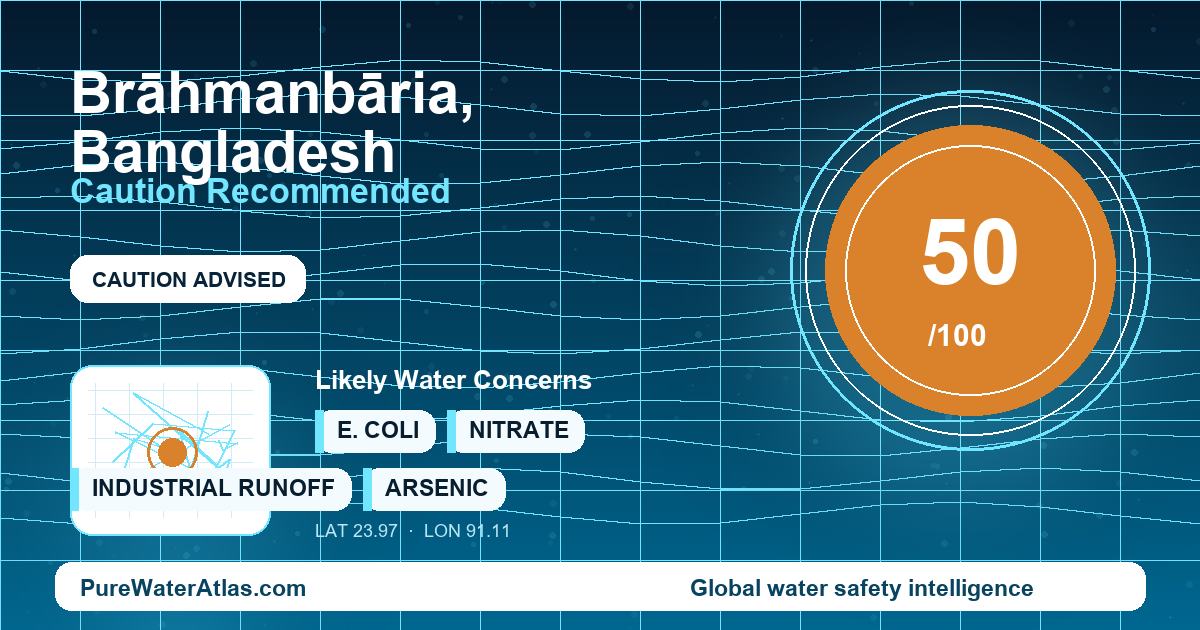
Brāhmanbāria, Bangladesh: groundwater-dependent municipal and household water with caution recommended due to microbial, storage-tank, private-well, and arsenic-testing uncertainties.
Quick Answer
| Overall status | Caution recommended. PureWaterAtlas assigns Brāhmanbāria a water safety score of 50/100. Untreated tap water should not be assumed reliably potable. |
|---|---|
| Can tourists drink the tap water? | Not recommended unless the water has been boiled, UV-treated, or filtered and disinfected by a system you trust. Use sealed bottled water for routine drinking. |
| Resident guidance | Treat tap water as conditionally usable, not automatically safe. Prefer a tested municipal connection where available, maintain tanks, disinfect water when microbial quality is uncertain, and test private wells. |
| Main water source pattern | Brāhmanbāria is best characterized as a groundwater-dependent municipal and household system using production tube wells or deep tube wells, municipal distribution, storage tanks, and private wells in some areas. |
| Local authority | Urban water service is associated with Brāhmanbāria Pourashava. National technical support for water supply outside major WASA areas sits with the Department of Public Health Engineering under the Local Government Division. |
| Filter recommendation | For municipal tap or tank water: sediment prefiltration plus boiling or UV disinfection is the priority. For private wells: test first, especially for arsenic, bacteria, nitrate, iron, and manganese, then choose treatment based on results. |
Why Brāhmanbāria Is Different
Brāhmanbāria is not best evaluated like a large metropolitan water utility with a published consumer-confidence report and citywide treatment documentation. It is a pourashava city in eastern Bangladesh, associated with the Titas River area and the wider Meghna basin floodplain system. That setting matters because low-lying, monsoon-influenced urban environments can face practical drinking-water risks from drainage problems, flooding, shallow groundwater vulnerability, and water handling after distribution.
The most important local distinction is not simply “tap water” versus “bottled water.” In Brāhmanbāria, the real drinking-water pathway may include a municipal groundwater well, a distribution pipe, a household service connection, a roof tank, an apartment or hotel storage tank, and finally an indoor tap. A neighboring household may instead rely partly or entirely on a private hand tube well or small local well. Those sources can have very different safety profiles even on the same street.
PureWaterAtlas did not identify a recent publicly accessible Brāhmanbāria Pourashava water-quality report, ward-level bacteriological monitoring table, residual chlorine dataset, distribution map, or municipal arsenic-testing dataset for this profile. For that reason, this page should be read as a risk-based drinking-water guide for Brāhmanbāria, not as a formal compliance certificate.
Where Does Brāhmanbāria’s Tap Water Come From?
Brāhmanbāria urban drinking water is best characterized as a groundwater-dependent municipal and household system. In Bangladeshi secondary towns outside the large WASA cities, piped water is commonly abstracted from production tube wells or deep tube wells and distributed through municipal pipelines. The water is then often stored in household, hotel, clinic, restaurant, or apartment building tanks before use.
The nearby Titas River is important to Brāhmanbāria’s geography, but this profile does not assume that the Titas is the treated drinking-water source. No current municipal engineering document was identified showing Brāhmanbāria as a large surface-water-treatment city. The available risk profile points instead to a groundwater-based pourashava supply model, supplemented in some homes or peri-urban areas by private hand tube wells and small wells.
Key infrastructure that affects water safety in Brāhmanbāria includes municipal production tube wells or deep tube wells, distribution mains, household service connections, internal building plumbing, overhead or roof tanks, and private wells. Even if source groundwater is from a deeper and lower-risk well, contamination can occur later through pipe leakage, intermittent pressure, cross-connections, unclean storage, or flood contact with shallow water infrastructure.
Who Manages Drinking Water in Brāhmanbāria?
The local urban service body is Brāhmanbāria Pourashava. At the national level, water supply and sanitation responsibilities for municipalities outside the major WASA service areas are supported by the Department of Public Health Engineering, under the Local Government Division, Ministry of Local Government, Rural Development and Cooperatives.
Bangladesh has national drinking-water standards and public-health engineering oversight. However, no recent open consumer-style water-quality report for Brāhmanbāria was found for this record. That creates a practical gap for consumers: the existence of a municipal system does not by itself prove that water at a household tap, hotel tank, restaurant tap, or private well is microbiologically safe on the day it is consumed.
This limitation is important for both visitors and residents. The correct question in Brāhmanbāria is not only whether the municipal source is improved, but whether water remains safe after pumping, distribution, storage, and building plumbing. A maintained municipal connection, a roof tank with a loose lid, and a shallow private tube well should not be treated as equivalent.
Main Local Water Concerns
Microbial contamination is the most immediate practical concern for untreated water. Risks can increase when pressure is intermittent, pipes leak, drains are close to water lines, tanks are poorly cleaned, or floodwater contacts wells, pumps, and distribution points. For more background, see the PureWaterAtlas guide to water microbiology and the contaminant profile for E. coli.
Arsenic is a major Bangladesh groundwater issue, especially for private and shallow wells. Conditions vary sharply by location and well depth, so testing is essential. This profile does not claim that every Brāhmanbāria well is unsafe, nor that every well is safe. It does mean private tube wells should be tested before they are used for drinking. See arsenic, arsenic testing methods, and arsenic treatment options.
Iron and manganese are common groundwater quality issues in many Bangladesh aquifers. They may cause reddish water, black staining, metallic taste, sediment, or discoloration. These issues are not always the main acute health risk, but they can affect acceptability and may signal the need for testing. Relevant profiles include iron and manganese.
Turbidity and sediment may appear after pipe repairs, low-pressure events, tank disturbance, or seasonal flooding. Turbid water can make disinfection less reliable because particles may shield microbes. See turbidity for details.
Nitrate and bacteria are possible in private wells near latrines, septic systems, drains, livestock areas, fertilizer storage, or densely settled compounds. This matters especially for infants and pregnant residents. See the PureWaterAtlas profile for nitrate and the guide to nitrate testing.
Lead is not documented here as a citywide Brāhmanbāria problem. However, older internal plumbing, brass fixtures, pumps, or building pipes can create premise-plumbing risk that is not reflected in municipal source-water quality. If materials are uncertain, review lead and lead testing methods.
For Travelers
Visitors to Brāhmanbāria should use sealed bottled water, properly boiled water, or water treated by a reliable purifier. Do not drink unboiled tap water unless your hotel or host can explain how it is filtered, disinfected, and safely stored. A cold tap in a room may be supplied through a roof tank, and tank condition is often more important than the original source.
Use bottled, boiled, or reliably filtered water for brushing teeth, especially for short-stay travelers, children, pregnant travelers, and immunocompromised people. Use safe water for medicines and infant formula. If carrying a portable purifier, combine particle filtration with disinfection; taste-only filters are not sufficient for bacteria, viruses, or turbid water.
Avoid ice unless you know it was made from treated water. In small restaurants, street stalls, and events, assume ice may have been made from untreated tap or well water. Hot tea and freshly boiled drinks are generally safer than cold drinks with ice, provided the drink is actually boiled and served hot.
Better hotels may provide bottled or filtered water, but ask how the water is treated and whether tanks are cleaned. CDC country-level travel guidance for Bangladesh supports conservative advice: use safe bottled, boiled, or treated water and avoid unsafe ice.
For Residents
Residents should treat Brāhmanbāria tap water as conditionally usable rather than automatically potable. If you are connected to a municipal supply, prioritize source reliability, tank hygiene, and microbial disinfection. A practical home setup for municipal tap or stored tank water often begins with sediment prefiltration followed by UV disinfection or boiling when microbial quality is uncertain. For technique details, see boiling water purification and UV water purification.
If you use a private tube well or small local well, do not choose a filter based only on taste, color, or price. Test first. Arsenic, bacteria, nitrate, iron, manganese, salinity, turbidity, and total dissolved solids require different treatment technologies. An arsenic filter is not the same as a UV unit; a sediment cartridge is not a microbiological guarantee.
Test any private tube well for arsenic before using it as a drinking-water source. Repeat testing if the well is modified or a new source is installed. Test for E. coli or thermotolerant coliforms after flooding, tank cleaning, pipe repairs, or unexplained diarrheal illness in the household. Include nitrate and microbiological testing for infants, pregnant residents, and homes near latrines, drains, livestock, or fertilizer storage.
Older Brāhmanbāria buildings may have aging internal pipes, pumps, fittings, or solder that are not represented by municipal source-water quality. Flush stagnant water before drinking, avoid using hot tap water for cooking or drinking, and test first-draw and flushed samples for lead if plumbing age or materials are uncertain.
Roof tanks and shared building tanks are a major control point. Keep lids sealed, prevent birds and insects from entering, clean and disinfect tanks on a schedule, and do not assume tank water is safe simply because incoming water is municipal.
Relevant Contaminants and Water-Quality Issues
The most relevant Brāhmanbāria water-quality issues are linked to groundwater, distribution integrity, household storage, and private well testing. Start with E. coli for microbial risk, arsenic for Bangladesh groundwater concerns, and turbidity for cloudy or particle-rich water that can interfere with disinfection.
For mineral-related taste, staining, and sediment, review iron and manganese. For private wells near sanitation or agricultural sources, review nitrate. For older building plumbing, review lead. If you are evaluating chlorinated water, the chlorine profile explains why disinfectant residual can matter, although this profile does not have a current Brāhmanbāria residual chlorine dataset.
How to Verify Your Water Quality
The safest way to answer “is my Brāhmanbāria water safe?” is to test the actual water you drink: the tap after the tank, the private tube well, or the kitchen point used for cooking. A municipal connection, a hotel filter, and a household storage tank can produce different results.
Use the PureWaterAtlas Water Testing guide to plan sampling and interpret results. For general safety concepts, see Drinking Water Safety. For treatment choices, see Water Purification.
You can also use the Global Water Quality Checker for broader location-based context and the Contaminants Search Engine to look up specific contaminants before buying a filter. For Brāhmanbāria residents using private wells, lab testing is especially important because arsenic, nitrate, bacteria, iron, and manganese cannot be reliably judged by appearance alone.
Official and Technical Sources
- Brāhmanbāria District official portal — used for local administrative and geographic context; not a tap-water compliance database.
- Department of Public Health Engineering, Bangladesh — used for national public health engineering and municipal water-supply context outside major WASA areas.
- Local Government Division — used for institutional context for pourashava water and sanitation services.
- British Geological Survey and DPHE arsenic investigation in Bangladesh — supports the need for well-specific arsenic testing in Bangladesh groundwater.
- WHO/UNICEF Joint Monitoring Programme Bangladesh data — provides national WASH context and the distinction between improved access and safely managed water.
- World Bank Bangladesh Municipal Water Supply and Sanitation Project — provides context on municipal water-supply and sanitation challenges in Bangladesh.
- CDC Travelers Health: Bangladesh — supports conservative traveler advice on safe water and ice.
- Bangladesh Meteorological Department — supports monsoon-season context relevant to flooding, drainage, and contamination risk.
Bottom Line
Brāhmanbāria tap water should be approached with caution, not treated as automatically safe. The city’s likely drinking-water reality is a groundwater-based pourashava system combined with household storage tanks and, in some areas, private wells. For visitors, sealed bottled water, boiled water, or reliably filtered and disinfected water is the safest routine choice; avoid untreated tap water and uncertain ice. For residents, the key actions are testing private wells for arsenic and bacteria, maintaining roof and shared tanks, using boiling or UV when microbial quality is uncertain, and matching filtration to test results. No recent open Brāhmanbāria municipal water-quality report was identified, so this is a risk-based guide rather than a formal compliance verdict.
Read the full guide: Global Water Quality Guide
Explore more in this category: Global Water Quality Articles