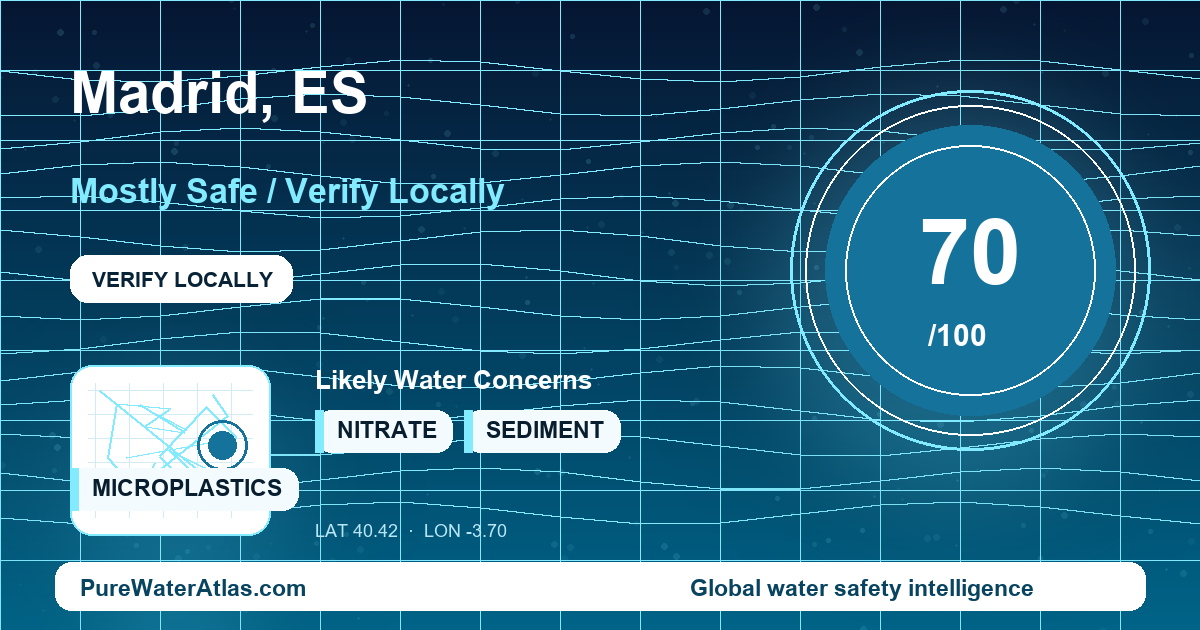
Madrid tap water is generally drinkable through a large Canal de Isabel II regional supply system, but travelers and residents should still verify building-level plumbing, storage tanks, temporary works, and current official notices.
Quick Answer
| Overall safety status | Mostly Safe / Verify Locally. Madrid tap water is generally considered drinkable, with a PureWaterAtlas safety score of 70/100. The rating is limited mainly by household-level uncertainty, not by evidence of a routine citywide failure. |
|---|---|
| For travelers | For most short-stay visitors in central Madrid, tap water is normally appropriate for drinking, brushing teeth, coffee, and restaurant ice unless a hotel, host, or official notice says otherwise. |
| For residents | The municipal supply is usually reliable at the point it enters a building, but internal plumbing, older service lines, private tanks, stagnant water, and building maintenance can affect what comes out of an individual tap. |
| Main source system | Madrid is supplied mainly by the Canal de Isabel II regional system, drawing from mountain catchments and reservoirs linked to the Lozoya, Jarama, Guadalix, Manzanares, Guadarrama-Aulencia, Alberche, and Sorbe systems, with groundwater available as support under some conditions. |
| Water authority | Canal de Isabel II, with health oversight through the Comunidad de Madrid and Spain’s national drinking-water framework, including SINAC. |
| Filter recommendation | A filter is not normally necessary for every Madrid home. Activated carbon may improve disinfectant taste and odor. In older buildings, use testing first; if lead is suspected, choose a filter certified for lead reduction. |
Why Madrid Is Different
Madrid’s drinking water profile is shaped by its geography. The city benefits from upland source-water catchments north and northwest of the capital, especially in the Sierra de Guadarrama region. This is one reason Madrid water is often described locally as relatively low in mineral content compared with harder or more saline supplies found in many other Spanish cities. A visitor arriving from a coastal or limestone-influenced area of Spain may notice that Madrid tap water often tastes less mineralized.
Madrid is also different because the capital is not dependent on one local intake inside the city. It is connected to a diversified regional reservoir, treatment, storage, and distribution network operated by Canal de Isabel II. That gives the system operational flexibility, but it also means the exact origin of water at a tap can vary by reservoir levels, season, drought management, network sector, and operating decisions.
The city’s water identity is historical as well as technical. Before the modern Canal de Isabel II system, Madrid relied on local springs, wells, the Manzanares area, and historic underground water galleries known as Viajes de Agua. The 19th-century Canal de Isabel II project was created to bring more reliable water from the Lozoya basin to the growing capital. Today, that legacy continues as a large regional public-water system serving Madrid and much of the Comunidad de Madrid.
Where Does Madrid’s Tap Water Come From?
Madrid’s tap water is supplied primarily by the Canal de Isabel II regional system. The system captures and stores surface water from mountain catchments in the Sierra de Guadarrama and surrounding basins. The wider supply network includes reservoirs associated with the Lozoya, Jarama, Guadalix, Manzanares, Guadarrama-Aulencia, Alberche, and Sorbe systems. Groundwater resources are also part of the wider system and may be used as support, especially during drought or operational constraints.
Key infrastructure includes a large reservoir network serving the Comunidad de Madrid, drinking-water treatment plants operated within the Canal de Isabel II system, pumping stations, storage deposits, pressure sectors, and a major metropolitan distribution network serving Madrid and surrounding municipalities. Reservoirs in the regional system include El Atazar, Valmayor, Santillana, Pinilla, Riosequillo, Puentes Viejas, El Villar, Pedrezuela, and others depending on operating conditions.
This regional arrangement matters for consumers. A change in taste, hardness perception, or disinfectant character does not necessarily mean water is unsafe; it may reflect normal source blending or network conditions. At the same time, drought years, reservoir status, local works, or changes in system operation are reasons to follow current notices from Canal de Isabel II and public-health authorities.
Who Manages Drinking Water in Madrid?
Canal de Isabel II is the main regional public water company responsible for abstraction, treatment, distribution, sewerage, and related water services for Madrid and much of the Comunidad de Madrid. Its official consumer pages include information on water quality and the origin of the water supplied through the regional system.
Health oversight involves the Comunidad de Madrid and Spain’s national public-health drinking-water framework. Madrid drinking water is regulated under Spanish and European Union rules. Spain’s Real Decreto 3/2023 establishes sanitary criteria for water intended for human consumption and implements the modern EU drinking-water framework. Official water-quality information is also reported through SINAC, Spain’s national drinking-water information system managed by the Ministry of Health.
The important limitation is that official regional and city-level information does not prove the condition of every apartment, building tank, service connection, or internal pipe. Madrid’s public supply can be compliant while an individual building still has problems caused by old plumbing, stagnant water, poorly maintained tanks, or recent renovation work.
Main Local Water Concerns
The main Madrid-specific concern is not a documented routine citywide safety failure. It is the gap between a highly managed regional supply and the condition of individual buildings. Madrid has many older residential buildings, and internal plumbing can be more important than the city supply itself. Lead, old galvanized steel, brass fittings, or poorly maintained private pipes cannot be ruled out without building-specific information.
Private building storage tanks, booster systems, rooftop tanks, or basement tanks can also create stagnation and microbial risk if they are poorly maintained. Safety in these situations depends on cleaning, covers, turnover, disinfection control, and maintenance records. Residents in buildings with recurring taste, odor, sediment, or microbiological concerns should ask the building administrator for tank maintenance information.
Short-term discoloration, turbidity, or sediment can occur after distribution works, pressure changes, hydrant use, or disturbance of internal building plumbing. If Madrid tap water is brown, yellow, cloudy, or particle-laden after flushing, the issue should not be dismissed as a simple taste problem. Boiling may help for some microbial risks, but it does not remove metals or sediment.
Disinfectant taste can also be noticeable to sensitive users, especially in warm periods or after water has been sitting in pipes. Summer heat can increase taste and odor sensitivity and can worsen stagnation in buildings after holidays or low occupancy. Heavy rain after dry periods can increase raw-water turbidity in reservoirs or catchments, requiring treatment adjustments. Drought and climate variability in central Spain can change reservoir levels and source blending, although this does not automatically mean unsafe tap water.
Emerging contaminants such as PFAS and microplastics are broader monitoring topics under European and Spanish drinking-water policy. This profile does not document them as confirmed citywide tap-water problems in Madrid.
For Travelers
In normal conditions, Madrid tap water is generally suitable for travelers to drink. For most short-stay visitors in central Madrid, tap water is normally appropriate for drinking, brushing teeth, coffee, and restaurant ice. Bottled water is mainly a preference for taste, convenience, or individual medical vulnerability, not a routine necessity for visitors.
Use common-sense checks. If a hotel, apartment host, or official notice advises against drinking the water, follow that instruction. If water is brown, cloudy, contains particles, smells strongly unusual, or appears during nearby works, avoid drinking it until the issue is clarified. Do not rely on boiling as a fix for metals, sediment, or discoloration; ask the property manager or check Canal de Isabel II and local health notices.
Brushing teeth with Madrid tap water is normally fine. Ice served in regulated hotels, restaurants, cafes, and bars is normally expected to be made from potable water. Avoid ice only in unregulated settings or if there is a local water advisory. If staying in an older apartment rental, let the cold tap run briefly after arrival, especially if the unit has been vacant. Use cold tap water for drinking and refill a bottle rather than assuming bottled water is required.
For Residents
A home filter is not normally required for every Madrid resident when the building plumbing is modern and well maintained. If the main concern is disinfectant taste or odor, a certified activated-carbon filter may be useful. If the concern is lead or other metals from old plumbing, do not choose a filter based only on taste; arrange appropriate testing or select a filter certified for lead reduction.
Residents in older buildings should treat internal plumbing as the main uncertainty. Test first-draw and flushed cold-water samples for lead if the home has old service lines, old solder, brass components, unexplained metallic taste, or a history of renovations. Use only cold water for drinking and cooking, and flush taps after stagnation, especially after holidays or long absences.
Testing is also relevant where buildings use private storage tanks, pressure groups, rooftop or basement cisterns, or have a history of maintenance problems. Microbiological indicator testing may be appropriate in those cases. If water is repeatedly brown, yellow, cloudy, or particle-laden after flushing, test or investigate turbidity, iron, and sediment sources rather than assuming the regional supply is the cause.
Citywide Canal de Isabel II or SINAC results can provide supply-zone context, but they should not be treated as proof that an individual apartment’s internal plumbing is risk-free. If there are infants, pregnancy, immunocompromised residents, dialysis patients, or people with specialized medical needs in the home, seek professional testing or medical guidance rather than relying only on taste and appearance.
Relevant Contaminants and Water-Quality Issues
For Madrid, the most practical consumer issues are taste, temporary sediment, turbidity, and building-level metal exposure. Chlorine in drinking water is relevant because disinfectant residual can affect taste and odor even when water is potable. Sensitive users may notice this more in warm periods or after water has been standing in internal pipes.
Turbidity and sediment in drinking water are relevant when water appears cloudy, brown, yellow, or particle-laden after pipe works, pressure changes, storms, or internal plumbing disturbance. These issues should be evaluated by appearance, persistence, and whether the problem remains after flushing.
Lead in drinking water is the most important household-level contaminant to consider in older buildings, but this is not a claim of a confirmed citywide lead problem in Madrid. The risk depends on building-specific plumbing materials and stagnation. For broader emerging-contaminant context, readers can review microplastics in drinking water; this profile does not identify microplastics as a documented Madrid-specific exceedance.
How to Verify Your Water Quality
Start with official Madrid sources. Canal de Isabel II provides public information on water quality and source-water origin. The Comunidad de Madrid provides regional health information on water intended for human consumption, and SINAC is Spain’s national drinking-water information system. These sources are the right place to check for supply context and current public information.
For a specific apartment or building, citywide data is not enough. Use building-specific testing when plumbing is old, storage tanks are present, water has been stagnant, or there are repeated problems with metallic taste, discoloration, cloudiness, sediment, or odor. PureWaterAtlas has a detailed guide to water testing, plus a practical guide to lead testing and detection methods.
If testing suggests lead-bearing plumbing, review lead filter and treatment options. If you are deciding whether boiling is useful, see the boiling water purification guide; boiling is not a solution for metals or sediment. Readers comparing cities can use the Global Water Quality Checker, search individual substances in the Contaminants Search Engine, or review PureWaterAtlas guides to drinking water safety, water treatment systems, and global water quality.
Data limitation: this profile uses official institutional context and the supplied dataset, but it does not verify live advisories at the moment you read it, neighborhood-level compliance, exact contaminant concentrations, or the condition of any individual Madrid building.
Official and Technical Sources
- Canal de Isabel II — official regional water company for Madrid and the Comunidad de Madrid.
- Canal de Isabel II: Calidad del agua — utility water-quality information for consumers.
- Canal de Isabel II: Origen del agua — official information on the origins of water supplied through the regional system.
- Comunidad de Madrid: Agua de consumo humano — regional public-health information on drinking water.
- Ministerio de Sanidad: SINAC — Spain’s national drinking-water information system.
- Boletín Oficial del Estado: Real Decreto 3/2023 — Spanish sanitary criteria for water intended for human consumption.
- European Commission: Drinking Water — EU drinking-water policy framework.
Bottom Line
Madrid tap water is generally considered drinkable and is supplied by a large, highly managed Canal de Isabel II regional system drawing mainly from mountain catchments and reservoirs north and northwest of the city. For travelers, it is normally fine for drinking, brushing teeth, coffee, and restaurant ice unless a property notice or official advisory says otherwise. For residents, the main uncertainty is the building, not the regional supply: older pipes, lead-bearing materials, private tanks, booster systems, stagnation, and recent plumbing work can affect water at the tap. Use cold water, flush after absences, investigate persistent discoloration or sediment, and test when old plumbing or vulnerable household members make building-level exposure more important.
Read the full guide: Global Water Quality Guide
Explore more in this category: Global Water Quality Articles