Introduction
Water is essential for life, public health, food production, industry, and ecosystem stability. Yet access to safe and reliable water remains uneven across the world, and water quality problems affect communities in both low-income and highly developed regions. A strong global water crisis overview testing perspective helps explain not only why water insecurity exists, but also how contamination is identified, measured, interpreted, and addressed.
The global water crisis is not a single problem. It includes water scarcity, degraded infrastructure, climate-related stress, pollution from human activity, and unequal access to treatment and sanitation. In many places, the crisis is visible through drought, failing wells, polluted rivers, unsafe household storage, or aging distribution systems. In other places, the danger is less obvious because contaminants cannot be seen, smelled, or tasted. That is why testing and detection methods are central to understanding risk.
Educational resources can help readers build a broader foundation before diving into technical details. For a wider background, readers may explore this complete guide and additional materials in the global water quality category. Understanding how contamination is measured also connects closely with broader subjects such as water contamination and water microbiology.
This article explains what the crisis is, what drives it, how it affects health and safety, and most importantly, how testing and detection methods are used to identify water problems. It also discusses the strengths and limits of home kits, professional sampling practices, laboratory analysis, and interpretation of findings. A careful global water crisis overview testing approach is valuable because solutions depend on accurate information. Without testing, contamination may go unnoticed. With poor testing, decisions may be based on incomplete or misleading evidence. With good testing, however, governments, utilities, researchers, and households can respond more effectively.
What It Is
The global water crisis refers to the widespread challenge of securing adequate quantities of safe water for drinking, hygiene, agriculture, healthcare, ecosystems, and economic activity. It involves both water quantity and water quality. In some regions the primary issue is not enough water. In others, there may be enough water physically available, but it is contaminated, poorly managed, too expensive, or inaccessible to parts of the population.
From a quality standpoint, the crisis includes contamination by pathogens, chemicals, metals, nutrients, sediments, and emerging pollutants. Water may become unsafe at the source, during transport, in treatment systems, or inside homes and buildings. The crisis also includes failures in monitoring. If a region lacks equipment, trained staff, accredited laboratories, or standard sampling protocols, water hazards may remain undetected.
A useful way to understand the issue is to think in layers:
- Source water problems: polluted groundwater, lakes, rivers, reservoirs, and rainwater catchments
- Infrastructure problems: leaking pipes, cross-connections, inadequate treatment, low pressure, and storage failures
- Household-level problems: unsafe collection containers, poor sanitation, indoor plumbing corrosion, and inadequate point-of-use treatment
- Monitoring gaps: insufficient routine testing, weak reporting systems, and delayed responses
When discussing a global water crisis overview testing framework, it is important to remember that testing is not separate from the crisis; it is part of how the crisis is defined. A community with safe water only some of the time, or only according to limited tests, remains vulnerable. True water security requires regular surveillance, representative sampling, good interpretation, and action based on evidence.
Main Causes or Sources
The causes of the water crisis vary by location, but most regions experience a combination of natural pressures and human-made impacts. A more focused discussion of causes can be found in this causes and sources guide, but the major drivers can be summarized below.
Population Growth and Urban Expansion
Growing populations increase demand for drinking water, sanitation, agriculture, and industry. Rapid urbanization can outpace infrastructure, leading to overdrawn aquifers, insufficient sewage systems, and inconsistent treatment. Informal settlements may rely on unsafe supplies or shared sources vulnerable to contamination.
Agricultural Runoff
Agriculture is one of the largest users of freshwater globally. Fertilizers, animal waste, pesticides, and irrigation return flows can carry nitrates, phosphates, pathogens, and chemicals into surface water and groundwater. This can make water unsafe for infants, contribute to algal blooms, and complicate treatment.
Industrial Discharges and Mining
Industrial activity may release solvents, petroleum compounds, PFAS, acids, salts, heavy metals, and other hazardous substances. Mining operations can contribute arsenic, lead, mercury, and acid mine drainage. Some contamination events are dramatic and obvious, while others are long-term and difficult to detect without targeted testing.
Inadequate Sanitation
Where sewage collection and treatment are insufficient, human waste can contaminate drinking water sources. Fecal contamination remains one of the most serious global hazards because it may carry bacteria, viruses, and parasites. In these settings, microbiological testing becomes especially important.
Aging Water Infrastructure
Even in wealthier countries, old pipes, corroded plumbing, storage tanks, and outdated treatment plants can create water quality problems. Lead service lines, biofilm growth, and pressure losses can all affect safety. Infrastructure failures often show why a global water crisis overview home testing discussion is relevant even outside traditionally water-stressed regions.
Climate Change
Climate change influences water quality and availability by shifting rainfall patterns, intensifying droughts and floods, warming surface waters, and increasing salinity intrusion in coastal aquifers. Flooding can spread sewage and industrial contaminants, while drought can concentrate pollutants in shrinking water bodies.
Natural Geologic Sources
Not all contamination comes directly from human activity. Arsenic, fluoride, iron, manganese, and other substances may occur naturally in groundwater depending on local geology. Natural presence does not mean harmlessness; some geogenic contaminants require careful routine testing and long-term management.
Health and Safety Implications
Unsafe water can cause acute disease, chronic illness, developmental harm, and large-scale public health disruption. The effects depend on the contaminant, dose, duration of exposure, route of exposure, and vulnerability of the population. More detailed reading is available in this health effects and risks resource.
Microbiological Risks
Pathogens in water can cause diarrhea, cholera, dysentery, typhoid, hepatitis, and other infections. Bacteria such as E. coli, viruses such as norovirus, and parasites such as Giardia or Cryptosporidium may spread when sewage contaminates water supplies. These hazards are especially dangerous for infants, older adults, pregnant people, and those with weakened immune systems.
Chemical Risks
Chemical contaminants may produce long-term effects that are less immediately visible than infection. Arsenic exposure has been associated with skin lesions, cardiovascular effects, and certain cancers. Excess nitrate can cause methemoglobinemia in infants. Lead can impair neurological development in children. PFAS, solvents, and disinfection byproducts also raise public health concerns in many settings.
Safety Beyond Drinking
Water quality affects more than direct consumption. It matters for bathing, cooking, infant formula preparation, food washing, medical procedures, and industrial processes. Poor water quality can also reduce trust in public systems, leading households to rely on more expensive or less reliable alternatives.
Psychological and Social Effects
Communities affected by contamination often experience anxiety, economic stress, and loss of confidence in institutions. Households may spend more on bottled water, filters, storage, or medical care. Schools and healthcare facilities may also struggle when water is unreliable or unsafe.
These health and safety implications explain why testing matters. Risks cannot be managed effectively unless contaminants are identified, quantified, and tracked over time. A strong global water crisis overview test results process should connect data to real exposure pathways and practical health guidance.
Testing and Detection
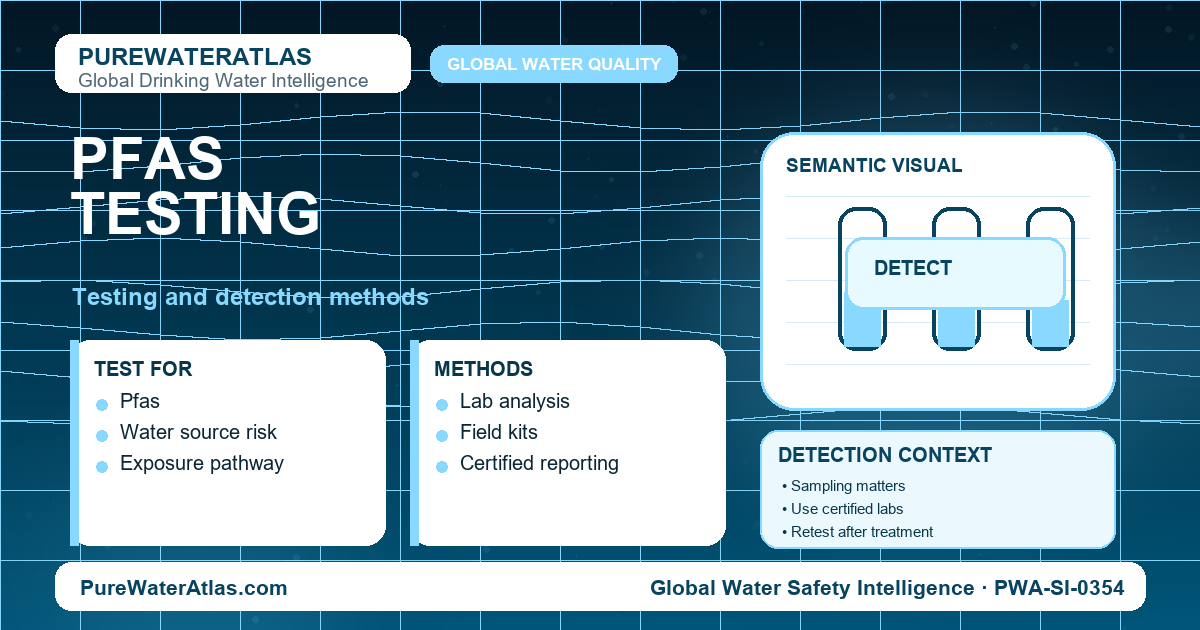
Testing and detection are central to any serious global water crisis overview testing strategy. Water can contain many different hazards, and no single test can detect all of them. Effective assessment usually combines field observations, routine screening, laboratory analysis, and repeat sampling over time.
What Water Testing Looks For
Water testing may target several categories of indicators and contaminants:
- Physical parameters: temperature, turbidity, color, conductivity, total dissolved solids
- Chemical parameters: pH, alkalinity, hardness, nitrate, fluoride, chlorine residual, metals, pesticides, VOCs, PFAS
- Microbiological indicators: total coliforms, fecal coliforms, E. coli, enterococci
- Operational indicators: disinfectant residuals, corrosion indicators, organic carbon
Some measurements serve as direct evidence of contamination, while others act as warning signs. For example, turbidity may not identify a specific pathogen, but high turbidity can indicate treatment problems or increased microbial risk.
Home Testing
A global water crisis overview home testing discussion is increasingly relevant because consumers now have access to strips, handheld meters, mail-in kits, and digital sensors. Home testing can be useful for basic screening and awareness. Common home methods include:
- Test strips for pH, hardness, nitrate, nitrite, chlorine, and alkalinity
- Portable meters for conductivity, total dissolved solids, and sometimes pH
- Color-comparison kits for iron, copper, or selected disinfectants
- Mail-in kits that allow a user to collect a sample and send it to a lab
Home testing has clear strengths. It is accessible, relatively inexpensive, and helpful for routine checks or preliminary investigation. It can alert households to visible changes or support decisions about whether to pursue more advanced testing.
However, home testing also has major limitations. Many kits do not measure contaminants at regulatory thresholds with high precision. Some are sensitive to user technique, lighting, expiration dates, sample timing, and storage conditions. Most importantly, home kits generally cannot replace comprehensive microbiological or trace chemical analysis performed by qualified laboratories.
Laboratory Analysis
A global water crisis overview lab analysis approach provides greater sensitivity, specificity, and reliability. Laboratories may use standardized methods and quality control procedures to detect contaminants at low concentrations. Examples include:
- Culture-based microbiology: membrane filtration, presence-absence tests, most probable number methods
- Spectrometry and spectroscopy: ICP-MS or atomic absorption for metals such as lead, arsenic, and cadmium
- Chromatography: GC-MS or LC-MS for pesticides, solvents, and emerging contaminants
- Wet chemistry methods: nutrients, alkalinity, hardness, and other routine parameters
- Molecular methods: PCR-based detection in specialized settings for specific pathogens or genetic markers
Laboratory testing is especially important when regulatory compliance, health risk evaluation, legal documentation, or source identification is required. It is also necessary when contamination may be present at low levels that still matter for long-term exposure.
Sampling Methods
A reliable global water crisis overview sampling methods discussion must emphasize that water test quality depends heavily on sample collection. Even the best laboratory cannot correct a poorly collected or contaminated sample.
Common sampling considerations include:
- Representative location: source water, treatment plant, distribution point, household tap, storage tank, or well
- Timing: first-draw versus flushed samples, seasonal variation, post-rainfall events, peak demand periods
- Container selection: sterile bottles for microbiology, preservative-treated containers for certain chemicals
- Preservation and transport: cooling, acidification, holding times, chain of custody
- Sampling frequency: one-time screening, routine monitoring, event-based sampling, follow-up verification
For example, first-draw samples are often used when assessing lead exposure from plumbing because water that has sat in pipes may accumulate metals. By contrast, a flushed sample may better represent water coming from the main line. Microbiological samples require sterile technique and prompt delivery to the lab to avoid false results.
Accuracy and Quality Assurance
Global water crisis overview accuracy depends on multiple factors: the method selected, the detection limit, laboratory competence, calibration, sample integrity, environmental variability, and interpretation. Accuracy in water testing should not be reduced to a simple true-or-false concept. Instead, it includes:
- Precision: how consistent repeat measurements are
- Bias: whether results systematically over- or under-estimate the true value
- Sensitivity: the ability to detect low concentrations
- Specificity: the ability to distinguish the target contaminant from others
- Uncertainty: the range within which the true value is likely to fall
Good testing programs use blanks, duplicates, calibration standards, control samples, and validated methods. Accreditation and method reporting are important because they help users assess whether a result is suitable for its intended purpose.
Interpreting Test Results
A sound global water crisis overview test results process goes beyond reading numbers from a report. Results must be compared with relevant health-based guidelines, local regulations, and exposure context. Important questions include:
- Which contaminant was tested, and by what method?
- What was the detection limit?
- Was the result above a health guideline, action level, or operational target?
- Was the sample representative of typical use?
- Is follow-up sampling needed to confirm the finding?
A single clean result does not always prove water is consistently safe. Likewise, one elevated result should usually trigger confirmation and investigation rather than immediate broad conclusions. Water systems change over time, and contamination can be intermittent.
Why Testing Must Be Ongoing
The water crisis is dynamic. Storms, drought, pipe breaks, seasonal agricultural activity, treatment failures, and source shifts can all change water quality rapidly. For this reason, testing should be viewed as continuous surveillance rather than a one-time event. Long-term monitoring generates trends, supports early warning, and allows interventions to be evaluated.
Prevention and Treatment
Testing identifies problems, but prevention and treatment are what reduce risk. The best strategies depend on the contamination source and the scale of the system.
Source Protection
Protecting watersheds, controlling industrial discharges, improving sanitation, managing agricultural runoff, and regulating waste disposal can reduce pollution before it reaches drinking water sources. Prevention at the source is often more effective and less costly than downstream treatment alone.
Infrastructure Upgrades
Replacing lead service lines, repairing leaks, improving pressure management, and modernizing treatment plants are essential in many regions. Better infrastructure improves both water quality and reliability.
Treatment Technologies
Treatment options vary by contaminant:
- Disinfection: chlorine, chloramine, ozone, or UV for microbial control
- Filtration: sand, membrane, or cartridge systems for particles and some pathogens
- Activated carbon: useful for taste, odor, and some organic chemicals
- Reverse osmosis: effective for many dissolved contaminants, including salts and some metals
- Ion exchange and adsorption media: useful for nitrate, arsenic, and other specific contaminants
- Corrosion control: chemistry adjustment to reduce metal leaching from plumbing
Household-Level Measures
Point-of-use and point-of-entry systems can provide important protection, especially where centralized treatment is limited or trust in tap water is low. However, treatment devices must be selected based on actual test findings. A filter designed for sediment may not remove lead, and a carbon cartridge may not reliably remove nitrate. Testing should guide device choice and maintenance schedules.
Monitoring After Treatment
Treatment is not the end of the process. Water should be retested after corrective actions to confirm performance. This step is essential because treatment systems can fail, become saturated, or introduce other issues if poorly maintained.
Common Misconceptions
Misunderstandings about water safety often lead to under-testing or inappropriate responses. Several misconceptions are especially common.
If Water Looks Clear, It Is Safe
Many harmful contaminants are invisible. Lead, arsenic, nitrate, and many pathogens may be present even when water appears clean and tastes normal.
Boiling Solves All Water Problems
Boiling can help with certain microbiological risks, but it does not remove metals, nitrate, salts, or most industrial chemicals. In some cases, boiling may even concentrate dissolved contaminants as water evaporates.
One Negative Test Means Permanent Safety
Water quality changes over time. A single negative microbiological or chemical test does not guarantee ongoing safety. Routine monitoring remains important.
Home Kits Are the Same as Professional Testing
Home kits can be helpful screening tools, but they are not equivalent to certified laboratory analysis for all contaminants. A proper global water crisis overview accuracy perspective requires understanding these limits.
Bottled Water Is Always Safer
Bottled water quality varies, and it is not a universal solution to infrastructure or contamination problems. It may provide short-term relief, but long-term water security depends on reliable systems, monitoring, and source protection.
Regulations and Standards
Water regulations differ across countries, but the overall goal is similar: to protect public health through enforceable limits, treatment requirements, monitoring rules, and reporting obligations. Internationally, organizations such as the World Health Organization provide guideline values that many jurisdictions use as a reference.
What Standards Cover
Drinking water standards may address:
- Microbiological safety indicators
- Maximum allowable concentrations for chemicals and metals
- Operational requirements for treatment and disinfection
- Sampling frequency and approved methods
- Public notification and corrective action procedures
Why Standards Matter for Testing
Standards shape how water is tested, how often, and by whom. They also define what counts as exceedance, what requires immediate response, and what must be reported to the public. In practice, regulations support consistency and accountability, though implementation capacity varies widely between regions.
Limits of Regulation
Regulations are essential, but they are not a complete solution. Some contaminants may be unregulated or newly emerging. Monitoring may miss local hot spots. Rural communities and small systems may have limited resources for compliance. As a result, public education, independent testing, and transparent communication remain important complements to formal regulation.
Conclusion
The global water crisis is a complex challenge involving scarcity, contamination, infrastructure, governance, and unequal access. Understanding it requires more than recognizing that water is important; it requires knowing how water quality is measured and why those measurements matter. A meaningful global water crisis overview testing approach connects environmental realities to practical detection methods, from basic household screening to advanced laboratory analysis.
Testing reveals whether water is safe, what contaminants are present, how serious the risk may be, and whether treatment is working. At the same time, reliable results depend on good sampling, appropriate methods, strong quality control, and careful interpretation. Home tools can support awareness, but professional analysis is often necessary for accurate decision-making, especially where health risks or regulatory concerns are involved.
Ultimately, solving water quality problems requires prevention, treatment, monitoring, and public trust working together. Source protection, infrastructure investment, sanitation improvements, sound regulations, and routine surveillance are all part of the response. By understanding testing and detection methods in context, readers can better evaluate risks, interpret reports, and support informed action at the household, community, and policy levels.
Read the full guide: Global Water Quality Guide
Explore more in this category: Global Water Quality Articles