Medan, North Sumatra: treated municipal water exists, but direct drinking from the faucet is not the safest default because final tap quality depends on river-source conditions, distribution pressure, building plumbing, and storage tanks.
Quick Answer
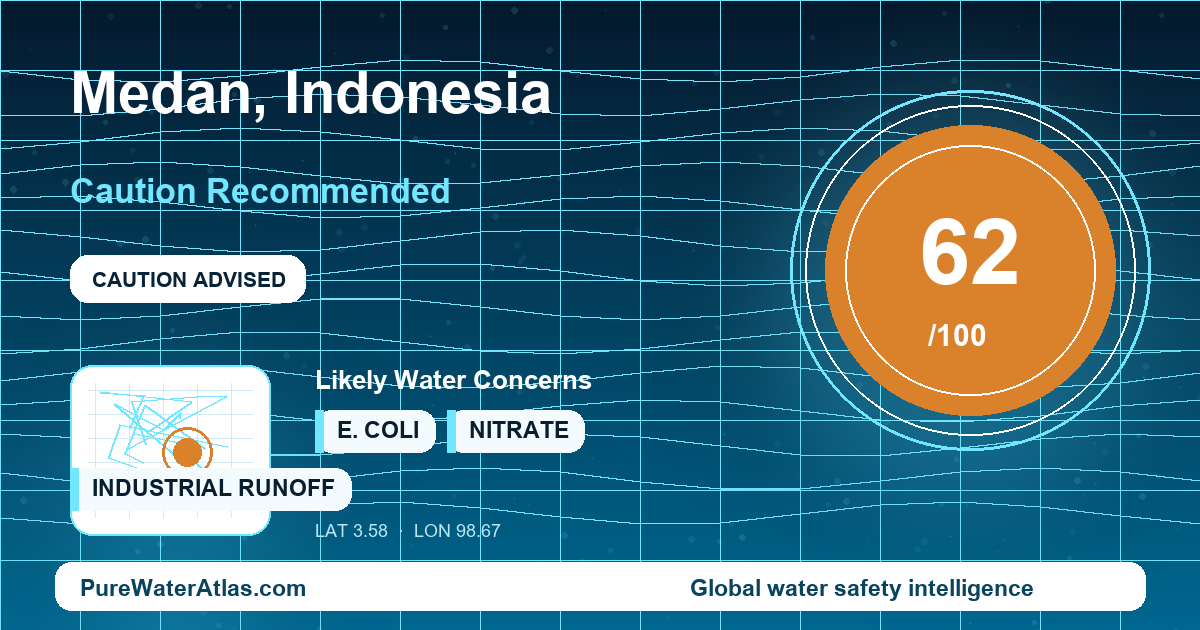
| Water safety score | 62 / 100 |
|---|---|
| Risk level | Caution Recommended |
| Can visitors drink tap water? | No as a default practice. Visitors should use sealed bottled water, boiled water, or water from a verified filtration and disinfection system. |
| Resident guidance | PDAM Tirtanadi piped water is generally a safer baseline than untreated private wells, but point-of-use treatment is prudent for drinking and cooking, especially in older buildings or homes with tanks. |
| Main water source context | Medan is supplied mainly by a treated surface-water system using river catchments around Medan and Deli Serdang, including the Belawan, Deli, and Belumai river systems, plus the historic Sibolangit spring legacy. |
| Water authority | Perumda Tirtanadi / PDAM Tirtanadi, owned by the Provincial Government of North Sumatra. |
| Filter recommendation | For drinking, use sediment prefiltration plus activated carbon and a reliable disinfection or membrane step such as UV, ultrafiltration, reverse osmosis, or boiling where appropriate. |
Editorial verdict: caution is recommended. Medan has an established municipal utility and treated piped water system, but the available public evidence does not support telling visitors to drink tap water directly from the faucet. The main practical risks are not only at the treatment plant; they include river-source turbidity and pollution pressure, distribution-network integrity, intermittent pressure in some areas, building plumbing, and household or hotel storage tanks.
Why Medan Is Different
Medan is a large lowland city in North Sumatra near the Strait of Malacca. The Deli and Babura rivers run through the urban area, and broader raw-water dependence is tied to surrounding Deli Serdang river catchments. That geography matters because Medan’s drinking-water safety cannot be understood as a simple “mountain spring” story or as a single-source reservoir system.
The city’s water identity is strongly associated with Tirtanadi and the historic Sibolangit spring system in the highlands south of Medan, developed during the Dutch colonial period and later incorporated into the public supply. That legacy remains locally important. However, modern safety decisions should be based on current treatment, distribution, household plumbing, and tank conditions rather than historical reputation alone.
Medan’s municipal system is a mixed urban supply network with surface-water intakes, treatment plants, pumping, storage, and distribution pipes. Water that leaves a treatment plant may not have the same risk profile as water drawn from a hotel bathroom tap, apartment kitchen, or house with a roof tank. In practice, final tap quality can be affected by sediment in pipes, low-pressure events, internal plumbing, booster pumps, and storage tanks that are not cleaned or sealed properly.
Where Does Medan’s Tap Water Come From?
Medan is served mainly by Perumda or PDAM Tirtanadi of North Sumatra. Published utility and project documentation describe a surface-water-based system using river catchments around Medan and Deli Serdang, including the Belawan, Deli, and Belumai river systems. Raw water is treated at multiple installations before distribution to customers.
Major treatment infrastructure commonly identified in Medan supply documentation includes Sunggal, Deli Tua, Limau Manis, and Hamparan Perak or associated treatment installations. The exact current source mix at a particular tap can vary by service zone and is not publicly presented as a simple consumer map. For that reason, it is not accurate to assume that every building in Medan receives the same source water or has the same final tap-water risk.
The system relies on more than treatment plants. Distribution pipelines, pumping, service reservoirs, and building-level tanks are important parts of the final water-quality pathway. Private wells are also used by some households or businesses and have a different risk profile from treated PDAM water, especially in low-lying or coastal-influenced areas where salinity and seawater-intrusion relevance can be greater for groundwater.
Who Manages Drinking Water in Medan?
The principal drinking-water utility for Medan is Perumda Tirtanadi / PDAM Tirtanadi, owned by the Provincial Government of North Sumatra. Tirtanadi is the key local authority for the piped municipal supply serving Medan and surrounding parts of North Sumatra.
Indonesia’s drinking-water quality framework is set nationally through Ministry of Health sanitary and drinking-water quality requirements, including Permenkes No. 2 Tahun 2023. Local implementation involves the water utility, local health authorities, provincial oversight, and environmental agencies responsible for raw-water protection.
A major limitation for consumers is transparency at the neighborhood level. Medan has identifiable city-level institutions and infrastructure documentation, but recent consumer-facing, citywide tap-water compliance data and street-level results are not readily available in a public format comparable to consumer confidence reports in some countries. This guide therefore avoids claiming exact current compliance percentages, precise contaminant concentrations, or neighborhood-specific safety conditions.
Main Local Water Concerns
- River-source turbidity: heavy rainfall can increase suspended sediment and microbial loading in raw river water. This makes turbidity control an important issue for Medan’s surface-water treatment system.
- Urban river pollution pressure: the Deli, Belawan, and surrounding catchments face pressure from domestic wastewater, drainage channels, solid waste, small industry, and runoff. These pressures make raw-water protection central to long-term drinking-water safety.
- Distribution and pressure risk: intermittent or low-pressure conditions in some urban systems can increase intrusion risk where pipes are damaged or cross-contaminated. Residual chlorine is important because it helps protect treated water as it moves through the network.
- Sediment and discoloration: sediment, discoloration, iron, and manganese complaints can occur in distribution systems or private wells, although recent citywide public data are not transparent enough to quantify neighborhood risk.
- Storage tanks and building plumbing: older buildings, roof tanks, ground tanks, pumps, dead-end plumbing, and poorly maintained fixtures can create a local water-quality problem even when municipal treatment is functioning.
- Private wells: wells have a separate risk profile from treated PDAM water. In addition to microbial concerns, private-well users should consider salinity, chloride, conductivity, hardness, iron, manganese, and nitrate, especially after flooding or changes in taste, color, or smell.
Season also matters. Heavy rainfall can increase river turbidity and microbial load; flooding can increase contamination risk for shallow wells, ground tanks, and damaged pipes; dry periods can concentrate pollutants in smaller flows and may worsen pressure or supply reliability in some service areas. After outages, pipe repairs, flooding, or visible discoloration, users should flush taps and treat drinking water until it runs clear and has been boiled or otherwise disinfected.
For Travelers
Do not drink Medan tap water straight from the faucet as a default traveler practice. Use sealed bottled water, boiled water, or water from a verified filtration and disinfection system. This is consistent with cautious traveler practice in Indonesia and with the fact that Medan’s final tap-water safety can be affected by distribution and building-level conditions.
For brushing teeth, most healthy travelers can use tap water if they avoid swallowing it, but cautious travelers, young children, and anyone with a sensitive stomach should use bottled or boiled water. Avoid swallowing shower water, especially if you are newly arrived or recovering from gastrointestinal illness.
For ice, use it only in reputable hotels, cafes, and restaurants that state they use treated water or commercial ice. Avoid uncertain ice from street stalls or informal vendors if your goal is to minimize gastrointestinal risk. Higher-end hotels and restaurants often provide bottled water, dispenser water, or internal treatment systems, but do not assume the bathroom tap is potable. Ask whether drinking water is filtered, boiled, or commercially supplied.
Practical travel steps in Medan are simple: carry sealed bottled water during the day, check that caps are intact, use boiled water for tea or coffee, and keep oral rehydration salts available in case gastrointestinal illness occurs. For broader traveler health context, see CDC Travelers’ Health guidance for Indonesia.
For Residents
Residents connected to PDAM Tirtanadi generally have a safer baseline than untreated private wells, but point-of-use treatment is still prudent for drinking and cooking unless you have recent test results from your own tap showing safe microbiological quality and acceptable chemistry. A practical home setup is sediment prefiltration followed by activated carbon and either UV, ultrafiltration, reverse osmosis, or boiling depending on the household risk profile.
Boiling is useful for reducing microbial risk, and PureWaterAtlas explains the method in the Boiling Water Purification Complete Guide. However, boiling does not remove metals, salinity, nitrate, or many chemical contaminants. If you use UV, filtration before the UV unit is important because high turbidity can reduce disinfection effectiveness; see the UV Water Purification Complete Guide.
Testing should be done at the point of use, not only at the building inlet. Tanks and internal plumbing can change water quality before it reaches the kitchen tap. At minimum, residents should consider testing for E. coli, total coliform, turbidity, pH, residual chlorine, total dissolved solids, and basic appearance, taste, and odor indicators. For private wells, add nitrate, iron, manganese, hardness, chloride, conductivity or salinity, and, where feasible, arsenic and other metals.
Older buildings require special caution. Corroded internal pipes, old fixtures, dead-end plumbing, and poorly maintained pumps can affect water quality. Even if lead service lines are not documented as a dominant Medan issue, lead and other metals can come from premise plumbing and fixtures. Testing first-draw and flushed samples is the only reliable way to rule it out in a specific building; PureWaterAtlas also provides a guide to lead testing and detection methods.
Roof tanks, ground tanks, and hotel or apartment storage systems should be sealed, screened against insects and animals, cleaned regularly, and protected from backflow. A dirty tank can recontaminate treated water with sediment and bacteria before it reaches the tap.
Relevant Contaminants and Water-Quality Issues
For Medan, the most relevant water-quality topics are linked to river-source treatment, urban distribution, tanks, and private wells. Turbidity is important because heavy rain can rapidly change raw-water conditions in river catchments. E. coli is the key microbial warning indicator for unsafe water affected by fecal contamination, intrusion, flooding, or dirty storage tanks. Sediment is relevant to discoloration, pipe deposits, and tank accumulation.
Chlorine matters because residual disinfectant helps protect treated water in the distribution system. Iron and manganese can be important aesthetic or groundwater-related concerns. Nitrate is especially relevant for private wells affected by septic leakage or runoff; see also the PureWaterAtlas guide to nitrate testing and detection methods.
For catchment context, the PureWaterAtlas article on agricultural runoff in drinking water is relevant to understanding how runoff can affect river systems, though Medan-specific concentrations should not be assumed without testing.
How to Verify Your Water Quality
The most reliable way to know whether your Medan tap water is safe to drink is to test the water actually coming from your tap. Building tanks, filters, pumps, and internal pipes can change quality after water leaves the municipal system. Retest after flooding, nearby construction, pipe repairs, long outages, tank cleaning, or sudden changes in color, smell, or taste.
For a broader framework, use the PureWaterAtlas guide to water testing and analysis. For general safety principles, see Drinking Water Safety, Water Microbiology, and Water Purification Methods.
You can also compare city-level guidance using the Global Water Quality Checker, browse the Contaminants Search Engine, or explore related PureWaterAtlas categories: Global Water Quality, Drinking Water Safety, Water Testing, and Water Purification. For country and city comparisons, see Global Water Quality.
Official and Technical Sources
- Perumda Tirtanadi official website — local utility identity, service notices, institutional history, and contact context for Medan and North Sumatra.
- JICA Open Report on the Medan urban water supply project — technical documentation describing PDAM Tirtanadi context, treatment plants, infrastructure, and supply constraints.
- Permenkes No. 2 Tahun 2023 via BPK regulation database — national Indonesian drinking-water and environmental health regulatory context.
- BPS Kota Medan — official city statistics source for geography, population, administrative context, and local development indicators.
- Pemerintah Kota Medan official portal — municipal government context for Medan.
- World Health Organization drinking-water fact sheet — general public-health guidance on safe drinking water and microbial risk.
- CDC Travelers’ Health: Indonesia — traveler-focused guidance supporting caution with food and water exposure in Indonesia.
Bottom Line
Medan has a real municipal water system operated by PDAM Tirtanadi, with treated supply linked mainly to river catchments around Medan and Deli Serdang, not just the historic Sibolangit spring legacy. That makes the city’s tap-water safety a distribution-and-building question as much as a treatment-plant question. Visitors should not drink tap water directly from the faucet; use sealed bottled water, boiled water, or verified treated water. Residents should prefer treated PDAM water over untreated wells but should still use point-of-use treatment for drinking, maintain storage tanks, and test water at the tap. Because recent neighborhood-level compliance data are not publicly transparent, caution is the most defensible guidance for Medan.
Read the full guide: Global Water Quality Guide
Explore more in this category: Global Water Quality Articles