
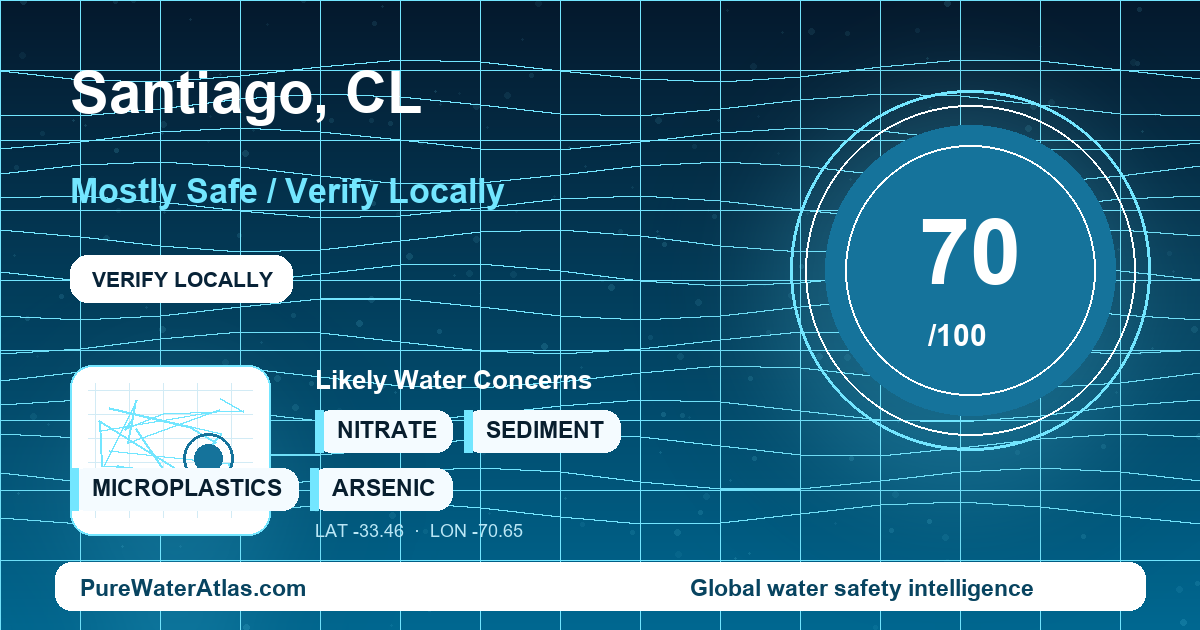
Santiago’s tap water is generally treated and regulated in serviced urban districts, but travelers and residents should verify local conditions during Andean turbidity events, outages, building plumbing problems, or storage-tank concerns.
Quick Answer
| Overall safety status | Mostly Safe / Verify Locally. Santiago’s municipal tap water is usually drinkable in serviced areas, with a PureWaterAtlas safety score of 70/100. |
|---|---|
| Traveler advice | Most visitors in central Santiago, Providencia, Las Condes, Vitacura, Ñuñoa and other fully serviced urban districts can usually drink tap water if there is no active outage, turbidity notice, discolored water, or building-specific warning. |
| Resident advice | Treat the utility supply as generally potable, but verify your own building. Old internal plumbing, poorly maintained tanks, post-repair sediment, or repeated taste and odor complaints may justify testing or filtration. |
| Main water source | Primarily Andean surface water from the Maipo River basin, including the Maipo and Mapocho river systems, high-mountain storage such as Embalse El Yeso, and supplemental groundwater wells. |
| Main authority | Aguas Andinas is the main utility for much of Greater Santiago, with oversight by Chile’s Superintendencia de Servicios Sanitarios and national drinking-water rules. |
| Filter recommendation | A filter is not automatically required for safety in a sound municipal connection. Activated carbon can improve chlorine taste; lead-certified filtration or testing is more relevant in older buildings with uncertain plumbing. |
Why Santiago Is Different
Santiago is not a generic urban water system. The city sits in a semi-arid basin immediately west of the Andes, and its drinking-water security is closely tied to mountain snowpack, high-elevation rainfall, reservoir storage, and river conditions in the Maipo basin. That geography gives Santiago access to major Andean water sources, but it also means that storms, warm rain over snow, landslides, rapid snowmelt, and drought can affect raw-water conditions before treatment.
The practical result is that Santiago’s tap water is usually treated and drinkable in serviced urban areas, but local verification matters more during specific events. High raw-water turbidity from the Andes has historically caused visible alerts or disruptions when sediment levels exceeded normal operating conditions. These episodes are not evidence that the treated supply is normally unsafe; they are a reminder that mountain-fed systems can change quickly.
Another Santiago-specific issue is taste. Visitors often notice chlorinated or mineralized flavors compared with water in their home country. That taste is commonly related to residual disinfection or mineral character and does not, by itself, prove the water is unsafe. However, sudden brown water, strong sewage odor, loss of pressure, or recent building repairs should trigger caution and local checking.
Where Does Santiago’s Tap Water Come From?
Santiago’s metropolitan drinking water is primarily based on Andean surface water in the Maipo River basin. The supply portfolio includes the Maipo and Mapocho river systems, high-mountain storage such as Embalse El Yeso, and related Andean water bodies. Groundwater wells are also used as support and resilience sources, especially during operational stress.
Several pieces of infrastructure are central to Santiago’s water identity. Embalse El Yeso is a strategic raw-water reservoir in the Andes. Maipo River basin intakes and conveyance works feed the main urban production system. Mapocho River basin sources are part of the wider metropolitan supply portfolio. Major potable-water production infrastructure includes the Las Vizcachas complex and La Florida treatment works. Santiago has also invested in emergency storage, including Pirque reserve ponds and other works intended to increase autonomy during high-turbidity raw-water events.
This infrastructure reflects the city’s history and geography. Santiago developed around the Mapocho River and irrigation canals at the foot of the Andes, but modern drinking water is now delivered through engineered storage, intakes, large treatment plants, and a metropolitan distribution network operating under Chile’s sanitary-services concession model.
Who Manages Drinking Water in Santiago?
The main drinking-water utility for Greater Santiago is Aguas Andinas, with affiliated concessionaires serving parts of the metropolitan area. The utility provides customer information, service-interruption notices, water-quality information, and infrastructure updates. Its customer-facing water-quality page is available at Aguas Andinas calidad del agua.
Oversight is provided by Chile’s Superintendencia de Servicios Sanitarios, the national regulator for sanitary-service companies. SISS publishes sanitary-sector information and reports, including material relevant to urban water and wastewater concessions, through resources such as its sector management and reports page.
Potable water quality in Chile is tied to national drinking-water standards and health regulations, commonly associated with NCh409 requirements and Ministry of Health sanitary rules. The Biblioteca del Congreso Nacional de Chile text for Decreto 735 is one official legal source related to potable-water service regulation and sanitary requirements. Water-resource context for the Maipo basin can also be checked through the Dirección General de Aguas.
These authorities confirm that Santiago is served by a regulated urban water system. They do not prove that every individual apartment tap, storage tank, fixture, or old internal pipe is safe at all times.
Main Local Water Concerns
The main Santiago water concerns are local and event-driven rather than a blanket indication that the municipal supply is unsafe. The most important issue is high raw-water turbidity after intense Andean rain, warm storms, landslides, or rapid snowmelt. Turbidity means suspended particles in the source water; when levels rise sharply, treatment and distribution operations can be stressed, and service interruptions or warnings may occur.
Drought and long-term pressure on Maipo basin water availability are also important. Santiago’s semi-arid setting and dependence on Andean hydrology make reservoir storage, snowpack, river flows, and backup sources central to water security. The World Bank Climate Change Knowledge Portal for Chile provides high-level climate and water-stress context for the country, including the broader variability affecting central Chile.
At the neighborhood or building level, short-term sediment or discoloration can appear after pipe repairs, pressure changes, local outages, or construction. Chlorine taste or odor can come from residual disinfection in the distribution system; learn more in the PureWaterAtlas profile on chlorine. Older internal plumbing, fixtures, or solder can create building-level metal concerns such as lead, where present. Poorly maintained private tanks, cisterns, or stagnant internal plumbing can create microbial risk, including concerns related to E. coli.
A key limitation is that public sources do not provide a simple real-time contaminant profile for every Santiago neighborhood or building. Conditions can differ after storms, outages, pipe repairs, earthquakes, or inside older buildings and storage tanks.
For Travelers
For most travelers staying in central Santiago, Providencia, Las Condes, Vitacura, Ñuñoa, or other fully serviced urban districts, tap water is generally considered drinkable in normal conditions. If your hotel or apartment has no active advisory, the water is clear, pressure is normal, and there has not been a recent service interruption, drinking tap water is usually reasonable.
Use bottled water or boiled water if there is an active notice, if your accommodation reports a cut, if the tap runs brown or cloudy, or if you are staying somewhere with uncertain plumbing or questionable storage tanks. During major Andean storms or visible citywide water alerts, check Aguas Andinas or local communications before relying on tap water.
Brushing teeth with tap water is usually acceptable in hotels and apartments connected to the municipal system. Use bottled or boiled water for brushing if the water is discolored, if pressure has been lost, or if the building has told guests not to drink it.
Ice from established hotels, restaurants, and cafes is generally low concern when made from municipal water. Avoid ice from street or informal vendors if you cannot tell whether treated water was used. Mainstream hotels and restaurants in central and eastern Santiago are normally connected to the regulated municipal supply, but it is still sensible to ask reception about recent outages, tank maintenance, or advisories if you notice unusual taste, odor, cloudiness, or sediment.
Travelers with sensitive stomachs, infants, immunocompromised travelers, or people on very short stays may prefer bottled water initially. This is not because Santiago’s municipal water is normally unsafe, but because mineral content and residual chlorine can differ from what a visitor is used to.
For Residents
Residents should treat Santiago’s municipal supply as generally potable where the home is connected to the regulated system and the building plumbing is sound. A home filter is not automatically required for safety. A certified activated-carbon filter can be useful for improving chlorine taste and odor. Reverse osmosis is usually unnecessary unless testing identifies a specific dissolved contaminant concern.
Testing is more important than guessing in older homes and apartment buildings. If the property is old, has unknown internal plumbing, or has brass fixtures of uncertain age, test first-draw and flushed samples for lead and copper. If the building uses a private storage tank, cistern, well, or has experienced repeated low-pressure events, test for E. coli or total coliforms. If the water is repeatedly brown, cloudy, or contains particles after local pipe work, check turbidity, iron, or sediment through an accredited laboratory.
The difference between utility water and building water matters. Aguas Andinas or another concessionaire can deliver compliant treated water to the property boundary while an old building can still introduce metals, sediment, or microbial problems through internal pipes, fixtures, stagnant plumbing, or tanks. This is especially relevant in older apartments, renovated properties with mixed materials, and taps that sit unused for long periods.
Apartment and building storage tanks should be covered, protected from contamination, and periodically cleaned. A neglected tank can create microbial or sediment problems even when the incoming municipal water is treated. After large storms, water cuts, abnormal taste or odor events, earthquakes, major construction, pipe breaks, or pressure losses, residents should review Aguas Andinas and SISS communications and verify water clarity before drinking.
Relevant Contaminants and Water-Quality Issues
The most Santiago-specific issue is turbidity, because Andean storms, landslides, warm rainfall over snow, and snowmelt can rapidly increase sediment in raw river water. Turbidity is mainly a raw-water and operational challenge, but it can lead to advisories or interruptions when levels are extreme.
Chlorine is relevant because treated municipal water requires residual disinfection, and chlorine taste or odor is a common visitor complaint. Taste alone does not prove unsafe water. Sediment is relevant after local pipe repairs, outages, pressure changes, or high-turbidity episodes, especially if water appears brown, cloudy, or particle-filled.
Lead should be considered as a building-level plumbing issue rather than a proven citywide Santiago problem. Older internal pipes, fixtures, or solder can affect the water that reaches a specific tap. E. coli is mainly relevant where there are storage tanks, cisterns, pressure losses, or suspected microbial contamination. Santiago’s public information does not provide a tap-by-tap profile for lead, PFAS, microplastics, or every other contaminant, so site-specific testing is the correct approach when there is a specific concern.
How to Verify Your Water Quality
Start with local notices. Check Aguas Andinas for service interruptions and customer information, and use SISS for regulatory context. If you are dealing with a storm, outage, pressure loss, or visible discoloration, do not assume the issue is only cosmetic; verify the current advisory status and let taps run briefly after service is restored before evaluating clarity.
For household decisions, use testing rather than taste alone. PureWaterAtlas has a detailed guide to water testing, including how to choose tests and interpret results. Residents in older properties can also use Lead in Drinking Water: Testing and Detection Methods. During advisories or suspected microbial contamination, see the Boiling Water Purification Guide. For private tanks or supplemental microbial control, the UV Water Purification Guide may be useful.
To research specific contaminants, use the PureWaterAtlas Contaminants Search Engine. For broader comparisons, see the Global Water Quality Checker, the Drinking Water Safety guide, the Water Purification guide, and the Global Water Quality resource. Related categories include Drinking Water Safety, Global Water Quality, and Water Testing.
Official and Technical Sources
- Aguas Andinas official website — main local utility source for much of Greater Santiago, including customer notices and service information.
- Aguas Andinas customer water-quality information — consumer-facing potable-water quality and supply context.
- Superintendencia de Servicios Sanitarios — Chile’s national regulator for sanitary-service companies, including drinking-water concessions.
- SISS sanitary sector management and reports — regulatory reports and sector information for verifying utility and service context.
- Biblioteca del Congreso Nacional de Chile, Decreto 735 — official legal text related to potable-water service regulation and sanitary requirements.
- Dirección General de Aguas, Ministerio de Obras Públicas — official Chilean water-resources authority relevant to basins, drought context, and hydrological monitoring.
- World Bank Climate Change Knowledge Portal: Chile — high-level climate and water-stress context for Chile and central Chile variability.
Bottom Line
Santiago’s tap water is generally safe to drink in serviced urban areas because it is treated and supplied through a regulated metropolitan system. The main exceptions are local and time-sensitive: Andean storm turbidity, service cuts, pressure losses, brown or cloudy water, post-repair sediment, and building-level problems such as old plumbing or poorly maintained storage tanks. Travelers in central and eastern districts can usually drink tap water, brush teeth, and use ice from established venues, while sensitive travelers may prefer bottled water for comfort. Residents should focus on their own building conditions, especially in older apartments or properties with tanks. Official utility and regulator sources are useful, but they do not guarantee every individual tap at every moment.
Read the full guide: Global Water Quality Guide
Explore more in this category: Global Water Quality Articles