
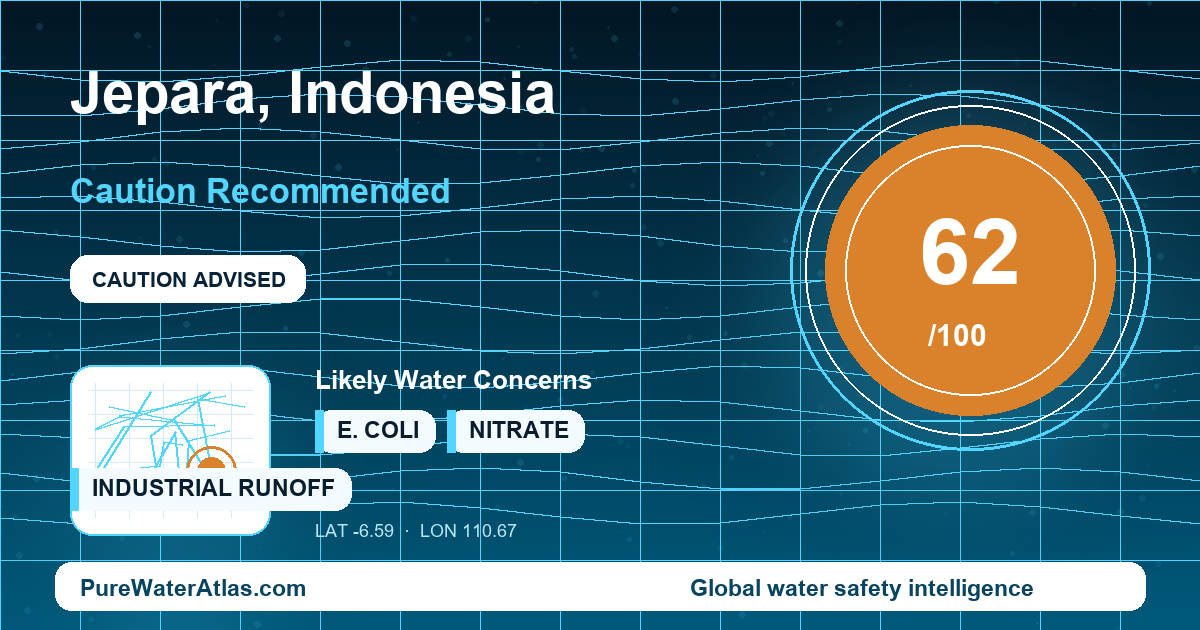
Jepara, Indonesia: coastal Central Java water safety profile for PDAM supply, private wells, storage tanks, refill water, and traveler precautions.
Quick Answer
| Overall safety status | Caution recommended. Jepara has a local piped-water utility and national Indonesian drinking-water standards, but public city-level tap-point testing data are limited. Ordinary tap water should not be assumed potable without boiling, verified filtration, or recent test results. |
|---|---|
| PureWaterAtlas score | 62 / 100 — risk level: Caution Recommended. |
| Traveler advice | Most short-term visitors should drink sealed bottled water, properly boiled water, or water treated by a reliable filter or UV system. Use caution with ice and refill containers unless the provider can explain the treatment source. |
| Resident advice | Prefer a regulated PDAM connection where reliable, but manage household storage tanks and consider point-of-use treatment. Private wells, especially in coastal or low-lying areas, should be tested before drinking use. |
| Main water sources | Mixed system: PDAM network water, treated local raw-water sources, springs, groundwater production wells, private wells, rural communal systems, refill depots, stored water, and in dry periods delivered water. |
| Local authority | Perumda Air Minum Tirta Jungporo Kabupaten Jepara for piped water; public-health oversight is associated with Dinas Kesehatan Kabupaten Jepara and national Ministry of Health standards. |
| Filter recommendation | For PDAM water, consider sediment filtration, activated carbon, and boiling or UV when tank hygiene or pressure is uncertain. For private wells, test first; treatment may need UV, chlorination, RO, or mineral-specific filtration depending on results. |
Why Jepara Is Different
Jepara is not a city where tap-water safety can be judged from one single source description. It is a coastal city and regency on the north coast of Central Java facing the Java Sea, with low-lying coastal settlements and inland catchments influenced by the Muria mountain area. That geography matters: some water sources are associated with upland springs or surface-water catchments, while shallow coastal groundwater can be more vulnerable to salinity, high dissolved solids, or brackish taste.
The practical reality in Jepara is mixed water use. A building may receive water from Perumda Air Minum Tirta Jungporo Kabupaten Jepara, from a private dug well or bore well, from a rural communal system, from a refill-water depot, from a storage tank, or from more than one of these sources. This is especially important for visitors staying in hotels, guesthouses, rented villas, or properties near coastal areas: a modern-looking bathroom tap does not prove the water is continuously treated to drinking-water quality.
Jepara’s urban core, coastal tourism activity, furniture and small-industry economy, and surrounding rural villages also create uneven demand and service conditions. Public reports and local news in dry seasons frequently describe clean-water stress in parts of Jepara Regency. Conditions can differ by neighborhood, source, tank maintenance, and season, so this profile uses a cautious city-level verdict rather than claiming that every tap in Jepara has the same risk.
Where Does Jepara’s Tap Water Come From?
Jepara’s drinking-water system is best understood as a mixed system rather than a single fully documented citywide supply. Networked water is supplied by Perumda Air Minum Tirta Jungporo Kabupaten Jepara. The local PDAM system uses raw-water assets on mainland Jepara, including treated surface-water or river-intake systems, springs, and groundwater production wells. Public source-by-zone production tables are limited, so PureWaterAtlas does not treat Jepara as having one uniform water source across the whole city and regency.
Outside fully reliable piped service, households may use private dug wells or bore wells, communal rural SPAM or PAMSIMAS-style systems, rainwater or stored water, refill-water depots, gallon-water distribution, and in dry periods delivered water. This means the water arriving at a kitchen tap may depend not only on the official source but also on the property’s internal plumbing, roof tank, ground tank, pump, backup source, and maintenance habits.
Historically, many Jepara households relied on shallow wells, local springs, and small surface-water sources from the Muria foothill catchments and coastal plain. Piped supply and rural water programs have expanded access, but the shift has not eliminated household-level variation. A PDAM-connected home with a clean, sealed tank has a different risk profile from a shallow well near septic systems, and both differ from refill water stored in reused containers.
Who Manages Drinking Water in Jepara?
The local piped-water utility is Perumda Air Minum Tirta Jungporo Kabupaten Jepara. Local government context and public-service administration sit under the Pemerintah Kabupaten Jepara. Public-health oversight is associated with Dinas Kesehatan Kabupaten Jepara, while national drinking-water and environmental health requirements are set by the Indonesian Ministry of Health.
Indonesia’s health framework for drinking-water quality is governed nationally through Ministry of Health regulations, including Permenkes No. 2 Tahun 2023, which sets environmental health quality standards. The Kementerian Kesehatan Republik Indonesia is the national public-health authority relevant to drinking-water health guidance.
The key limitation is public transparency at the tap level. Jepara has identifiable institutions and official standards, but current open-source neighborhood-level compliance summaries, tap-by-tap testing results, source-by-zone reports, and continuous residual disinfectant data are not consistently available. For that reason, household testing and source verification remain important, especially where private wells, tanks, or refill water are used.
Main Local Water Concerns
Microbial contamination is the most important acute concern for untreated private wells, refill containers, poorly maintained tanks, and plumbing affected by low pressure or stagnation. Water may look clear and still contain disease-causing organisms; the absence of smell or color is not proof of safety.
Salinity, high TDS, and brackish taste are plausible concerns for shallow coastal groundwater because Jepara faces the Java Sea and includes low-lying coastal settlements. Standard sediment or carbon filters do not remove dissolved salts; residents relying on coastal wells should test conductivity, TDS, chloride, and salinity indicators before using the water for drinking.
Turbidity and sediment can increase during heavy rain when runoff affects surface-water sources, small communal systems, wells, or poorly protected tanks. Cloudiness or discoloration can also follow pipe disturbance, repairs, tank cleaning, or long outages.
Dry-season water stress can reduce source yield and pressure in some parts of Jepara Regency, increasing reliance on stored or delivered water. Lower pressure and intermittent supply can make household tank management more important.
Iron and manganese may affect groundwater-fed supplies, producing staining, metallic taste, sediment, or black deposits. These issues should be tested rather than judged only by appearance. Nitrate is also plausible in shallow wells near septic systems, livestock, gardens, rice fields, or agricultural runoff, but household-specific testing is needed before making health claims.
For Travelers
Short-term visitors should not drink ordinary tap water in Jepara as a default travel practice. The safer options are sealed bottled water, properly boiled water, or water treated with a credible filtration and disinfection system. This is particularly important for travelers whose bodies are not accustomed to local microbial conditions, for children, pregnant travelers, older adults, and immunocompromised visitors.
For brushing teeth, the lower-risk choice is bottled, boiled, or reliably filtered water if the property’s source is unclear. Some experienced travelers may rinse with tap water, but PureWaterAtlas recommends treated water for short stays because the building may use PDAM, a bore well, stored water, or a combination.
Use caution with ice. Avoid ice from street stalls or small vendors unless you are confident it was made from treated commercial ice or purified water. In hotels and established restaurants, ask whether ice is made from purified water if you are sensitive to stomach illness.
Hotels and restaurants in Jepara may use gallon water, commercial ice, filters, UV systems, or boiled water for drinking service, but this is not guaranteed. Ask a simple source question: “Is the drinking water PDAM, bore-well, refill-depot, RO, UV-treated, or boiled?” Do not rely on bathroom tap water as drinking water unless the property specifically states that it is potable.
If visiting beaches, rural villages, workshops, or the Jepara harbor area, carry bottled or refillable treated water. If using a travel filter, pair mechanical filtration with disinfection or UV for microbial risk. Normal backpacking filters will not remove dissolved salts from salty or brackish well water.
For Residents
For residents, a home treatment system is advisable for drinking water unless recent test results show the specific tap is safe. For PDAM water, a sediment prefilter can reduce visible particles, and activated carbon can improve taste and reduce chlorine-related taste issues. If tank hygiene, pressure, or internal plumbing is uncertain, boiling or UV can add microbial protection.
For private wells, choose treatment only after testing. A well with E. coli or coliform risk needs disinfection such as UV or chlorination, not just a taste filter. A brackish coastal well may require reverse osmosis or another technology designed for dissolved salts. A well with nitrate, iron, or manganese requires parameter-specific treatment.
Private wells should be tested at least annually for E. coli or total coliform, especially before the rainy season and after flooding. Coastal or low-lying wells should be tested for electrical conductivity, TDS, chloride, and salinity indicators. Wells near septic tanks, livestock areas, gardens, rice fields, or agricultural runoff should be tested for nitrate. If the water leaves brown or black staining, has metallic taste, or creates sediment or slime in tanks and fixtures, test iron and manganese.
Older buildings and renovated properties deserve additional attention. Indonesia is not generally known for the same historic lead service-line pattern as some older North American or European cities, but lead can still enter water from old plumbing, solder, brass fixtures, pumps, or unknown building materials. If children live in the home or pipe materials are unclear, consider first-draw and flushed samples for lead and other metals.
Storage tanks are a major risk point in Jepara households. Tanks should be covered, screened from insects and animals, cleaned regularly, protected from roof runoff and floodwater, and flushed after long stagnation. Even treated PDAM water can become unsafe if stored in a dirty tank or pulled through contaminated internal pipes.
Relevant Contaminants and Water-Quality Issues
The most important immediate health issue in uncertain Jepara water is microbial contamination, especially E. coli, which indicates fecal contamination risk in wells, tanks, or untreated water. For deeper background on microbes in household water, see the PureWaterAtlas guide to Water Microbiology.
During heavy rain, pipe disturbance, or tank problems, residents may notice turbidity or sediment. These are not only appearance issues: particles can interfere with disinfection and may signal source or storage problems. PDAM-treated water may also contain a disinfectant residual, so chlorine taste can be relevant for consumers using activated carbon filters.
For private wells, Jepara residents should pay attention to nitrate where wells are near septic systems, livestock, or agricultural land. Groundwater mineral issues can include iron and manganese, especially where staining, sediment, or metallic taste appears. Lead is best treated as a building-plumbing concern rather than a proven Jepara-wide source-water issue.
How to Verify Your Water Quality
The most reliable answer for a Jepara household is a test of the water actually used for drinking, taken after the building’s tank, pump, and internal plumbing. For a general safety framework, start with Drinking Water Safety: How to Know If Your Tap Water Is Safe to Drink. For sample planning and parameter selection, use How to Test Drinking Water.
If microbial risk is the concern and you need an immediate short-term measure, review Boiling Water Purification. For households or guesthouses considering device-based disinfection, see UV Water Purification. If a shallow well is near septic or agricultural sources, the guide to Nitrate Contamination Testing is directly relevant. For older buildings, see Lead in Drinking Water: Testing and Detection Methods.
To compare Jepara with other destinations, use the Global Water Quality Checker. If you receive a local laboratory report, look up each parameter in the Contaminants Search Engine. For choosing equipment, the PureWaterAtlas guide to Water Treatment Systems can help match sediment filters, carbon, UV, RO, and other technologies to actual test results. Related topic hubs include Drinking Water Safety, Water Testing, Water Purification, and Water Contamination.
Official and Technical Sources
- Perumda Air Minum Tirta Jungporo Kabupaten Jepara — local piped-water utility for Jepara’s municipal drinking-water service.
- Pemerintah Kabupaten Jepara official portal — official local-government context and public-service administration.
- Badan Pusat Statistik Kabupaten Jepara — official statistics source for Jepara demographic, housing, sanitation, and household infrastructure context.
- Permenkes No. 2 Tahun 2023 via BPK RI — Indonesian national environmental health quality standards, including drinking-water health parameters.
- Kementerian Kesehatan Republik Indonesia — national health authority relevant to drinking-water regulation and public health.
- PAMSIMAS official program site — context for rural and communal drinking-water systems that may supplement municipal utilities.
- WHO Drinking-water fact sheet — international health basis for prioritizing microbial safety and safe storage.
- WHO/UNICEF Joint Monitoring Programme country data for Indonesia — national WASH context showing that service level varies by household source and location.
Bottom Line
Jepara’s tap-water safety deserves caution rather than a simple yes or no. The city has an identifiable PDAM utility and Indonesian drinking-water standards, but public neighborhood-level tap results are limited, and many properties also rely on wells, storage tanks, refill depots, or backup water. Visitors should drink sealed bottled water, properly boiled water, or reliably treated water, and should ask about ice and refill sources. Residents should prefer a regulated PDAM connection where reliable, keep tanks clean and covered, and test private wells for microbes, salinity/TDS, nitrate, iron, manganese, and other relevant parameters. In coastal or low-lying areas, do not assume clear well water is safe or non-brackish without testing.
Read the full guide: Global Water Quality Guide
Explore more in this category: Global Water Quality Articles