
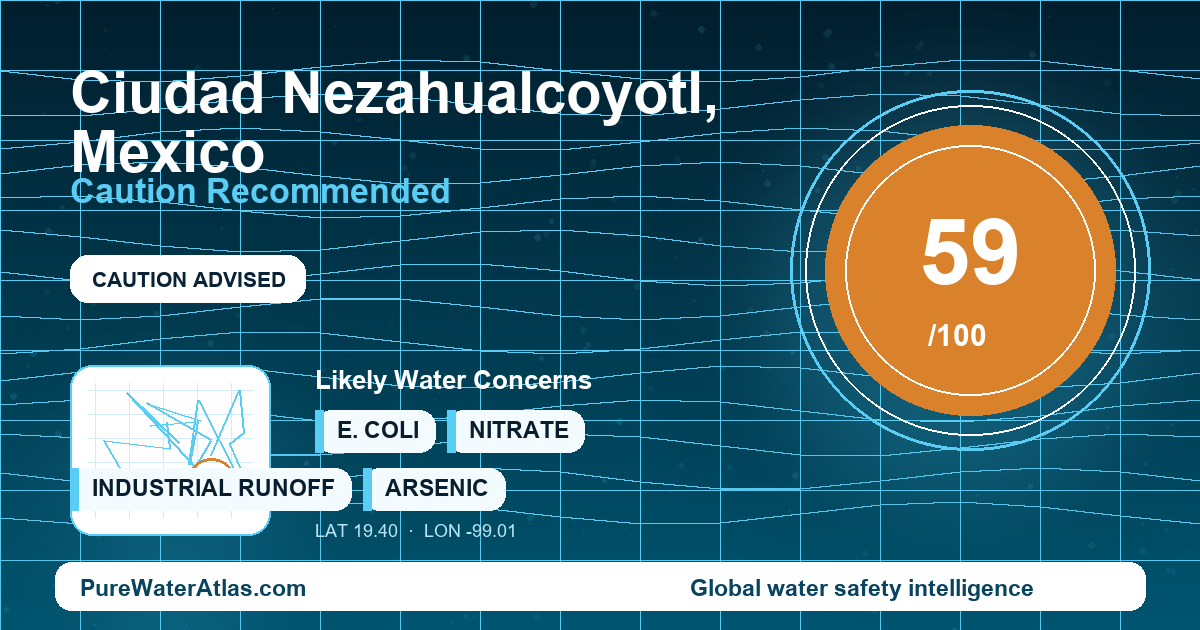
Ciudad Nezahualcoyotl has regulated municipal water service, but final-tap safety depends heavily on Mexico Valley supply conditions, old or variable distribution infrastructure, intermittent pressure, household cisterns, rooftop tinacos, and building plumbing.
Quick Answer
| Water safety score | 59 / 100 |
|---|---|
| Risk level | Caution Recommended |
| Can you drink the tap water? | Not recommended as a routine drinking source for short-term visitors unless boiled, disinfected, or treated with a reliable purifier. Residents should treat tap water as conditionally usable at the final tap, not automatically safe. |
| Traveler advice | Use sealed bottled water, commercially purified garrafon water, or water treated by a maintained purifier. Be cautious with ice of uncertain origin. |
| Resident advice | Use a maintained point-of-use treatment system or reputable garrafon supply for drinking and cooking, especially in homes with cisterns, rooftop tinacos, old plumbing, or recurring sediment and taste issues. |
| Main water source | Mixed Mexico Valley supply: local and regional groundwater from the Mexico Basin aquifer system, municipal and State of Mexico infrastructure, and imported treated surface water when allocated through the Cutzamala System and state bulk-water networks. |
| Water authority | ODAPAS Nezahualcoyotl locally; CAEM at the State of Mexico level; CONAGUA federally for national waters and major systems such as Cutzamala. |
| Filter recommendation | Sediment prefiltration plus activated carbon is a practical baseline. Add UV or another verified disinfection step where storage-tank microbial risk is a concern. Reverse osmosis may be appropriate only when testing confirms high dissolved solids, salinity, arsenic, nitrate, or metals. |
Why Ciudad Nezahualcoyotl Is Different
Ciudad Nezahualcoyotl is not a mountain-watershed city with a single simple source. It is a dense municipality in the eastern Mexico Valley, built on low, flat former Lake Texcoco terrain. That local geography matters for drinking water because the city depends on pumping, pressure management, storage, and drainage in a former lakebed environment rather than on a nearby protected upland source.
The editorial verdict for Ciudad Nezahualcoyotl is caution recommended. The city is served by a regulated municipal system, but several practical risk factors can affect water by the time it reaches a kitchen tap: mixed metropolitan supply, over-stressed Mexico Basin groundwater, intermittent pressure in some periods, old distribution infrastructure, widespread household cisterns and rooftop tanks, and limited public neighborhood-level water-quality reporting.
The main concern is not a single proven contaminant affecting every tap in the municipality. The more realistic concern is cumulative risk: mineralized groundwater in parts of the Mexico Basin, turbidity or sediment after pressure changes, residual chlorine loss during storage, and possible microbial recontamination in pipes, cisterns, rooftop tinacos, or poorly maintained internal plumbing. This is why the water may be regulated at the system level while still requiring caution at the household tap.
Where Does Ciudad Nezahualcoyotl’s Tap Water Come From?
Ciudad Nezahualcoyotl is part of the Mexico Valley water-supply region. Its supply is best understood as a mixed system. Local and regional groundwater from the Mexico Basin aquifer system is distributed through municipal and State of Mexico infrastructure. Imported treated surface water may also be supplied when allocated through the Cutzamala System and state bulk-water networks. Exact proportions can vary by operating conditions, drought, maintenance, and network pressure.
This variability is important. During dry-season or drought periods, reduced Cutzamala availability can increase reliance on groundwater or supply rotations in the metropolitan region. Major Cutzamala maintenance shutdowns or low-reservoir alerts can also cause temporary changes in pressure, service continuity, or neighborhood storage practices. Rainy-season storms can raise turbidity challenges in surface-water systems and can also create local flooding in low-lying streets.
The city’s infrastructure includes the ODAPAS Nezahualcoyotl drinking-water and sewer network, municipal wells and pumping infrastructure connected to the local grid, State of Mexico water infrastructure operated or coordinated by CAEM, and regional bulk supply linked to Cutzamala when available. At the household level, many buildings rely on cisterns, rooftop tinacos, pressure pumps, and storage tanks to manage intermittent or pressure-limited service.
Those private storage systems are a major part of the local water identity. A clean supply can become less safe if it sits in a dirty, uncovered, or poorly disinfected cistern or rooftop tank. Heat, dust, insects, stagnant water, and declining chlorine residual can all turn household storage into the final weak point in the safety chain.
Who Manages Drinking Water in Ciudad Nezahualcoyotl?
The local water utility is ODAPAS Nezahualcoyotl, the municipal agency responsible for drinking water, sewerage, and sanitation service in the municipality. At the regional level, the Comision del Agua del Estado de Mexico, or CAEM, coordinates state water infrastructure and bulk supply. At the federal level, CONAGUA manages national water resources and major systems, including the Cutzamala System.
Mexico’s drinking water quality framework is governed by national health standards, especially NOM-127-SSA1-2021, Agua para uso y consumo humano. This standard provides the national regulatory context for water for human use and consumption. However, the existence of national rules should not be treated as proof that every final tap in every neighborhood or building is compliant at all times.
Publicly accessible information identifies the utility, regional supply systems, and infrastructure context, but recent open datasets with routine finished-water results by Nezahualcoyotl neighborhood, distribution zone, building type, and household storage condition are limited. For that reason, PureWaterAtlas assigns moderate confidence to this city profile: the source-water and infrastructure context is well documented, but neighborhood-level final-tap lab data are not publicly available in a form that supports exact compliance claims.
Main Local Water Concerns
Intermittent pressure and intrusion risk: If the distribution network loses positive pressure during interruptions, scheduled reductions, repairs, or pressure-limited periods, water can be more vulnerable to intrusion through leaks, cross-connections, or compromised service lines. This does not mean every outage causes contamination, but it raises the need to flush and treat water after suspicious events.
Mineralized groundwater: Groundwater in the Mexico Basin can be naturally mineralized. In former lakebed settings, some supplies may have salty, hard, or alkaline taste. Conditions vary, so this should not be assumed at every tap, but it is a plausible local explanation for taste concerns and for households considering testing for conductivity, total dissolved solids, hardness, iron, manganese, arsenic, or nitrate.
Turbidity, sediment, and colored water: Cloudiness, sediment, or discoloration can appear after pipe repairs, pressure surges, well switching, or changes related to regional supply. Older pipes, local repairs, and household tanks can also contribute to visible particles. Water that is unusually cloudy, colored, or has sewage-like odor should not be used for drinking until flushed, evaluated, and treated.
Residual chlorine loss: Chlorination can protect water in distribution, but free chlorine residual can decline in long household storage, dirty cisterns, rooftop tinacos, or tanks exposed to heat and dust. If residual disinfectant is gone, microbial regrowth becomes more plausible, especially when tanks are not sealed or cleaned.
Old internal plumbing: Nezahualcoyotl grew rapidly during the second half of the twentieth century, often faster than formal urban services could be installed. As a result, building plumbing and service connections can vary widely in age and condition. Older fixtures, solder, brass components, corroded galvanized pipe, or unknown service-line materials can introduce metals such as lead, particularly after water stagnates overnight.
Flooding and sewer context: The city’s low-lying former lakebed setting makes drainage and sewer infrastructure important. During heavy rains, flooding or sewer overflows can increase the importance of avoiding water from compromised cisterns or taps affected by low pressure, bad odor, visible contamination, or recent service disruption.
For Travelers
Visitors should not rely on untreated tap water in Ciudad Nezahualcoyotl as a routine drinking source. The municipal system is regulated, but traveler risk is driven by uncertainty at the final tap: local storage tanks, pressure changes, sediment events, and building-level plumbing conditions may differ from one hotel, rental, restaurant, or home to another.
Use sealed bottled water or reputable commercially purified garrafon water for drinking. For longer stays, use a maintained purifier certified for microbial reduction plus carbon filtration, or boil water for at least one minute when microbial safety is uncertain. See the PureWaterAtlas Boiling Water Purification: Complete Guide for practical boiling guidance during outages, floods, or suspected contamination events.
Brushing teeth with tap water is generally lower risk than drinking full glasses for healthy adults, but cautious travelers, people with sensitive stomachs, and immunocompromised travelers should use bottled or purified water. For ice, use only ice from hotels, restaurants, or shops that use purified water. Avoid informal ice or ice of uncertain origin, especially from street vendors.
Better hotels and established restaurants often use garrafon or purified water for drinking and ice, but ask if unsure. In rentals, check whether the kitchen tap is connected to a filter and whether that filter is actually maintained. Do not drink water that is cloudy, has sewage odor, has unusual color, or appears immediately after a local outage until it has been flushed and treated.
For Residents
For residents, the practical question is not simply whether Ciudad Nezahualcoyotl has a regulated municipal supply. The more useful question is whether the water at your own kitchen tap remains safe after distribution, building plumbing, cistern storage, rooftop tank storage, and stagnation.
A home treatment barrier is advisable in many households, especially where water is stored in cisterns or tinacos, pressure is intermittent, plumbing is old, or taste and sediment are recurring problems. A practical setup is sediment prefiltration plus activated carbon for particles, taste, odor, and some chlorine-related concerns. If microbial risk from cisterns or rooftop tanks is a concern, add UV or another verified disinfection step. The PureWaterAtlas UV Water Purification: Complete Guide explains when UV can help and why prefiltration and maintenance matter.
Reverse osmosis may be appropriate where testing confirms high dissolved solids, salinity, arsenic, nitrate, or metals, but it should not be chosen blindly. RO systems require maintenance, cartridge replacement, and sometimes prefiltration. For broader treatment planning, see Water Treatment Systems: Choosing the Right Solution for Safe Drinking Water.
Test at the kitchen tap if you drink the water, not only at the building inlet. Include free chlorine residual, pH, conductivity or total dissolved solids, turbidity, color, and odor. Use a certified laboratory for total coliforms and E. coli after flooding, cistern contamination, plumbing work, or long service interruptions. Test for lead if the building has old plumbing, unknown service lines, brass fixtures, or water that sits overnight before use.
Cisterns and rooftop tinacos are especially important in Nezahualcoyotl. Keep tanks covered, screen vents, prevent insect and dust entry, clean and disinfect periodically and after contamination events, and check that pumps and float valves do not allow backflow. A well-chlorinated supply can become unsafe if it is stored in a dirty tank.
Relevant Contaminants and Water-Quality Issues
Chlorine in Drinking Water is relevant because residual disinfectant can decline in long distribution lines, cisterns, and rooftop tinacos. Chlorine presence is not a complete safety guarantee, but very low residual after storage can signal reduced microbial protection.
Turbidity in Drinking Water and Sediment in Drinking Water are important for Ciudad Nezahualcoyotl because cloudy or particle-laden water may appear after pressure changes, pipe repairs, storm events, well switching, or storage-tank disturbance. Turbidity can also interfere with disinfection.
E. coli in Drinking Water is the key microbial indicator to test after flooding, suspected sewage contact, cistern contamination, or long service interruptions. For background on microbial risks, see Water Microbiology: Bacteria, Viruses and Microbial Risks in Drinking Water.
Lead in Drinking Water is relevant to older or unknown household plumbing. If the plumbing history is unclear, review Lead in Drinking Water: Testing and Detection Methods and, if lead is confirmed, Lead in Drinking Water: Best Filters, Systems and Solutions.
Iron in Drinking Water and Manganese in Drinking Water can be relevant where groundwater influence, pipe corrosion, discoloration, metallic taste, or brown and black staining are recurring issues. If groundwater-related inorganic contaminants are a concern, residents can also review Arsenic in Drinking Water: Testing and Detection Methods.
How to Verify Your Water Quality
The most reliable way to verify water quality in Ciudad Nezahualcoyotl is to test the water you actually drink. Because final-tap quality can differ from water leaving wells, treatment works, or municipal mains, household testing should account for storage tanks, plumbing age, stagnation, and recent pressure events.
Start with practical observations: sudden cloudiness, unusual color, sewage odor, metallic taste, salty taste, or sediment after an outage should trigger caution. Then measure basic field indicators such as chlorine residual, pH, conductivity or total dissolved solids, and turbidity. For health-significant questions, use a certified laboratory for microbiological indicators and metals.
PureWaterAtlas resources can help interpret results. Use the Water Testing guide for sampling strategy, the Contaminants Search Engine to look up items on a lab report, and the Drinking Water Safety guide for understanding warning signs. Travelers comparing destinations can use the Global Water Quality Checker.
Official and Technical Sources
- ODAPAS Nezahualcoyotl official site — municipal drinking water, sewerage, and sanitation authority.
- Comision del Agua del Estado de Mexico — State of Mexico water infrastructure and bulk-supply coordination.
- Sistema Cutzamala, CONAGUA — official description of the major imported treated surface-water system for the Mexico Valley and parts of the State of Mexico.
- Sistema Nacional de Informacion del Agua, CONAGUA — national water-resource and infrastructure information.
- NOM-127-SSA1-2021 — Mexican national drinking-water quality standard for water for human use and consumption.
- INEGI Areas geograficas: Municipio Nezahualcoyotl, Estado de Mexico — official municipal geography and demographic context.
- Atlas Nacional de Riesgos — official hazard context relevant to flooding, subsidence, and low-lying Mexico Valley municipalities.
- CDC travel guidance for Mexico — public-health travel guidance supporting conservative water and ice precautions for visitors.
Bottom Line
Tap water in Ciudad Nezahualcoyotl should be approached with caution. The municipality is served by a regulated water system, but the final-tap risk profile is shaped by mixed Mexico Valley sources, groundwater stress, pressure variability, older infrastructure, and widespread use of cisterns and rooftop tinacos. Visitors should use bottled, garrafon, boiled, or reliably purified water for drinking and be cautious with ice. Residents should focus on household controls: clean storage tanks, maintain filters, test kitchen-tap water, and pay special attention after outages, flooding, plumbing work, or visible sediment. The most important point is local: water quality can change between the municipal network and the glass, so household storage and building plumbing matter in Nezahualcoyotl.
Read the full guide: Global Water Quality Guide
Explore more in this category: Global Water Quality Articles