
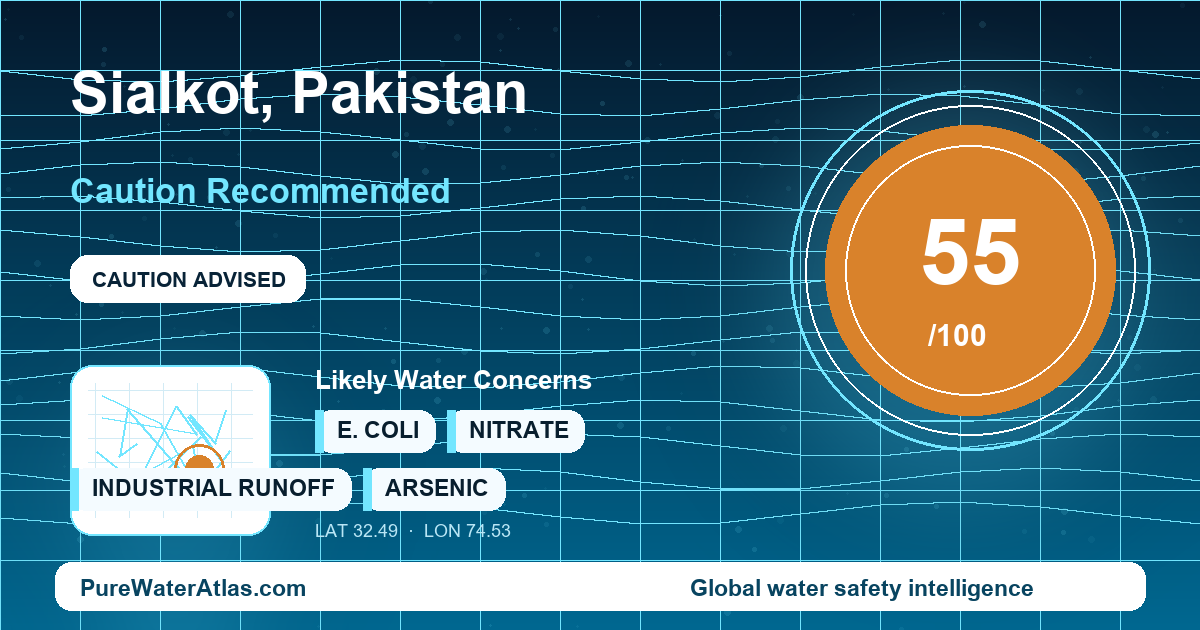
Sialkot, Pakistan: groundwater-based drinking water with location-dependent quality, household storage risks, and caution recommended for untreated tap or bore water.
Quick Answer
| Water safety score | 55 / 100 |
|---|---|
| Risk level | Caution Recommended |
| Can you drink tap water in Sialkot? | Untreated tap water is not recommended for short-term visitors. Residents should treat safety as neighborhood- and building-specific. |
| Main water source | Primarily groundwater from municipal tube wells and private boreholes in the alluvial aquifer. |
| Main concerns | Microbial contamination, intermittent pressure, household tank recontamination, variable TDS and hardness, possible nitrate, arsenic, iron, manganese, lead from plumbing, and industrial or drainage pressure on groundwater. |
| Traveler advice | Use sealed bottled water, properly maintained hotel filtration, boiled water, or reliably disinfected water. Avoid ice unless the water source is confirmed safe. |
| Resident advice | Test the water at the drinking point before choosing a filter. A point-of-use system is usually advisable, but the correct technology depends on lab results. |
| Local authority context | Municipal Corporation Sialkot and Punjab local government bodies are associated with urban water services, with provincial project and technical support from relevant Punjab agencies. |
Verdict: Caution recommended. Sialkot’s drinking water is not best understood as one uniform citywide supply. The final water in a glass may come through a municipal tube well, private bore, distribution line, suction pump, underground tank, roof tank, and kitchen filter. Each step can improve or degrade safety.
Why Sialkot Is Different
Sialkot is an industrial city in northeastern Punjab, located in the upper Rechna Doab region between the Chenab and Ravi river systems and near the Jammu foothill zone. Its drinking water identity is strongly tied to groundwater, not to a single large treated river-water plant. Municipal tube wells and many private boreholes draw from unconsolidated alluvial aquifers, and water quality can vary by bore depth, construction, surrounding drains, pipe condition, storage practice, and local hydrogeology.
This makes Sialkot different from cities where most consumers receive centrally treated surface water with regularly published neighborhood compliance results. In Sialkot, the same street can include households using municipal water, private bore water, public filtration points, or a mixture of sources. The safety of the final drinking water can therefore differ significantly even inside the same neighborhood.
Sialkot’s export-oriented industrial activity also matters for water risk assessment. The city is known for surgical instruments, sports goods, leather-related activity, and metalwork. These activities do not prove that a specific tap is contaminated, but they increase the importance of groundwater protection, wastewater control, and laboratory testing, especially for private bores near drains, workshops, tanneries, or metal-processing areas.
Where Does Sialkot’s Tap Water Come From?
Sialkot’s public and private drinking water supply is primarily groundwater-based. Municipal tube wells supply parts of the urban network, while many households and buildings also rely on private boreholes. Historically, households in Sialkot and surrounding Punjab settlements used hand pumps, shallow wells, and later deeper tube wells. Today, the quality of bore water depends on construction quality, depth, aquifer conditions, proximity to drains or sewers, and whether the bore is protected from surface contamination.
Important infrastructure elements include municipal groundwater tube wells, distribution mains, local water supply lines, overhead reservoirs, public filtration points, and household storage systems. Distribution integrity is a central issue. Where pressure is intermittent or pipes are damaged, the risk of contaminated water entering the system increases, especially near sewer lines, drains, or flooded areas.
Open drains such as Nullah Aik and Nullah Palkhu are important urban drainage features in and around Sialkot. They should not be understood as drinking-water sources; they are contamination-pressure pathways. If leaking sewers, stormwater drains, flooded streets, damaged water pipes, or shallow groundwater intersect, microbial and chemical risks can increase.
Household infrastructure is also part of the water system. In many Sialkot homes, water may pass from a municipal line or private bore to a suction pump, then into an underground tank, roof tank, and finally through a kitchen filter. A safe source can become unsafe if storage tanks are unsealed, dirty, cracked, insect-accessible, or affected by seepage. Conversely, a well-maintained filtration and disinfection system can reduce risk if selected for the actual contaminants present.
Who Manages Drinking Water in Sialkot?
Urban water supply functions in Sialkot are associated with Municipal Corporation Sialkot and Punjab local government bodies. Provincial support and infrastructure programs involve organizations such as the Public Health Engineering Department, the Punjab Municipal Development Fund Company, and the Punjab Intermediate Cities Improvement Investment Program. The Asian Development Bank project page identifies Sialkot among intermediate cities where water supply, sewerage, and drainage improvements are important urban infrastructure needs.
The Pakistan Council of Research in Water Resources is a national technical body involved in water-quality monitoring and research, but it is not the local utility. Drinking-water quality in Pakistan is guided by the National Standards for Drinking Water Quality, with national and provincial environmental and public-health oversight. The Pakistan Environmental Protection Agency and the Environmental Protection Department, Punjab are relevant reference points for standards and environmental control.
A key limitation for Sialkot consumers is that recent, consumer-facing, ward-level tap-water compliance data are not consistently available in a simple public report. The available public record supports the conclusion that Sialkot relies heavily on groundwater and faces infrastructure, storage, and drainage-related risk pathways. It does not support a blanket claim that every neighborhood passes or fails for E. coli, arsenic, nitrate, lead, TDS, or residual chlorine. Site-specific testing remains essential.
Main Local Water Concerns
Microbial contamination is the leading practical concern. The main pathways are intermittent supply, damaged distribution lines, sewer cross-connections, shallow or poorly sealed bores, suction pumps, and household tanks. If water pressure drops, contaminated water can be drawn into leaks. If tanks are uncovered or poorly cleaned, water can be recontaminated after reaching the building.
Turbidity and sediment can increase after disturbance. Pipe repairs, pressure changes, monsoon flooding, and dirty storage tanks can introduce visible particles or cloudiness. Turbid water can also reduce the effectiveness of UV disinfection and other treatment systems.
Groundwater chemistry is variable. Sialkot users may experience differences in total dissolved solids, hardness, taste, salinity, iron, or manganese depending on bore depth and local aquifer conditions. Iron and manganese can cause staining, metallic taste, and filter fouling, even when the main health concern is elsewhere.
Nitrate and arsenic should be tested, not guessed. Nitrate may be relevant where shallow groundwater is affected by agriculture, septic leakage, or sewer leakage. Arsenic occurs in parts of Punjab groundwater, so private bore users should verify their own water rather than assuming safety or contamination from regional information alone.
Older building plumbing can add risk. Lead exposure may come from older plumbing, fittings, solder, brass components, or storage materials. This is a building-level issue; no citywide claim about lead service lines should be made without testing.
Seasonal conditions matter. Monsoon rain can increase flooding, drain overflow, turbidity, and intrusion risk. Hot weather increases household water storage and can reduce disinfectant protection where residuals are low. Power outages and low pressure may encourage suction pump use, which can increase contamination risk through leaks.
For Travelers
Short-term visitors should not rely on untreated tap water in Sialkot. A healthy adult may tolerate some local water, but the risk of gastrointestinal illness is high enough that sealed bottled water, boiled water, or reliably filtered and disinfected water is the safer choice.
Use bottled or treated water for brushing teeth, especially for children, pregnant travelers, elderly travelers, people with sensitive stomachs, and anyone immunocompromised. Check that bottled-water caps are intact before drinking.
Avoid ice from street vendors and small restaurants unless staff can confirm that it was made from treated water. Ice made from untreated tap or bore water can carry the same microbial risks as the water itself. In hotels and restaurants, do not assume that filtration is present or maintained. Ask whether drinking water and ice come from sealed bottles, reverse osmosis, UV-treated water, or boiled water.
Hot tea or coffee is safer when the water has been brought to a full boil. Be cautious with raw foods washed in untreated water when hygiene is uncertain. If stomach illness occurs, oral rehydration salts can help prevent dehydration while medical advice is sought when symptoms are severe or persistent.
For Residents
For Sialkot residents, a home filter is usually advisable, but the correct system depends on testing. Boiling is useful for short-term microbial control, but it does not remove arsenic, nitrate, lead, salts, or most industrial chemicals. A sediment prefilter plus UV or ultrafiltration may help where the main problem is microbiology and turbidity is low enough for the technology to work properly. If a private bore has high TDS, nitrate, arsenic, fluoride, or metals, reverse osmosis or a targeted certified system may be needed.
Testing should be done at the point where the household actually drinks the water, not only at the bore or street connection. At minimum, residents should test for total coliform and E. coli, TDS, electrical conductivity, hardness, pH, turbidity, iron, and manganese. Private bore users should screen for arsenic and nitrate, especially where the bore is shallow or near agriculture, septic systems, drains, or industrial activity.
Lead testing is prudent in older buildings, buildings with old metal plumbing, brass fittings, soldered joints, or water that sits overnight in pipes. Retest after major plumbing work, flooding, new bore installation, unusual taste or color, or repeated stomach illness in the household. Accredited laboratories or recognized public-health or university laboratories are preferable; field strips can be useful for screening but should not be treated as definitive for metals or microbiology.
Underground and roof tanks are a major control point in Sialkot homes. Keep tanks covered, screened, structurally sound, and cleaned on a schedule. Protect tanks from insects, dust, dirty buckets, sewage seepage, and biofilm. In older buildings, flush stagnant water before use and consider testing for lead and other metals if children or pregnant people live in the home.
Relevant Contaminants and Water-Quality Issues
The most important Sialkot-specific issue is microbial risk. Learn more about E. coli in drinking water, especially if your household uses storage tanks, private bores, or water from an intermittent supply. Turbidity is also relevant because cloudy or sediment-laden water can follow pipe repairs, monsoon flooding, tank disturbance, or filtration failure.
For private bore users, arsenic and nitrate should be treated as test-and-confirm issues. They cannot be reliably judged by taste, smell, or appearance. Lead is most relevant to older buildings and plumbing components, while iron can explain staining, metallic taste, and filter fouling in some groundwater supplies.
For treatment decisions, see PureWaterAtlas guides on boiling water purification, UV water purification, and choosing the right water treatment system.
How to Verify Your Water Quality
Because Sialkot water quality is location-dependent, the best next step is testing. Start with the PureWaterAtlas guide: How to Test Drinking Water. For bore-water users, the guides on arsenic testing, nitrate testing, and lead testing are especially relevant.
If your concern is illness risk, review Water Microbiology: Bacteria, Viruses and Microbial Risks. For broader context on sources and prevention, see Water Contamination in Drinking Water.
You can also compare Sialkot with other cities using the Global Water Quality Checker, search specific lab-report terms in the Contaminants Search Engine, or browse related topics in Drinking Water Safety, Water Testing, and Water Purification.
Official and Technical Sources
- Asian Development Bank: Punjab Intermediate Cities Improvement Investment Project
- Punjab Municipal Development Fund Company: Punjab Intermediate Cities Improvement Investment Project
- Government of the Punjab: District Sialkot official portal
- Municipal Corporation Sialkot
- Pakistan Council of Research in Water Resources
- Pakistan Environmental Protection Agency: National Standards for Drinking Water Quality reference point
- World Health Organization: Guidelines for Drinking-water Quality
- WHO/UNICEF Joint Monitoring Programme household drinking-water data
- Environmental Protection Department, Punjab
Bottom Line
Sialkot’s tap water should be approached with caution, not panic. The city depends mainly on groundwater from municipal tube wells and private bores, and safety varies by bore construction, distribution condition, storage tanks, plumbing, and local drainage pressure. Visitors should use sealed bottled, boiled, or reliably treated water and avoid uncertain ice. Residents should test their actual drinking water point for microbes, TDS, hardness, nitrate, arsenic, iron, manganese, and lead where relevant before choosing a filter. Household tanks and older plumbing are major control points. Because recent neighborhood-level public compliance data are limited, site-specific testing is the most reliable way to confirm whether a particular Sialkot tap is safe.
Read the full guide: Global Water Quality Guide
Explore more in this category: Global Water Quality Articles