
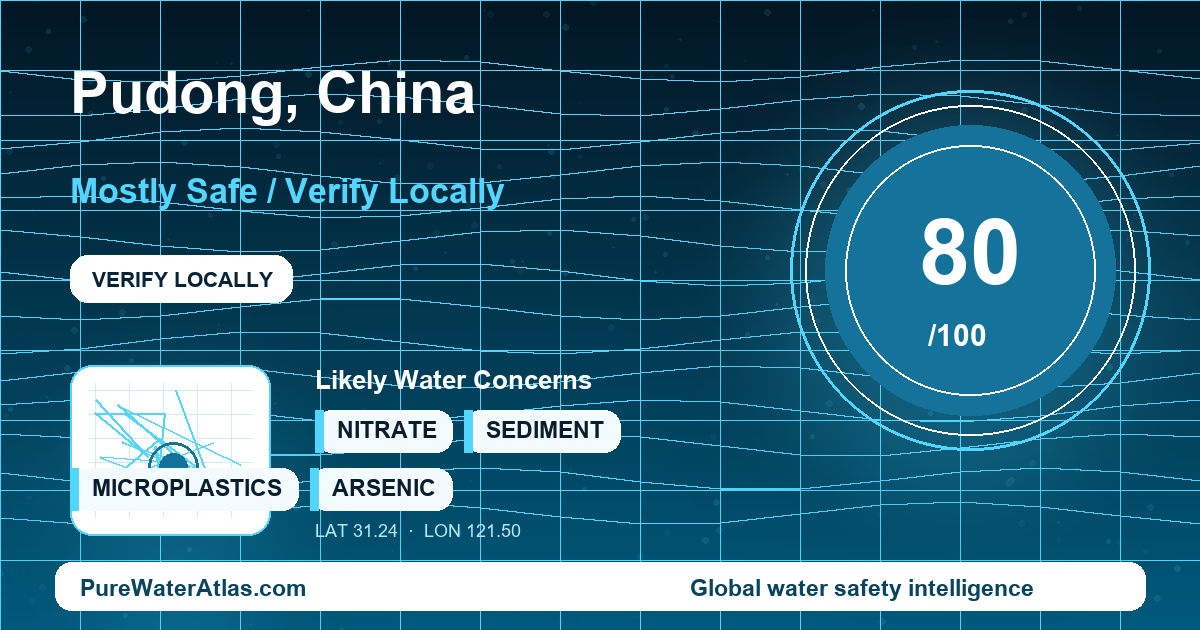
Pudong is served by Shanghai’s modern municipal drinking-water system, but tap safety at the point of use depends heavily on building plumbing, high-rise storage tanks, maintenance records, and local conditions at the specific address.
Quick Answer
| Overall safety status | Mostly Safe / Verify Locally. Pudong’s base municipal supply is treated through Shanghai’s water system, but individual tap quality can vary by building, tank, pipes, and maintenance. |
|---|---|
| Water safety score | 80 / 100 |
| Traveler advice | For short visits, bottled water or boiled tap water is the conservative choice for direct drinking, especially in older apartment-style buildings or if you have a sensitive stomach. |
| Resident advice | Use the municipal supply as the base, but verify the building-side system: secondary tanks, booster pumps, old pipes, filters, and stagnation are the practical weak points. |
| Main raw-water system | Shanghai’s municipal network, with the Qingcaosha Reservoir on Changxing Island in the Yangtze River estuary as the most important source for central Shanghai and large parts of the urban system. |
| Authority and regulation | Shanghai Municipal Water Authority, municipal and district water suppliers, and China’s national drinking-water quality standard GB 5749. |
| Filter recommendation | A filter is not automatically required for every household. Activated carbon can help with taste and disinfectant odor; reverse osmosis is more appropriate when testing or specific concerns indicate dissolved metals, PFAS, nitrate, or salinity-related issues. |
Why Pudong Is Different
Pudong’s drinking-water profile is shaped by its position within Shanghai rather than by a small independent local water system. Pudong lies east of the Huangpu River and extends toward the Yangtze River estuary and the East China Sea. That geography matters because Shanghai’s source-water planning has to manage both inland river pollution pressures and estuarine saltwater intrusion, especially during low-flow or dry-season periods.
The main verdict for Pudong is therefore nuanced: the district is generally served by Shanghai’s modern municipal drinking-water infrastructure, but the water that reaches a household, hotel room, serviced apartment, office tower, or restaurant has often passed through additional building-level systems. In Pudong high-rises, the practical risk is frequently not the centralized treatment plant itself but secondary water-supply equipment: roof tanks, underground tanks, booster pumps, compound pipes, internal plumbing, dispensers, and fixtures.
This distinction is important for places such as Lujiazui, Zhangjiang, Jinqiao, Century Park, and areas near Pudong Airport. A new, well-maintained hotel or commercial building may present a different point-of-use risk than an older apartment block with aging pipes or uncertain tank-cleaning records. Public information is usually reported at Shanghai municipal, supplier, or monitoring-point level rather than for every Pudong tower or individual tap, so local verification remains part of responsible water-use decision-making.
Where Does Pudong’s Tap Water Come From?
Pudong is part of Shanghai’s municipal water-supply network. The most important raw-water source for central Shanghai and large parts of the urban system is the Qingcaosha Reservoir on Changxing Island in the Yangtze River estuary. The reservoir was developed to reduce heavier dependence on Huangpu River intake water and to improve resilience against estuarine saltwater intrusion.
Shanghai historically relied heavily on the Huangpu River and upper Huangpu raw-water intakes. Later, the city developed the Chenhang Reservoir and then the larger Qingcaosha raw-water project because the lower Huangpu River and tidal estuary environment faced pressures from industry, shipping, urban runoff, and salinity. That history is highly relevant to Pudong because the district sits on the east side of the Huangpu and near the Yangtze estuary, where raw-water security and salt-tide control are recurring planning concerns.
The key infrastructure affecting Pudong includes the Qingcaosha Reservoir and associated raw-water conveyance system, Shanghai municipal water-treatment plants, trunk distribution networks serving the central urban area and Pudong, district-level distribution pipes, and building-level internal supply systems. In many high-rise residential and commercial buildings, water may be stored or pressure-boosted through secondary systems before it reaches the tap.
Some parts of the wider Shanghai system may use other raw-water sources and reservoirs. A specific Pudong address should therefore be verified with the local supplier or property manager if the exact source, supply zone, or maintenance history matters for a household, business, hotel, or vulnerable user.
Who Manages Drinking Water in Pudong?
Drinking water in Pudong is governed within the Shanghai municipal water framework. The Shanghai Municipal Water Authority is the municipal water-affairs regulator. Day-to-day supply is operated by municipal and district water-supply companies, including entities associated with Shanghai Chengtou Water Group and local Pudong-area suppliers depending on the address.
The applicable drinking-water quality standard is China’s national GB 5749 standard, which can be verified through the China national standards database. Public-health and drinking-water hygiene regulation is connected at the national level to the National Health Commission of the People’s Republic of China. Shanghai municipal notices and city regulations may also be published through the Shanghai Municipal People’s Government.
For Pudong-specific notices, infrastructure information, or district public-service information, residents can also check the Shanghai Pudong New Area People’s Government. The key limitation is that official compliance and operational data may not describe every building tank, apartment riser, old fixture, or in-room dispenser. Municipal compliance is not the same as a guarantee that every individual tap has identical quality.
Main Local Water Concerns
The main Pudong water concerns are linked to source-water management, treatment byproducts and taste, pipe conditions, and building-level water handling.
- Saltwater intrusion: Yangtze River estuary salt tides can increase pressure on raw-water management during dry seasons. Shanghai’s reservoirs and operational controls are designed to buffer this risk, but it remains part of the regional water-security context.
- Turbidity, algae, taste, and odor: River conditions, storms, heat, and reservoir operations can influence raw-water characteristics. Treatment plants are designed to manage changing source water, but taste and odor can still vary.
- Disinfectant taste: Chlorine or chlorine-like disinfectant taste can be noticeable at the tap, especially after network flushing or in buildings with long internal pipe runs.
- Sediment, rust, and iron staining: Brown, cloudy, or particle-laden water can occur after pipe repairs, pressure changes, or in older internal plumbing.
- Lead and metals: Lead risk should not be judged at city scale. It depends on premise plumbing, fixtures, solder, corrosion, and how long water has been stagnant in the pipes.
- Microbial risk: The most relevant microbial risk in Pudong is often secondary storage tanks, rooftop tanks, pump rooms, point-of-use dispensers, and poor maintenance rather than the treated municipal supply alone.
- Emerging contaminants: PFAS, microplastics, and industrial trace contaminants are plausible research concerns for a dense industrial and estuarine megacity region, but public Pudong tap-level data is limited and should not be overstated without testing.
Season also matters. Winter and dry-season low-flow periods can increase salt-tide pressure. Typhoons, heavy rain, and floods can raise turbidity and runoff loads. Hot summers can worsen taste, odor, and biological activity in storage systems. Holiday or vacancy periods can leave water stagnant in apartments, offices, and hotel rooms.
For Travelers
For most short visits to Pudong, the conservative choice is bottled water, boiled tap water, or hotel-provided drinking water for direct drinking. This is a practical traveler precaution rather than proof that Shanghai’s municipal water is unsafe. Treated tap water is part of a modern system, but a visitor usually cannot verify the maintenance history of a hotel tank, serviced-apartment plumbing system, ice machine, or in-room dispenser.
Brushing teeth with tap water is generally reasonable in standard hotels and modern buildings. Use bottled or boiled water if you are immunocompromised, traveling with infants, have a sensitive stomach, or are staying in an older apartment or low-cost lodging where plumbing and tank maintenance are uncertain.
Use caution with ice from informal vendors or places with unknown water handling. Ice in reputable hotels and higher-end restaurants is usually lower risk, but its safety depends on whether it is made from treated drinking water and whether the ice machine is cleaned. Hot tea, coffee, soups, and boiled water are generally safer choices because heating reduces microbial risk. For more detail on heating water, see the PureWaterAtlas guide to boiling water purification.
In a Pudong hotel, check whether bottled water is provided, whether the room kettle is clean, and whether any in-room dispenser has recent maintenance. If the water is brown, has visible particles, or has a strong unusual odor, do not drink it. Notify the hotel, serviced-apartment operator, or property manager and use bottled or boiled water until the issue is explained.
For Residents
Pudong residents can usually treat the municipal supply as the base water source, but should evaluate what happens after that water enters the building. This is especially important in high-rises, older residential compounds, and buildings with secondary water-supply systems.
A home filter is not automatically required for every Pudong household. For many apartments, a certified activated-carbon filter can improve taste and reduce chlorine odor. Reverse osmosis is more appropriate when testing or specific concerns indicate dissolved metals, nitrate, PFAS, or salinity-related issues. Any filter must be maintained carefully; neglected cartridges and poorly serviced devices can become microbial risks rather than safeguards. For system selection, see the PureWaterAtlas guide to water treatment systems.
Residents should request recent water-quality information from the supplier or property management company, especially after pipe repairs or if the building uses a secondary tank. In older buildings, or where infants, pregnancy, or immunocompromised residents are present, test both first-draw and flushed samples for lead and other metals rather than relying only on citywide averages. The PureWaterAtlas guides to lead testing and lead filtration solutions are useful when old plumbing or unknown fixtures are concerns.
Older Pudong buildings and older fixtures can create tap-level risks not visible in municipal compliance data. Corrosion, galvanized iron pipes, old valves, brass fixtures, solder, and stagnant dead-end pipe sections can increase metals, sediment, taste, and discoloration. If the first water in the morning is discolored or metallic-tasting, flush the cold-water tap until the temperature stabilizes and consider laboratory testing.
For high-rise storage systems, ask property management for the latest tank-cleaning and water-quality records. Tank-room hygiene, seals, vents, access control, disinfection records, and pump maintenance matter. Be cautious if tanks are dirty, uncovered, rarely inspected, or inaccessible to normal maintenance verification.
Relevant Contaminants and Water-Quality Issues
The most relevant issues for Pudong are not a single confirmed citywide contaminant, but a set of tap-level and infrastructure-linked risks. Chlorine is relevant because treated municipal water can have a noticeable disinfectant taste or odor. Turbidity matters after storms, pipe repairs, flushing events, or source-water changes. Sediment and iron are relevant when water appears rusty, brown, cloudy, or particle-laden.
Lead should be treated as a building-plumbing concern rather than a proven Pudong-wide tap-water problem. Risk depends on premise plumbing, fixtures, solder, corrosion conditions, and stagnation time. E. coli is relevant as a microbial verification indicator where secondary tanks, pump rooms, or dispensers are poorly maintained. PFAS is relevant as an emerging-contaminant topic for industrial and estuarine regions, but Pudong tap-level public data is limited, so testing is needed before drawing household-level conclusions.
For broader context, see PureWaterAtlas resources on drinking water safety, water microbiology, and global water quality.
How to Verify Your Water Quality
The best way to verify a specific Pudong tap is to combine official information with building-level checks and, where needed, laboratory testing. Start by asking the property manager or supplier for recent water-quality records, tank-cleaning records, and notices about pipe repairs, flushing, or supply interruptions. If you live in a high-rise, ask specifically about secondary supply tanks, booster pumps, tank vents, cleaning schedules, and disinfection records.
For health-related decisions, use an accredited laboratory. Home test strips may help screen for basic conditions, but they are not enough to confirm lead, PFAS, or microbiological safety. If water is cloudy, rusty, or contains particles, test for turbidity, iron, manganese, and basic microbial indicators. If there is a persistent chlorine, earthy, musty, or chemical odor, ask about network flushing, source-water events, or tank maintenance before assuming the issue is only cosmetic.
PureWaterAtlas resources can help plan the next step: use the complete water testing guide, compare destinations with the Global Water Quality Checker, and look up specific issues in the Contaminants Search Engine. If microbial risk is the concern, the guide to UV water purification can help explain where UV treatment may or may not be appropriate.
Official and Technical Sources
- Shanghai Municipal Water Authority — municipal water-affairs authority for Shanghai water supply, water resources, and public notices relevant to Pudong.
- Shanghai Municipal People’s Government — official city portal for Shanghai regulations, public-service notices, and government information.
- National Health Commission of the People’s Republic of China — national public-health authority connected to drinking-water hygiene standards and health regulation.
- China National Standard GB 5749-2022, Standards for Drinking Water Quality — official standards database where China’s drinking-water standard can be searched and verified.
- Shanghai Chengtou Water Group — major Shanghai water-supply and water-infrastructure operator.
- Shanghai water-supply information via Shanghai Water Authority — public water-supply management, utility notices, and related information where available.
- Shanghai Qingcaosha Reservoir information via Shanghai water authority materials — official water-infrastructure reference for the key raw-water reservoir serving much of Shanghai’s urban supply.
- World Health Organization Guidelines for Drinking-water Quality — international reference for drinking-water risk concepts, microbial safety, metals, and household water management.
- Shanghai Pudong New Area People’s Government — local district portal for Pudong-specific notices and public services.
Bottom Line
Pudong’s tap water is best described as mostly safe after local verification. The district benefits from Shanghai’s large municipal drinking-water system and major raw-water infrastructure, especially the Qingcaosha Reservoir system that supports much of the urban supply. The most practical risks are usually closer to the tap: high-rise storage tanks, booster pumps, internal pipes, older fixtures, stagnant water, filters, and ice or dispenser maintenance. Travelers should use bottled or boiled water for direct drinking if uncertain, while residents should check tank-cleaning records, flush after stagnation, and test older or vulnerable households when needed. Do not assume every Pudong tap is identical just because the municipal system is treated.
Read the full guide: Global Water Quality Guide
Explore more in this category: Global Water Quality Articles