
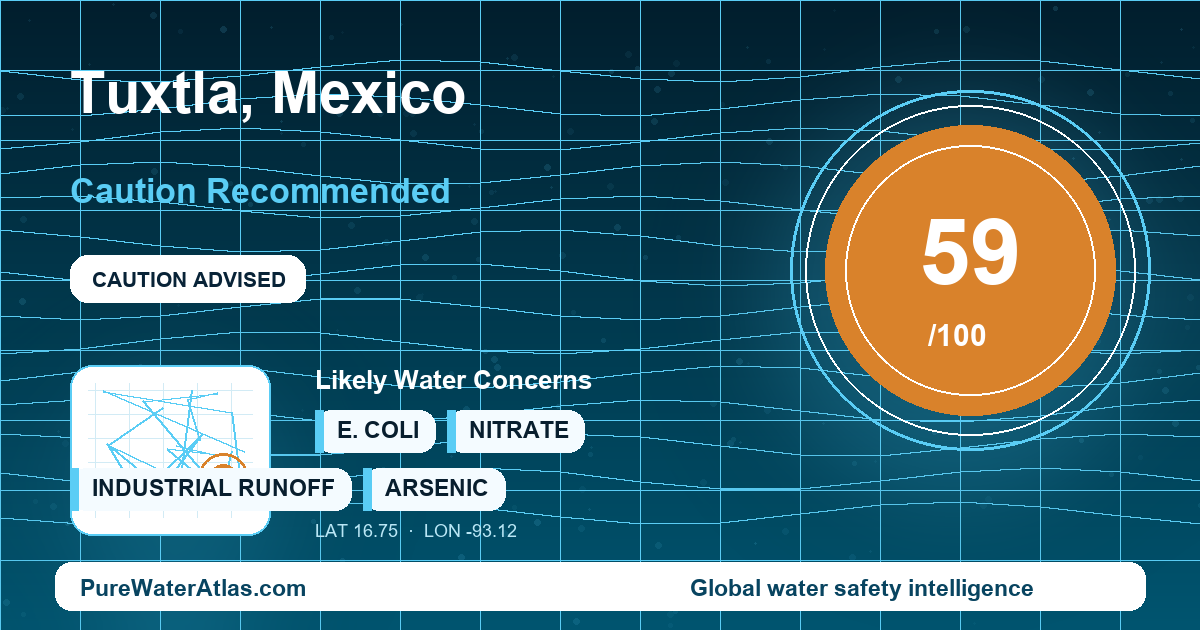
Tuxtla Gutiérrez has a treated municipal water system, but intermittent service, surface-water turbidity, distribution conditions, and private storage tanks mean untreated tap water should be approached with caution.
Quick Answer
| Water safety score | 59 / 100 |
|---|---|
| Risk level | Caution Recommended |
| Can visitors drink the tap water? | Not recommended untreated. Use sealed bottled water, verified purified water, or properly treated water for drinking. |
| Resident guidance | Treat municipal tap water as a utility supply that may need point-of-use protection, especially where water is stored in cisterns or rooftop tinacos. |
| Main water source | Treated surface water tied to the Grijalva River basin, with pumping, storage, and municipal distribution infrastructure serving Tuxtla Gutiérrez. |
| Water authority | Sistema Municipal de Agua Potable y Alcantarillado de Tuxtla Gutiérrez, commonly known as SMAPA. |
| Filter recommendation | For drinking water, a sediment prefilter plus activated carbon is a practical minimum; UV disinfection or reverse osmosis adds stronger protection when microbiological quality or dissolved contaminants are uncertain. |
Overall verdict: Caution is recommended. Tuxtla has a formal municipal utility and treated public supply, but recent, easily accessible, tap-by-tap compliance data are limited for end users. The main practical issue is not the absence of treatment; it is what can happen between treatment and the glass: turbidity after rains, pressure interruptions, older distribution infrastructure, repairs, and household storage tanks can affect water quality before use.
Why Tuxtla Is Different
Tuxtla Gutiérrez is not a city where the drinking-water question can be answered only by asking whether there is a municipal treatment system. The city sits in the Central Depression of Chiapas near the Grijalva River system and the Sumidero Canyon area. It has a pronounced rainy season, steep urban drainage, and a water supply that depends on pumped surface-water infrastructure rather than an abundant local high-elevation spring source.
This matters because surface-water systems are more sensitive to changes in turbidity during heavy rains. Turbid raw water can require careful treatment and can also be associated with sediment movement in the distribution network after storms, outages, or line repairs. In Tuxtla, the real drinking-water pathway often includes more than the public main. Many homes, apartment buildings, hotels, and restaurants use cisterns and rooftop tinacos because service pressure and continuity can vary. The condition of those private tanks can be as important as the quality leaving the municipal treatment system.
Tuxtla also grew around the Sabinal River corridor, but the Sabinal should be understood today primarily as an urban drainage, wastewater, stormwater, and watershed-management concern rather than as a dependable drinking-water source. Its presence in the urban landscape helps explain why flooding, wastewater control, and stormwater management matter locally, but it should not be used as evidence that all tap water in Tuxtla is contaminated.
Where Does Tuxtla’s Tap Water Come From?
Tuxtla Gutiérrez is primarily served by a municipal drinking-water system operated by SMAPA. The system depends heavily on treated surface water from the Grijalva River basin. Water must be moved through raw-water intake and pumping infrastructure, treatment facilities, storage tanks, pressure zones, and distribution mains before reaching consumers across an uneven and hilly urban area.
Local wells or auxiliary sources may supplement parts of the system, but public reporting does not provide a simple, continuously updated, source-by-source breakdown for every service area. For that reason, it is not appropriate to claim that every neighborhood receives exactly the same source blend or the same water-quality profile. The safer interpretation is that Tuxtla has a formal treated municipal supply, while the water at a specific tap can vary depending on distribution pressure, storage, building plumbing, and maintenance.
The most important vulnerability is the chain between the treatment plant and the consumer. Pressure interruptions, leaks, repairs, sediment mobilization, and poorly maintained tanks can all reduce quality after the water has been treated. After outages or main repairs, first-draw water may appear cloudy, colored, or strongly chlorinated. In those situations, flushing and using treated drinking water are prudent.
Who Manages Drinking Water in Tuxtla?
The municipal water and sewer utility is the Sistema Municipal de Agua Potable y Alcantarillado de Tuxtla Gutiérrez, commonly known as SMAPA. SMAPA is responsible for local public service operation, including the municipal water and sewer system serving Tuxtla Gutiérrez. The H. Ayuntamiento de Tuxtla Gutiérrez provides municipal public-service context and local government information.
At the national level, drinking water in Mexico is regulated under health standards, especially NOM-127-SSA1-2021, which establishes sanitary quality requirements for water for human use and consumption. Federal roles include the Secretaría de Salud, COFEPRIS, and CONAGUA. The CONAGUA Sistema Nacional de Información del Agua provides national water-resource and basin context relevant to Chiapas and the Grijalva basin.
A key limitation for consumers is that the absence of a public warning is not the same as verified potability at every tap. Building storage tanks, private plumbing, and neighborhood-level pressure conditions can change water quality after municipal treatment. Public-facing contaminant-by-contaminant monitoring for Tuxtla is not comprehensive enough to make a high-confidence, drink-directly-from-the-tap recommendation for every household, hotel, or restaurant.
Main Local Water Concerns
- Rainy-season turbidity: Heavy storms can increase surface-water turbidity and disturb sediment in parts of the distribution system. Turbidity is important because it can interfere with disinfection and signal particulate matter in the water.
- Intermittent service and pressure changes: Low-pressure conditions can increase vulnerability where pipes, valves, or household connections are compromised. Tuxtla has recurring public concern around water availability, service interruptions, and infrastructure investment needs.
- Cisterns and rooftop tinacos: Many buildings store water. If tanks are not covered, screened, cleaned, and disinfected, disinfectant residual can decline and the tank can become a microbiological reservoir.
- Older premise plumbing: Older buildings may contain corroded galvanized pipes, solder, brass fixtures, or other plumbing materials that affect taste, metals, and sediment after the water leaves the municipal network.
- Sabinal River watershed conditions: The Sabinal River corridor is relevant to urban pollution, wastewater, flooding, and stormwater management. It is not proof that the potable supply is always unsafe, but it is part of Tuxtla’s local water-risk context.
- Limited public tap-level data: Claims about exact neighborhood quality should be avoided without current local sampling. City-level governance and source context are identifiable, but tap-by-tap results are not publicly available in a way that supports precise household-level conclusions.
For Travelers
Drinking: Visitors should not rely on untreated tap water for drinking in Tuxtla. Use sealed bottled water, hotel-provided purified water from garrafones, or water treated with a reliable filter plus disinfection. This is especially important for children, pregnant travelers, older adults, people with sensitive stomachs, and anyone with a weakened immune system.
Brushing teeth: Use bottled or purified water for brushing teeth unless your accommodation clearly provides treated drinking water. This is a simple and low-cost precaution in Tuxtla because the water reaching a room may have passed through a private cistern or rooftop tinaco.
Ice: Ice in established hotels and restaurants is often made from purified water, but ask whether it is made with agua purificada. Avoid ice from informal vendors or unknown sources.
Hotels and restaurants: Prefer properties and restaurants that provide garrafón water, sealed bottles, or clearly labeled purified water. In rooms, rentals, or kitchens with a tap, do not assume the tap is drinkable unless the property has a maintained filtration or purification system.
Food and boiling: Be cautious with raw foods washed in unknown water. Boiling can reduce microbial risk when done correctly, but it does not remove metals, salts, nitrate, or many chemical contaminants. For broader travel-health precautions, see the CDC Travelers’ Health guidance for Mexico.
For Residents
Residents should treat Tuxtla’s tap water as a municipal utility supply that may need point-of-use protection for drinking and cooking. A practical home setup is a washable or replaceable sediment prefilter, activated carbon for chlorine taste and some organic compounds, and either UV disinfection or reverse osmosis for higher protection. Reverse osmosis offers stronger protection for dissolved contaminants, but it requires maintenance and proper wastewater handling. UV can be useful where microbiological quality is uncertain, but it should be installed after sediment control because cloudy water can reduce UV effectiveness.
Households using cisterns or tinacos should clean and disinfect them routinely. Tanks should be covered, screened, and checked for sediment, insects, algae, cracked lids, dirty float valves, and long residence time. If a tank is visibly dirty or has not been maintained, do not treat the tap as drink-ready without point-of-use filtration and disinfection.
Testing is especially important after flooding, sewage backups, long outages, plumbing work, repeated stomach symptoms, or changes in taste, color, odor, or pressure. Test for total coliform and E. coli when water is stored in a cistern or tinaco or when contamination is suspected. Basic indicators such as turbidity, residual chlorine, pH, conductivity, and hardness can help evaluate treatment stability and household plumbing conditions. In older buildings, consider metals testing, especially for lead, copper, iron, and manganese indicators. Nitrate testing is relevant if using a private well, auxiliary source, or an unverified water vendor rather than the municipal network.
Relevant Contaminants and Water-Quality Issues
The most relevant Tuxtla issues are not best understood as a single contaminant. They are a combination of surface-water treatment, distribution stability, storage hygiene, and premise plumbing. During storms or after repairs, turbidity in drinking water and sediment in drinking water are practical indicators to watch. Cloudy, colored, or particulate water should not be used for drinking without treatment and verification.
Where cisterns and tinacos are poorly maintained, microbial testing matters. E. coli in drinking water is a critical warning sign because it indicates fecal contamination risk. Chlorine residual is also important because disinfectant can decline during long storage; learn more about chlorine in drinking water and how it relates to taste and disinfection.
Older plumbing can introduce additional concerns after water leaves the municipal system. Residents in older buildings or homes with unknown plumbing should understand lead in drinking water and review lead testing and detection methods. If a household uses a private well, auxiliary supply, or unverified vendor, nitrate in drinking water may also be relevant; see PureWaterAtlas guidance on nitrate testing and detection.
How to Verify Your Water Quality
For a Tuxtla household, the most reliable way to move from general caution to a specific decision is testing at the point of use. Sample the water you actually drink: after the building tank, after internal plumbing, and after any filter if one is installed. Use an accredited laboratory when decisions involve infants, pregnancy, chronic illness, suspected sewage contamination, or investment in a major treatment system.
Start with microbiological testing for total coliform and E. coli if you use a cistern or tinaco, if the tank has not been cleaned, or after flooding and long outages. Add turbidity, residual chlorine, pH, conductivity, and hardness for general system stability. Add metals if the building is old or plumbing materials are unknown. Add nitrate if your water comes from a private well, auxiliary source, or unverified vendor.
For broader decision-making, use the PureWaterAtlas Water Testing guide, the Drinking Water Safety guide, and the Water Treatment Systems guide. For microbial risks, see Water Microbiology. You can also search specific issues in the Contaminants Search Engine or compare city-level context with the Global Water Quality Checker. If boiling is your emergency option, review Boiling Water Purification; for disinfection systems, see the UV Water Purification guide.
Official and Technical Sources
- SMAPA Tuxtla Gutiérrez — local municipal water and sewer utility.
- H. Ayuntamiento de Tuxtla Gutiérrez — official municipal government source.
- CONAGUA Sistema Nacional de Información del Agua — national water data and basin context.
- CONAGUA — federal water authority for policy, infrastructure, and hydrometeorological information.
- NOM-127-SSA1-2021 — Mexican sanitary standard for water for human use and consumption.
- COFEPRIS: Agua de uso y consumo humano — federal health-regulator context.
- INEGI México en Cifras: Tuxtla Gutiérrez, Chiapas — official demographic and geographic context.
- CDC Travelers’ Health: Mexico — conservative travel-health guidance.
- WHO Guidelines for Drinking-water Quality — international reference for drinking-water risk management and household safety principles.
Bottom Line
Tuxtla Gutiérrez has a formal treated municipal water supply operated by SMAPA, but untreated tap water is not the best drinking choice for visitors and deserves point-of-use protection for many residents. The key local risks are surface-water turbidity during rains, intermittent service, distribution-line disturbance, older premise plumbing, and the widespread use of cisterns and rooftop tinacos. Travelers should use sealed bottled or verified purified water for drinking and brushing teeth. Residents should maintain storage tanks, flush after outages or repairs, consider sediment and carbon filtration, and add UV or reverse osmosis where higher protection is needed. Because public tap-level monitoring data are limited, testing the actual water at your tap is the most reliable way to confirm safety.
Read the full guide: Global Water Quality Guide
Explore more in this category: Global Water Quality Articles