
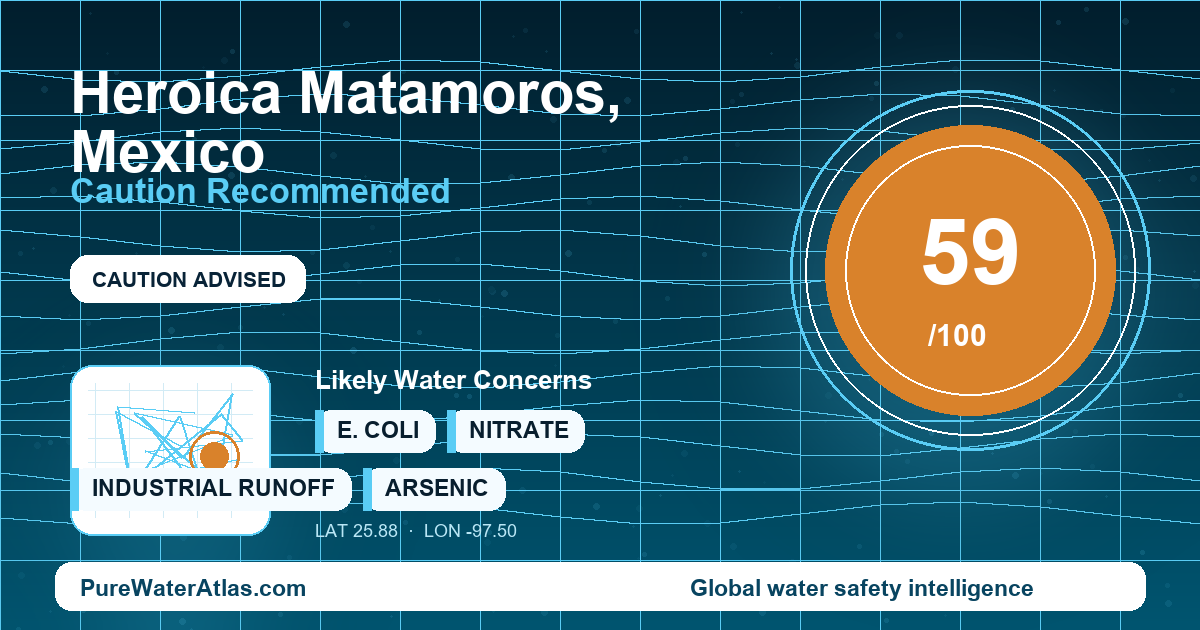
Heroica Matamoros, Tamaulipas: Rio Bravo/Rio Grande source water, municipal treatment, border-region distribution risks, and practical drinking-water guidance for visitors and residents.
Quick Answer
| Water safety score | 59 / 100 |
|---|---|
| Risk level | Caution Recommended |
| Can visitors drink the tap water? | Not recommended for most short-term travelers. Use sealed bottled water, professionally purified water, boiled water, or a purifier suitable for microbial risk. |
| Resident advice | Treat municipal tap water as utility-supplied water that may be usable after household controls: maintained point-of-use treatment, clean storage tanks, and targeted testing. |
| Main raw water context | Lower Rio Bravo/Rio Grande border-region surface-water system, with vulnerability to drought, storms, turbidity, agricultural drainage, urban wastewater pressures, and salinity changes. |
| Local water authority | Junta de Aguas y Drenaje de Matamoros, commonly known as JAD Matamoros. |
| Filter recommendation | For drinking and cooking, use a maintained home purifier. A practical setup may include sediment filtration, activated carbon, and reverse osmosis or another certified system if testing shows high dissolved solids, salinity, nitrate, arsenic, or metals. |
PureWaterAtlas verdict: caution recommended. Heroica Matamoros has a formal municipal water and drainage operator, but public, neighborhood-level data on current treated-water compliance, disinfectant residual, microbiology, metals, nitrate, and distribution performance is limited. The safest interpretation for visitors is that tap water may be treated but should not be assumed reliably drinkable without point-of-use treatment.
Why Heroica Matamoros Is Different
Heroica Matamoros is not a city supplied by an isolated mountain spring or a small protected aquifer. It sits at the far northeast of Tamaulipas on the Mexico-United States border, directly across the Rio Grande/Rio Bravo from Brownsville, Texas, and near the Gulf of Mexico. Its drinking-water identity is tied to the lower Rio Bravo/Rio Grande system and to the low-lying delta landscape around the border.
That location matters. The lower river is a heavily managed international waterway used for municipal supply, irrigation, industry, and ecological needs. Water conditions can be affected by upstream reservoirs, drought, return flows, agricultural drainage, urban wastewater pressures, stormwater, and cross-border water management. In practical terms, Matamoros residents and visitors are not only evaluating treatment at a plant; they are also evaluating what happens as water moves through pipes, storage, building plumbing, cisterns, and rooftop tanks.
The city’s low-lying delta setting also makes water service sensitive to flooding, tropical rainfall, drainage problems, and storm-related turbidity. During hot weather, disinfectant residual can decay more quickly, especially in household or building storage. After outages, low-pressure events, repairs, or flooding, the risk at a tap can change even if the same municipal source and utility remain in place.
Where Does Heroica Matamoros’s Tap Water Come From?
Heroica Matamoros is associated with surface water from the lower Rio Bravo/Rio Grande system. The city’s municipal supply depends on intake, treatment, pumping, storage, and distribution infrastructure connected to this border-region water source. The local supply is treated before distribution, and conventional municipal treatment is expected to include clarification or filtration steps and chlorination.
The key local issue is that source water in the lower basin can be variable. Drought and reduced flows can concentrate dissolved minerals and make salinity, taste, odor, and total dissolved solids more relevant. Heavy rains, tropical storms, flooding, and river disturbance can increase turbidity, which can challenge treatment and distribution stability. Agricultural and urban runoff in the lower valley can contribute nutrients, microbial indicators, pesticides, and organic matter to source water; whether those reach a specific tap depends on treatment performance and distribution integrity.
PureWaterAtlas did not locate a recent, complete, publicly accessible plant-by-plant and neighborhood-by-neighborhood compliance dataset for all Matamoros distribution zones. For that reason, this profile does not claim that every tap in the city either meets or fails every legal standard. The score reflects the identifiable river-source context, known categories of lower-basin pressure, local distribution and storage risks, traveler susceptibility, and limited public verification.
Who Manages Drinking Water in Heroica Matamoros?
Local water and drainage service in Heroica Matamoros is handled by the Junta de Aguas y Drenaje de Matamoros, commonly known as JAD Matamoros. The utility is the relevant local operator for water and drainage services in the city.
Mexico’s drinking-water framework includes national sanitary standards, including NOM-127-SSA1-2021, the Mexican standard for water for human use and consumption. Federal water-management roles involve CONAGUA, and national hydrologic information is available through the CONAGUA National Water Information System. Because Matamoros is on the Rio Bravo/Rio Grande border system, broader source-water allocation and river-management context also involves binational institutions such as the International Boundary and Water Commission and the Mexican section, Comisión Internacional de Límites y Aguas.
For consumers, the practical gap is transparency at the neighborhood tap level. A formal utility and national standards are important, but residents still benefit from verifying household conditions, especially where cisterns, rooftop tanks, old fixtures, intermittent pressure, or recent repairs may affect water after it leaves the municipal system.
Main Local Water Concerns
- Lower-river source pressure: drought and reduced Rio Bravo/Rio Grande flows can concentrate dissolved minerals and increase treatment difficulty.
- Storm turbidity: tropical rainfall, flooding, or river disturbance can raise suspended sediment and stress treatment and distribution stability.
- Salinity and dissolved solids: salinity and total dissolved solids are relevant in the lower Rio Grande basin, especially during low-flow periods, but tap-specific values should be verified by testing.
- Agricultural and urban runoff: the lower valley landscape can contribute nutrients, microbial indicators, pesticides, and organic matter to source water; tap risk depends on treatment and distribution conditions.
- Distribution-system vulnerability: intermittent pressure, pipe repairs, aging mains, sediment disturbance, and cross-connections can increase contamination risk after treatment.
- Premise plumbing: older buildings may add metals risk, including lead from old fixtures, solder, brass, service components, or unknown plumbing materials.
- Household storage: cisterns and rooftop tanks can lose disinfectant residual and become microbial reservoirs if uncovered, dirty, or poorly maintained.
For Travelers
Most short-term visitors to Heroica Matamoros should not drink tap water directly. Use sealed bottled water, professionally treated water, boiled water, or water purified with a method appropriate for bacteria and viruses. This is a precautionary travel recommendation based on limited public neighborhood-level verification and traveler vulnerability, not a verified finding that every tap in the city is unsafe.
Use bottled or treated water for brushing teeth, especially for children, pregnant travelers, older adults, immunocompromised travelers, and anyone with a sensitive stomach. Tap water is generally acceptable for bathing and handwashing, but avoid swallowing it during brushing, showering, or rinsing.
Be careful with ice. Avoid ice unless the hotel or restaurant can confirm it was made from purified water. Commercial bagged ice from reputable suppliers is generally lower risk than unknown in-house ice. In restaurants, ask about purified water for ice, fountain drinks, aguas frescas, and drinks blended or served with ice. Raw produce washed in tap water can also be an exposure route.
During hot weather, carry sealed water. If bottled water is not available, bring water to a rolling boil or use a purifier rated for microbial contaminants. The PureWaterAtlas Boiling Water Purification Guide explains when boiling is useful for short-term microbial risk reduction. Do not rely on taste, clarity, or a chlorine smell as proof that water is safe.
For Residents
Residents should treat Matamoros tap water as municipal water that may require household risk controls before drinking. A maintained kitchen filter or purifier is recommended for drinking and cooking water if the household wants a stronger safety margin. For many homes, a practical approach is sediment prefiltration plus activated carbon for taste and chlorine-related issues, with reverse osmosis or another certified system if testing shows high dissolved solids, salinity, nitrate, arsenic, or metals. UV treatment can help with microbes, but only if the water is clear and the unit is properly maintained; see the PureWaterAtlas UV Water Purification Guide.
Testing is especially important for homes with cisterns, rooftop tanks, intermittent pressure, recent flooding, recent plumbing work, or recurring gastrointestinal concerns. Test for total coliform and E. coli when microbial risk is plausible. Also consider field indicators such as free chlorine residual, turbidity, pH, conductivity, total dissolved solids, hardness, and odor when taste or appearance changes.
Households with infants, pregnant people, private wells, or mixed-source water near agricultural areas should test for nitrate. Older homes and buildings with unknown plumbing should test first-draw and flushed samples for lead and copper. If water has persistent metallic taste, staining, or high salinity, residents using private or non-municipal sources should consider arsenic, manganese, iron, sulfate, chloride, and broader metals testing.
Cisterns and rooftop tanks deserve special attention in Matamoros. They should be sealed, screened, cleaned, and disinfected on a routine schedule. Dirty or uncovered storage can introduce sediment, insects, biofilm, and fecal bacteria, making otherwise treated municipal water unsafe at the household tap.
Relevant Contaminants and Water-Quality Issues
The most relevant Matamoros water-quality issues are not limited to one contaminant. Turbidity is important because lower-river supplies and storm events can increase suspended sediment and complicate treatment. E. coli is relevant for storage tanks, low-pressure events, flood impacts, and traveler risk. Chlorine matters because maintaining disinfectant residual through distribution pipes and household storage is central to microbiological safety.
Lead is mainly a premise-plumbing concern in older buildings or homes with unknown fixtures, solder, brass, or service components. Nitrate is relevant because the lower Rio Grande/Rio Bravo region includes agricultural and urban runoff pressures. For broader context, see PureWaterAtlas guides on agricultural runoff in drinking water, lead testing and detection, and nitrate testing and detection.
How to Verify Your Water Quality
The most reliable way to evaluate a specific Matamoros tap is to combine official guidance with household testing. Start by checking announcements from JAD Matamoros and health or civil-protection notices after storms, outages, pipe repairs, or pressure disruptions. Then test the water where it is actually consumed: the kitchen tap after municipal delivery, building storage, and household plumbing.
For a structured testing plan, use the PureWaterAtlas Complete Guide to Water Testing and Analysis. For general decision-making, see Drinking Water Safety: How to Know If Your Tap Water Is Safe. Residents comparing treatment options can use Water Treatment Systems: Choosing the Right Solution, while microbial concerns are explained in Water Microbiology.
You can also compare Matamoros with other destinations using the Global Water Quality Checker and research specific analytes through the Contaminants Search Engine. Related PureWaterAtlas categories include Global Water Quality, Drinking Water Safety, Water Testing, and Water Purification.
Official and Technical Sources
- Junta de Aguas y Drenaje de Matamoros — local water and drainage utility for Matamoros.
- CONAGUA, National Water Commission of Mexico — federal water authority for national water management and basin context.
- CONAGUA National Water Information System — official national water information system relevant to hydrology and water availability.
- Diario Oficial de la Federación, NOM-127-SSA1-2021 — Mexico’s sanitary standard for water for human use and consumption.
- International Boundary and Water Commission — binational Rio Grande/Rio Bravo water-management authority.
- Comisión Internacional de Límites y Aguas entre México y Estados Unidos — Mexican section of the binational boundary and water commission.
- CDC Travelers’ Health: Mexico — travel health guidance, including food and water precautions.
- U.S. EPA Consumer Confidence Reports guidance — reference explaining why public annual water-quality reporting is useful; not a Matamoros compliance source.
Bottom Line
Heroica Matamoros should be approached with caution for drinking water. The city has a formal water and drainage utility, JAD Matamoros, and is tied to the lower Rio Bravo/Rio Grande system, but publicly available neighborhood-level compliance data is limited. Visitors should use sealed bottled water or properly treated water for drinking and brushing teeth, and should be careful with ice, fountain drinks, aguas frescas, and raw produce. Residents can reduce risk with maintained point-of-use treatment, routine cleaning of cisterns and rooftop tanks, and targeted testing for microbes, chlorine residual, turbidity, dissolved solids, nitrate, and metals where relevant. The main concern is not only the river source, but also distribution integrity and household storage after treatment.
Read the full guide: Global Water Quality Guide
Explore more in this category: Global Water Quality Articles