
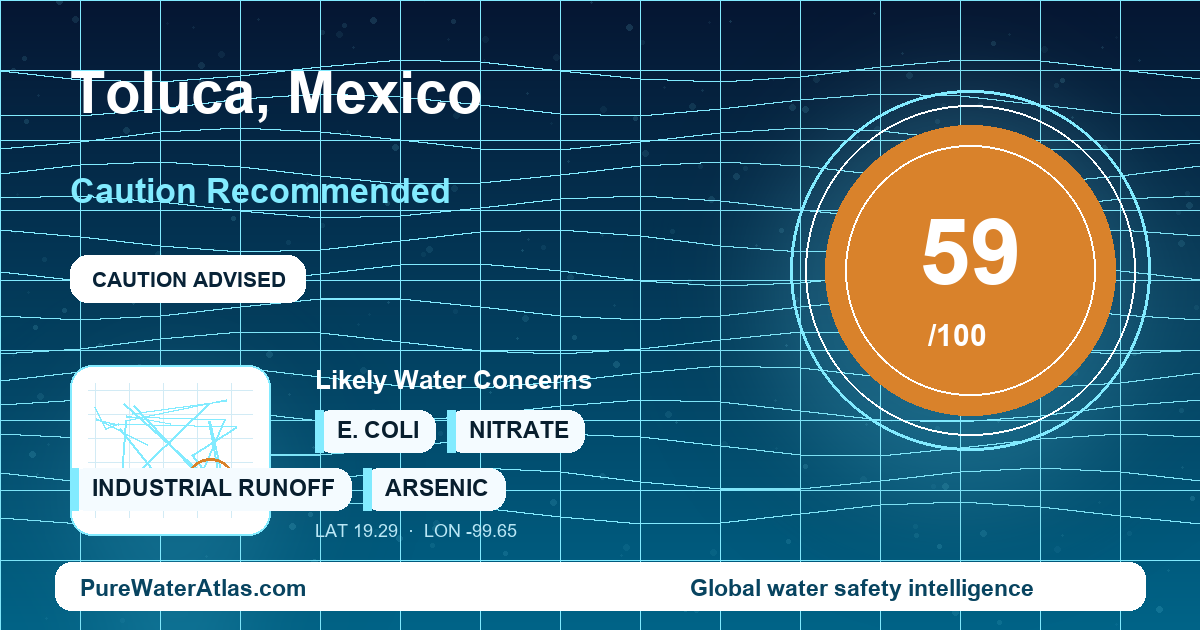
Toluca has treated municipal water and an organized utility system, but mixed groundwater and regional supply, pressure interruptions, aging distribution, and household cistern or rooftop-tank storage mean caution is recommended at the faucet.
Quick Answer
| Water safety score | 59 / 100 |
|---|---|
| Risk level | Caution Recommended |
| Can tourists drink the tap water? | No as a conservative default. Short-term visitors should use sealed bottled water, hotel-provided purified water, or water that has been boiled or reliably treated. |
| Resident guidance | Treat Toluca tap water as a supply that may be made drinkable after building-level verification, tank hygiene, and suitable treatment, not as automatically safe at every faucet. |
| Main water source | Mixed supply: municipal groundwater wells in the Valle de Toluca aquifer, with some bulk treated water and regional interconnections associated with Estado de México and CONAGUA systems, including Cutzamala-related supply. |
| Local water authority | Organismo Agua y Saneamiento de Toluca, commonly abbreviated OAyST or AyST. |
| Filter recommendation | A point-of-use filter is advisable for regular drinking, but it should be selected based on testing. Sediment plus activated carbon can help with particles, taste, and chlorine; reverse osmosis or UV may be appropriate depending on confirmed contaminants. |
Overall verdict: Caution recommended. Toluca distributes treated water through public infrastructure, but actual drinking-water safety can vary by supply zone, pressure events, building plumbing, and the condition of cisterns and rooftop tinacos. Unless your specific building supply has been tested, a verified bottled source, maintained purifier, or boiling is the safer default for drinking.
Why Toluca Is Different
Toluca is not a simple “good” or “bad” tap-water case. It is a high-altitude city in the Valle de Toluca, within the Lerma basin, west of Mexico City. Its drinking-water situation is shaped by a stressed highland groundwater system, regional water transfers, and the practical realities of local distribution and household storage.
The city historically depended on local springs, wetlands, and groundwater in the Toluca-Lerma valley. Over time, the broader region became connected to major interbasin water projects serving the Mexico City metropolitan area, including the Lerma and Cutzamala systems. That regional context matters because Toluca’s water security is tied not only to municipal operations, but also to groundwater extraction, urban growth, drought, maintenance, and demand pressure across Estado de México.
At the consumer’s faucet, the most important risk is often not just the original source water. Water may be disinfected before or within distribution, but it then moves through pipes, pressure zones, storage tanks, household cisterns, and rooftop tinacos. Low pressure, pipe repairs, long stagnation, dirty tanks, or old internal plumbing can change the water that actually reaches a kitchen tap.
Another Toluca-specific issue is elevation. The city is above 2,000 meters. If you need to disinfect water by boiling, use a full rolling boil for 3 minutes, not the 1-minute low-altitude rule. For more background, see the PureWaterAtlas Boiling Water Purification Complete Guide.
Where Does Toluca’s Tap Water Come From?
Toluca’s drinking-water supply is best understood as a mixed system. A major component comes from municipal deep wells that tap groundwater in the Valle de Toluca aquifer. In some areas, this can be supplemented by bulk treated water and regional supply links involving Estado de México water infrastructure and CONAGUA systems, including Cutzamala-related supply. The exact blend can vary by zone and operational conditions.
Key infrastructure includes municipal wells and pumping stations, chlorination and disinfection points, local storage and regularization tanks, regional supply links, and the distribution pipes that move water across the city. Sewer and drainage infrastructure also matters indirectly: during low-pressure events, flooding, pipe breaks, or repairs, intrusion risk can increase if the system is vulnerable at a local point.
For many households, the final stage is private storage. Cisterns and rooftop tinacos are common last-mile storage points in Toluca and can determine actual faucet quality. A sealed, clean, well-maintained tank can help manage intermittent service. A dirty, uncovered, cracked, or sediment-filled tank can recontaminate otherwise treated water.
Season also matters. During the rainy season, generally May through October, runoff, stormwater intrusion risk, turbidity, and sediment disturbance may increase. During dry periods, scarcity and regional drought can contribute to lower pressure, service interruptions, and greater reliance on stored water. Regional Cutzamala drought or maintenance reductions can also affect operational patterns in connected areas.
Who Manages Drinking Water in Toluca?
The local water utility is the Organismo Agua y Saneamiento de Toluca, commonly abbreviated OAyST or AyST. This is the main local reference point for water and sanitation service information, local notices, payments, and public communications.
At the state level, the Comisión del Agua del Estado de México is relevant for hydraulic infrastructure, state water works, and bulk-water roles. At the federal level, CONAGUA regulates national waters, water rights, aquifer availability, and major hydraulic systems. CONAGUA also publishes information on the Sistema Cutzamala and broader hydrologic data through the Sistema Nacional de Información del Agua.
Drinking-water quality in Mexico is governed by federal health standards, especially NOM-127-SSA1-2021, which sets sanitary quality requirements for water for human use and consumption. Health oversight involves authorities including COFEPRIS and state health agencies.
Data limitation: Toluca has identifiable authorities and regulatory standards, but routinely updated public datasets showing finished-water results by neighborhood, building, or distribution zone are not readily available in one transparent public dashboard. This page therefore does not claim universal contamination or universal compliance. The correct safety answer can vary by zone, outages, plumbing, and tank maintenance.
Main Local Water Concerns
- Intermittent or low-pressure service: Pressure loss can increase the chance of intrusion through leaks or cross-connections, especially after repairs, outages, or pipe breaks.
- Cisterns and rooftop tinacos: Household storage can recontaminate treated water if tanks are unsealed, dirty, cracked, or cleaned irregularly.
- Turbidity, sediment, or colored water: These may appear after pipe work, network flushing, heavy rain, or pressure changes. Learn more about turbidity in drinking water.
- Groundwater stress: Dependence on the Valle de Toluca aquifer raises sustainability concerns because regional aquifer documents identify pressure from extraction and demand.
- Land-use vulnerability: Agricultural and urban land use in the Toluca-Lerma valley makes nitrate, microbial indicators, and some industrial or solvent-related parameters reasonable testing targets. Citywide exceedances should not be assumed without current laboratory data.
- Older plumbing: Older buildings may have galvanized pipes, brass fixtures, solder, internal corrosion, or service-line components that contribute metals at the tap, including lead, even when water leaving municipal infrastructure is acceptable.
For Travelers
For tourists, the conservative answer is clear: do not drink untreated tap water in Toluca as your main water source. Use sealed bottled water, hotel-provided purified water, or water that has been boiled or reliably filtered and disinfected. Check that bottle caps are intact, especially when buying water outside established stores.
Brushing teeth with tap water is often lower risk for healthy adults if the water is not swallowed, but cautious travelers should use bottled or purified water. This is especially sensible for children, pregnant travelers, people with sensitive stomachs, and anyone who is immunocompromised.
Use ice only if the hotel or restaurant says it is made from purified water. Better hotels and established restaurants commonly use garrafón water, purified water, or in-house filtration for drinking water and ice, but visitors should ask directly for agua purificada or bottled water when uncertain. Avoid informal street ice or ice of unknown source, especially after local water outages or during gastrointestinal illness concerns.
Avoid fountain drinks if the water source is uncertain. If you must disinfect water in an emergency, bring it to a full rolling boil for 3 minutes because Toluca is at high elevation. A travel filter can be useful, but when microbial safety is uncertain, filtration should be combined with disinfection. For broader travel context, consult CDC Travelers’ Health guidance for Mexico.
For Residents
Residents who want to drink tap water regularly should treat the home as the final verification point. A practical setup begins with testing, tank hygiene, and a treatment system matched to results. A sediment prefilter plus activated carbon can improve particles, chlorine taste, odor, and general aesthetics. Reverse osmosis is more appropriate if testing shows elevated nitrate, arsenic, high dissolved solids, or certain metals. UV can help with microbes, but only when the water is clear and the lamp is correctly maintained; see the PureWaterAtlas UV Water Purification Complete Guide.
Test both at the kitchen tap and, if possible, at the water entering the property. This helps separate municipal-network issues from building-storage or internal-plumbing problems. At minimum, request total coliforms and E. coli, free residual chlorine, turbidity, pH, conductivity or TDS, hardness, nitrate, arsenic, lead, iron, and manganese.
If the property is near industrial activity, workshops, fuel storage, dry cleaning, or old contaminated land, consider adding volatile organic compounds and other site-specific industrial parameters through an accredited laboratory. Retest after major plumbing work, long outages, flooding, tank cleaning, or any change in taste, odor, color, or sediment.
Older buildings deserve extra caution. Let stagnant water run before use, do not use hot tap water for cooking or baby formula, and test specifically for lead and other metals if plumbing history is unknown. For testing details, see Lead in Drinking Water: Testing and Detection Methods.
Cisterns and rooftop tinacos should be sealed, protected from insects and dust, inspected for cracks and sediment, and cleaned and disinfected routinely, commonly every 6 months or after contamination events. A dirty tank can make water unsafe even when municipal water is chlorinated.
Relevant Contaminants and Water-Quality Issues
The most relevant Toluca water-quality questions are local and building-specific. Microbial indicators such as E. coli are important after outages, flooding, pressure loss, or storage-tank contamination. Turbidity matters because particles and sediment can interfere with disinfection and signal disturbance in pipes or tanks.
Chlorine is also important because residual disinfectant helps protect water in distribution, but low residual at the tap may indicate stagnation or loss of protection. For chemical testing, nitrate is a reasonable target because of agricultural and urban land-use context in the Toluca-Lerma valley; see also Nitrate Contamination in Drinking Water: Testing and Detection Methods.
Arsenic should be included in a baseline test where groundwater is an important source; PureWaterAtlas has a dedicated guide to arsenic testing and detection methods. Lead is mainly a building-plumbing concern and should not be dismissed in older properties.
How to Verify Your Water Quality
The most reliable answer for a Toluca household is a current laboratory test from the specific faucet used for drinking. Start with microbiology, disinfectant residual, turbidity, basic chemistry, nitrate, arsenic, lead, iron, and manganese. If your home uses a cistern or tinaco, test after the storage system as well as before it if possible.
For step-by-step guidance, use the PureWaterAtlas pillar guide How to Test Drinking Water. For general safety interpretation, see Drinking Water Safety, Water Microbiology, and Water Treatment Systems.
You can also compare city-level guidance through the Global Water Quality Checker and research specific substances in the Contaminants Search Engine. Related PureWaterAtlas categories include Drinking Water Safety, Global Water Quality, Water Testing, and Water Purification.
Official and Technical Sources
- Organismo Agua y Saneamiento de Toluca — official local water and sanitation utility for Toluca.
- Comisión del Agua del Estado de México — state water authority involved in infrastructure and bulk-water roles.
- CONAGUA Sistema Cutzamala — federal information on the major regional surface-water supply system.
- CONAGUA Sistema Nacional de Información del Agua — national water information portal for hydrologic and aquifer data.
- NOM-127-SSA1-2021 — Mexican federal drinking-water standard for water for human use and consumption.
- COFEPRIS — federal health-protection authority relevant to potable-water sanitary oversight.
- CDC Travelers’ Health: Mexico — travel health guidance for food and water precautions.
- World Health Organization drinking-water fact sheet — global public-health context on drinking-water safety and household water management.
Bottom Line
Toluca’s tap water should be approached with caution, not panic. The city has an organized municipal water system and treated water is distributed through public infrastructure, but the practical risk at the faucet depends on mixed groundwater and regional supply, pressure interruptions, local pipe conditions, and household cistern or tinaco maintenance. Tourists should use sealed bottled or purified water and should boil for 3 minutes at Toluca’s elevation in emergencies. Residents should test their own tap, clean and seal storage tanks, and choose filtration based on results. Because neighborhood-level finished-water data are not available in one transparent public dashboard, building-specific verification is the most reliable way to decide whether Toluca tap water is safe to drink in a specific home.
Read the full guide: Global Water Quality Guide
Explore more in this category: Global Water Quality Articles