
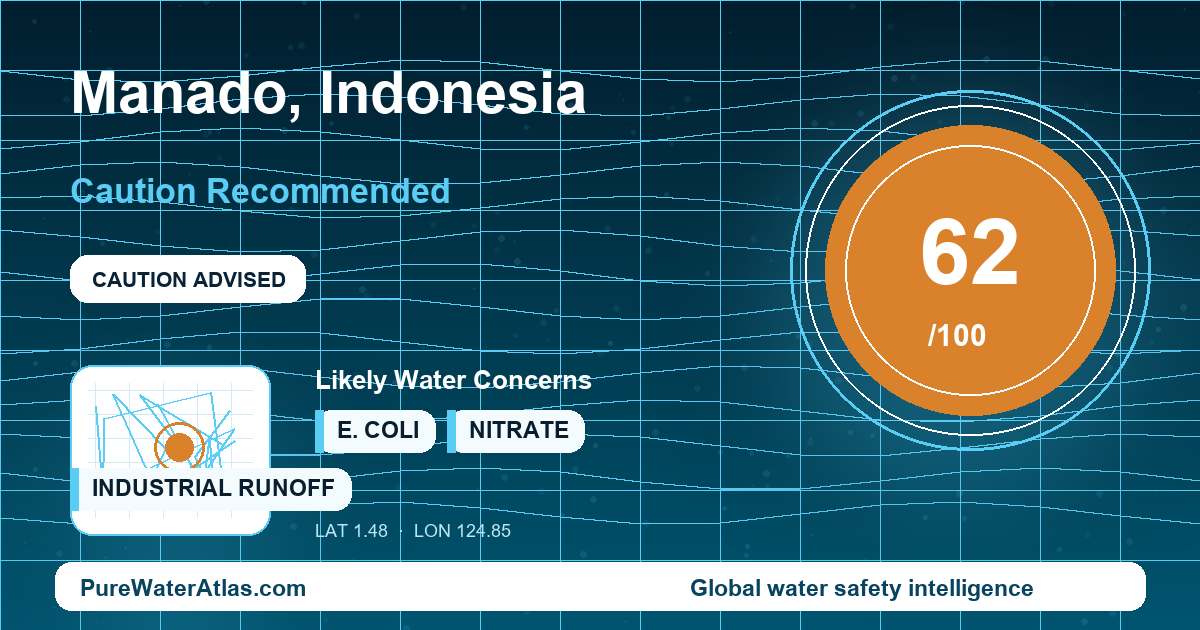
Manado, North Sulawesi: treated municipal water exists, but untreated tap water is not recommended for drinking without building-level confirmation.
Quick Answer
| Overall safety status | Caution recommended. Manado has a formal piped drinking-water utility and treated surface-water supply, but public city-level water-quality reporting is limited and household safety can vary by pressure, pipe condition, rainfall, storage tanks, and private wells. |
|---|---|
| Water safety score | 62 / 100 — Caution Recommended |
| Can tourists drink the tap water? | No, not untreated. Visitors should use sealed bottled water, reputable refill water, or tap water that has been boiled, UV-treated, or filtered with an appropriate purifier. |
| Resident advice | Residents connected to PT Air Manado should treat tap water for direct drinking, clean household storage tanks, and test after floods, service interruptions, repairs, or illness clusters. |
| Main water source | Treated municipal supply using local surface-water catchments and river intakes in and around Manado, including the Tondano River system and smaller upland catchments such as Malalayang/Koka. |
| Water authority | PT Air Manado, with drinking-water public-health oversight under Indonesian health regulations and local/provincial/national health authorities. |
| Filter recommendation | Recommended for direct drinking. A practical home setup is sediment prefiltration plus activated carbon, followed by boiling, UV, ultrafiltration, or reverse osmosis depending on test results and household risk. |
Why Manado Is Different
Manado is not a city where tap-water safety can be reduced to a simple “safe” or “unsafe” label. The city sits on Manado Bay in North Sulawesi, with hilly volcanic terrain, short urban rivers, and the Tondano River flowing toward the city and bay. That geography matters for drinking water: steep catchments can respond quickly to intense rain, and runoff can raise sediment, turbidity, and microbial loading in raw water.
The public supply is a treated piped system, not an untreated community source. However, the most important practical risk in Manado is not a single well-known chemical contaminant. The higher everyday concern is microbiological safety at the point of use, especially where pressure drops, pipes leak, private plumbing is old, household tanks are dirty, or water has been stored too long. Water may leave a treatment plant disinfected and still become unsafe at a bathroom or kitchen tap if distribution or building conditions are poor.
PureWaterAtlas rates Manado as Caution Recommended with a score of 62/100. Confidence is medium: the utility identity, geography, rainfall context, and Indonesian regulatory framework are verifiable, but a current official public dataset showing routine Manado tap-water results by distribution zone was not found. That means this guide should be used as a risk-based decision tool, not as a guarantee for every hotel, house, refill depot, well, or neighborhood.
Where Does Manado’s Tap Water Come From?
Manado’s public drinking-water supply is operated by PT Air Manado. Public utility and planning references describe a multi-source system relying mainly on local surface-water catchments and river intakes in and around Manado. These include the Tondano River system and smaller upland catchments referenced in public materials, such as Malalayang/Koka. Water is treated through IPA water treatment plants before entering the distribution network.
The city’s drinking-water infrastructure includes municipal piped distribution, surface-water intakes, treatment plants commonly referenced around Koka, Malalayang, and Paal Dua or Kairagi areas, service reservoirs, pumps, pressure zones, and household roof or ground storage tanks. Some households and small businesses also use private wells, rainwater, bottled water, or refill-water supply chains when piped supply is unavailable, unreliable, or not preferred for drinking.
Historically, Manado developed around several small river and upland water sources rather than one large protected reservoir. This is important because water quality and pressure can vary by intake, treatment plant, elevation, rainfall, and distribution zone. PureWaterAtlas did not find a current official source-to-neighborhood map with real-time water-quality results, so neighborhood-level caution is appropriate.
Who Manages Drinking Water in Manado?
The local drinking-water utility serving Manado is PT Air Manado. The city’s utility structure has been associated with PT Air Manado rather than a simple stand-alone PDAM identity, and the system has been linked in public materials to multiple treatment plants and catchments. This means a single citywide assumption is not enough to determine safety at a specific building.
Public-health oversight for drinking-water quality sits within Indonesia’s national regulatory framework. The key national standard is Ministry of Health Regulation No. 2 of 2023, which sets environmental health standards, including drinking-water quality parameters. Local health authorities, including the Manado city health office and provincial/national health agencies, are responsible for public-health surveillance and sampling. Municipal drinking-water systems are also tracked through public works and drinking-water performance systems, including the Directorate General of Human Settlements drinking-water information portal.
These regulations and institutions are important, but they do not prove that every tap in Manado is safe at all times. Pipe condition, storage practices, pressure interruptions, private wells, and building plumbing can all change the water that finally reaches a glass.
Main Local Water Concerns
- Microbial contamination risk: E. coli, total coliforms, viruses, and protozoa can enter water through contaminated source water, distribution leaks, low pressure, private wells, or dirty storage tanks. This is the main reason travelers should avoid untreated tap water in Manado.
- Turbidity and sediment after heavy rain: Manado’s wet tropical setting and short, steep catchments can produce rapid runoff. High turbidity can interfere with disinfection and may signal treatment stress or sediment entry.
- Intermittent pressure and distribution ingress: When pipes lose pressure, contaminated water can be drawn into leaks or joints. This can make water unsafe even if it was treated properly at the plant.
- Coastal salinity in private wells: Manado’s coastal location makes salinity, chloride, conductivity, and TDS relevant for private wells, especially in low-lying or heavily pumped areas. This concern applies mainly to wells, not necessarily to the treated municipal network.
- Iron, manganese, color, and odor: Brown, black, metallic, or stained water can occur at household or well level. These are often aesthetic and operational concerns, but they can also indicate a need for testing and treatment adjustment.
- Lead or other metals from premise plumbing: No evidence was found of a citywide lead problem in Manado. However, older fixtures, solder, brass components, and stagnant plumbing can raise risk at individual taps, so first-draw testing is justified in older buildings.
Season also matters. During rainy season and intense storms, runoff can increase raw-water turbidity, organic matter, sediment, and microbial loading. Flooding can contaminate wells, tanks, yard pipes, and low-pressure lines. Dry periods can concentrate pollutants and worsen salinity risks in coastal wells. After utility repairs or service interruptions, residents should flush taps until clear and use treated water until normal pressure and clarity return.
For Travelers
Do not drink untreated tap water in Manado for ordinary travel use. Unless your hotel or host can provide verified treated water and recent test information for the specific building, use sealed bottled water, reputable refill water, or tap water that has been boiled or purified. Hot drinks are lower risk when made with water that has been fully boiled.
For brushing teeth, most healthy adults may tolerate tap water, but bottled or treated water is the safer choice for short-stay travelers, children, pregnant travelers, immunocompromised people, and anyone with a sensitive stomach. Avoid swallowing shower water, especially after visible flooding, plumbing work, or periods of low pressure.
Use caution with ice. Ice from reputable hotels, restaurants, or packaged commercial sources is usually lower risk, but loose or street ice should be avoided if the water source is unknown. Better hotels and restaurants commonly provide bottled, dispenser, or treated water, but visitors should still ask whether drinking water and ice are made from treated or bottled water. Do not assume bathroom tap water is potable.
If you develop diarrhea, use oral rehydration salts and seek medical care for fever, blood in stool, dehydration, or symptoms lasting more than a few days.
For Residents
For residents connected to PT Air Manado, treatment is recommended for water used directly for drinking. A practical approach is sediment prefiltration to reduce particles, activated carbon for taste and chlorine-related issues, and then a microbial barrier such as boiling, UV, ultrafiltration, or reverse osmosis depending on test results and risk tolerance. For private wells, do not choose treatment blindly: salinity, nitrate, bacteria, iron, manganese, and hardness require different solutions.
Private wells and household tanks should be tested for E. coli and total coliforms before the water is used for drinking, then retested after flooding, repairs, pressure events, or illness clusters. Coastal wells or salty-tasting water should be tested for turbidity, pH, conductivity, TDS, chloride, and salinity indicators. Nitrate testing is important if infants, pregnant people, or immunocompromised residents use well water, or if the well is near septic systems, drains, agriculture, or dense housing.
Older buildings need special attention. Internal plumbing, corroded pipes, stagnant dead-legs, roof tanks, and rarely used taps can introduce metals or microbial risk. Flush stagnant water before use, clean faucet aerators, and use first-draw plus flushed sampling if lead or other metals are a concern.
Storage tanks are a major control point in Manado homes and small businesses. Keep tanks covered, insect-proof, and cleaned on a schedule. Disinfect after repairs or flooding, prevent hose or pump backflow, and treat tank water before drinking if residual disinfectant is uncertain.
Relevant Contaminants and Water-Quality Issues
The most important acute issue for untreated tap water, wells, and storage tanks in Manado is microbial contamination. Start with E. coli in Drinking Water and the broader PureWaterAtlas guide to Water Microbiology.
Rainfall and runoff make Turbidity in Drinking Water and Sediment in Drinking Water especially relevant after storms, pipe work, or discoloration. Disinfection performance and residual protection make Chlorine in Drinking Water relevant, particularly in long or intermittent distribution systems.
For private wells, especially near septic systems, drains, agriculture, or dense settlements, see Nitrate in Drinking Water. For household plumbing and older buildings, see Lead in Drinking Water and Lead in Drinking Water: Testing and Detection Methods. Brown, black, metallic, or staining water may require review of Iron in Drinking Water and Manganese in Drinking Water.
How to Verify Your Water Quality
Because PureWaterAtlas did not find a current official public dataset with routine Manado tap-water results by distribution zone for E. coli, residual chlorine, turbidity, nitrate, metals, chloride, and related parameters, verification should happen at the building or water-source level. Residents using wells, storage tanks, refill depots, or older plumbing should test the actual water they drink, not just rely on citywide utility status.
Use the PureWaterAtlas Water Testing guide to plan sampling, especially for first-draw metals, microbial testing, and post-flood checks. The Contaminants Search Engine can help interpret parameters such as E. coli, turbidity, nitrate, iron, manganese, and lead. For broader comparison with other destinations, use the Global Water Quality Checker.
If your test results show microbial risk, read Boiling Water Purification: Complete Guide for short-term treatment and UV Water Purification: Complete Guide for point-of-use treatment where turbidity is controlled. For choosing a longer-term system, see Water Treatment Systems and the general Drinking Water Safety guide.
Official and Technical Sources
- PT Air Manado official website — local utility context and public information.
- Kota Manado official government website — city administration, geography, and public-service context.
- BPS Kota Manado — official Manado statistics, geography, population, housing, sanitation, and municipal indicators.
- Ministry of Health Regulation No. 2 of 2023 — Indonesian environmental health and drinking-water quality standards.
- Directorate General of Human Settlements drinking-water information portal — Indonesian public-works drinking-water system and utility performance context.
- BMKG official weather and climate information — rainfall, weather, and climate context relevant to flooding and turbidity.
- WHO Guidelines for Drinking-water Quality — international reference for microbial safety, turbidity, disinfection, and chemical contaminants.
- WHO/UNICEF Joint Monitoring Programme country data for Indonesia — national drinking-water and sanitation context, not a substitute for Manado tap-level testing.
Bottom Line
Manado has a formal treated piped supply operated by PT Air Manado, drawing on local surface-water catchments and river systems, but untreated tap water should not be considered reliably drinkable at every tap. The city’s coastal, rainy, hilly setting makes turbidity, runoff, flooding, and storage-tank hygiene important. The main practical risk is microbial contamination from distribution, pressure loss, private wells, dirty tanks, or premise plumbing, not a single confirmed citywide chemical contaminant. Tourists should use bottled, reputable refill, boiled, or properly purified water. Residents should treat drinking water, maintain tanks, and test wells or building taps after floods, repairs, pressure interruptions, discoloration, salty taste, or health concerns.
Read the full guide: Global Water Quality Guide
Explore more in this category: Global Water Quality Articles