
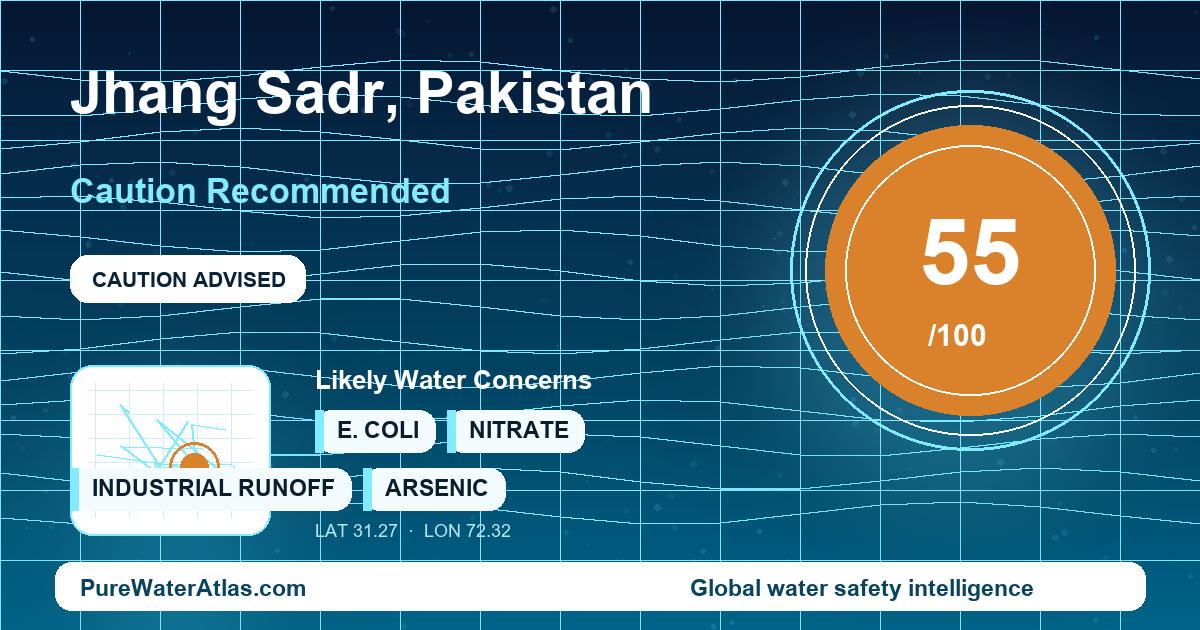
Jhang Sadr, Pakistan: groundwater-based urban supply on the Chenab-Jhelum alluvial plain, with drinking-water safety depending heavily on local source, pipe condition, seasonal flooding, and household storage.
Quick Answer
| Overall safety status | Caution recommended. Jhang Sadr’s tap and pump water should not be assumed safe at every household or supply point. The PureWaterAtlas safety score for this city profile is 55/100, reflecting variable groundwater quality and contamination risks. |
|---|---|
| Can travelers drink it? | No, not untreated. Short-stay visitors should use sealed bottled water from reputable brands, boiled water, or reliably filtered and disinfected water. |
| Resident guidance | Residents should treat water safety as source-dependent. Municipal supply, private bore water, hand pumps, storage tanks, and commercial filtered water can differ significantly and should be tested periodically. |
| Main water source | Jhang Sadr is best understood as a groundwater-supplied city. Municipal and local schemes in Punjab towns commonly use tube wells, while many households also use private pumps, hand pumps, or purchased filtered water. |
| Local management context | Urban water and sanitation functions are handled through the Jhang municipal local government structure under Punjab Local Government and Community Development Department oversight, with Punjab Public Health Engineering Department relevant for schemes and infrastructure. |
| Filter recommendation | A filter is often advisable, but it should be selected after testing. Microbial risk requires disinfection or a maintained microbiological barrier; high TDS, salinity, nitrate, arsenic, or fluoride may require reverse osmosis or contaminant-specific treatment. |
Why Jhang Sadr Is Different
Jhang Sadr is not a city where one simple statement about “the tap water” is enough. It is the administrative urban center of Jhang District in Punjab, located in the irrigated alluvial plains associated with the Chenab River system. The nearby Trimmu river-control area and the Jhelum-Chenab confluence make the broader district hydrologically important and seasonally flood-sensitive. That river setting affects recharge, waterlogging, shallow groundwater conditions, and flood-related contamination pathways.
The key point for drinking water is that Jhang Sadr appears to rely primarily on local groundwater abstraction, not on a large, modern, centralized surface-water treatment plant drawing directly from the Chenab River for ordinary household supply. This makes water quality very local. One street, school, market area, or household bore can have different quality from another because well depth, aquifer chemistry, nearby drains, pipe leaks, suction pumps, and storage tanks all matter.
For Jhang Sadr, the practical water-safety question is often not only whether a municipal tube well starts with acceptable water. It is whether that water remains safe after moving through intermittent distribution lines, old or leaking pipes, underground tanks, rooftop tanks, and household dispensers. A clean source can become unsafe after contact with contaminated storage, low-pressure lines, or dirty containers.
Where Does Jhang Sadr’s Tap Water Come From?
Jhang Sadr’s drinking-water system is best described as a mixed groundwater-based system. Municipal tube wells and pumping stations serve parts of the urban area, while many households and institutions also use private boreholes, suction pumps, hand pumps, or purchased water from small filtration or water-vending points. In the broader Punjab town context, tube wells commonly pump groundwater into distribution lines or storage reservoirs before water reaches homes and businesses.
The city’s water infrastructure may include municipal pumping stations, distribution pipelines, overhead reservoirs, ground storage tanks, rooftop tanks, underground tanks, and private pumping arrangements. In areas where supply is intermittent rather than continuous, low-pressure periods can increase the risk of intrusion through leaks, especially where water pipes run near urban drains or sewerage infrastructure. This is one reason microbial contamination can be a practical concern even if the original groundwater source is not obviously polluted.
Jhang’s historic connection to the Chenab River system is still important. The city sits near a major river corridor, and the Trimmu area downstream is where the Jhelum joins the Chenab. Monsoon rains and flood periods can influence shallow wells, hand pumps, underground tanks, turbidity, and contamination of local groundwater. However, there is no strong public evidence in the available dataset that normal household drinking water in Jhang Sadr is supplied by a fully treated river-water plant.
Who Manages Drinking Water in Jhang Sadr?
Urban water supply and sanitation functions in Jhang Sadr are handled locally through the Jhang municipal local government structure, commonly referred to as Municipal Committee or Municipal Corporation Jhang depending on current administrative classification. This local structure operates under the broader oversight framework of the Local Government and Community Development Department, Government of the Punjab. The Public Health Engineering Department, Government of the Punjab is also relevant for water-supply and sanitation schemes, particularly for infrastructure projects and service areas outside the core municipal system.
Drinking-water quality in Pakistan is guided by national drinking-water standards and provincial implementation. Relevant institutions include Punjab local government bodies, Punjab Public Health Engineering Department, Punjab Environmental Protection Agency, Punjab Healthcare Commission in health settings, and national technical bodies such as the Pakistan Council of Research in Water Resources. The District Jhang, Government of Punjab website provides official local context for the district and its administrative setting.
A major limitation is that recent, public, point-by-point compliance reporting for Jhang Sadr neighborhoods, municipal tube wells, private bores, water-vending points, and household storage tanks is not consistently available in one official public dashboard. This profile therefore identifies credible local risk pathways and practical precautions rather than claiming that every ward, pump, or household connection has the same water quality.
Main Local Water Concerns
The main concern in Jhang Sadr is not one confirmed contaminant across the whole city. The risk profile is a combination of microbial contamination pathways, groundwater chemistry, intermittent supply, storage conditions, and seasonal hydrology.
- Microbial contamination: Leaking pipes, low-pressure supply intervals, open drains, poor storage hygiene, monsoon runoff, and flood conditions can introduce disease-causing organisms. Water that looks clear can still carry microbial risk.
- High TDS, salinity, hardness, or brackish taste: Parts of Punjab’s alluvial groundwater can have elevated dissolved minerals. In Jhang Sadr, this may show up as salty, hard, or scaling water depending on the source.
- Nitrate risk: Shallow groundwater near sewage seepage, livestock areas, septic systems, fertilizer use, or agricultural runoff may be vulnerable to nitrate. This is especially important for infant formula and long-term household use.
- Geogenic contaminants: Arsenic, fluoride, iron, and manganese can vary across Punjab groundwater. They should be tested locally rather than assumed absent because several of these cannot be reliably detected by taste, smell, or appearance.
- Turbidity, sediment, color, and odor episodes: These can occur after pipe repairs, pump changes, tank cleaning, flooding, or disturbance of deposits in storage and plumbing.
- Private filtered water uncertainty: Water sold by small vendors or filtration points is not automatically safe unless membranes, UV lamps, chlorination systems, and storage containers are properly maintained.
Season matters. Monsoon rains can increase turbidity, drain overflow, shallow groundwater contamination, and flood-related safety problems. Summer heat raises water demand and can worsen intermittent supply, low pressure, and bacterial regrowth in tanks. Dry periods may concentrate dissolved minerals and make salinity or hardness more noticeable.
For Travelers
Short-stay visitors should not drink untreated tap water in Jhang Sadr. Use sealed bottled water from reputable brands, boiled water, or water treated by a reliable purifier. The main immediate risk for travelers is gastrointestinal illness from microbial contamination, with added uncertainty from local groundwater chemistry.
For brushing teeth, use bottled, boiled, or reliably filtered water, especially for children, pregnant travelers, and anyone with a sensitive stomach. Avoid swallowing shower water, and do not refill bottles from bathroom or kitchen taps unless the water has been treated.
Ice should be avoided unless you are confident it was made from bottled or properly treated water. Ice from informal shops, roadside vendors, or unknown hotel sources should be treated as unsafe. In hotels and restaurants, ask whether drinking water is sealed bottled water or treated on-site. Prefer sealed bottles opened at the table. Do not assume that jug water, table water, or ice is safe just because the venue appears clean.
During hot weather, carry sealed water with you. If bottled water is unavailable, boiled water is a safer emergency option for drinking and oral rehydration. Seek medical help quickly for persistent diarrhea, fever, blood in stool, or signs of dehydration.
For Residents
For residents of Jhang Sadr, the best approach is to test the actual water used at home rather than choosing a filter blindly. Municipal supply, a private bore, a hand pump, an underground tank, and a rooftop tank can each have a different risk profile. If the main problem is microbial contamination, options include boiling, chlorination, ultraviolet treatment, ultrafiltration, and safe storage. If the main problem is high TDS, salinity, nitrate, arsenic, or fluoride, a simple carbon filter is not enough; reverse osmosis or contaminant-specific treatment may be required.
Testing should include E. coli or thermotolerant coliform and total coliform, especially after monsoon flooding, pipeline repairs, visible turbidity, odor changes, or household illness patterns. Chemical testing should include TDS, electrical conductivity, chloride, sulfate, hardness, pH, and alkalinity to understand salinity and scaling. Nitrate is important for shallow bores, hand pumps, and tanks near drains, septic systems, livestock, or agricultural land. Arsenic and fluoride should be tested at least once for any private bore or long-term household source. Iron and manganese should be checked if water stains fixtures, turns reddish-brown or black, tastes metallic, or leaves sediment.
Older buildings need extra caution. Corroded fittings, galvanized pipes, brass fixtures, solder, and stagnant plumbing can add metals or sediment even if source water is acceptable. Flush stagnant taps before use, avoid using hot tap water for cooking or infant formula, and consider both first-draw and flushed samples if metal contamination is suspected.
Storage tanks are a major control point in Jhang Sadr. Rooftop and underground tanks should be covered, mosquito-proof, physically cleaned, and disinfected after cleaning, flooding, repairs, or visible contamination. Avoid cross-connections between suction pumps, drains, and drinking-water lines. A dirty storage tank can make treated water unsafe.
Relevant Contaminants and Water-Quality Issues
For Jhang Sadr, the most relevant water-quality topics are those connected to groundwater variability, intermittent distribution, storage, and seasonal contamination. Microbial risk is central, so residents and travelers should understand E. coli in drinking water and broader water microbiology risks. Cloudy or dirty-looking water should be evaluated for turbidity and sediment, particularly after monsoon events, pipe work, or tank disturbance.
Because Jhang Sadr depends heavily on groundwater, chemical contaminants should not be ignored. Relevant PureWaterAtlas profiles include arsenic, nitrate, iron, manganese, and chlorine. Arsenic, fluoride, and nitrate cannot be ruled out by taste or appearance. Iron and manganese may be more visible through staining, metallic taste, black deposits, or reddish-brown water, but testing is still the reliable way to confirm levels.
How to Verify Your Water Quality
The safest method for Jhang Sadr households is to test the actual water being consumed, including the point after storage and filtration. A bore sample taken before a tank may not represent water coming from the kitchen tap. If infants, pregnant residents, elderly people, or immunocompromised people use the water, choose a certified laboratory test rather than relying only on basic color-change strips.
Use the PureWaterAtlas complete guide to water testing to plan microbiological and chemical sampling. For general safety principles, see Drinking Water Safety. If treatment is needed, compare options in Water Purification Methods, including boiling water purification and UV water purification.
For contaminant-specific decisions, review arsenic testing and detection, nitrate testing, and the guide to agricultural runoff in drinking water. You can also compare broader risk context using the Global Water Quality Checker and search individual substances in the Contaminants Search Engine.
Official and Technical Sources
- District Jhang, Government of Punjab — official local government context for Jhang District.
- Local Government and Community Development Department, Government of the Punjab — provincial framework for municipal water supply and sanitation services.
- Public Health Engineering Department, Government of the Punjab — water-supply, sanitation, and public health engineering schemes.
- Pakistan Council of Research in Water Resources — national technical authority for water-quality research and monitoring context.
- World Health Organization Guidelines for Drinking-water Quality — health-based reference for microbial and chemical drinking-water safety.
- WHO/UNICEF Joint Monitoring Programme Pakistan Data — national WASH context for Pakistan.
- Pakistan Meteorological Department Flood Forecasting Division — flood and hydrometeorological context relevant to the Chenab-Jhelum system.
- Punjab Disaster Management Authority — flood alerts and emergency conditions affecting water safety.
- FAO AQUASTAT Pakistan Country Profile — national water-resources, irrigation, groundwater, and salinity context.
Bottom Line
Jhang Sadr’s tap water should be approached with caution. The city’s drinking-water reality is highly local because supply is mainly groundwater-based, with municipal tube wells, private bores, pumps, storage tanks, and small filtration points all playing roles. Travelers should avoid untreated tap water and use sealed bottled, boiled, or reliably treated water. Residents should test their specific source and storage system for microbial contamination, TDS or salinity, nitrate, arsenic, fluoride, iron, and manganese where relevant. Monsoon rains, flood periods, low-pressure distribution, old plumbing, and dirty rooftop or underground tanks can all change water safety. Because recent neighborhood-level public compliance data is limited, household testing and maintained treatment are the most practical safeguards.
Read the full guide: Global Water Quality Guide
Explore more in this category: Global Water Quality Articles