
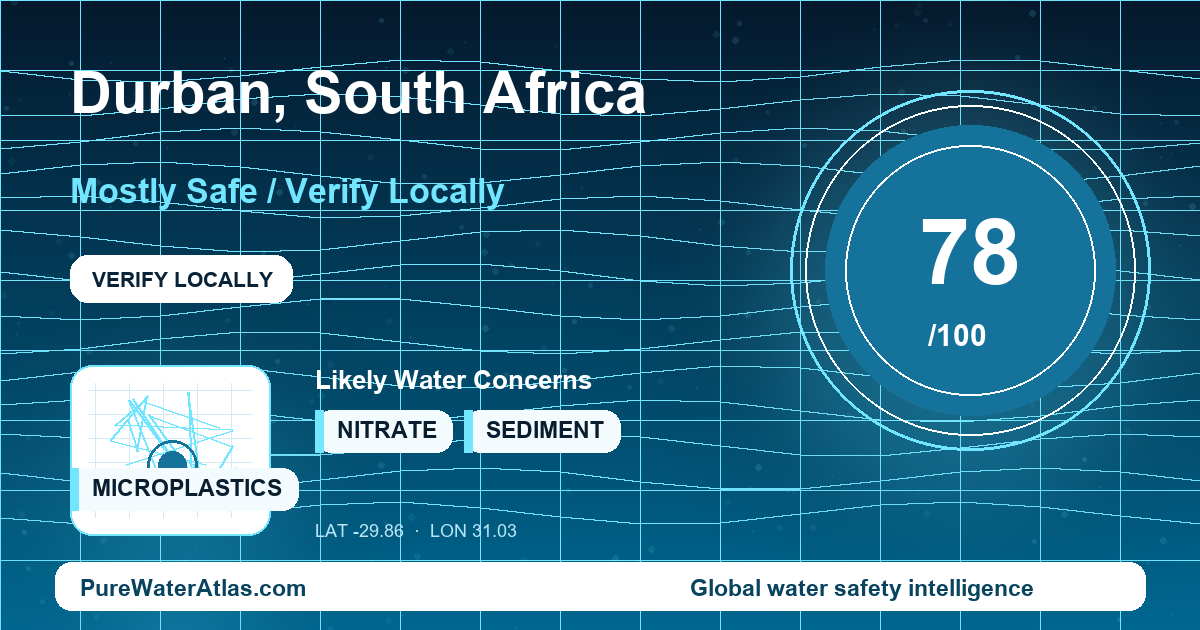
Durban tap water is generally drinkable in formal areas on the eThekwini municipal network, but local verification matters after outages, storms, pipe repairs, reservoir problems, or when a building relies on private storage tanks.
Quick Answer
| City | Durban, South Africa |
|---|---|
| Water safety score | 78 / 100 |
| Risk level | Mostly Safe / Verify Locally |
| Can you drink the tap water? | Usually yes in established municipal-supplied areas when there is no current boil-water notice, outage advisory, or visible water-quality problem. |
| Traveler advice | Most visitors in formal hotels, guesthouses, and central urban areas can usually drink tap water, brush teeth with it, and use ice from reputable venues. Use sealed bottled or boiled water during outages, after major storms, or where tank maintenance is uncertain. |
| Resident advice | Treat municipal water as generally usable, but monitor eThekwini notices, flush taps after interruptions or repairs, maintain tanks, and test if there are recurring sediment, discoloration, gastrointestinal concerns, or old internal plumbing. |
| Main water source | Primarily treated inland surface water from the uMngeni or Mgeni water resource system, including dams such as Midmar, Albert Falls, Nagle, and Inanda, with Mooi-Mgeni transfer augmentation. |
| Water authority | eThekwini Municipality Water and Sanitation is the local water services authority. Bulk treated water is supplied largely by uMngeni-uThukela Water. |
| Filter recommendation | A filter is not automatically required for every municipal-supplied household. Carbon and sediment filtration can improve taste and particles; boiling, UV, or another microbiological barrier is more relevant during advisories, tank concerns, or pressure-loss events. |
Why Durban Is Different
Durban is a coastal Indian Ocean city in KwaZulu-Natal, but its ordinary municipal drinking water is not seawater. Most central Durban municipal taps are supplied by treated inland surface water from the uMngeni catchment and related regional systems. This distinction matters because the main day-to-day tap-water question in Durban is usually not coastal salinity in the municipal network, but whether the specific suburb, hotel, apartment block, reservoir zone, or private tank has recently experienced low pressure, repairs, brown water, or an official advisory.
The practical risk profile is operational and local. Durban depends on regional dams, bulk treatment works, service reservoirs, pumps, and long distribution mains across hilly terrain and a large metro area. Pressure management, reservoir levels, pump reliability, pipe breaks, planned maintenance, and unplanned outages can all affect confidence at the tap. A hotel in a well-managed formal area with no recent interruption can be low risk, while a nearby property using a poorly maintained backup tank after an outage may need more caution.
The April 2022 KwaZulu-Natal floods also remain important local context. Those floods caused severe damage to water, sanitation, roads, and other municipal infrastructure in the Durban area. Flood-related damage and wastewater failures do not mean all treated tap water in Durban is unsafe, but they help explain why local notices, post-outage flushing, and tank hygiene are more than theoretical concerns.
Where Does Durban’s Tap Water Come From?
Durban is mainly supplied through the uMngeni, also called Mgeni, water resource system. Key inland water sources and infrastructure in the broader system include Midmar Dam, Albert Falls Dam, Nagle Dam, Inanda Dam, and augmentation from the Mooi-Mgeni transfer system. The broader eThekwini metro can also receive water from additional regional systems serving northern and southern supply zones, but central Durban is strongly tied to the uMngeni system and bulk treatment infrastructure.
Important infrastructure includes the uMngeni-uThukela Water bulk water supply system, Durban Heights Water Treatment Works, Wiggins Water Treatment Works, municipal reservoirs, pump stations, and distribution mains operated through the eThekwini system. After treatment, water must still travel through reservoirs, pipes, pumps, and sometimes private building storage before reaching the kitchen tap. That final distribution stage is where local problems such as pressure loss, pipe bursts, sediment disturbance, or private tank contamination can change the practical safety picture.
Durban’s modern supply developed around the uMngeni catchment and a network of dams, aqueducts, treatment works, service reservoirs, and high-lift distribution infrastructure. Desalination and local groundwater may come up in drought planning conversations, but they are not the ordinary primary source for most municipal taps in Durban. Private boreholes and shallow groundwater, especially near the coast or near septic influences, should be treated as separate water sources and tested before drinking.
Who Manages Drinking Water in Durban?
The local water services authority is eThekwini Municipality Water and Sanitation. It is responsible for municipal water and sanitation services, local distribution, customer-facing notices, and many of the practical alerts residents and visitors need to follow. Bulk treated water is supplied largely by uMngeni-uThukela Water, the regional bulk water board serving eThekwini and other KwaZulu-Natal municipalities. uMngeni-uThukela Water’s annual reports and integrated reporting provide context on bulk supply systems, treatment works, and regional water-resource infrastructure.
National oversight sits with South Africa’s Department of Water and Sanitation. Municipal drinking water is regulated under national water services legislation and benchmarked against SANS 241, the South African National Standard for drinking water quality, associated with the South African Bureau of Standards. The Department also publishes regulatory assessments such as the Blue Drop reports.
These frameworks are useful for understanding system-level performance, but they do not replace current local information. Publicly available data does not confirm every tap, suburb, hotel tank, reservoir zone, or apartment building in real time. For Durban, a good system-level profile should be combined with current eThekwini notices and property-level judgment.
Main Local Water Concerns
The main Durban-specific concern is local microbiological vulnerability during disruptions. Microbial risk can rise after pipe bursts, low-pressure events, outages, reservoir contamination, or poorly maintained private storage tanks. When pressure is lost, contaminants can enter damaged or compromised parts of the system, and stagnant water can create additional uncertainty when supply returns.
Turbidity, sediment, and brown water can appear after main breaks, planned repairs, flushing, pressure changes, or heavy rainfall. Discolored water should not be assumed safe. Let the cold tap run until clear when service returns, avoid drinking visibly brown or cloudy water, and follow any official boil-water or service advisory.
A chlorine taste or odor may be noticeable in treated Durban municipal water because residual disinfectant is used to protect water through the distribution network. A light chlorine smell is not by itself evidence that water is unsafe. Conversely, good taste and no odor do not prove that water is microbiologically safe after an outage or tank problem.
Seasonal and weather-related factors are also important. Summer rainfall and severe storms can increase raw-water turbidity, flood damage, runoff, and wastewater overflows. Drought periods can place pressure on regional dams and may lead to restrictions, pressure management, or operational balancing. After prolonged outages or pump interruptions, flushing and official guidance become especially important.
Beach water quality alerts and sewage pollution in rivers or the ocean should not be confused with treated municipal tap-water quality. However, they are relevant signs of wider sanitation infrastructure stress in the metro, especially after floods or wastewater failures.
For Travelers
For most short-term visitors staying in established hotels, guesthouses, and formal urban areas of Durban, tap water is usually acceptable to drink when there is no current advisory. Brushing teeth with tap water is generally reasonable in formal accommodation connected to the eThekwini municipal supply. Ice from reputable hotels, restaurants, and formal venues is generally low risk if made from municipal water.
Travelers should be more cautious during water outages, after major storms, after visible discoloration, or where accommodation uses backup tanks of uncertain maintenance. Ask the hotel or host whether the property is on the municipal supply, whether there have been recent interruptions, and whether tanks are sealed, cleaned, and managed. Higher-end hotels and major restaurants usually manage water storage better than informal accommodation, but this should not be assumed without checking if recent interruptions have occurred.
Use sealed bottled water or boiled water during a boil-water notice, after an outage if water is cloudy or brown, or if you are staying somewhere with uncertain water storage. Infants, immunocompromised travelers, pregnant travelers, elderly visitors, and anyone highly sensitive to gastrointestinal illness should use a more conservative approach. Carry sealed bottled water for beach visits, long day trips, and areas experiencing service interruptions.
For Residents
A home filter is not automatically required for every Durban resident connected to the municipal network. If the issue is chlorine taste, odor, or occasional fine sediment, a certified activated-carbon and sediment filter can improve usability. If the concern is microbiological safety during an advisory, a simple carbon filter is not enough; boiling or a properly maintained disinfection system is more relevant. See the PureWaterAtlas Boiling Water Purification guide and UV Water Purification guide for treatment options during higher-risk situations.
Residents should test for E. coli and total coliforms if water comes from a private tank, borehole, or a building with recurring outages or pressure loss. Test turbidity and physical quality if water is frequently cloudy, brown, or sediment-laden after repairs. Test lead and other metals if the building is old, has unknown internal plumbing, or water has a metallic taste after stagnation. For private boreholes, especially near the coast or near septic or agricultural influences, test nitrate, conductivity, total dissolved solids, and salinity.
Older apartment blocks, schools, hospitals, and houses can have aging pipes, stagnant branches, corroded fittings, rooftop tanks, or low-use taps that alter water quality after it leaves the municipal main. Municipal compliance does not guarantee that every kitchen tap is free of building-level problems. Private tanks should be covered, screened, periodically cleaned, disinfected, and sampled for microbiological quality, especially after installation, cleaning, or filling during low-pressure conditions.
Relevant Contaminants and Water-Quality Issues
The most relevant Durban water-quality issues are operational rather than a single confirmed citywide contaminant. Chlorine is relevant because residual disinfectant can create taste or odor while helping protect water in the distribution network. Turbidity and sediment are important after heavy rain, pressure changes, pipe repairs, or brown-water complaints.
E. coli is the key indicator to consider when evaluating microbiological risk after outages, pressure loss, private tank use, or suspected contamination. Lead is not identified here as a proven Durban source-water issue, but it can be a building-level plumbing concern in older properties. Residents in older buildings can also use the PureWaterAtlas guide to lead testing and detection methods.
How to Verify Your Water Quality
For Durban, verification should start locally. Check eThekwini Municipality Water and Sanitation notices, ask your hotel, body corporate, landlord, or facility manager about recent outages, and confirm whether the building uses private tanks. If water has just returned after an interruption, flush the cold tap until clear, avoid drinking visibly discolored water, and use boiled or bottled water if an advisory is active or if local conditions are uncertain.
For a broader decision framework, use the PureWaterAtlas Drinking Water Safety guide. For household sampling, boreholes, tanks, old plumbing, or recurring discoloration, see the Water Testing guide. To understand outage-related biological risk, read Water Microbiology. To choose a filter or disinfection system based on the actual risk, use Water Treatment Systems.
Travelers comparing Durban with other destinations can use the Global Water Quality Checker. For specific contaminant questions, search the PureWaterAtlas Contaminants Search Engine. Related categories include Drinking Water Safety, Water Testing, Water Microbiology, and Water Purification.
Official and Technical Sources
- eThekwini Municipality Water and Sanitation – local water services authority for Durban distribution, customer notices, and water and sanitation services.
- uMngeni-uThukela Water – regional bulk water supplier serving eThekwini and other KwaZulu-Natal municipalities.
- uMngeni-uThukela Water annual reports and integrated reporting – bulk water infrastructure, treatment works, and regional resource context.
- South African Department of Water and Sanitation – national regulatory and water-resource authority.
- Department of Water and Sanitation Blue Drop Reports – South Africa’s drinking-water quality regulatory assessment framework.
- South African Bureau of Standards – standards context for SANS 241 drinking-water quality.
- KwaZulu-Natal Provincial Government – provincial context on flood disaster impacts affecting infrastructure in the Durban region.
- World Health Organization drinking-water fact sheet – public-health principles for safe drinking water and microbial risk.
- CDC Travelers’ Health South Africa – general traveler-health context and conservative advice for vulnerable visitors.
Bottom Line
Durban tap water is generally considered drinkable in formal areas connected to the eThekwini municipal network when no boil-water notice, outage advisory, or local service interruption is in effect. The main risk is not a known permanent citywide contaminant, but changing local conditions: pipe breaks, low pressure, storm damage, private tanks, old building plumbing, and post-repair sediment. Visitors in established hotels can usually drink the tap water and use it for brushing teeth, but should switch to bottled or boiled water during outages or visible discoloration. Residents should monitor eThekwini notices, flush after interruptions, maintain tanks, and test when problems recur. Because real-time suburb-by-suburb data is limited, verify locally before assuming every Durban tap is safe at every moment.
Read the full guide: Global Water Quality Guide
Explore more in this category: Global Water Quality Articles