
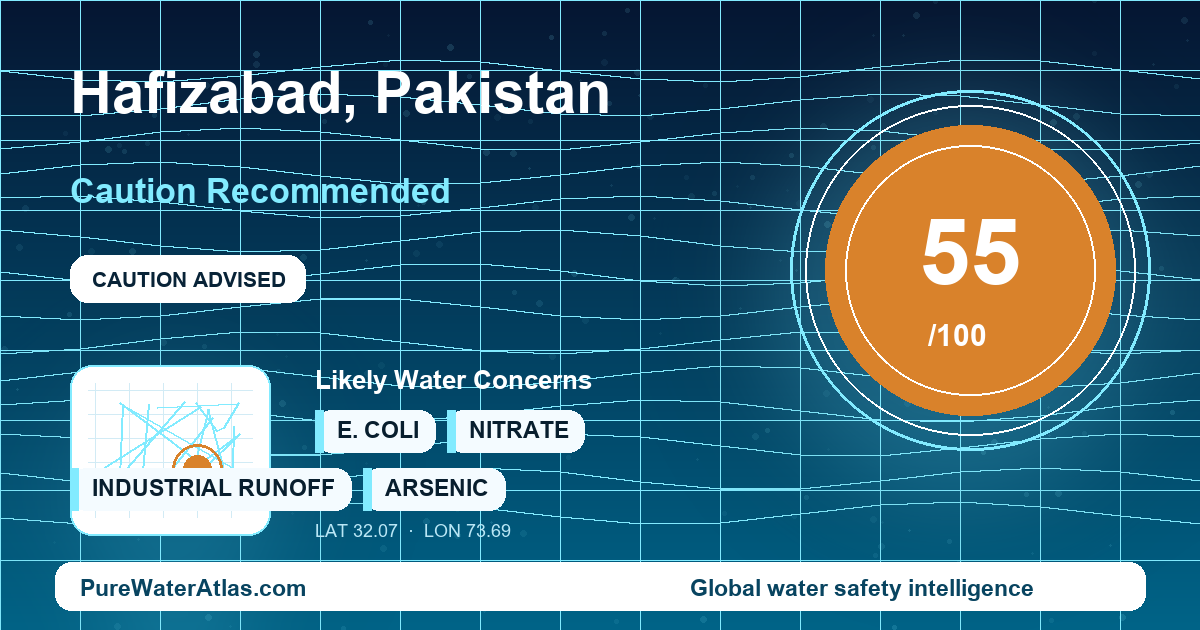
Hafizabad, Punjab: groundwater-based urban supply with variable bore, pipe, storage-tank, and household treatment risks. Water safety score: 55/100 — caution recommended.
Quick Answer
| Overall safety status | Caution recommended. Hafizabad tap water should not be treated as universally safe to drink untreated. Quality can vary by tube-well depth, municipal line condition, chlorination, household storage, and private bore quality. |
|---|---|
| For travelers | Do not drink untreated tap water. Use sealed bottled water, boiled water, or reputable filtered water from a maintained RO/UV system. Use bottled, boiled, or filtered water for brushing teeth. |
| For residents | Use point-of-use treatment matched to test results. At minimum, protect against bacteria through boiling, UV, or properly maintained disinfection/filtration. Private bores should be tested for microbial and chemical contaminants. |
| Main raw water source | Groundwater from municipal tube wells, supplemented by private motor pumps, hand pumps, household bores, and some community filtration points. |
| Local water authority context | Urban water and sanitation responsibilities are associated with the Municipal Committee/local government structure, with provincial support through Punjab public-health and local-government departments. |
| Filter recommendation | A home treatment system is advisable unless recent, location-specific testing confirms safety. Use sediment plus UV/boiling/chlorination for microbial risk; consider RO or contaminant-specific treatment where TDS, salinity, arsenic, nitrate, or other dissolved contaminants are confirmed. |
Why Hafizabad Is Different
Hafizabad is a district headquarters city in central Punjab, located in the canal-irrigated Rechna Doab between the Chenab and Ravi river systems. That setting matters for drinking water because the city depends mainly on groundwater in an intensively irrigated agricultural district known for rice and wheat. Groundwater in this part of Punjab can change from one bore to another depending on depth, local sanitation conditions, irrigation return flows, and nearby drainage.
The practical safety question in Hafizabad is not simply “does the city have water?” but “which water is reaching this specific tap?” A household may receive municipal tube-well water part of the day, use a private bore or motor pump when supply is intermittent, store water in an underground tank, pump it to a rooftop tank, and then drink it through internal plumbing. Each step can improve or worsen quality. Two houses on the same street may have different risks if one uses a deeper bore and a cleaned tank while another relies on a shallow pump or poorly sealed storage.
For that reason, Hafizabad should be understood as a groundwater-testing city. The visible clarity or taste of water is not enough to confirm safety, especially for E. coli, nitrate, arsenic, or contamination introduced after pumping.
Where Does Hafizabad’s Tap Water Come From?
Hafizabad’s practical raw-water source is groundwater. Urban supply is understood to rely on municipal tube wells, overhead reservoirs, and distribution mains in serviced areas. Where municipal supply is intermittent or unavailable, residents may supplement with private household bores, commercial boreholes, hand pumps, motor pumps, or community filtration points where these have been installed and maintained.
This is different from a city whose drinking water comes mainly from a large, continuously monitored surface-water treatment plant. In Hafizabad, the aquifer, the tube well, the pumping system, pipe integrity, storage tanks, and household treatment all influence final tap quality. The city’s alluvial groundwater setting can include naturally elevated dissolved minerals in some sources. Wider evidence from Pakistan’s Indus Plain also supports caution about groundwater arsenic in parts of the region, meaning local testing is needed before long-term drinking from a private bore.
Key infrastructure affecting Hafizabad water quality includes municipal tube wells, overhead reservoirs, distribution mains, private bores and pumps, community or public filtration plants where available, household underground and rooftop tanks, and sewerage or open-drain infrastructure. The last item is important: during low pressure, leakage, flooding, or pipe damage, nearby drains and sewerage can become a pathway for microbial intrusion.
Who Manages Drinking Water in Hafizabad?
Urban water supply and sanitation responsibilities in Hafizabad are associated with the Municipal Committee or local government structure. Provincial support, planning, and scheme implementation may involve the Public Health Engineering Department, Government of the Punjab and the Local Government and Community Development Department, Punjab. This governance model is typical of many Punjab municipalities rather than a single city water utility publishing a detailed annual consumer confidence report.
Pakistan has national drinking-water quality guidance through the National Standards for Drinking Water Quality. The Pakistan Council of Research in Water Resources also publishes water-quality research and monitoring reports relevant to national and provincial risks, including microbial contamination, salinity/TDS, arsenic, and nitrate. However, recent public, routine, Hafizabad ward-level tap-water results by tube well, distribution zone, or storage tank are limited. This profile therefore uses city-specific infrastructure context plus Punjab and Pakistan water-quality evidence, without claiming universal compliance or universal non-compliance.
Main Local Water Concerns
The main concern in Hafizabad is microbial contamination after water leaves the source. Intermittent supply, pressure drops, cracked or aging pipes, pipe repairs, open drains, sewer proximity, and household storage tanks can allow contamination even when the original tube-well water is acceptable. This is especially relevant during monsoon rain, after local sewer overflow, after pump interruptions, and when tanks are uncovered or not cleaned.
Turbidity and sediment can appear after pipe disturbance, low-pressure periods, monsoon runoff, or tank disturbance. Cloudy water or visible particles are not only an aesthetic issue; they can reduce the effectiveness of disinfection and point-of-use systems. Hafizabad households should treat sudden turbidity as a warning sign and avoid drinking the water untreated until it has been clarified, disinfected, or tested.
Groundwater chemistry is the second major issue. Some sources may have high TDS, hardness, salinity, chloride, sulfate, iron, manganese, or taste problems. These cannot be judged reliably by appearance. Arsenic is also a precautionary issue because central Punjab is within the wider Indus alluvial aquifer region where arsenic occurs. The same applies to nitrate risk in shallow groundwater influenced by agriculture, livestock, fertilizer use, or on-site sanitation. Lead risk is more likely to come from older building plumbing, brass fixtures, solder, fittings, or corroded internal pipes than from the raw aquifer itself.
For Travelers
Visitors should not drink untreated tap water in Hafizabad. Use sealed bottled water from reputable brands, boiled water, or water treated by a maintained RO/UV system. Check bottle seals and avoid refilled bottles with broken or suspicious caps. If staying in a hotel, ask whether the water is bottled, boiled, or filtered, and whether filters are maintained and changed on schedule.
For brushing teeth, use bottled, boiled, or filtered water, especially for children, pregnant travelers, short-stay visitors, and anyone with a sensitive stomach. Tap water may be acceptable for washing hands or bathing, but swallowing it is not recommended unless it has been treated.
Avoid ice unless you are confident it was made from bottled or properly treated water. Ice from street vendors or small outlets should be considered uncertain. In restaurants, choose sealed bottles opened at the table, hot tea, boiled drinks, and freshly cooked food. Be cautious with uncooked salads or foods washed in local water. If diarrhea occurs, use oral rehydration salts and safe water for mixing.
For Residents
Residents connected to a municipal line or using private bore water should base treatment on testing, not on taste alone. If the main issue is microbial contamination from storage or distribution, boiling, UV, or properly maintained chlorination with sediment filtration may be sufficient. If testing shows high TDS, salinity, arsenic, nitrate, or other dissolved contaminants, a properly maintained reverse-osmosis system or contaminant-specific treatment may be needed.
Private bores should be tested before long-term drinking use, especially before using the water for infants, pregnant people, elderly residents, or immunocompromised residents. Recommended testing includes E. coli, total coliforms, arsenic, nitrate, TDS, hardness, chloride, sulfate, iron, manganese, pH, and electrical conductivity. If the home uses an RO plant, test both raw and treated water to confirm the system is actually removing dissolved contaminants.
Retest after installing a new bore, changing pump depth, repairing plumbing, switching between municipal and private sources, monsoon flooding, sewage incidents, pump repairs, or any change in taste, odor, color, or turbidity. Use an accredited laboratory, PCRWR facility where accessible, university lab, or recognized Punjab public-health/water-quality lab rather than relying only on handheld TDS meters.
Storage tanks are a major weak point in Hafizabad homes. Keep underground and rooftop tanks covered, mosquito-proof, and protected from drain or sewage ingress. Clean and disinfect tanks periodically, especially before and after monsoon season. Avoid suction-pump arrangements that can draw contaminated water back into the line. In older buildings, flush stagnant morning water and consider first-draw and flushed sampling if lead or metal contamination is suspected.
Relevant Contaminants and Water-Quality Issues
The most important Hafizabad concern for immediate illness risk is E. coli and related coliform contamination, especially where intermittent pressure, sewer intrusion, or dirty tanks are possible. Turbidity and sediment are also important because particles can signal pipe disturbance, tank contamination, or reduced disinfection performance.
For groundwater-dependent households, arsenic and nitrate deserve special attention. Arsenic requires testing because it can occur naturally in parts of Pakistan’s Indus alluvial aquifer system. Nitrate testing is important for shallow groundwater in an agricultural district affected by fertilizer, livestock, and sanitation influences. Iron may cause staining or taste problems and can be a reason to run broader chemistry tests. Chlorine is relevant where disinfection is used to maintain a barrier against microbial contamination in piped or stored water.
For treatment choices, see PureWaterAtlas guides on boiling water, UV purification, arsenic testing, nitrate testing, agricultural runoff, and lead testing for older buildings.
How to Verify Your Water Quality
For Hafizabad, verification should be local and household-specific. Start with the exact water you drink: municipal tap after storage, private bore water, RO-treated water, or filtered hotel water. A single TDS reading does not prove safety because it cannot detect E. coli, arsenic, nitrate, or many plumbing-related metals.
Use the PureWaterAtlas Water Testing guide to plan sampling and parameter selection. The Contaminants Search Engine can help match symptoms, sources, and treatment options to suspected contaminants. For broader comparison and travel context, use the Global Water Quality Checker. For decision-making basics, see Drinking Water Safety, Water Microbiology, Water Treatment Systems, and Water Contamination.
Official and Technical Sources
- Pakistan Council of Research in Water Resources publications and water-quality reports — national water-quality monitoring and research context for Pakistan.
- National Standards for Drinking Water Quality, Pakistan — official drinking-water quality standards context.
- Public Health Engineering Department, Government of the Punjab — provincial water-supply and sanitation scheme authority.
- Local Government and Community Development Department, Punjab — municipal and local-service governance context.
- World Bank: Punjab Cities Program — municipal governance and service-delivery context for Punjab intermediate cities.
- WHO/UNICEF Joint Monitoring Programme country data for Pakistan — national drinking-water, sanitation, and hygiene background.
- Punjab Bureau of Statistics district publications — district and geographic context for Hafizabad.
- Water quality and arsenic risk in the Indus Plain of Pakistan — peer-reviewed evidence supporting precautionary groundwater arsenic testing.
Bottom Line
Hafizabad’s tap water should be approached with caution, not assumed unsafe in every building and not assumed safe without testing. The city relies mainly on groundwater from municipal and private tube wells, with final quality shaped by bore depth, pipe integrity, intermittent pressure, drains, chlorination, and household tanks. Visitors should use sealed bottled, boiled, or properly filtered water and avoid uncertain ice. Residents should test their actual drinking source for E. coli/coliforms, TDS, hardness, arsenic, nitrate, iron, manganese, and basic chemistry, especially for private bores or stored water. A maintained treatment system is advisable, with UV/boiling/disinfection for microbial risk and RO or contaminant-specific treatment where chemical testing shows a need.
Read the full guide: Global Water Quality Guide
Explore more in this category: Global Water Quality Articles