
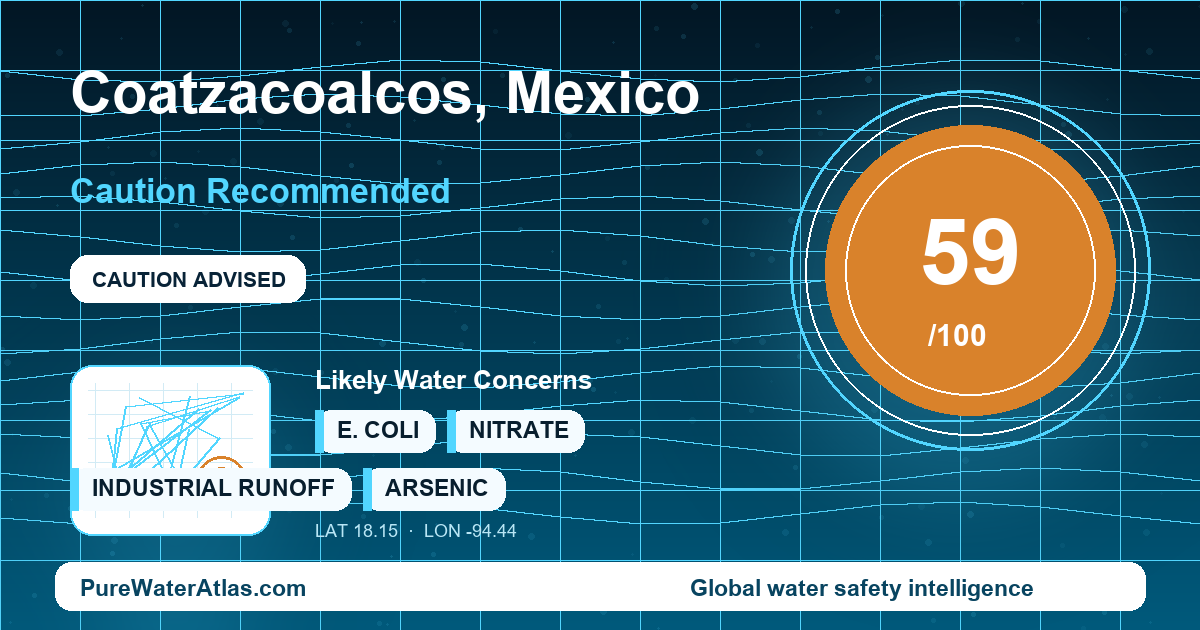
Coatzacoalcos, Veracruz: municipal water is organized but should be treated with caution because of Yuribia aqueduct interruptions, low-pressure events, storage-tank risks, storm conditions, and limited recent neighborhood-level tap-water data.
Quick Answer
| Overall safety status | Caution recommended. PureWaterAtlas score: 59/100. Coatzacoalcos has a formal municipal water system, but the tap water should not be treated as reliably drinkable without additional treatment, especially by visitors. |
|---|---|
| Can travelers drink the tap water? | No as a default. Travelers should use sealed bottled water, verified purified water, or water that has been boiled, disinfected, or filtered with a microbiological barrier. |
| Resident guidance | Residents should treat the municipal supply as utility water that may be made suitable for drinking after appropriate point-of-use treatment and careful cistern or tinaco hygiene. |
| Main water source context | Coatzacoalcos is principally associated with the Sistema Yuribia, an upland surface-water supply and aqueduct system linked to the Sierra de Santa Marta or Tatahuicapan area and serving the Coatzacoalcos-Minatitlán corridor. |
| Local water authority | CMAS Coatzacoalcos, the Comisión Municipal de Agua y Saneamiento de Coatzacoalcos. |
| Filter recommendation | A maintained activated-carbon filter plus a microbiological barrier such as UV, ultrafiltration, or boiling during advisories and outages is advisable. Reverse osmosis may be appropriate where private wells, salinity, nitrate, metals, or chemical concerns are being evaluated. |
Why Coatzacoalcos Is Different
Coatzacoalcos is not just another coastal city with a simple local well supply. It is a Gulf of Mexico port city in southern Veracruz at the mouth of the Coatzacoalcos River, within a humid tropical, flood-prone, industrial and petrochemical corridor. Its drinking-water risk profile is shaped by three local realities: dependence on the regional Yuribia system, frequent practical use of household or building storage, and limited public release of recent tap-level laboratory data by neighborhood.
The city’s connection to the Sistema Yuribia creates a very specific vulnerability. When upstream intake, dam, pipeline, maintenance, or community-dispute issues affect Yuribia, water availability in Coatzacoalcos can be disrupted even if the city itself has not experienced a local drought. These interruptions matter for safety because low pressure and outages can increase the chance of intrusion into distribution pipes, and service resumption can bring turbidity, sediment, or discoloration.
In practice, the water a person actually drinks in Coatzacoalcos is often determined by the final building-level system. A hotel, apartment, restaurant, school, or small business may all receive municipal water, but each may have different cistern cleaning, rooftop tinaco covers, pump reliability, pipe condition, and purified-water practices. For this reason, a single citywide answer cannot guarantee the quality at a specific tap.
Where Does Coatzacoalcos’s Tap Water Come From?
Coatzacoalcos is principally associated with the Sistema Yuribia, an upland surface-water supply and aqueduct system that conveys water from the Sierra de Santa Marta or Tatahuicapan area toward the Coatzacoalcos-Minatitlán urban corridor in southern Veracruz. Public notices and local reporting also refer to supplemental local sources and operational storage during Yuribia interruptions, but consolidated, public, source-by-source production data are limited.
The key local water infrastructure includes the Yuribia surface-water intake and dam area, the Yuribia aqueduct and transmission works, the municipal distribution network operated by CMAS Coatzacoalcos, disinfection and storage points within the potable-water system, and the many household cisterns, rooftop tinacos, hotel tanks, and garrafón distribution systems used as final water infrastructure.
Historically and practically, the metropolitan area has also used local wells, storage tanks, and sectorized distribution infrastructure. This does not mean every household is drinking well water; rather, it means the city’s water experience includes a mix of municipal delivery, stored water, bottled garrafón water, and private purification systems. During outages or low-pressure periods, household storage becomes especially important.
Who Manages Drinking Water in Coatzacoalcos?
The local water operator is Comisión Municipal de Agua y Saneamiento de Coatzacoalcos, commonly known as CMAS Coatzacoalcos. State-level water-sector context and coordination may involve the Comisión del Agua del Estado de Veracruz, or CAEV.
At the national level, CONAGUA regulates national waters and water concessions, while the Sistema Nacional de Información del Agua provides official water-resource and infrastructure context. Drinking-water quality in Mexico is governed by federal health standards, including NOM-127-SSA1-2021 for water for human use and consumption. Health surveillance responsibilities involve Secretaría de Salud and COFEPRIS.
These standards are important, but they should not be read as proof that every tap in Coatzacoalcos is always compliant. The most important unknowns for an individual user are current service conditions, recent pressure history, building plumbing, storage-tank maintenance, and whether the water comes from the municipal system, a private well, or a purified-water vendor.
Main Local Water Concerns
The main Coatzacoalcos tap-water concerns are operational and building-level rather than a single confirmed contaminant level that applies citywide. The most important issue is intermittent service and low pressure during Yuribia aqueduct shutdowns, repairs, or upstream conflicts. Low pressure can increase the risk that contaminated water enters distribution lines through leaks or cross-connections.
Turbidity, sediment, and discoloration may occur after heavy rain, pipe repairs, flushing, or resumption of service following outages. In a humid tropical, storm-exposed city, rainy season and tropical storms can increase raw-water turbidity, runoff, flooding, and service interruptions. Hurricane-season power outages can also affect pumping, pressure, and building storage systems.
Chlorine decay is another practical concern. Residual chlorine can decline in long distribution lines, stagnant pipes, cisterns, rooftop tanks, and warm storage. Hot weather can accelerate chlorine loss and microbial regrowth risk in stagnant tanks. This is why water that may have been disinfected earlier in the system can still become risky by the time it reaches a kitchen tap.
Household storage is a major local risk point. Uncovered, cracked, dirty, or infrequently cleaned cisterns and tinacos can introduce or sustain microbial contamination. Older buildings may also have deteriorated internal plumbing, galvanized pipes, old solder, corroded fixtures, or neglected tanks that affect color, taste, sediment, metals, and microbial risk after water leaves the municipal network.
Coatzacoalcos is also located in a wider river, port, industrial, and petrochemical corridor. This does not prove that the municipal Yuribia supply is contaminated by industrial chemicals. It does mean that private wells, untreated local surface water, and water near workshops, fuel storage, dumps, petrochemical facilities, or flood-prone areas should not be assumed safe without laboratory testing.
For Travelers
For visitors to Coatzacoalcos, the safest default is simple: do not use untreated tap water as routine drinking water. Use sealed bottled water, properly maintained purified-water dispensers, or water that has been boiled or treated. Short-term visitors are more vulnerable to gastrointestinal illness from unfamiliar water systems and from building storage conditions they cannot verify.
Use bottled or purified water for brushing teeth if you are a traveler, pregnant, immunocompromised, traveling with small children, or staying in a building where the water has visible sediment, odor, low pressure, or uncertain tank maintenance. Tap water is generally more acceptable for bathing and handwashing, but avoid swallowing it when conditions look poor or service has recently returned after an outage.
Use ice only when the hotel or restaurant confirms it is made from purified water. In established hotels and restaurants, purified ice is often standard, but street stalls and informal vendors vary. Ask whether drinking water and ice come from garrafón, a commercial purifier, or the municipal tap. Do not assume that bathroom tap water in a hotel room is the same quality as water served at the restaurant.
Carry bottled water during storms, outages, or periods of reported supply interruption. If water is cloudy, brown, has a strong sewer smell, or service has just returned after low pressure, do not drink it untreated. Let it run clear for non-drinking uses, then boil or filter it before drinking if no safer source is available. For emergency treatment steps, see PureWaterAtlas’s Boiling Water Purification: Complete Guide.
For Residents
Residents should treat Coatzacoalcos municipal water as a utility supply that may need final household treatment for drinking and cooking. A practical baseline is a maintained activated-carbon filter plus a microbiological barrier such as UV, ultrafiltration, or boiling during advisories and outage periods. Carbon can improve taste and reduce some chlorine-related issues, but carbon alone is not a reliable microbial barrier after low-pressure or tank-contamination events.
UV systems can be useful where the incoming water is reasonably clear and the system is maintained correctly; see UV Water Purification: Complete Guide. Reverse osmosis is worth considering where private wells, salinity, nitrate, metals, or industrial chemical concerns are being evaluated, but RO should be paired with testing and maintenance rather than used blindly.
Testing should focus on the water people actually drink. Test stored household water from the kitchen tap, not only water entering the building, because cisterns and tinacos can change water quality. After repeated outages or low-pressure events, test for total coliforms and E. coli if the water will be used for drinking. Private wells should be tested for microbial contamination, nitrate, total dissolved solids, salinity or conductivity, iron, manganese, arsenic where regionally relevant, and site-specific industrial contaminants if near workshops, fuel storage, petrochemical facilities, dumps, or flood-prone sites.
Older apartments, rental homes, schools, and small businesses may have internal plumbing that matters more than the municipal supply for lead, iron, color, taste, and sediment. If plumbing materials are unknown, test first-draw and flushed samples for lead and other metals. Let stagnant water run before non-drinking use, but do not rely on flushing alone for drinking-water safety.
Cisterns and rooftop tinacos should be covered, screened, disinfected, and cleaned on a regular schedule. In Coatzacoalcos, warm weather, intermittent supply, storms, and power-related pumping problems make tank maintenance one of the most important household controls.
Relevant Contaminants and Water-Quality Issues
The most relevant Coatzacoalcos water-quality topics are turbidity in drinking water and sediment in drinking water, especially after storms, pipe repairs, flushing, or service resumption. Cloudy or discolored water is not automatically dangerous, but it is a warning sign that treatment and verification are needed before drinking.
Microbial risk is central in low-pressure systems and poorly maintained storage tanks. Learn more about E. coli in drinking water and the broader PureWaterAtlas guide to Water Microbiology. Disinfection is also relevant: chlorine in drinking water helps control microbes, but residual chlorine can decay in warm, stagnant tanks and long plumbing runs.
For old buildings, lead in drinking water is relevant because the water at the tap can be affected by internal plumbing and fixtures. Residents with private wells or peri-urban groundwater should also understand nitrate in drinking water. Because Coatzacoalcos is in an industrial corridor, some residents may choose targeted screening for PFAS in drinking water; this is a cautious testing consideration, not a claim of documented municipal PFAS exceedances.
How to Verify Your Water Quality
Because recent, independently accessible, neighborhood-level tap-water results for Coatzacoalcos are limited, verification should be local and tap-specific. Start by identifying whether your water is municipal, private well, purified garrafón, or a building-level treated supply. Then test the water at the point where it is consumed, especially after outages, low pressure, flooding, tank cleaning, or plumbing changes.
Use PureWaterAtlas’s Water Testing guide to plan sampling, choose a lab, and decide which parameters matter. For older buildings, see Lead in Drinking Water: Testing and Detection Methods. For wells, see Nitrate Contamination in Drinking Water: Testing and Detection Methods. If industrial-area screening is needed, see PFAS in Drinking Water: Testing and Detection Methods.
You can also use the Contaminants Search Engine to interpret lab reports and the Global Water Quality Checker for broader destination context. For selecting treatment equipment, review Water Treatment Systems and the general Drinking Water Safety framework.
Official and Technical Sources
- CMAS Coatzacoalcos — local municipal water and sanitation authority.
- Comisión del Agua del Estado de Veracruz — state water-sector context for Veracruz.
- CONAGUA — national water authority for Mexico.
- Sistema Nacional de Información del Agua — official national water information portal.
- NOM-127-SSA1-2021 — Mexican federal drinking-water standard for water for human use and consumption.
- INEGI geographic information for Coatzacoalcos municipality — official geography and municipal context.
- CDC Travelers’ Health: Mexico — traveler health context supporting conservative food and water precautions.
- WHO Guidelines for Drinking-water Quality — international guidance on microbial risk, disinfection, turbidity, and safe water management.
- Gobierno del Estado de Veracruz — state context for public notices, infrastructure, and water-service issues.
- Ayuntamiento de Coatzacoalcos — municipal context, civil protection, public services, storms, and local notices.
Bottom Line
Coatzacoalcos tap water deserves a cautious rating, not because a single contaminant level can be applied citywide, but because the city’s real-world risk depends on Yuribia aqueduct reliability, pressure interruptions, storm conditions, and building-level storage. Visitors should default to sealed bottled water or verified purified water and should use purified water for brushing teeth when conditions are uncertain. Residents can often manage risk with maintained point-of-use treatment, periodic testing, and disciplined cistern or tinaco cleaning. Private wells and older buildings need extra scrutiny. Recent neighborhood-level laboratory data are limited, so the safest decision is to verify the water at the tap you actually use, especially after outages, low pressure, flooding, or visible turbidity.
Read the full guide: Global Water Quality Guide
Explore more in this category: Global Water Quality Articles