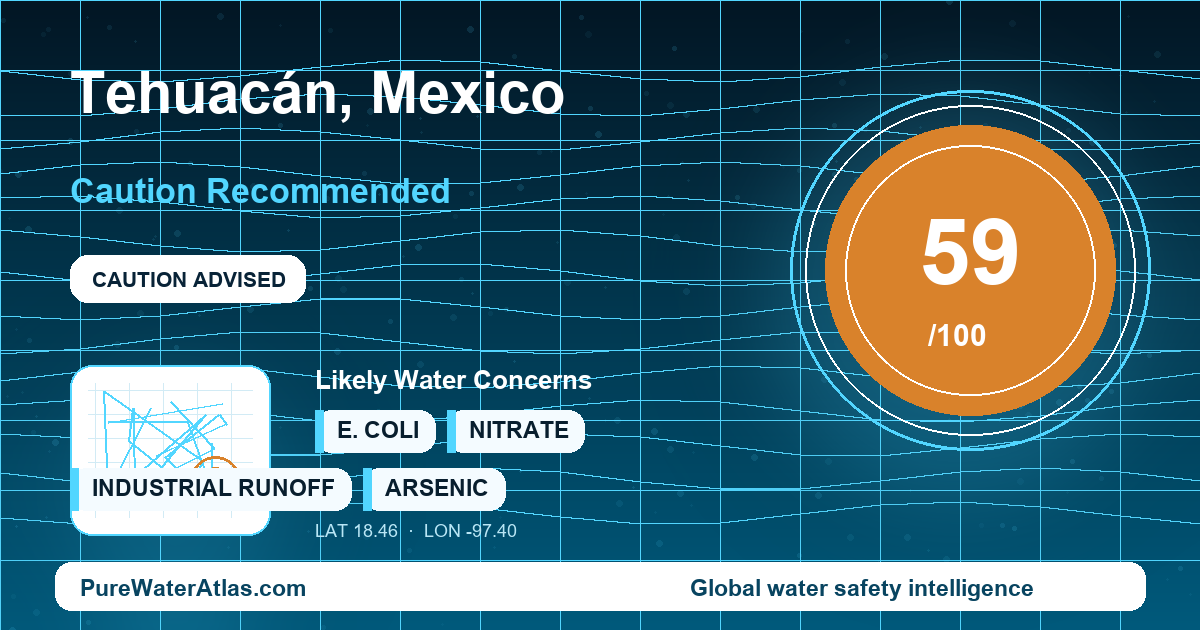
Tehuacán, Puebla has a groundwater-dependent municipal supply, a strong local mineral-water identity, and building-level storage practices that make point-of-use water safety especially important.
Quick Answer
| Overall safety status | Caution recommended. Tehuacán is not best treated as a drink-from-any-tap destination because the public supply is groundwater-dependent, city-level water-quality reporting is limited, and household cisterns or rooftop tinacos can change water quality after it leaves the municipal system. |
|---|---|
| Water safety score | 59 / 100 — Risk level: Caution Recommended. |
| Advice for visitors | Use sealed bottled water or verified filtered and disinfected water for drinking. Avoid relying on ordinary tap water unless the building has a confirmed, well-maintained drinking-water system. |
| Advice for residents | Do not assume every tap is unsafe, but manage the final point of use: clean storage tanks, confirm disinfection, maintain filters, and test when plumbing, private wells, taste, sediment, or health concerns justify it. |
| Main water source | Predominantly groundwater pumped from wells in the Valle de Tehuacán aquifer system, distributed through municipal infrastructure after pumping, storage, and disinfection. |
| Local authority | Organismo Operador de los Servicios de Agua Potable y Alcantarillado del Municipio de Tehuacán, commonly known as OOSAPAT. |
| Filter recommendation | For routine drinking at home, use point-of-use treatment. A practical approach is sediment prefiltration plus activated carbon, with reverse osmosis where testing shows high dissolved solids, nitrate, arsenic, fluoride, or other dissolved contaminants. UV can help for microbial control after filtration, but it does not remove minerals or chemicals. |
Why Tehuacán Is Different
Tehuacán is not a simple “municipal tap water is always safe” or “all tap water is always unsafe” case. The city sits in southeastern Puebla in the semi-arid Tehuacán Valley, where groundwater availability, aquifer pressure, mineralization, and pumping infrastructure matter more than they would in a city supplied mainly by large surface reservoirs. That local setting shapes both water taste and practical reliability.
The city also has a well-known historical association with mineral springs and bottled mineral water. That identity is relevant because it points to naturally mineralized groundwater in the valley. However, it should not be confused with a guarantee that municipal tap water has the same quality control, packaging protection, or batch consistency as sealed commercial bottled water. Mineral character can explain hardness, scaling, salty or mineral taste, and consumer preference for bottled or filtered water, but mineral taste alone does not prove microbiological safety or danger.
The most important Tehuacán-specific issue is the path from well to glass. A hotel, restaurant, rental, or home may receive water that has been handled by the utility, but many buildings store water before use. Cisterns and rooftop tinacos can materially affect water quality at the tap, especially if they are uncovered, dirty, poorly disinfected, or affected by low pressure and service interruptions. For travelers, the building’s treatment and tank maintenance can matter as much as the municipal source.
Where Does Tehuacán’s Tap Water Come From?
Tehuacán’s public water supply is understood to rely predominantly on groundwater pumped from municipal wells in the Valle de Tehuacán aquifer system. This is different from cities where a large conventional surface-water treatment plant dominates the supply. In Tehuacán, wells, pumping stations, electrical pumping infrastructure, disinfection points, storage tanks, and distribution mains are central pieces of the drinking-water system.
Because the system is groundwater-based, reliable pumping and pressure are especially important. Dry-season stress, electrical or pumping disruptions, pipe repairs, and low-pressure events can all increase the importance of household storage hygiene and point-of-use treatment. Groundwater may also carry dissolved minerals that affect taste, hardness, conductivity, scaling, chloride, sulfate, sodium, iron, or manganese. Public sources do not support one exact citywide numeric mineral or salinity claim for every Tehuacán tap, so individual testing is the right approach when taste, scale, or corrosion concerns appear.
The distribution system includes utility-level storage and mains, but the final stretch is often inside private buildings. Cisterns and tinacos are common final-storage points. If disinfectant residual declines inside a tank, or if sediment accumulates, the water reaching a kitchen tap may not reflect the quality at the utility entry point. This is why Tehuacán residents who drink tap water should pay close attention to tank cleaning, covers, screens, flushing, and filtration.
Who Manages Drinking Water in Tehuacán?
Municipal drinking-water and sewerage service in Tehuacán is handled by OOSAPAT, the Organismo Operador de los Servicios de Agua Potable y Alcantarillado del Municipio de Tehuacán. The operator is responsible for local service delivery, including the municipal network components used to produce and distribute public water.
Mexico’s drinking-water quality framework is national as well as local. Drinking water for human use and consumption is governed by sanitary requirements including NOM-127-SSA1-2021. CONAGUA regulates national water resources and aquifer availability, while public-health surveillance involves authorities such as COFEPRIS and state-level sanitary authorities.
There is a major data limitation for consumers: this review found enough public information to identify the local operator, legal framework, aquifer context, and regional water-resource issues, but not a single recent, official, public, consumer-facing dataset showing routine Tehuacán distribution-zone results for microbiology, disinfectant residual, metals, nitrate, TDS, and other parameters. For that reason, this profile does not claim exact citywide compliance, neighborhood-level conditions, or contaminant concentrations at individual taps.
Main Local Water Concerns
- Groundwater dependence and aquifer pressure: CONAGUA documentation for the Valle de Tehuacán area identifies groundwater management as a central regional issue. Heavy reliance on wells makes the city sensitive to drought, pumping costs, and long-term aquifer stress. Practically, users should not assume unlimited, continuously pressurized service.
- Mineralization, hardness, salinity, and taste: Tehuacán’s groundwater setting and mineral-water identity make dissolved minerals a plausible local issue. Scale, mineral taste, salty taste, or appliance buildup can justify testing for TDS, conductivity, hardness, chloride, sulfate, sodium, iron, and manganese.
- Microbial risk after distribution or storage: Chlorination may be used in the public supply, but disinfectant residual can decline in building storage, and microbial regrowth can occur in poorly maintained cisterns or tinacos. Any outage, depressurization, or dirty tank increases concern.
- Turbidity and sediment after repairs or pressure changes: Groundwater distribution systems can mobilize iron, manganese, pipe scale, or sediment after network work, low pressure, or tank disturbance. Brown, cloudy, or particle-filled water should not be consumed untreated.
- Nitrate for private wells and uncertain sources: The broader Tehuacán Valley includes agriculture and urban wastewater pressures. Public sources do not establish a universal nitrate exceedance in municipal taps, but nitrate is a sensible test parameter for private wells, peri-urban wells, and households with infants or pregnant people.
- Lead from premise plumbing: Lead risk is usually building-specific, related to old fixtures, solder, brass components, galvanized lines, or long stagnation. No reviewed source supports a citywide lead claim for Tehuacán, but older buildings and rentals should test if tap water is consumed.
For Travelers
Visitors to Tehuacán should generally use sealed bottled water or verified filtered water for drinking. The cautious recommendation is not based on a verified citywide emergency; it reflects the combination of groundwater mineralization, limited published neighborhood-level test data, possible intermittent service, and building-level storage that travelers cannot easily inspect.
For brushing teeth, most healthy adults can usually use tap water if they avoid swallowing it. More cautious travelers, children, and anyone with a sensitive stomach should use bottled or treated water. For drinking water, medication, rehydration, and making infant formula, use sealed bottles or water that has been filtered and disinfected.
Ice should be treated as source-dependent. Use ice only when the hotel or restaurant confirms it is made from purified water. Better hotels and restaurants commonly use garrafón water, sealed bottles, or on-site purification, but confirmation is still worthwhile. Avoid informal ice when the source is unknown.
If the tap water is cloudy, brown, has particles, smells unusual, or follows a local outage or plumbing repair, switch to bottled or boiled water. For emergency microbial control, see the PureWaterAtlas guide to boiling water purification.
For Residents
Residents connected to OOSAPAT should manage the last step of water safety inside the home. If your household regularly drinks tap water, a maintained point-of-use system is advisable. A practical setup is a sediment prefilter followed by activated carbon for taste and chlorine control. If testing shows high dissolved solids, nitrate, arsenic, fluoride, or other dissolved contaminants, a certified reverse-osmosis unit may be appropriate. UV can be useful after sediment filtration when microbial risk is the main concern, but UV alone does not remove minerals, nitrate, metals, or chemicals.
Testing should be targeted. If you use a cistern, tinaco, private well, or any nonstandard source, test at least once for total coliform and E. coli. Measure free chlorine at the tap during normal service and after outages. If the water tastes salty, mineral, bitter, metallic, or causes scaling, test TDS, conductivity, hardness, chloride, sulfate, sodium, iron, and manganese. If you use a private or peri-urban well, or if infants or pregnant people will drink the water, test nitrate. For private wells or long-term treatment planning, consider arsenic and fluoride testing rather than assuming municipal results apply.
Older buildings need special attention. Lead-bearing brass, old solder, galvanized plumbing, corroded lines, and long stagnation can elevate metals or sediment even if the municipal source is acceptable. Use first-draw and flushed sampling for lead when tap water is consumed in older homes, rentals, schools, or childcare settings.
Cisterns and rooftop tinacos should be covered, screened, cleaned, and disinfected on a schedule. A dirty or uncovered tank can turn otherwise chlorinated supply into unsafe household water. After flooding, prolonged outage, major plumbing work, tank-cleaning failure, or a change in taste, color, odor, or illness patterns, retest and treat water before drinking.
Relevant Contaminants and Water-Quality Issues
Several PureWaterAtlas contaminant profiles are especially relevant for Tehuacán’s groundwater-and-storage context. Chlorine in drinking water matters because utility disinfection and residual chlorine can decline in storage tanks or during low-pressure events. Turbidity and sediment are relevant when water becomes cloudy, brown, or particle-filled after repairs, pressure changes, or tank disturbance.
For microbial safety, E. coli is a key indicator for cisterns, tinacos, private wells, and post-outage testing. For groundwater and private wells near agricultural or wastewater-influenced areas, nitrate is a practical screening parameter, especially where infants or pregnant people may drink the water. Lead should be considered a premise-plumbing issue in older buildings rather than a proven citywide aquifer problem. Arsenic is also worth considering for private well testing or long-term reverse-osmosis decisions without assuming a verified Tehuacán citywide problem.
How to Verify Your Water Quality
The best way to verify Tehuacán tap water is to combine official information with building-specific testing. Start with OOSAPAT for local service notices and available documentation. For aquifer and regional context, consult CONAGUA resources such as the Valle de Tehuacán aquifer availability document and the Sistema Nacional de Información del Agua. For current drought context, check the Monitor de Sequía en México.
For household decisions, use a certified laboratory or reliable field screening where appropriate. PureWaterAtlas resources can help structure the process: see the complete guide to water testing, the broader drinking water safety framework, and the water treatment systems guide. For microbial concerns related to tanks and intermittent service, review water microbiology and UV water purification.
You can also explore the PureWaterAtlas Contaminants Search Engine and compare destinations with the Global Water Quality Checker.
Official and Technical Sources
- OOSAPAT Tehuacán official website — identifies the municipal water and sewerage operator for Tehuacán. Operational notices may not provide a complete consumer-facing laboratory dataset for every distribution zone.
- CONAGUA groundwater availability document for Valle de Tehuacán — high-authority aquifer context, but not a household tap-water compliance report.
- Sistema Nacional de Información del Agua — national portal for Mexican water-resource information, generally regional or administrative rather than building-specific.
- NOM-127-SSA1-2021 — Mexican sanitary standard for water for human use and consumption.
- COFEPRIS water for human use and consumption guidance — national public-health context for drinking-water surveillance.
- INEGI geographic information for Tehuacán municipality — official geographic reference for the municipality.
- Monitor de Sequía en México — drought monitoring relevant to semi-arid water-supply stress.
- CDC Travelers’ Health: Mexico — country-level traveler guidance supporting cautious food and water practices.
Bottom Line
Tehuacán tap water deserves a cautious, building-specific approach. The city relies mainly on pumped groundwater from the Valle de Tehuacán aquifer system, and that setting makes mineralization, hardness, taste, pumping reliability, storage, and pressure events important. The local operator is OOSAPAT, and Mexican drinking-water standards apply, but recent public neighborhood-level laboratory data are not readily available in one transparent consumer report. Visitors should use sealed bottled or verified purified water for drinking and confirm the source of ice. Residents should maintain cisterns and tinacos, check disinfectant residual, use appropriate point-of-use treatment, and test for microbes, minerals, nitrate, lead, or groundwater contaminants when their building or source conditions warrant it.
Read the full guide: Global Water Quality Guide
Explore more in this category: Global Water Quality Articles