
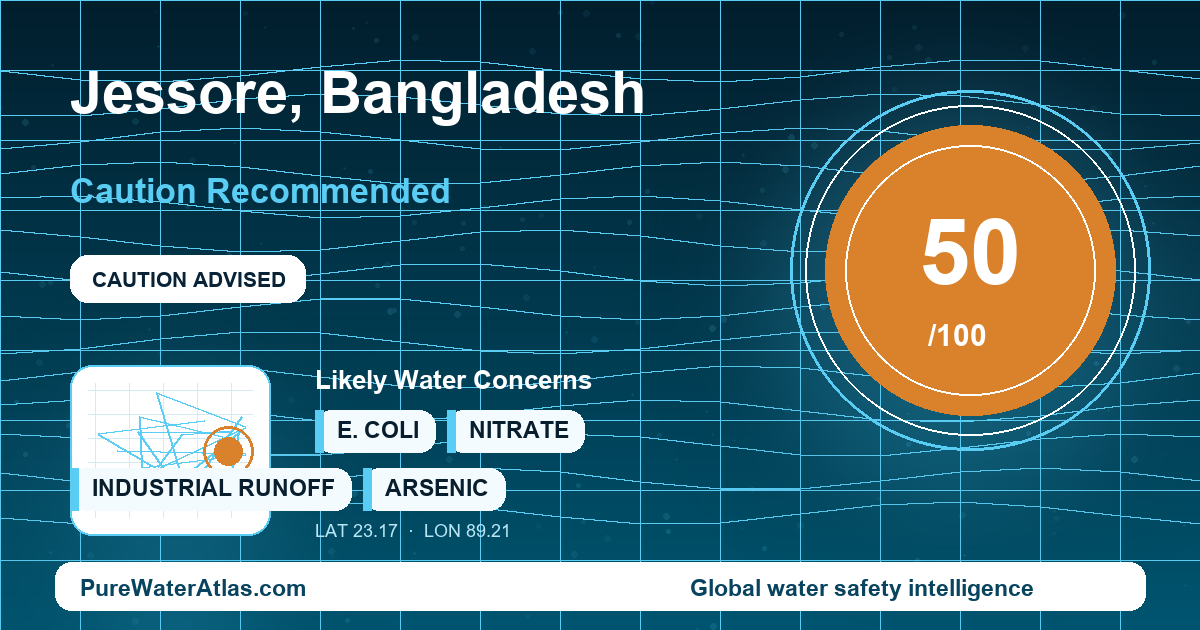
Jessore, officially Jashore, is a groundwater-dependent city in southwest Bangladesh where untreated tap water should be approached with caution, especially by visitors and households using private or shallow wells.
Quick Answer
| Water safety score | 50 / 100 |
|---|---|
| Risk level | Caution Recommended |
| Can you drink the tap water? | Not untreated. Visitors should use sealed bottled water, properly boiled water, or water treated by a reliable purifier. |
| Traveler advice | Do not drink bathroom or kitchen tap water unless it has been boiled, filtered and disinfected, or verified as safe. Use safe water for brushing teeth and avoid uncertain ice. |
| Resident advice | Treat drinking water as source-specific. Municipal deep-tubewell water may be safer than shallow private wells, but testing and point-of-use treatment are still advisable. |
| Main water source | Primarily groundwater from municipal and private tubewells, rather than a large surface-water treatment plant. |
| Local authority | Jessore/Jashore Pourashava, with national technical context from Bangladesh’s Department of Public Health Engineering. |
| Filter recommendation | Use treatment matched to test results: sediment prefiltration, arsenic-appropriate removal if arsenic is detected, and boiling, UV, chlorination, or a maintained purifier for microbial control. |
PureWaterAtlas rates Jessore tap water as caution recommended. The main reason is not one single confirmed citywide failure, but the lack of recent public Jessore-specific compliance data combined with known Bangladesh groundwater and household-storage risks. Publicly available information does not provide enough routine local evidence on E. coli, residual chlorine, arsenic by municipal well, manganese, nitrate, salinity, or distribution-zone performance to recommend untreated tap water as reliably safe for everyone.
Why Jessore Is Different
Jessore is an inland city in southwest Bangladesh, located in the Bengal delta and historically associated with the Bhairab River. Its drinking-water risk profile is therefore different from a city supplied by alpine reservoirs, desalinated seawater, or a large centralized river-treatment plant. In Jessore, the practical safety question is usually about groundwater quality, well depth, well construction, distribution-pipe condition, household storage, and whether water is treated before drinking.
The wider Jessore/Jashore district lies within Bangladesh’s alluvial groundwater environment. In this setting, naturally occurring arsenic, iron, and manganese can be important depending on local hydrogeology and aquifer depth. Nearby wells can have very different chemistry, so it is not safe to assume that one test result applies to every home, school, hotel, or neighborhood.
Jessore is also not one of Bangladesh’s major WASA cities. Urban supply is municipally managed, which can make water-quality information less centralized and less visible to ordinary consumers. For a person staying in Jessore, the main difference may be treated hotel drinking water versus untreated roof-tank water, a deep municipal well versus a shallow private tubewell, or freshly boiled water versus boiled water stored later in an unclean container.
Where Does Jessore’s Tap Water Come From?
Jessore’s urban drinking water is understood to rely primarily on groundwater abstracted through municipal and private tubewells. Where municipal piped supply is available, water is expected to come from groundwater production wells or deep tubewells serving the urban network. Where supply is absent, intermittent, or not trusted, households and institutions may use private tubewells.
This groundwater dependence is important. Deep, well-constructed municipal wells may reduce arsenic risk compared with many shallow wells, but they do not automatically remove all concern. Arsenic, manganese, iron, salinity, nitrate, and microbial contamination risks must be evaluated by source and sampling point. The safest practical approach is to test the actual drinking-water source used by the household or building.
Jessore’s local water system also includes distribution mains, household connections, and storage arrangements. Roof tanks, underground reservoirs, storage drums, and building-level plumbing can change water quality after water leaves the well or municipal main. In Bangladesh-style urban systems, these storage and plumbing points are often as important as the original groundwater source because they can allow microbial recontamination.
Seasonal conditions matter. During the monsoon, floodwater and waterlogging can increase contact between shallow wells, roadside drains, damaged pipes, and household storage. Power cuts or pumping interruptions can reduce pressure in the network and increase the chance of intrusion through leaks. In the dry season, some wells may taste more mineralized or saline depending on location and aquifer conditions.
Who Manages Drinking Water in Jessore?
The local urban water supplier is Jessore/Jashore Pourashava, the municipal government responsible for urban civic services and water-supply functions. National technical support for water supply outside Bangladesh’s largest WASA systems is associated with the Department of Public Health Engineering.
Bangladesh drinking-water quality is governed through national standards and public-health institutions, with roles for the Department of Public Health Engineering, the Local Government Division, and public-health authorities. However, for Jessore, PureWaterAtlas did not find a recent public consumer confidence report comparable to those issued by some utilities in high-income countries. That limitation matters: national standards describe what water should meet, but they do not prove that every Jessore tap, tank, tubewell, or distribution zone is meeting those standards today.
Because public city-level results are limited, this profile should be read as a risk-based guide rather than a claim that every water point in Jessore is unsafe. The evidence supports caution, source-specific testing, and appropriate treatment for drinking water.
Main Local Water Concerns
- Arsenic in groundwater: Bangladesh’s groundwater arsenic problem is well documented nationally, and the wider southwest groundwater setting makes well-specific arsenic testing essential. Shallow private wells are a particular concern unless tested.
- Iron and manganese: These are common groundwater issues in many Bangladesh aquifers. Reddish, blackish, metallic-tasting, or staining water should not be dismissed as only aesthetic without testing.
- Microbial contamination: E. coli and other fecal indicators can enter water through unsafe storage, leaking pipes, intermittent pressure, flooding, proximity to drains, or septic leakage pathways.
- Turbidity and sediment: Cloudy or sediment-laden water may increase after pipe repairs, service interruptions, monsoon events, or disturbance of tanks and pipes. Learn more about turbidity.
- Salinity and high dissolved solids: Jessore is less coastal than Khulna or Satkhira, but brackish taste or dry-season changes should prompt testing for electrical conductivity, total dissolved solids, and chloride.
- Nitrate: Nitrate can be relevant for shallow wells in agricultural and densely settled peri-urban areas, especially near latrines, septic pits, livestock areas, or fertilizer use.
- Lead from building plumbing: Lead is not identified here as a proven Jessore citywide source-water contaminant, but older internal plumbing, brass fixtures, solder, and building pipes can add metals after water enters a property.
For Travelers
Visitors should not drink untreated tap water in Jessore. Use factory-sealed bottled water with an intact cap, properly boiled water, or water from a reliable purifier. Short-stay travelers are often more vulnerable to gastrointestinal illness because they may not be accustomed to local microbial exposures.
Use bottled, boiled, or reliably filtered water for brushing teeth, especially for children, pregnant travelers, immunocompromised travelers, and anyone with a sensitive stomach. Avoid ice unless you can confirm it was made from purified water. In small restaurants, roadside tea stalls, informal vendors, and uncertain venues, assume ice may not be safe.
Better hotels may provide bottled or filtered drinking water, but bathroom tap water should not automatically be treated as potable. Ask whether drinking water comes from sealed bottles, reverse osmosis, UV, or boiling, and whether storage tanks are cleaned regularly. Use boiled water for tea and oral rehydration, avoid raw foods washed in tap water where hygiene is uncertain, and consider carrying oral rehydration salts during hot weather or travel days.
For Residents
Residents should manage drinking water by source, not by citywide assumption. If a household uses a private tubewell, test it for arsenic before using it for drinking or cooking. Retest if the well is repaired, replaced, deepened, or if nearby pumping patterns change. For households using municipal supply, testing should still be done at the point of use because distribution pipes, roof tanks, underground reservoirs, and household containers can recontaminate water.
A practical treatment setup may include sediment prefiltration, arsenic-appropriate treatment if arsenic is detected, and microbial control through boiling, UV, chlorination, or a properly maintained purifier. Boiling can help with microbial safety when performed correctly, but it does not remove arsenic, nitrate, salinity, iron, manganese, or lead. See the PureWaterAtlas Boiling Water Purification Guide and UV Water Purification Guide for treatment limitations and correct use.
For shallow wells or peri-urban homes near latrines, livestock, drains, or fertilizer use, include nitrate in the test panel. If water is discolored, metallic, reddish, or blackish, test iron and manganese. If water tastes salty or brackish, measure electrical conductivity, total dissolved solids, and chloride. If the building is older or has unknown plumbing materials, consider lead testing using first-draw and flushed samples.
Storage tanks are a major control point in Jessore homes and buildings. Roof tanks, underground reservoirs, and storage drums should be covered, screened against insects and animals, cleaned on a schedule, disinfected after flooding or repairs, and protected from cross-connections with drains or wastewater. Water that was safe at the source can become unsafe after storage in an unclean container.
Relevant Contaminants and Water-Quality Issues
The most important Jessore-related contaminant profile is arsenic, because Bangladesh’s groundwater arsenic crisis shows why well-specific testing is necessary. For practical testing and treatment decisions, see Arsenic in Drinking Water: Testing and Detection Methods and Arsenic in Drinking Water: Best Filters, Systems and Solutions.
For short-term illness risk, E. coli is the key indicator to understand. It is especially relevant after monsoon flooding, pressure interruptions, tank contamination, or use of shallow wells near sanitation sources. For groundwater aesthetics and health screening, Jessore residents should also understand iron, manganese, turbidity, nitrate, and building-level lead risk.
How to Verify Your Water Quality
The most reliable way to judge water in Jessore is to test the actual water being consumed. Test at the point of use, not only at the wellhead or municipal standpipe, because storage tanks and household containers can change water quality. Keep results by date, source, and sampling point, and use an accredited or government-recognized laboratory where possible.
Start with the PureWaterAtlas Water Testing Guide for choosing parameters and interpreting results. For broader context, use the Drinking Water Safety guide, the Water Microbiology guide, and the Water Purification guide. You can also compare city-level risk using the Global Water Quality Checker and research individual contaminants in the Contaminants Search Engine.
Official and Technical Sources
- Jashore Pourashava official website — local municipal authority context for urban civic services in Jessore/Jashore.
- Department of Public Health Engineering — Government of Bangladesh technical agency context for public water supply and sanitation.
- Jashore District official portal — geographic and administrative context for Jessore/Jashore.
- Arsenic contamination of groundwater in Bangladesh — British Geological Survey and Department of Public Health Engineering groundwater arsenic context.
- WHO/UNICEF JMP Bangladesh household drinking water data — national WASH context and the distinction between improved sources and contamination-free water.
- Bangladesh Multiple Indicator Cluster Survey 2019 — national household water quality and sanitation context.
- Bangladesh travel health information — U.S. CDC food and water precautions for travelers.
- WHO Guidelines for Drinking-water Quality — health basis for microbial safety, chemical contaminants, and risk-based water safety management.
- Bangladesh Water Development Board — regional water-resources context for southwest Bangladesh, including flooding and salinity pressures.
Bottom Line
Jessore tap water should be treated with caution, not because every source is known to be unsafe, but because public city-level water-quality evidence is not transparent enough to confirm reliable safety for untreated drinking. The city depends mainly on groundwater from municipal and private tubewells, so well depth, aquifer chemistry, pipe condition, and household storage strongly affect risk. Travelers should use sealed bottled, boiled, or reliably purified water and avoid uncertain ice. Residents should test their actual drinking source for arsenic, microbial indicators, and other relevant parameters such as nitrate, iron, manganese, salinity, and lead where conditions warrant. In Jessore, safe drinking water is best verified at the household or building level, then protected through proper treatment and clean storage.
Read the full guide: Global Water Quality Guide
Explore more in this category: Global Water Quality Articles