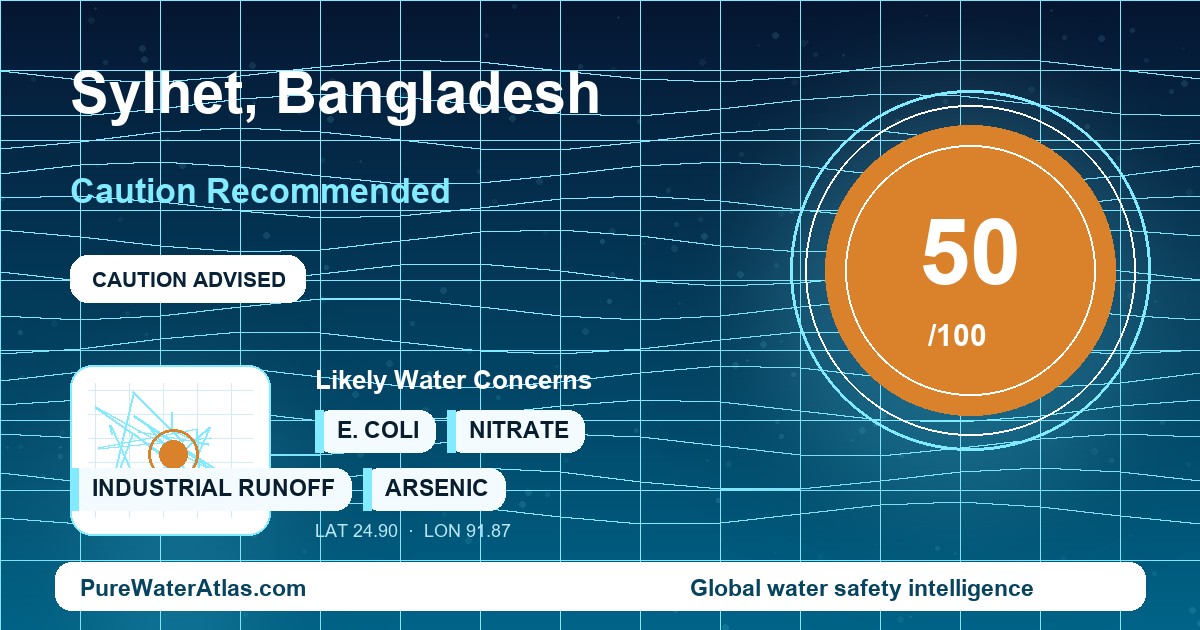
Sylhet, Bangladesh: municipal groundwater-based supply, monsoon and flood-related contamination risks, limited public tap-water reporting, and practical guidance for visitors and residents.
Quick Answer
| Overall safety status | Caution recommended. Sylhet has a municipal water-supply system, but publicly accessible city-level compliance data are limited. Practical risk depends strongly on distribution integrity, household storage tanks, intermittent pressure, monsoon flooding, and building plumbing. |
|---|---|
| Water safety score | 50 / 100 — Risk level: Caution Recommended. |
| Can tourists drink the tap water? | Not recommended untreated. Visitors should use sealed bottled water, properly boiled water, or water treated by a reliable purifier. |
| Resident guidance | Residents should treat drinking water at the point of use unless they have recent, credible test results from their actual tap and storage tank. |
| Main water source | Sylhet city drinking water is understood to rely primarily on municipal groundwater production wells and deep tube wells, with public-sector references also indicating surface-water treatment capacity associated with the Surma River and the Kushighat area. |
| Water authority | Sylhet City Corporation, with national technical support and sector context from the Department of Public Health Engineering. |
| Filter recommendation | For most households: sediment control plus boiling or UV for microbial risk. Test private or uncertain wells before choosing treatment for arsenic, iron, manganese, nitrate, or lead. |
Why Sylhet Is Different
Sylhet is not a city where tap-water safety can be judged by source water alone. It sits in northeastern Bangladesh on and around the Surma River, in a very high-rainfall region close to haor wetlands, tea-growing areas, and flash-flood-prone catchments draining from the Meghalaya hills. That local geography matters because heavy monsoon rainfall and flash floods can increase turbidity, affect drains and sanitation infrastructure, and create short-term contamination pressure on wells, tanks, low-lying pipes, and household storage systems.
The city’s main practical risk is therefore a combination of municipal supply uncertainty and last-mile water handling. Even if water is pumped from relatively protected deep groundwater, bacteria can be reintroduced through intermittent supply, low pressure, leaking pipes, cross-connections with drains, uncovered storage tanks, dirty rooftop tanks, or poorly cleaned household containers. In hotels and apartments, the water reaching the bathroom tap may reflect the condition of the building’s underground reservoir or rooftop tank as much as the quality of the incoming municipal supply.
Bangladesh also has a nationally significant history of arsenic in groundwater. Sylhet is not usually identified as one of the worst national arsenic hot spots compared with some southwest and central alluvial delta areas, but that does not make every private tube well or undocumented groundwater source safe. In Sylhet, the safest position is to treat microbial risk seriously and verify groundwater chemistry by testing where the source is private, shallow, old, or poorly documented.
Where Does Sylhet’s Tap Water Come From?
Sylhet city drinking water is understood to rely primarily on groundwater production wells and deep tube wells operated through the municipal water-supply system. Public-sector infrastructure references also indicate water treatment and pumping infrastructure associated with the Surma River area, including the Kushighat side of the city. Because public operating data are limited, PureWaterAtlas characterizes Sylhet as a municipal system based mainly on groundwater, with supplemental, project-linked, or planned surface-water treatment infrastructure rather than a fully transparent single-source system.
This distinction is important. Groundwater may be less exposed to immediate surface pollution than untreated river or pond water, but it can still contain naturally occurring or aquifer-related contaminants such as iron, manganese, or arsenic depending on local conditions. Surface-water treatment capacity, where used, must manage turbidity and microbial contamination, especially during monsoon periods. Publicly available information does not support a claim that every neighborhood receives the same mix of sources or the same finished-water quality at all times.
Like many Bangladeshi cities outside the largest WASA service areas, Sylhet historically depended heavily on tube wells, private wells, and smaller local supply arrangements. The surrounding river and pond environment is part of the city’s water context, but untreated surface water is vulnerable to microbial contamination and turbidity, particularly during flooding. For drinking, the most relevant question is not simply “groundwater or river water?” but “what reaches this exact tap after pumping, distribution, storage, and building plumbing?”
Who Manages Drinking Water in Sylhet?
Sylhet is served locally by Sylhet City Corporation, the municipal body responsible for urban services including city water-supply functions. The city is not served by Dhaka WASA or Chattogram WASA. For national technical support, standards implementation context, groundwater safety, arsenic-safe water programs, and municipal water-supply development outside the main WASA cities, the key agency is the Department of Public Health Engineering under the Ministry of Local Government, Rural Development and Cooperatives.
The broader government context includes the Local Government Division, which is the parent government division for local-government water and sanitation services, including city corporations and DPHE. Bangladesh drinking-water quality is governed nationally through public-health and environmental standards and implemented through local institutions, DPHE support, and public-sector projects.
A major limitation for Sylhet is transparency of routine tap-water data. Some official information exists on municipal governance and Bangladesh water-supply institutions, and development project documents provide infrastructure context. However, routine Sylhet tap-water quality results, residual chlorine data, microbial testing results, and neighborhood-level performance reports are not consistently published in an easily verifiable format comparable to annual consumer confidence reports in some countries. This page therefore does not claim that all Sylhet tap water either meets or fails a specific legal standard; it gives a risk-based drinking-water safety assessment using the available evidence.
Main Local Water Concerns
- Microbial contamination: The most practical concern for untreated tap water in Sylhet is gastrointestinal illness risk from bacteria introduced through intermittent supply, low pressure, pipe leaks, floodwater intrusion, household storage tanks, or poor point-of-use hygiene. Learn more about E. coli in drinking water and why a clear-looking sample can still be unsafe.
- Monsoon turbidity and sediment: Heavy rainfall and flash flooding can increase suspended sediment, drainage backflow, and short-term contamination risk. Turbidity can also reduce the effectiveness of disinfection if not controlled. See turbidity in drinking water.
- Iron and manganese: These are plausible groundwater-quality issues in Bangladesh aquifers and can cause reddish water, blackish deposits, metallic taste, staining, or filter clogging. Their health relevance depends on measured concentration. See iron and manganese.
- Arsenic in groundwater: Sylhet is not generally cited among the worst arsenic districts nationally, but Bangladesh’s groundwater arsenic history means private wells and undocumented tube wells should not be assumed safe without testing. See arsenic in drinking water.
- Nitrate and sanitation influence: Nitrate and microbial contamination can occur where shallow groundwater or surface water is affected by septic systems, drains, livestock, sanitation, or agricultural runoff.
- Lead from building plumbing: Lead is mainly a premise-plumbing risk, not a confirmed citywide Sylhet source-water issue. Older buildings, brass fittings, soldered joints, or unknown metal pipes can contribute if present. See lead in drinking water.
- Salinity: Salinity is not the dominant Sylhet concern because the city is inland and northeastern, unlike coastal districts of Bangladesh.
For Travelers
Visitors should not assume untreated tap water is safe to drink in Sylhet. For short stays, tolerance to local microbes is low, and the practical risk is gastrointestinal illness from variable microbial quality, storage tanks, and food-water handling. Use sealed bottled water, properly boiled water, or water treated by a reliable purifier for drinking.
Use bottled, boiled, or filtered water for brushing teeth, especially for children, pregnant travelers, immunocompromised travelers, and anyone with a sensitive stomach. Avoid ice unless you know it was made from treated water in a reputable hotel or restaurant. Street-vendor ice and unlabeled ice should be treated as unsafe.
In hotels and restaurants, do not assume bathroom tap water is potable. Higher-end hotels may provide filtered or bottled water, but ask whether drinking water is bottled, boiled, UV-treated, or RO-treated. Check that bottled-water seals are intact. Avoid raw foods washed in untreated tap water if hygiene is uncertain, and switch immediately to bottled or boiled water if water is cloudy, contains sediment, has a sewage odor, or follows flooding or pipe repair. Carry oral rehydration salts during hot or monsoon conditions.
For Residents
For most Sylhet households, point-of-use treatment is advisable for drinking water unless recent, credible test results show that the actual tap and storage tank are safe. A practical household setup is sediment prefiltration followed by boiling or UV for microbial risk. Boiling is especially useful after flooding, pipe repairs, visible discoloration, or any suspected contamination event. See the PureWaterAtlas boiling water purification guide and UV water purification guide.
Reverse osmosis can help with several dissolved contaminants, but it must be maintained and is not a substitute for hygienic storage. If a household uses a private well, building well, or any groundwater source with unknown chemistry, testing should come before treatment selection. Arsenic, iron, manganese, nitrate, and lead require different treatment decisions than microbial contamination.
Older buildings can add risk through corroded internal pipes, contaminated underground reservoirs, old valves, brass fittings, or stagnant plumbing. Let water run briefly after long stagnation, do not use first-draw hot water for drinking, and test for lead if metal plumbing is suspected. Storage tanks should be covered, screened from insects and rodents, cleaned on a schedule, and disinfected after flooding or contamination. A clean municipal supply can become unsafe if stored in a dirty rooftop tank, underground reservoir, or household container.
Relevant Contaminants and Water-Quality Issues
The most relevant Sylhet drinking-water issue is microbial safety at the point of use. Start with E. coli because it directly relates to fecal contamination, storage tanks, drains, floodwater, and intermittent supply. During monsoon periods or after flooding, turbidity matters because sediment can signal runoff influence and can interfere with disinfection.
For groundwater and private wells, review arsenic, iron, and manganese. These contaminants cannot be judged reliably by taste alone, and arsenic in particular requires testing. For old apartments, hotels, or buildings with unknown plumbing, lead is a premise-plumbing concern rather than a proven citywide source-water problem.
How to Verify Your Water Quality
Because Sylhet-specific public tap-water compliance reporting is limited, the most reliable answer comes from testing the water people actually drink. Test for E. coli or thermotolerant coliforms at the drinking point, not only at a source or pump. Also test stored water from rooftop tanks or underground reservoirs, because tanks can be a larger risk than the incoming supply.
Private wells and building wells should be tested for arsenic before use for drinking or cooking. Add iron and manganese if water is reddish, blackish, metallic-tasting, staining fixtures, or clogging filters. Add nitrate if the source is shallow or near septic systems, drains, livestock, or agricultural land. Test lead if the building is old or has unknown metal pipes, brass fixtures, soldered joints, or water sits overnight in plumbing.
Use the PureWaterAtlas complete water testing guide, the arsenic testing guide, the lead testing guide, and the nitrate testing guide. For broader context, compare locations with the Global Water Quality Checker and look up specific substances in the Contaminants Search Engine. For general decision-making, see Drinking Water Safety, Water Microbiology, and Water Purification.
Official and Technical Sources
- Sylhet City Corporation — official local municipal authority for city services including water-supply functions.
- Department of Public Health Engineering, Government of Bangladesh — national technical agency for safe water supply and sanitation outside the main WASA cities.
- Local Government Division, Ministry of Local Government, Rural Development and Cooperatives — government division for local-government water and sanitation services.
- CDC Travelers’ Health — Bangladesh — traveler guidance supporting caution with food and water hygiene.
- WHO Guidelines for Drinking-water Quality — international public-health framework for microbial and chemical water risk.
- WHO/UNICEF Joint Monitoring Programme — Bangladesh WASH service-level context; not a substitute for Sylhet tap-water testing.
- British Geological Survey arsenic groundwater research — scientific background on Bangladesh groundwater arsenic risk.
- Asian Development Bank Bangladesh urban water supply and sanitation project documents — context on secondary-town water-supply constraints and infrastructure investment.
Bottom Line
Sylhet tap water should be approached with caution for drinking. The city has a municipal supply associated mainly with groundwater wells and deep tube wells, with referenced surface-water treatment infrastructure near the Surma River and Kushighat area, but routine public tap-water quality reporting is limited. The main practical risk is microbial contamination introduced through intermittent distribution, flood exposure, household storage tanks, and building plumbing. Tourists should use sealed bottled, boiled, or reliably purified water, including for brushing teeth. Residents should treat drinking water at the point of use and test actual tap and tank water, especially after flooding, plumbing work, discoloration, or when using private wells. In Sylhet, the safest decision is based on verified household-level water quality, not assumptions about the municipal source.
Read the full guide: Global Water Quality Guide
Explore more in this category: Global Water Quality Articles