
Introduction
Safe drinking water is one of the most important foundations of public health. People use it every day for drinking, cooking, brushing teeth, preparing infant formula, making ice, and washing food. Because of this constant exposure, even low levels of contamination can matter over time. That is why drinking water safety standards testing plays such a central role in water quality management. Testing helps determine whether water meets established limits for microbes, chemicals, metals, and physical characteristics that can affect safety, taste, odor, and usability.
Modern water safety programs rely on more than a single test or a quick visual check. Water that looks clear may still contain bacteria, lead, nitrates, pesticides, or other contaminants. Conversely, water with an unusual taste may not always pose a serious health threat, but it still deserves evaluation. Effective assessment combines careful sampling, field screening, laboratory confirmation, trend analysis, and interpretation against national or regional standards.
For homeowners, schools, businesses, utilities, and regulators, understanding how testing works is essential. The quality of a result depends on the contaminant being measured, the method used, the sampling conditions, and the skill of the people collecting and analyzing the sample. Questions about drinking water safety standards accuracy and the meaning of drinking water safety standards test results are common, especially when comparing home kits with certified laboratory reports.
This article explains what water safety standards are, where contaminants come from, why they matter to health, and how testing and detection methods are used in practice. It also discusses prevention, treatment, common misunderstandings, and the regulatory framework that supports safe water systems. Readers seeking broader background can also explore drinking water safety resources, the complete guide to water safety standards, and related information in water science.
What It Is
Drinking water safety standards are formal benchmarks used to determine whether water is acceptable for human consumption. These standards set allowable levels, treatment requirements, monitoring frequencies, and action thresholds for a wide range of contaminants and quality indicators. They are developed by governments, public health agencies, scientific bodies, and standards organizations based on toxicology, microbiology, exposure science, and epidemiology.
In practical terms, a standard answers questions such as:
- How much arsenic, lead, nitrate, or fluoride is acceptable in drinking water?
- Should pathogens such as E. coli or coliform bacteria be present at all?
- How often should a public water system test for regulated contaminants?
- What treatment or corrective action is required if contamination is found?
- How should samples be collected, preserved, transported, and analyzed?
Standards usually address several categories of water quality:
- Microbiological contaminants: bacteria, viruses, protozoa, and indicator organisms.
- Chemical contaminants: pesticides, solvents, industrial chemicals, disinfection byproducts, and naturally occurring compounds.
- Inorganic contaminants: metals and minerals such as lead, arsenic, copper, mercury, nitrate, and chromium.
- Radiological contaminants: radionuclides such as uranium and radium.
- Aesthetic and operational parameters: pH, hardness, turbidity, color, odor, iron, manganese, and total dissolved solids.
Not every parameter affects health in the same way. Some are linked directly to illness, cancer risk, developmental harm, or acute toxicity. Others are mainly indicators of treatment performance or water acceptability. Turbidity, for example, may not always be dangerous by itself, but it can indicate particles that shield microorganisms from disinfectants. pH may not usually be the primary health concern, yet it strongly influences corrosion and the release of metals from plumbing.
Testing is the process used to evaluate compliance with these standards. The phrase drinking water safety standards testing therefore refers not just to detecting contaminants, but also to verifying whether the measured levels fall above or below relevant limits. This is important because detection alone does not automatically indicate a violation or a health emergency. Context matters: the contaminant, the concentration, the duration of exposure, and the population exposed all affect risk.
Homeowners and private well users often focus on drinking water safety standards home testing as an initial step. These tests can be helpful for screening, but they are not always sufficient for compliance-grade decisions. Utilities and health agencies more often rely on drinking water safety standards lab analysis performed by accredited laboratories using validated methods and quality control procedures.
Main Causes or Sources
Drinking water contamination can enter the water supply at the source, during treatment, in storage, or as water travels through distribution systems and household plumbing. Understanding these sources is essential for deciding what to test for and when. A more detailed overview is available in this resource on causes and sources of drinking water contamination.
Natural Sources
Some contaminants occur naturally in soil, rock, and groundwater. These include arsenic, fluoride, iron, manganese, uranium, radon, and hardness minerals such as calcium and magnesium. Groundwater moving through certain geologic formations can dissolve these substances and carry them into wells. Nitrate may also accumulate naturally in some environments, although human activities are often the larger contributor.
Agricultural Activities
Farming can affect both surface water and groundwater. Fertilizers contribute nitrates and phosphates, while manure may introduce bacteria, viruses, and parasites. Pesticides and herbicides can also reach water sources through runoff, drift, or infiltration. Seasonal rains, irrigation patterns, and local soil conditions influence how rapidly these contaminants move.
Industrial and Commercial Pollution
Manufacturing sites, mining operations, landfills, fuel storage areas, dry cleaners, and chemical handling facilities can release metals, solvents, petroleum compounds, and persistent organic pollutants. Even where direct discharges are controlled, legacy contamination from older industrial practices may remain in soil and groundwater for decades.
Municipal Waste and Wastewater
Sewage overflows, failing septic systems, wastewater discharges, and stormwater runoff can all introduce microbial pathogens and chemical contaminants into source waters. In densely populated areas, pharmaceuticals and personal care product residues may also be detected, usually at very low concentrations but of ongoing scientific interest.
Distribution System Problems
Water that leaves a treatment plant in good condition can deteriorate later. Aging pipes, broken mains, low pressure events, cross-connections, backflow incidents, and biofilm growth can compromise safety. Corrosion is especially important because it can release lead and copper from plumbing materials. This is one reason first-draw and flushed samples may both be needed, depending on the concern being investigated.
Household Plumbing and Fixtures
Contamination may originate inside a building rather than in the public supply. Lead solder, brass fixtures, copper plumbing, water heaters, softeners, filters that are poorly maintained, and stagnant water in rarely used lines can all alter water quality at the tap. Private wells are especially vulnerable when construction, sealing, drainage, or maintenance are inadequate.
Extreme Weather and Environmental Change
Floods, droughts, wildfires, and heavy storms can increase sediment, organic matter, microbial loading, and chemical runoff. Drought can concentrate contaminants in limited supplies, while wildfire ash and debris may affect source waters and treatment operations. Climate-related changes make robust monitoring programs even more important.
Health and Safety Implications
The health effects of unsafe drinking water depend on the contaminant, dose, route of exposure, and length of time people are exposed. Some effects appear quickly, while others develop slowly over months or years. Children, infants, pregnant people, older adults, and people with weakened immune systems are often more vulnerable. More detail can be found in this guide to health effects and water quality risks.
Microbial Risks
Pathogens in drinking water can cause acute illness, often affecting the gastrointestinal system. Common symptoms include diarrhea, vomiting, cramps, fever, and dehydration. Organisms of concern include E. coli, Salmonella, Campylobacter, Giardia, and Cryptosporidium. Viral contamination may also occur. In healthy adults these illnesses may be temporary, but in vulnerable groups they can become severe or even life-threatening.
Chemical and Metal Exposure
Chemicals often raise concern because they may not produce immediate symptoms. Instead, they can be associated with long-term outcomes such as neurological effects, developmental problems, endocrine disruption, kidney damage, cardiovascular impacts, or increased cancer risk. Lead is a well-known example because even relatively low exposure can affect brain development in children. Arsenic is associated with skin, cardiovascular, and cancer risks. Nitrate can be particularly dangerous for infants because it can interfere with oxygen transport in the blood.
Radiological Concerns
Some regions have naturally occurring radioactive substances in groundwater. Long-term exposure to elevated radionuclides may increase cancer risk and can also affect specific organs depending on the isotope involved. Because these contaminants are invisible and tasteless, testing is the only reliable way to identify them.
Aesthetic Indicators and Indirect Risks
Taste, smell, color, and cloudiness are not always direct health measures, but they can still be important. Unpleasant water may discourage adequate consumption or signal treatment or plumbing issues. Turbid water, for instance, can indicate suspended particles and may suggest increased contamination risk. Rotten-egg odor can point to hydrogen sulfide or anaerobic conditions, while blue-green staining may be linked to corrosive water affecting copper pipes.
Because many dangerous contaminants have no obvious sensory signs, relying on appearance alone is unsafe. This is a key reason why structured drinking water safety standards testing is necessary.
Testing and Detection
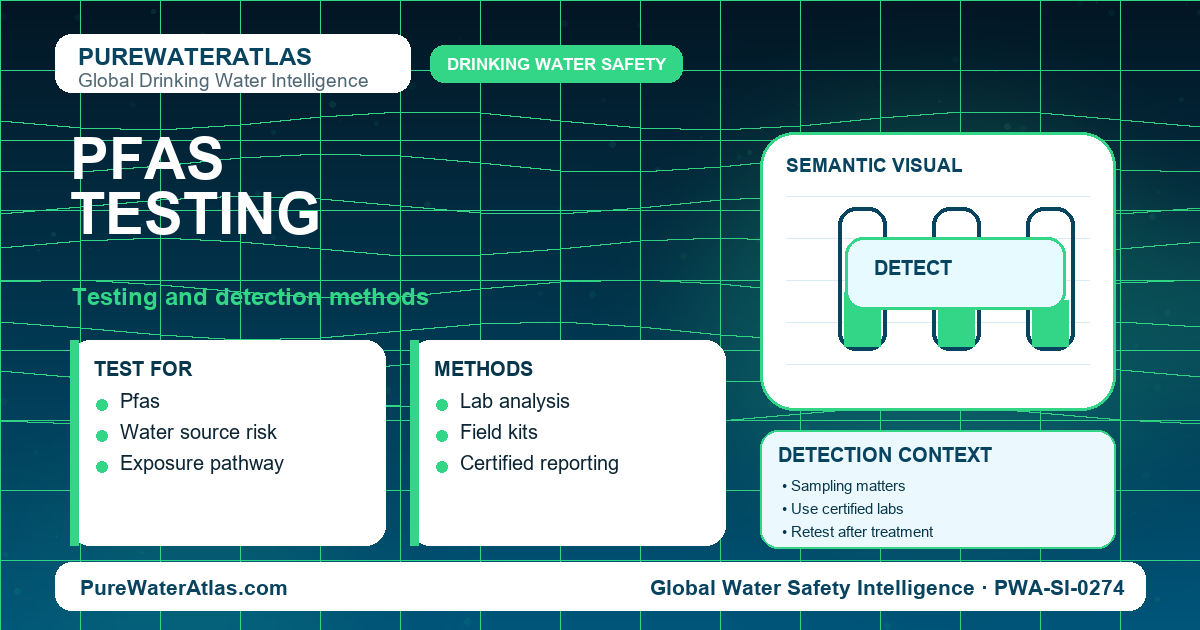
Testing and detection methods are the practical tools used to determine whether drinking water meets established safety benchmarks. These methods range from simple field strips to advanced laboratory instruments capable of measuring contaminants at parts-per-billion or even parts-per-trillion levels. The right method depends on the target contaminant, the reason for testing, the required sensitivity, and the consequences of the result.
Why Testing Is Necessary
Water quality can change over time. Seasonal weather, land use, source water variation, maintenance work, plumbing changes, and treatment failures can all affect results. Routine monitoring is therefore essential, not just one-time testing. Public water systems often follow scheduled monitoring plans, while private well owners should test at intervals based on local risk factors and household circumstances.
Categories of Testing Methods
- Field screening: rapid, portable methods used on site for parameters such as chlorine residual, pH, conductivity, temperature, nitrate, and sometimes bacteria indicators.
- Home test kits: consumer products designed to screen for selected contaminants. These are common for hardness, pH, iron, nitrates, lead, and total coliform presence-absence.
- Certified laboratory analysis: formal testing using standardized methods, instrumentation, calibration, blanks, controls, and documented quality assurance.
- Continuous monitoring: online sensors for utilities that track turbidity, chlorine, pH, conductivity, and other treatment-related indicators in real time.
Common Parameters and How They Are Measured
Microbiological testing often relies on culture-based methods, enzyme substrate tests, membrane filtration, or molecular methods. Total coliform and E. coli are widely used as indicator organisms. Their presence suggests that pathogens may be entering the water or that treatment and distribution integrity need attention.
Metals testing such as lead, copper, arsenic, and chromium is commonly performed with techniques like inductively coupled plasma mass spectrometry or atomic absorption spectroscopy. These methods offer high sensitivity and are usually part of drinking water safety standards lab analysis.
Nutrients and inorganic chemicals including nitrate, nitrite, fluoride, sulfate, and chloride are analyzed using ion chromatography, colorimetric methods, or selective electrodes, depending on the parameter.
Organic chemical analysis for pesticides, volatile organic compounds, and industrial contaminants often requires gas chromatography or liquid chromatography, usually paired with mass spectrometry.
Physical and operational parameters such as turbidity, pH, conductivity, temperature, and residual disinfectant are measured with probes, meters, turbidimeters, and portable field instruments.
Home Testing Versus Laboratory Analysis
Drinking water safety standards home testing is useful for preliminary screening, routine homeowner awareness, and identifying obvious changes. Home kits are widely available, relatively inexpensive, and easy to use. However, they have limitations:
- They may provide only approximate ranges rather than exact concentrations.
- They may be more prone to user error.
- They may not detect contaminants at low but still important levels.
- They may not be recognized for regulatory compliance or legal documentation.
- They often test fewer contaminants than a full lab panel.
By contrast, drinking water safety standards lab analysis offers greater sensitivity, better quality control, and more defensible documentation. Accredited labs use validated analytical methods, standardized calibration, detection limit reporting, chain-of-custody procedures, and repeatable quality assurance practices. For contaminants such as lead, arsenic, pesticides, volatile organics, PFAS, and radiological parameters, laboratory analysis is generally the preferred option.
Sampling Methods Matter
One of the most overlooked factors in water quality evaluation is sample collection. Poor collection can produce misleading results, even when laboratory analysis is excellent. Proper drinking water safety standards sampling methods are therefore essential.
Key considerations include:
- Location: source water, treatment plant, distribution point, kitchen tap, bathroom tap, or wellhead may yield different results.
- Timing: samples may need to be collected after stagnation, after flushing, during peak use, after rainfall, or during a suspected contamination event.
- Container type: sterile bottles are used for microbiology; preserved containers may be required for metals or organics.
- Preservation: some samples need acidification, cooling, or chemical preservatives to prevent changes before analysis.
- Holding time: many contaminants must be analyzed within specified time windows.
- Avoiding contamination: dirty hands, rinsing bottles incorrectly, touching the inside of caps, or sampling from dirty faucets can alter the result.
Examples of Sampling Approaches
First-draw sampling is often used for lead because water that sits in plumbing can dissolve metals from pipes and fixtures. Flushed sampling may help evaluate water coming from the service line or main rather than stagnant indoor plumbing. Grab samples represent a single moment in time, while composite samples combine multiple samples to estimate average conditions over a period.
For microbiological testing, sterile technique is critical. Aerators may need to be removed, the tap may or may not be disinfected depending on protocol, and the sample must usually be kept cool and delivered promptly. For volatile chemicals, containers must be filled carefully to avoid air bubbles because some compounds can escape from the water before analysis.
Accuracy, Precision, and Detection Limits
When people ask about drinking water safety standards accuracy, they are often referring to whether the result can be trusted. In analytical science, several concepts are relevant:
- Accuracy: how close a measured value is to the true value.
- Precision: how close repeated measurements are to one another.
- Detection limit: the lowest concentration a method can reliably detect.
- Quantitation limit: the lowest level that can be measured with acceptable confidence.
- Specificity: how well a method measures the target contaminant without interference.
Accurate testing depends on validated methods, proper calibration, reference standards, blank samples, duplicates, matrix spikes, and instrument maintenance. But it also depends on representative sampling. A highly accurate laboratory test cannot correct for a poorly chosen sample location or improper storage during transport.
Interpreting Test Results
Drinking water safety standards test results should always be interpreted in context. A report typically includes the analyte tested, the measured concentration, the unit of measurement, the detection or reporting limit, the analytical method, and sometimes the applicable standard or guideline value.
Important interpretation questions include:
- Is the contaminant detected above or below the regulatory limit?
- Was the sample representative of normal water use conditions?
- Was the result confirmed with repeat testing if needed?
- Does the contaminant pose an acute or chronic risk?
- Are sensitive populations present in the household?
- Does the finding point to the source water, treatment process, or plumbing system?
Results near a standard limit may justify repeat sampling, especially if contamination is variable. A single non-detect does not always prove that a contaminant is permanently absent, and a single high result may need confirmation depending on the circumstances. Trend analysis over time is often more informative than isolated values.
Prevention and Treatment
The best approach to drinking water safety is prevention first, treatment second. Preventing contamination is generally more reliable and cost-effective than trying to remove it after the fact.
Source Protection
- Protect watersheds, aquifers, and recharge zones from pollution.
- Manage agricultural runoff through buffer zones and nutrient controls.
- Inspect septic systems and prevent wastewater leaks.
- Control industrial discharges and hazardous waste handling.
- Monitor areas affected by mining, landfills, or chemical storage.
Distribution and Plumbing Controls
- Maintain adequate disinfectant residuals where appropriate.
- Prevent cross-connections and backflow events.
- Replace aging infrastructure and lead-containing components.
- Use corrosion control strategies to reduce metal leaching.
- Flush stagnant lines after plumbing work or prolonged non-use.
Household and Point-of-Use Treatment
Treatment should match the contaminant. No single device removes everything. Common options include:
- Activated carbon: useful for improving taste and odor and removing some organic chemicals.
- Reverse osmosis: effective for many dissolved solids, nitrates, arsenic, and some metals, depending on system design.
- Ion exchange: often used for hardness, nitrate, or selected metals.
- Distillation: can remove many dissolved contaminants but is energy intensive.
- Ultraviolet disinfection: effective against many microorganisms when water is sufficiently clear.
- Oxidation and filtration: useful for iron, manganese, and hydrogen sulfide in some applications.
Filters and treatment systems must be certified for the contaminants of concern and maintained according to manufacturer instructions. A neglected filter can become ineffective or even worsen water quality.
Follow-Up Testing After Treatment
Testing should not stop once a treatment system is installed. Post-treatment sampling is needed to verify performance and ensure the system continues to meet goals over time. This is especially important for private wells and household devices.
Common Misconceptions
If Water Looks Clear, It Is Safe
This is false. Many hazardous contaminants are colorless, odorless, and tasteless. Lead, nitrate, arsenic, and many microbes cannot be reliably detected by sight or smell.
Home Test Kits Are Always Enough
Home kits can be valuable screening tools, but they do not replace certified lab analysis for all contaminants. They are best viewed as part of a broader testing strategy rather than the final answer in every situation.
Municipal Water Never Needs Additional Testing
Public water systems are monitored, but water can change inside buildings due to plumbing materials, stagnation, or maintenance issues. Tap-specific concerns, especially lead and copper, may still require testing at the point of use.
Boiling Water Solves All Problems
Boiling can kill many microorganisms, but it does not remove metals, nitrates, salts, or most chemical contaminants. In fact, boiling can concentrate some dissolved substances as water evaporates.
A Single Good Result Means Permanent Safety
Water quality is dynamic. Seasonal changes, land use, flooding, plumbing repairs, and source shifts can all affect quality. Ongoing monitoring is often needed.
All Standards Are the Same Everywhere
Different countries and jurisdictions may use different limits, monitoring schedules, and risk management approaches. However, many are built on similar health evidence and water safety principles. Additional perspectives can be found in global water quality resources.
Regulations and Standards
Drinking water regulations are designed to translate science into enforceable action. They define contaminant limits, treatment technique requirements, approved analytical methods, reporting obligations, and public notification procedures. Although terminology differs by country, common concepts include maximum contaminant levels, health-based guideline values, action levels, and treatment performance standards.
How Standards Are Developed
Regulators review toxicological studies, exposure assessments, epidemiological data, and feasibility considerations. They may establish a health-based goal and then set an enforceable standard that reflects both public health protection and practical implementation. For microbial contaminants, treatment performance requirements may be more important than a simple concentration limit because pathogens can be difficult to measure directly in routine operations.
Monitoring and Compliance
Public water systems are typically required to monitor at defined frequencies based on system size, source type, prior results, and contaminant category. Noncompliance may trigger corrective actions, public notices, boil water advisories, corrosion control reviews, or infrastructure upgrades. Laboratories performing compliance testing generally need certification or accreditation for the methods they use.
Private Wells and Non-Regulated Supplies
Private wells often fall outside the full regulatory framework applied to public systems, which means the owner is usually responsible for testing and maintenance. This makes education especially important. Well owners should assess local risks, test regularly, and keep records of all findings and corrective actions.
Why Standardized Methods Matter
Regulations do not just define acceptable contaminant levels. They also specify how testing should be conducted. Standardized methods help ensure consistency across jurisdictions and over time. Without consistent drinking water safety standards sampling methods and analytical protocols, comparing results would be difficult and enforcement would be less reliable.
For readers who want a broader overview of standards, compliance, and terminology, the complete guide to drinking water safety standards provides additional context.
Conclusion
Safe drinking water depends on science, monitoring, infrastructure, and informed interpretation. Drinking water safety standards testing is the process that turns broad public health goals into measurable evidence. It helps identify invisible risks, verify treatment performance, guide corrective action, and protect communities from both immediate and long-term harm.
Understanding the difference between screening and confirmation, between field checks and drinking water safety standards lab analysis, and between poor and proper drinking water safety standards sampling methods is essential for making sense of water quality information. Equally important is recognizing the limits of any single result. Reliable conclusions come from good sampling, validated methods, awareness of drinking water safety standards accuracy, and careful review of drinking water safety standards test results against applicable health benchmarks.
Whether the setting is a large public utility, a school, a food service business, or a private home well, the same principle applies: testing is most effective when it is routine, targeted, and followed by action. For continued learning, readers can explore the broader drinking water safety category and related topics in water science. In a world where many water threats cannot be seen, trusted testing remains one of the most important tools for protecting health.
Read the full guide: Drinking Water Safety Guide
Explore more in this category: Drinking Water Safety Articles
Great