
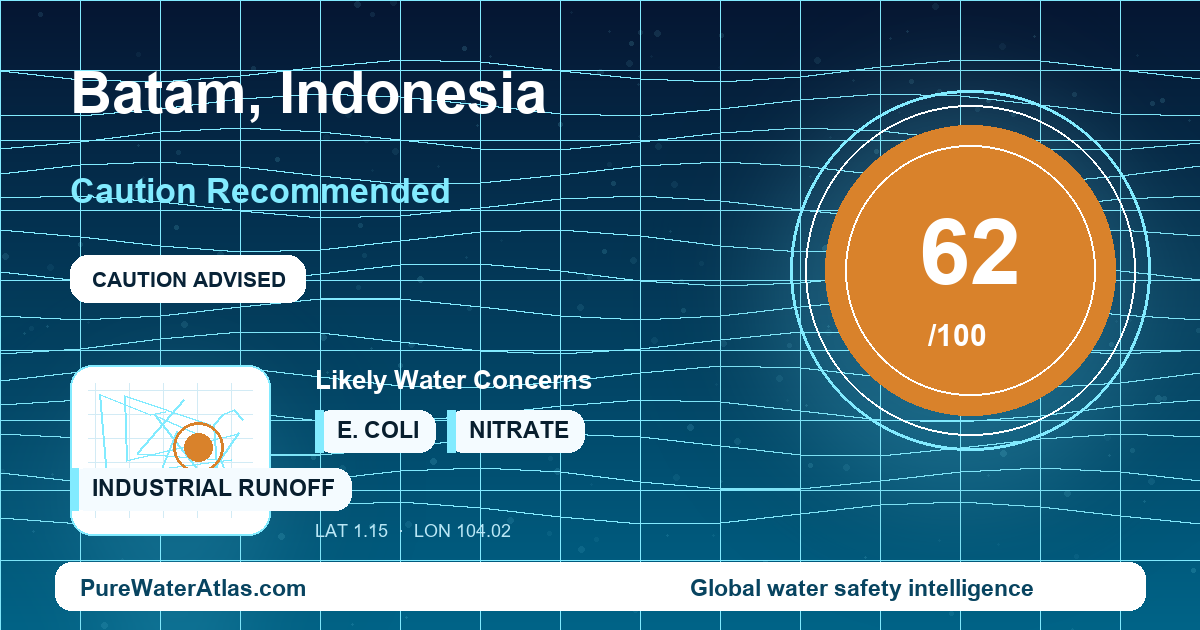
Batam has a treated island water-supply system built around rain-fed reservoirs, but drinking straight from the tap is not the safest default because final quality can be affected by reservoir stress, turbidity, pressure changes, internal plumbing, and building storage tanks.
Quick Answer
| Water safety score | 62 / 100 |
|---|---|
| Risk level | Caution Recommended |
| Can visitors drink the tap water? | Not recommended straight from the tap. Use sealed bottled water, properly boiled water, or water from a trusted hotel filtration system. |
| Resident guidance | Municipal water can be used as treated utility water, but drinking water should normally be boiled or treated, especially where storage tanks, older plumbing, intermittent pressure, or visible sediment are present. |
| Main water source | Rain-fed surface-water reservoirs and dams on Batam Island, including Duriangkang, Muka Kuning, Sei Ladi, Sei Harapan, Nongsa, and Tembesi. |
| Main authority | BP Batam through the Batam drinking-water supply system, commonly referred to as SPAM Batam, with downstream customer-facing service associated with Air Batam Hilir. |
| Filter recommendation | For drinking, use a maintained treatment step. A practical home setup is sediment prefiltration plus activated carbon, with boiling, UV, ultrafiltration, or reverse osmosis when microbial or dissolved-contaminant concerns exist. |
Batam is not a city where the safest advice is simply “drink from any tap.” The city has organized treated piped water, but the conservative choice is to treat the water at the point of use or use sealed bottled water. The key issue is not one confirmed citywide contaminant; it is the combination of reservoir dependence, operational variability, building tanks, internal plumbing, and limited public tap-water data by neighborhood and parameter.
Why Batam Is Different
Batam’s water profile is shaped by geography. It is a densely developed island city in the Riau Islands close to Singapore and Johor, but it does not have a large perennial mainland river system. Its drinking-water security depends heavily on local rainfall captured in reservoirs. That makes the city’s raw-water situation different from many mainland cities with larger river basins or abundant groundwater options.
This reservoir dependence matters for practical drinking-water safety. During extended dry weather or El Nino-type conditions, lower reservoir levels can put pressure on raw-water availability and service continuity. During heavy rain, runoff into reservoirs can contribute to higher turbidity. After pipe repairs, outages, or pressure changes, consumers may notice discoloration, air, or sediment at the tap. Those conditions do not prove that every tap is unsafe, but they are exactly why point-of-use caution is recommended in Batam.
Another Batam-specific factor is building-level storage. Hotels, apartments, boarding houses, shops, and homes may use roof tanks or ground tanks. Two buildings connected to the same municipal supply can deliver different water at the tap if one has a clean, covered, well-maintained tank and the other has a neglected tank, old fittings, or stagnant internal plumbing. In Batam, the final glass of water is often determined not only by the municipal system, but also by the building.
Where Does Batam’s Tap Water Come From?
Batam is supplied mainly by rain-fed surface-water reservoirs and dams on the island. Key reservoirs commonly associated with the SPAM Batam system include Duriangkang, Muka Kuning, Sei Ladi, Sei Harapan, Nongsa, and Tembesi. Duriangkang is widely treated as the principal strategic reservoir in the city’s raw-water system.
The core infrastructure includes rainfall-catchment reservoirs and dams, water treatment plants connected to the SPAM Batam system, transmission mains, distribution networks, and customer-side storage tanks. These networks serve residential, commercial, industrial, port, and tourism areas. Reservoir-level management and operational monitoring are central because the city’s supply is strongly tied to local rainfall and storage conditions.
Batam does have treated piped water. However, a treated municipal connection should not be interpreted as a guarantee that water is potable at every point of use. Water may pass through long distribution networks, experience pressure changes, and then sit in a private building tank before reaching a kitchen, bathroom, hotel room, or restaurant sink. Poorly maintained tanks can introduce sediment, odor, microbial regrowth, insects, animals, or other contamination risks. For drinking, the practical safety question is therefore: what happened to the water after central treatment?
Who Manages Drinking Water in Batam?
The main institutional authority for Batam’s drinking-water supply is BP Batam, Badan Pengusahaan Batam. The city’s drinking-water supply system is commonly referred to as SPAM Batam. Customer-facing downstream service has been associated with Air Batam Hilir, while BP Batam remains central to asset, raw-water, and system governance.
Batam’s modern piped-water system developed under the city’s industrial and free-trade-zone growth model. For many years, the private concessionaire ATB, Adhya Tirta Batam, operated the water system under a long concession that ended in 2020. Since then, BP Batam and SPAM Batam arrangements have been central to system management, with new upstream and downstream operational structures.
National drinking-water quality in Indonesia is governed by Ministry of Health standards, including Permenkes No. 2 Tahun 2023. For consumers, the important limitation is transparency: Batam has identifiable reservoirs, infrastructure, and institutions, but publicly accessible routine tap-water quality results by neighborhood, treatment plant, and parameter are limited. This page should not be read as a claim that every municipal sample meets or fails any specific standard. The main uncertainty is final point-of-use quality, especially after private tanks, old internal plumbing, local pressure events, and hotel or apartment filtration systems.
Main Local Water Concerns
Reservoir dependence and drought vulnerability: Batam’s water supply is tied to reservoir storage. Extended dry weather or El Nino-type drought can reduce reservoir levels and increase pressure on raw-water availability. In dry periods, residents should pay closer attention to official service announcements, storage hygiene, pressure changes, and any change in taste or appearance.
Turbidity and sediment: Heavy rain, runoff into reservoirs, distribution work, and pipe disturbance can increase suspended solids or cause discolored water at the tap. Do not drink water that is cloudy, brown, or visibly particle-filled without treatment and investigation. Letting water run until clear may help after minor disturbance, but it does not replace treatment when microbial safety is uncertain.
Microbial risk at the point of use: Even when water is treated centrally, microbial risk can increase if pressure is intermittent, pipes are depressurized, or water is stored in unclean building tanks. Boiling is a practical control when safety is uncertain, particularly for travelers, infants, pregnant people, immunocompromised people, and households with questionable storage conditions.
Chlorine taste or odor: A chlorine smell can occur in treated piped water and is not automatically a health hazard. Chlorine is used as a disinfectant in many treated systems. However, a strong, unusual, or chemical odor should be treated as a warning sign and reported to the relevant water-service channel.
Salinity and coastal raw-water sensitivity: Batam’s coastal island setting and reservoir system make salinity management a relevant raw-water issue, especially during low-water periods. Publicly available consumer tap-water data are not sufficient to make precise salinity claims by neighborhood. If water tastes salty or brackish, residents should consider testing total dissolved solids, chloride, and conductivity.
Old internal plumbing and private tanks: Metals, sediment, and bacterial regrowth are more likely to be building-specific issues than confirmed citywide problems. Older fittings, corroded pipes, poorly documented renovations, and neglected tanks should be treated as local risk factors.
For Travelers
Visitors to Batam should not drink tap water straight from the tap. Use sealed bottled water, properly boiled water, or water from a verified hotel filtration system. This is especially important for short stays because travelers do not have time to evaluate the building’s tank maintenance, pipe condition, or filtration reliability.
For brushing teeth, conservative travelers should use bottled or boiled water. This is particularly important if you are immunocompromised, pregnant, traveling with infants, or staying in budget accommodation where tank hygiene is uncertain. Some long-term residents may use tap water for brushing, but visitors should avoid swallowing untreated tap water.
Ice requires judgment. Ice in reputable hotels, chain restaurants, and busy established venues is usually lower risk if made from treated water, but avoid ice from street stalls or places where water handling is unclear. In hotels and restaurants, ask whether drinking water is filtered, boiled, or commercially bottled. Do not assume bathroom tap water in a hotel is potable; the final quality may depend on the hotel’s tanks, filters, and internal plumbing.
Carry sealed bottled water during the day, especially around ferry terminals, industrial areas, beaches, and during hot weather. If you must use tap water, bring it to a rolling boil or use a purifier designed for microbiological risks. A simple carbon taste-improving jug is not enough when microbial safety is uncertain. See PureWaterAtlas guidance on boiling water purification for practical treatment steps.
For Residents
Residents connected to SPAM Batam can generally treat municipal supply as utility water, but a home drinking-water treatment step is advisable. A practical setup is sediment prefiltration to reduce particles, activated carbon for taste and chlorine, and then boiling, UV, ultrafiltration, or reverse osmosis depending on the concern. Filter maintenance is essential. An old or neglected filter can become a contamination source rather than a safety barrier.
Testing is most important when the building has a roof tank or ground tank, pressure is intermittent, the water changes appearance, or plumbing has recently been repaired. Test for E. coli or total coliform if water is stored in a tank, after flooding, after a tank-cleaning event, or after pressure loss. Check turbidity, color, odor, and residual chlorine when water suddenly changes appearance or smell.
If the building is older, has unknown pipe materials, brass fittings, corroded components, or water that sits overnight in internal plumbing, consider testing for lead and other metals. Lead and metals are not presented here as confirmed citywide Batam problems; they are building-plumbing concerns that can occur locally. For households using non-municipal wells or trucked water, test microbiology, nitrate, salinity, iron, manganese, and basic chemistry before using that water for drinking.
Storage tanks deserve special attention in Batam. Tanks should be covered, screened against insects and animals, cleaned periodically, and protected from heat and contamination. If a tank has slime, odor, visible sediment, or has not been cleaned for a long time, do not drink that water without treatment. Flush stagnant water before use, especially in households with children, pregnant people, elderly residents, or immunocompromised residents.
Relevant Contaminants and Water-Quality Issues
The most relevant Batam issues are operational and point-of-use concerns rather than a single documented citywide contaminant. Turbidity is important because reservoir runoff, heavy rain, and pipe disturbance can make water cloudy or increase suspended solids. Sediment is relevant to discolored water, old pipes, and storage tank accumulation.
E. coli is a key testing marker when microbial contamination is suspected, especially after pressure loss or in buildings with storage tanks. Chlorine is relevant because treated piped water may have a chlorine taste or odor; this can reflect disinfection, though unusual odors should still be investigated. Lead is most relevant as a building-level plumbing issue in older or poorly maintained properties, not as a confirmed citywide Batam claim.
How to Verify Your Water Quality
The best way to know whether your specific Batam tap is safe is to test water at the point where you actually drink it: kitchen tap, dispenser outlet, hotel filtration outlet, or post-filter faucet. Citywide infrastructure information does not reveal what is happening inside your tank, pipes, or filter cartridges.
Use the PureWaterAtlas Water Testing guide to decide which parameters match your situation. If the water is cloudy or brown, prioritize turbidity, sediment, color, and residual chlorine. If the building uses tanks or has experienced pressure loss, prioritize microbiological testing. If the property is older or plumbing materials are unknown, review lead testing and detection methods.
For treatment choices, see the PureWaterAtlas guides to Water Treatment Systems, UV water purification, and boiling water purification testing and detection. You can also browse the Contaminants Search Engine or compare country and city risk context with the Global Water Quality Checker. For broader background, see Drinking Water Safety and Water Microbiology.
Official and Technical Sources
- BP Batam official website — institutional source for Batam’s water-supply authority, SPAM Batam context, reservoir and infrastructure references, and local water-supply announcements.
- SISDA BP Batam — official water-resources information context for Batam reservoirs and dam or water-resource monitoring.
- Air Batam Hilir official website — customer-facing utility context, service information, and downstream water-service role in Batam.
- Permenkes No. 2 Tahun 2023 — Indonesian Ministry of Health regulatory context for drinking-water and environmental health quality standards.
- CDC Indonesia Traveler View — traveler health guidance supporting conservative use of bottled, boiled, or treated water in Indonesia.
- World Health Organization drinking-water fact sheet — public-health basis for microbial safety, safe drinking-water principles, and household storage risk.
Bottom Line
Batam has a real treated piped-water system, but the safest drinking-water advice is caution. The city relies on rain-fed island reservoirs such as Duriangkang, Muka Kuning, Sei Ladi, Sei Harapan, Nongsa, and Tembesi, so drought, heavy rain, turbidity, and operational pressure changes matter. Just as important, final tap quality can be changed by hotel, apartment, shop, or home storage tanks and internal plumbing. Visitors should use sealed bottled water, boiled water, or verified hotel-filtered water for drinking. Residents should treat municipal water before drinking, maintain filters, clean storage tanks, and test when water changes appearance, pressure is intermittent, plumbing is old, or tanks are used. Public tap-water data by neighborhood are limited, so point-of-use verification is the practical standard.
Read the full guide: Global Water Quality Guide
Explore more in this category: Global Water Quality Articles