
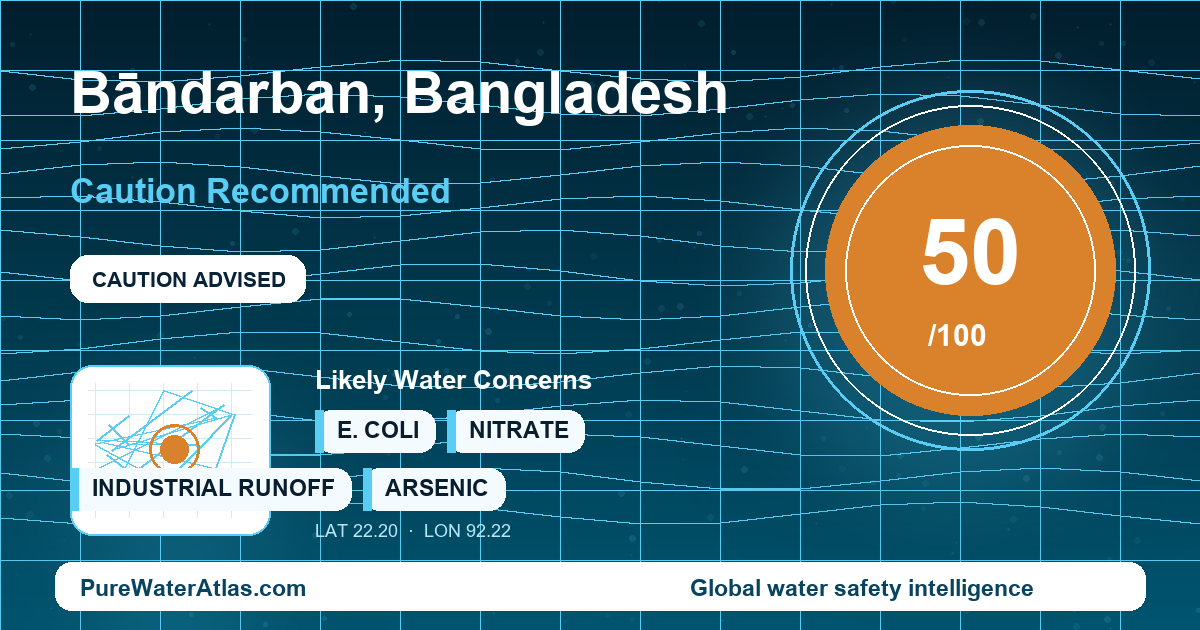
Bāndarban, Bangladesh: a hill-town water system where surface-water influence, monsoon turbidity, intermittent distribution, and storage tanks make untreated tap water a caution case.
Quick Answer
| Overall safety status | Caution recommended. PureWaterAtlas score: 50/100. There is not enough recent public city-level testing evidence to treat untreated tap water in Bāndarban as reliably safe for all users. |
|---|---|
| Can travelers drink the tap water? | No, not untreated. Visitors should use sealed bottled water from reputable brands, or water that has been boiled, properly filtered, chlorinated, or UV disinfected after clarification. |
| Resident advice | Residents should treat drinking and cooking water at the point of use unless they have recent evidence of adequate disinfection, low turbidity, and clean storage at the household tap. |
| Main water-source identity | Bāndarban is a Chittagong Hill Tracts town associated with the Sangu or Sankha River system, with municipal supply in the town and mixed non-network sources nearby, including springs, streams, wells, rainwater, and stored water. |
| Water authority context | Urban service is associated with Bāndarban Pourashava or municipality, with national technical support context from the Department of Public Health Engineering under Bangladesh’s local-government water-supply framework. |
| Filter recommendation | Use a microbiologically effective barrier: sediment prefiltration for cloudy water, then boiling, ceramic or ultrafiltration, UV, or correctly dosed chlorination. Consider reverse osmosis only when testing shows arsenic, nitrate, high TDS, or other dissolved contaminants. |
Why Bāndarban Is Different
Bāndarban is not a flat delta city with a large metropolitan WASA-style water utility. It is a hill town in the Chittagong Hill Tracts of southeastern Bangladesh, closely associated with the Sangu or Sankha River system. That geography matters for drinking-water safety. Steep terrain, slope erosion, surface runoff, heavy monsoon rainfall, and scattered settlements can all affect how water is collected, treated, distributed, and stored.
The practical concern in Bāndarban is mainly microbiological risk, not coastal salinity. Surface-water influence, springs and streams, intermittent distribution, building storage tanks, and small local systems can introduce or reintroduce fecal contamination. Visibly clear hill water may still contain bacteria, viruses, or protozoa. During monsoon periods, turbidity and sediment can rise quickly, reducing the effectiveness of disinfection and overloading simple household filters.
Another reason Bāndarban is different is that travelers may move between very different water systems during the same trip. A hotel in town may use municipal water, treated water, or stored water; a remote hill resort or trekking stop may depend on spring, stream, rainwater, well, tanker, or gravity-flow supplies. The safety of water at the tap therefore depends not only on the original source, but also on treatment reliability, pipe pressure, and storage-tank hygiene.
Where Does Bāndarban’s Tap Water Come From?
Available public context indicates that Bāndarban town’s municipal supply is linked to local surface water associated with the Sangu or Sankha River system. The town is a localized hill-town water system rather than a large metropolitan utility. Where the municipal network is present, the supply pathway likely includes intake or pumping, treatment steps such as sedimentation or filtration, chlorination, storage, and distribution. However, open technical data confirming current treatment-plant performance, routine turbidity, residual chlorine, and E. coli compliance at consumer taps were not located for this review.
Outside the core municipal network, water sources can be more varied. In and around the district, households, institutions, hotels, and small communities may use springs, streams, tube wells where feasible, ring wells, rainwater harvesting, gravity-flow systems, or stored household and commercial water. This mixed-source environment is typical of the Chittagong Hill Tracts context, where rocky hill geology, dispersed settlements, and difficult terrain have historically made conventional shallow groundwater supply less straightforward than in much of lowland Bangladesh.
For drinking safety, the final point of risk may be the building rather than the river or spring. Rooftop tanks, underground reservoirs, hotel storage systems, float valves, vents, overflows, and household containers can recontaminate water after treatment. In a small distribution system, low pressure or intermittent supply can also allow contaminated water to enter pipes through leaks or poor connections.
Who Manages Drinking Water in Bāndarban?
The local urban water service is associated with Bāndarban Pourashava or municipality. At the national level, the Department of Public Health Engineering is the key public-health engineering institution for water supply and sanitation support outside Bangladesh’s major WASA cities.
Bangladesh drinking-water supply is governed through national public-health engineering, local-government, and public-health frameworks. For practical safety assessment in Bāndarban, the most important routine indicators would be E. coli or thermotolerant coliforms, turbidity, pH, free residual chlorine where chlorination is used, and sanitary inspection. For groundwater sources, arsenic, iron, manganese, nitrate, pH, and electrical conductivity or TDS are also important.
A key limitation is that PureWaterAtlas did not locate an open, recent Bāndarban-specific compliance dataset showing routine microbial results, treated-water turbidity, residual chlorine at consumer taps, arsenic by source, or seasonal performance of the municipal distribution system. This profile therefore uses a cautious risk assessment based on the city’s source-water setting, hill-town infrastructure, Bangladesh WASH context, and traveler-health guidance rather than claiming verified compliance or verified failure.
Main Local Water Concerns
- Microbial contamination: Surface water, springs, streams, stored water, and distribution-system ingress can introduce fecal contamination, especially if chlorination is inconsistent or storage tanks are poorly maintained.
- Monsoon turbidity and sediment: Heavy rainfall in the hill catchment can increase suspended sediment and turbidity. High turbidity can shield microbes from disinfection and reduce the performance of simple filters.
- Intermittent supply and low pressure: Small distribution systems can be vulnerable to contamination entering through leaks, poor joints, or illegal connections when pressure drops.
- Storage-tank recontamination: Rooftop tanks, hotel reservoirs, household containers, and restaurant storage can become the final contamination point if they are uncovered, dirty, or exposed to insects, animals, dust, or drain water.
- Sanitation and drainage impacts: Heavy rain, flash flooding, landslides, drain overflow, and close spacing between latrines, septic systems, drains, and water points can raise risk.
- Groundwater chemistry where wells are used: Arsenic is a national Bangladesh concern, although the Chittagong Hill Tracts are not the classic high-arsenic alluvial setting. Private wells should still be tested. Iron and manganese can also occur in Bangladeshi groundwater and may affect color, staining, taste, and system operation.
- Not primarily a salinity problem: Bāndarban is inland and hilly, so coastal salinity is not the main concern in this city profile.
For Travelers
Short-term visitors should not drink untreated tap water in Bāndarban. The safer default is sealed bottled water from reputable brands, or water that has been boiled, filtered with a microbiologically effective device, chlorinated correctly, or UV disinfected after clarification. This is especially important for children, pregnant travelers, older adults, and anyone with immune compromise or a sensitive stomach.
Use bottled or treated water for brushing teeth. Avoid swallowing water in showers if you are prone to stomach illness. Carry sealed water for road trips, buses, trekking routes, hill resorts, and village visits, because the source may change from municipal water to spring, stream, rainwater, well, tanker, or stored water without being obvious.
Avoid ice unless the hotel or restaurant can confirm that it was made from purified water. In small restaurants, tea stalls, roadside settings, boats, buses, and trekking areas, skip ice. Hot tea or boiled beverages are generally safer only when the water has actually reached a boil and cups are clean.
In hotels and restaurants, do not assume that sink tap water is potable. Ask whether drinking water is bottled, boiled, filtered, chlorinated, or UV treated. In remote resorts, ask the actual water source and whether storage tanks are cleaned. For self-treatment, settle or prefilter visibly cloudy water first, then boil it or use a filter rated for bacteria and protozoa followed by UV or chlorine where appropriate. Boiling is strong for microbial risk, but it does not remove arsenic, nitrate, salts, or many chemicals if those are present.
For Residents
For Bāndarban households, a point-of-use treatment barrier is advisable for drinking and cooking water unless recent local testing confirms microbiological safety and adequate residual chlorine at the household tap. A practical setup is sediment prefiltration for cloudy water plus ceramic filtration, ultrafiltration, UV, or correctly dosed chlorination for microbes. Reverse osmosis should be considered when testing shows arsenic, nitrate, high TDS, or other dissolved contaminants, but it should not be purchased blindly without testing and maintenance planning.
Municipal tap users should test for E. coli or thermotolerant coliforms, total coliforms, turbidity, pH, free residual chlorine at the tap if the supply is chlorinated, and conductivity or TDS. Private wells or groundwater users should test arsenic, iron, manganese, nitrate, pH, conductivity or TDS, and microbial indicators. Springs, streams, rainwater, and gravity-flow sources should receive sanitary inspection plus E. coli testing, turbidity testing, and seasonal checks during and after monsoon rains.
Apartment buildings, hotels, schools, clinics, and restaurants should sample both the incoming water and the water after rooftop or underground storage. This helps identify whether contamination is entering from the source, the municipal network, or the building’s own storage system. Filters and UV systems should also be checked by testing treated water periodically; cartridges, lamps, seals, and storage containers must be replaced or cleaned on schedule.
Older buildings and improvised plumbing can add risk through corroded pipes, dead-end lines, cross-connections, dirty reservoirs, and low-pressure ingress. Lead service lines are not the main documented city-wide issue in Bāndarban, but individual fixtures, brass fittings, solder, pumps, or old plumbing can contribute metals. If children live in an older building, consider first-draw and flushed sampling.
Relevant Contaminants and Water-Quality Issues
The most relevant local indicator is E. coli in drinking water, because it signals fecal contamination risk in untreated, stored, or intermittently supplied water. Turbidity and sediment are also central for Bāndarban because monsoon runoff and hill-catchment erosion can make surface water cloudy and reduce disinfection effectiveness.
Where groundwater is used, residents should understand arsenic in drinking water, iron, and manganese. Bāndarban is not described here as a classic high-arsenic delta setting, but private wells should still be tested rather than assumed safe. For piped water systems that use disinfection, chlorine residual is an important practical indicator because it helps show whether treated water has some ongoing protection in the distribution system.
For broader background, PureWaterAtlas guides on water microbiology, water purification methods, and drinking water safety explain how to interpret these risks.
How to Verify Your Water Quality
The strongest way to verify water safety in Bāndarban is to test the water actually being consumed, not only the source. For municipal water, sample at the household tap and, where possible, before and after storage tanks. For wells, springs, streams, rainwater, and gravity-flow supplies, combine laboratory testing with sanitary inspection of nearby latrines, drains, animals, runoff paths, covers, pipes, and collection points.
Start with microbial indicators, turbidity, pH, and chlorine residual where chlorination is used. Add arsenic, iron, manganese, nitrate, and conductivity or TDS for groundwater or uncertain sources. Repeat testing after monsoon flooding, landslides, pipe repairs, pump repairs, changes in taste, color, or odor, or any suspected sewage intrusion.
Use the PureWaterAtlas complete water testing guide to plan a sampling strategy. The Global Water Quality Checker can help compare Bāndarban with other destinations, and the Contaminants Search Engine can help interpret test results. For household treatment choices, see the guides to boiling water purification, UV water purification, arsenic testing, and lead testing.
Official and Technical Sources
- Department of Public Health Engineering, Government of Bangladesh — national public-health engineering context for water supply and sanitation support outside major WASA utilities.
- Bāndarban Pourashava or municipality — local municipal authority context for urban services in Bāndarban town.
- Banglapedia: Sangu River — geographic context for the Sangu or Sankha River system and the Chittagong Hill Tracts setting.
- Asian Development Bank: Chittagong Hill Tracts Rural Development Project context — regional development context for terrain, dispersed settlements, and small-scale rural infrastructure.
- WHO Guidelines for Drinking-water Quality — international guidance for microbial safety, turbidity, disinfection, and chemical risk framing.
- WHO/UNICEF Joint Monitoring Programme household WASH data for Bangladesh — national context distinguishing improved access from safely managed drinking water.
- UNICEF Bangladesh: Progotir Pathey, Bangladesh MICS 2019 — national household survey context for water, sanitation, and water-quality limitations.
- CDC Travelers’ Health: Bangladesh — traveler food and water safety precautions supporting conservative visitor advice.
Bottom Line
Bāndarban’s tap water should be treated as a caution case. The town’s hill setting, surface-water influence, monsoon turbidity, mixed municipal and non-network sources, intermittent distribution risks, and widespread storage tanks make untreated tap water unsuitable as a default drinking source, especially for visitors. The main concern is microbiological contamination, not coastal salinity. Residents should use point-of-use treatment unless recent testing confirms safe microbial results and adequate disinfection at the household tap. Wells, springs, rainwater, and stored supplies need testing and sanitary inspection, with groundwater also checked for arsenic, iron, manganese, nitrate, pH, and TDS. Because open, recent Bāndarban-specific compliance reports were not found, the safest practical approach is bottled, boiled, properly filtered, chlorinated, or UV-disinfected water.
Read the full guide: Global Water Quality Guide
Explore more in this category: Global Water Quality Articles