
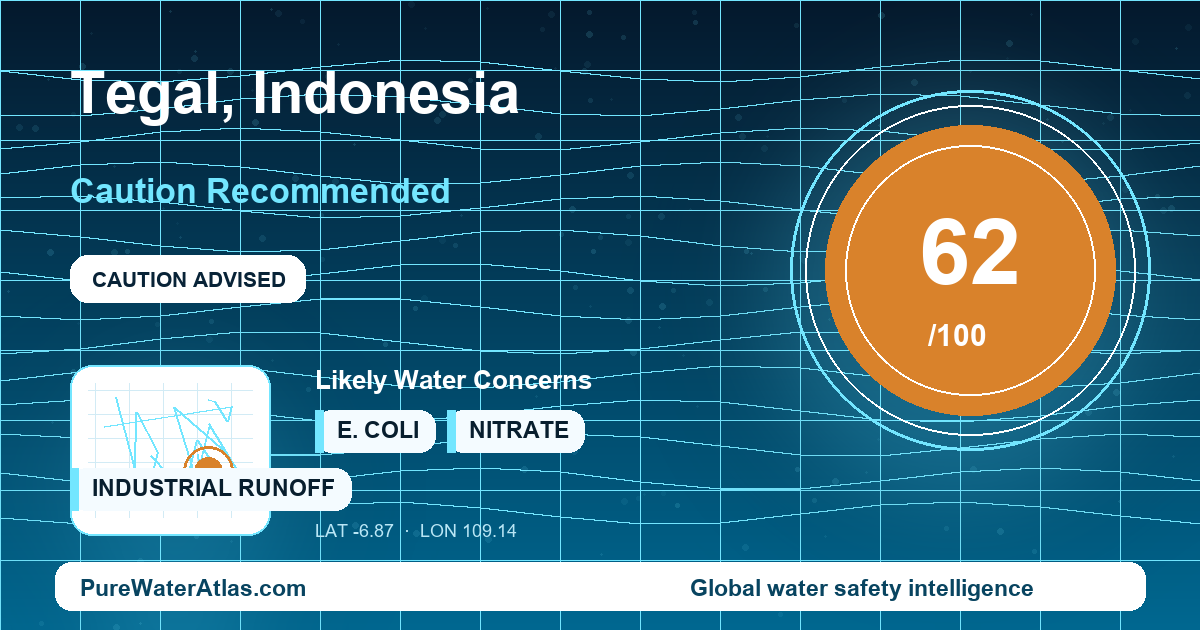
Tegal, Indonesia: coastal Java tap-water caution, municipal supply context, private-well risks, and practical drinking-water guidance for visitors and residents.
Quick Answer
| Overall status | Caution recommended. Tegal has an identifiable municipal water utility and treated piped-water system, but recent public citywide tap-level laboratory compliance data are not easy to verify. Untreated tap water should not be considered reliably drinkable for visitors. |
|---|---|
| PureWaterAtlas score | 62 / 100 — risk level: Caution Recommended. |
| For tourists | Drink sealed bottled water, properly boiled water, or water treated by reliable filtration and disinfection. Be cautious with ice and refill-water sources unless the hotel or restaurant can confirm treated water is used. |
| For residents | Municipal piped water can generally be used for washing and household use, but drinking water and infant formula should use boiled water, a maintained filter, a trusted dispenser system, or another verified safe source. |
| Main water identity | Municipal supply is operated by Perumda Air Minum Tirta Bahari Kota Tegal. Public references indicate reliance on source water transmitted from outside the coastal urban area, including upland spring or source systems such as the Kaligiri source area in the Brebes highlands, with operational variation. |
| Water authority | Perumda Air Minum Tirta Bahari Kota Tegal, with oversight involving the City Government of Tegal, Dinas Kesehatan Kota Tegal, provincial authorities, and national ministries. |
| Filter recommendation | A household treatment step is advisable for drinking water unless current testing confirms safety at your specific tap or well. Boiling helps microbial risk but does not remove salinity, nitrate, metals, or dissolved chemicals. |
Why Tegal Is Different
Tegal is not an upland water-rich city. It sits on the low northern coast of Central Java facing the Java Sea, and that flat coastal setting is central to understanding local drinking-water risk. In Tegal, water safety is shaped by the contrast between treated municipal supply brought through utility infrastructure and more vulnerable local shallow groundwater used by some households through wells, boreholes, or building-level systems.
The city’s coastal plain makes local drainage, tidal flooding, shallow groundwater quality, and salinity more relevant than in many inland Indonesian locations. A private well that looks clear may still be affected by septic leakage, urban drainage, nitrate, or brackish water. Boiling can reduce microbial risk, but it cannot fix salty water or remove nitrate. For this reason, Tegal residents should not judge water safety by taste alone, especially where wells are close to septic systems, dense settlement, flood-prone drains, or coastal influence.
For short-term visitors, the practical question is usually not whether the bathroom has running tap water. It is whether drinking water and ice are from sealed bottles, a maintained dispenser, boiled water, or a treated commercial source. Many households and businesses in Tegal separate water used for bathing and washing from water used for drinking, relying on boiled water, dispenser water, refill-gallon water, or bottled water for consumption.
This profile uses a cautious confidence level. The identity of the utility, the coastal setting, and the main risk pathways are clear, but PureWaterAtlas did not find a recent, complete, publicly accessible Kota Tegal consumer-confidence-style report showing tap-level results across microbial indicators, residual chlorine, turbidity, nitrate, metals, salinity, and distribution zones. Neighborhood and building-level conditions can differ significantly.
Where Does Tegal’s Tap Water Come From?
Kota Tegal is a small coastal municipality with limited local freshwater catchment area. The municipal piped supply is operated by Perumda Air Minum Tirta Bahari Kota Tegal. Publicly available references indicate that the city relies on source water transmitted from outside the coastal urban area, including upland spring or source systems such as the Kaligiri source area in the Brebes highlands. Additional production or interconnection sources may be used depending on operational conditions.
Because current detailed source proportions are not consistently published, the exact share of each source should be verified directly with the utility for operational decisions. For residents, the important point is that Tegal’s tap water is not simply “local shallow well water” once it enters the municipal network. It depends on long-distance transmission infrastructure, treatment, chlorination, reservoirs, and local distribution assets. Each of those steps can affect reliability and water quality.
Infrastructure-related risks in Tegal include pressure interruptions, pipe repairs, reservoir hygiene, and long household service lines. Any intermittent pressure can increase the importance of chlorine residual, pipe integrity, and clean home storage. Even if water leaves utility treatment in acceptable condition, it can deteriorate in dirty roof tanks, ground tanks, corroded service lines, or low-use plumbing inside buildings.
Alongside piped connections, some households use shallow wells, private boreholes, bottled water, refill-water depots, and gallon dispensers. In a low north-coast Java city, shallow groundwater is more vulnerable than upland spring water to salinity, septic leakage, urban drainage contamination, and flood or tidal-flood impacts.
Who Manages Drinking Water in Tegal?
The municipal drinking-water company serving Kota Tegal is Perumda Air Minum Tirta Bahari Kota Tegal. Its official website is the primary local utility source for service information, customer notices, and the official identity of the municipal water company. The Pemerintah Kota Tegal provides municipal government context, while Badan Pusat Statistik Kota Tegal is an authoritative source for demographic and geographic city information.
Indonesia’s drinking-water quality requirements are set nationally through Ministry of Health environmental health standards, including Permenkes No. 2 Tahun 2023. Water utilities are also subject to local government ownership and public-service rules. Ministry of Public Works and Housing programs and SPAM performance systems, including the Sistem Informasi Kinerja Penyelenggaraan SPAM, are relevant to infrastructure and service performance. Public-health monitoring also involves Dinas Kesehatan Kota Tegal and other provincial or national authorities.
For a household, however, formal regulation does not replace point-of-use reality. Tegal’s municipal supply, private wells, storage tanks, refill-water handling, and building plumbing are not all the same. The safest interpretation is that official utility service may support household use, but drinking-water safety should be verified at the tap, tank, well, or dispenser actually being used.
Main Local Water Concerns
- Microbial contamination: E. coli and other fecal indicators can enter unsafe wells, poorly maintained storage tanks, refill-water handling systems, or distribution sections affected by pressure loss. This is the main reason untreated tap or well water is not recommended for travelers in Tegal.
- Turbidity and sediment: Heavy rain, pipe disturbance, reservoir cleaning, or source-water changes can cause cloudy water or particles. Turbidity can reduce disinfection effectiveness, and sediment may signal distribution disturbance even when the supply is normally clear.
- Salinity and brackish groundwater: Tegal’s coastal location makes shallow private wells more vulnerable to saltwater influence, especially near the coast, during dry periods, or where groundwater pumping is high. Salty water is not made safe by boiling.
- Nitrate in wells: Nitrate can affect private wells near septic systems, dense settlement, drainage channels, or agricultural areas. This is particularly important for infants and pregnant people.
- Building-level plumbing and tanks: Dirty roof tanks, uncovered ground tanks, corroded pipes, low-use plumbing, and old fixtures can degrade water after utility delivery. Lead is not documented here as a citywide Tegal issue, but older fixtures should not be assumed safe without testing.
Season matters. Wet season rainfall can increase runoff, turbidity, flooding, and contamination risk for shallow wells and low-level tanks. Dry season conditions can make low pressure, supply interruption, or brackish private-well water more noticeable. Tidal flooding or coastal inundation can contaminate shallow wells, ground tanks, and plumbing openings if they are not sealed and disinfected afterward. BMKG Indonesia provides official weather and coastal hazard context through BMKG.
For Travelers
Do not drink untreated tap water in Tegal as a default. Use sealed bottled water, properly boiled water, or water treated by a reliable filtration and disinfection method. This advice is consistent with cautious travel-health practice for Indonesia and with the fact that building-level and neighborhood-level water safety cannot be confirmed from public citywide data alone. The U.S. CDC’s Indonesia Traveler View supports cautious use of safe bottled or treated water for visitors.
For brushing teeth, cautious travelers, young children, pregnant travelers, and anyone with a sensitive stomach should use bottled or treated water. Many short-term visitors choose this approach because the most immediate risk is microbial and often building-specific rather than visible.
Be careful with ice. Avoid ice from street vendors or small outlets unless you know it is made from treated commercial water. In reputable hotels, cafes, and restaurants, ask whether ice is factory-made or made from filtered or boiled water. Do not assume ice is safe simply because the drink looks clean.
Hotels and restaurants in Tegal may provide dispenser water or bottled water. Prefer sealed bottles or dispensers that appear maintained and are used frequently. Do not assume bathroom tap water is drinking water unless the property explicitly states it is potable and can explain the treatment system. Carry bottled water in hot weather, use bottled water for medications and infant formula, choose hot drinks made with boiling water, avoid swallowing shower water, and be more cautious after floods, water outages, or visibly cloudy tap water.
For more detail on emergency and household boiling practices, see Boiling Water Purification: Complete Guide. Boiling is useful for microbial risk, but it is not a universal treatment for Tegal’s private-well concerns such as salinity, nitrate, or metals.
For Residents
Residents connected to Perumda Air Minum Tirta Bahari Kota Tegal can generally use piped water for washing and ordinary household use, but for drinking water it is prudent to use an additional household treatment step unless current testing confirms safety at the specific tap. Options may include boiling for microbial control, a maintained filter and dispenser system, or another verified source. If using point-of-use disinfection, remember that ultraviolet systems work best on clear, prefiltered water; see the PureWaterAtlas UV Water Purification guide for background.
Private wells in Tegal deserve special attention because the city is coastal and low-lying. Test at least for E. coli or total coliform, nitrate, total dissolved solids or salinity, pH, turbidity, iron, manganese, and hardness. If water is salty, boiling will concentrate salts; test total dissolved solids or chloride and consider a different source or reverse osmosis system if appropriate. If the well is near septic tanks, drains, dense settlement, or agricultural influence, microbial and nitrate testing are especially important. Families with infants should review Nitrate Contamination in Drinking Water: Testing and Detection Methods.
After flooding, tidal inundation, nearby septic failure, or a long service interruption, disinfect storage tanks and retest for microbial indicators before drinking the water. Ground tanks and roof tanks should be covered, screened, cleaned, and protected from floodwater, insects, birds, rodents, and dirty hoses. A safe utility supply can become unsafe if stored in an unclean tank.
Older buildings and rented rooms may have unknown plumbing materials, stagnant lines, low-use taps, or corroded fixtures. Flush taps after stagnation and do not use hot tap water for drinking or cooking. If the home has old pipes, brass fixtures, or long stagnant plumbing, test first-draw and flushed samples for lead and other metals before using the water for infants or pregnant people. The PureWaterAtlas article Lead in Drinking Water: Testing and Detection Methods explains why fixture-level testing can matter even when a citywide lead problem has not been documented.
If using refill-gallon water, buy from depots with visible hygiene practices and current local health-office inspection status where available. Handling, container cleanliness, and dispenser hygiene can be as important as the original water source.
Relevant Contaminants and Water-Quality Issues
The most relevant Tegal issue for immediate illness risk is microbial contamination, especially E. coli, because unsafe wells, tanks, low-pressure distribution sections, and poorly handled refill water can transmit pathogens. The World Health Organization’s drinking-water fact sheet emphasizes the importance of safe management and microbial risk control in drinking water.
Turbidity and sediment matter in Tegal during rain, pipe disturbance, source-water changes, or tank cleaning. Cloudy water does not prove danger by itself, but it can reduce disinfection effectiveness and signal that a system has been disturbed. In piped networks, chlorine residual is important because it helps maintain microbial control after treatment and during distribution.
For private wells, nitrate is important where septic systems, dense settlement, drainage, or agricultural influence affect groundwater. Salinity and brackish water are also practical coastal concerns in Tegal, even though boiling will not solve them. Lead is included as a building-level consideration for old plumbing and fixtures, not as a verified citywide Tegal contaminant claim.
How to Verify Your Water Quality
The most reliable way to know whether your Tegal water is drinkable is to test the water you actually use: the kitchen tap, tank outlet, well, refill gallon, or dispenser. Start with the PureWaterAtlas Water Testing guide for choosing parameters and interpreting results. For a broader safety framework, see Drinking Water Safety: How to Know if Your Tap Water Is Safe to Drink.
If you are comparing Tegal with other destinations, use the Global Water Quality Checker. To look up individual substances and indicators mentioned in this profile, use the Contaminants Search Engine. For treatment decisions, review Water Purification Methods, and for biological risk, see Water Microbiology. Households using wells near runoff-prone areas may also find Agricultural Runoff in Drinking Water relevant.
Official and Technical Sources
- Perumda Air Minum Tirta Bahari Kota Tegal official website — local utility identity, service information, and customer notices.
- Pemerintah Kota Tegal official website — municipal government and public-service context.
- Badan Pusat Statistik Kota Tegal — authoritative city demographic and geographic data.
- Permenkes No. 2 Tahun 2023 — Indonesian national environmental health and drinking-water quality standards reference.
- Sistem Informasi Kinerja Penyelenggaraan SPAM — national SPAM performance and infrastructure context.
- BMKG Indonesia — rainfall, weather, and coastal hazard context relevant to seasonal water risks.
- CDC Indonesia Traveler View — travel-health guidance supporting cautious use of safe bottled or treated water.
- WHO Drinking-water fact sheet — global public-health reference on drinking-water risk principles.
Bottom Line
Tegal’s tap-water situation deserves caution, not panic. The city has a municipal utility, Perumda Air Minum Tirta Bahari Kota Tegal, and a treated piped-water system that draws on source water transmitted from outside the low coastal urban area. However, recent public tap-level compliance data are limited, and local risks vary by pipe condition, pressure, household tanks, private wells, refill-water handling, and flood exposure. Tourists should use sealed bottled water or properly treated water and be careful with ice. Residents should treat or test drinking water, maintain storage tanks, and test private wells for microbes, nitrate, salinity, turbidity, and relevant minerals or metals. Boiling helps microbial safety but does not solve brackish water, nitrate, or plumbing-related contaminants.
Read the full guide: Global Water Quality Guide
Explore more in this category: Global Water Quality Articles